Worry Vs. Trust

“Do not worry! Earthly goods deceive the human heart into believing that they give it security and freedom from worry. But in truth, they are what cause anxiety. The heart which clings to goods receives with them the choking burden of worry. Worry collects treasures, and treasures produce more worries. We desire to secure our lives with earthly goods; we want our worrying to make us worry-free, but the truth is the opposite. The chains which bind us to earthly goods, the clutches which hold the goods tight, are themselves worries. Abuse of earthly goods consists of using them as a security for the next day. Worry is always directed toward tomorrow. But the goods are intended only for today in the strictest sense. It is our securing things for tomorrow which makes us so insecure today. It is enough that each day should have its own troubles. Only those who put tomorrow completely into God’s hand and receive fully today what they need for their lives are really secure. Receiving daily liberates me from tomorrow.” (Dietrich Bonhoeffer)

I remember the account of the Israelites in the desert and how God provided manna for them. The trick — if you want to call it that — was that they could only gather enough for that particular day. They couldn’t stockpile it to last for weeks. They had to gather what they needed for the next 24 hours and trust God to provide again the next day.

Worry at its core says that God can’t be trusted, that I can’t take Him at His word. Worry says that if it’s to be, it is up to me. But faith says that if it is to be, God is up to it.

When God’s people tried to take more than what they needed, the surplus went bad and stank. Only when they were faithful did the manna last. When we take God at His word, we never go wrong.

It seems that Jesus had manna in mind when He told us to pray for our daily bread, trusting God for each day rather than trying to figure out the next week or month or year. We pray the same prayer, trusting the same God who keeps His same promises from one day to the next.
Planting Seeds

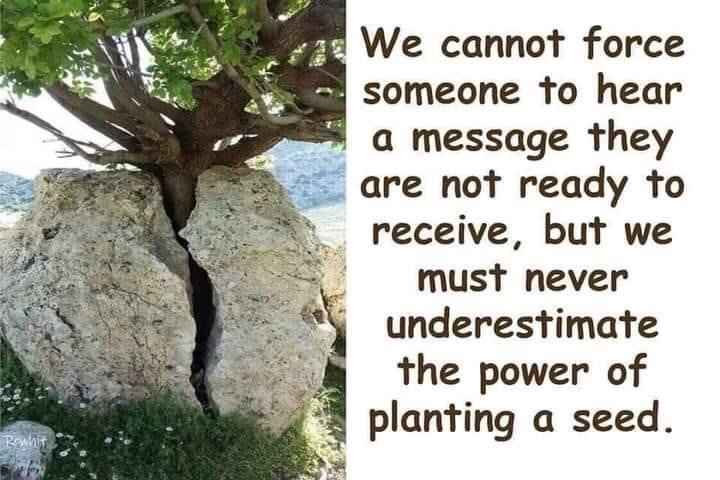
I heard once that the average person will hear the gospel seven times before they give their lives to Christ. At first, that might seem disheartening if you aren’t that fortunate seventh person. But remember that you are planting a seed. Regardless of what outwardly transpires, God’s word does not return void. When we are faithful to have gospel conversations, a tiny seed is planted. Always.

When you pray for a person’s salvation, it may seem pointless. You pray day after day and absolutely nothing seems to change. You can tell no difference. But that tiny seed has been planted.

Just as you can’t dig up the earth to see an actual seed growing without destroying the seed, so you can’t force that proverbial seed of faith to germinate. You have to trust the process. You have to trust God’s process. You have to trust that it’s not up to you to save anyone. Only God can do that.

You just have to be faithful to do your part. God will take care of the rest.

Interesting Quote

I’m just gonna put this out there and leave it for you to decide if it’s spot on or not:

“Vocation is not evoked by your bundle of need and desire. Vocation is what God wants from you whereby your life is transformed into a consequence of God’s redemption of the world. Look no further than Jesus’s disciples – remarkably mediocre, untalented, lackluster yokels – to see that innate talent or inner yearning has less to do with vocation than God’s thing for redeeming lives by assigning us something to do for God” (William H. Willomon).

Have You Heardle of It?

A while ago, I wrote about a word game called Wordle where you had to guess a five-letter word within six guesses with no clues. Basically, if you had the right letter in the wrong spot, it turns yellow. If you get the right letter in the right spot, it turns green. But really you need to play it for yourself to get the gist of it.

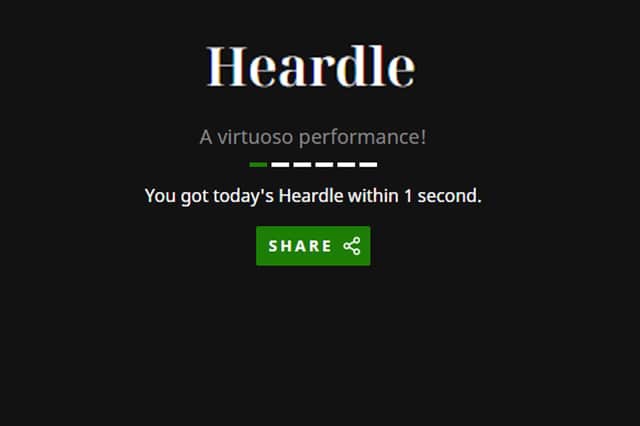
Well, now I’ve discovered a similar game involving snippets of songs. You get one second on the first try, and on subsequent guesses you get a little more. In all, you get six tries to figure out the song. It’s called Heardle.

There are multitude of different variations. You get a version of the game for every decade going back to the 60s. It’s a bit tricky, even if you are up on your music. There have been times where I recognized the song but didn’t know the name or the artist. Other times, I knew it within the first second.

Basically, it’s addicting. As with Wordle, there are many versions of the game, but the real one is heardle.app. That’s the legit site where you can only play once a day.

Go there and get started guessing those songs. You will thank me later.

Emphasizing the Wrong Thing

In case you can’t read the tiny print, the sign says, “Caution: this sign has sharp edges. Do not touch the edges of this sign. Also, the bridge is out ahead.”

As you can tell, they emphasized the wrong thing. The most important takeaway isn’t that the sign has sharp edges. I mean who is really going to grab the sign anyway? The main point is that the bridge is out ahead, so don’t go that way or it will end badly for you.

It’s funny, but it’s also funny how we do the same thing in our own lives. We make a big deal out of stuff that doesn’t really matter as much, and we neglect what is vitally important. But how can we tell what ultimately matters?

I heard a quote once that said that anything that isn’t eternal is eternally obsolete. That includes all those things the people on TV tell you that you have to have to be someone and to be successful. The say that whoever dies with the most toys, wins.

But I believe that whoever dies with the most toys is still dead. You can’t take any of your toys with you wherever you go, no matter which of the two places is your final destination.

What you can take with you is not things but people. You can take with you the people who know Jesus because of you. You can take with you those who saw Jesus in you and wanted to know more of Him.

That is the most important part of life.

Casting Stones & Cancel Culture

“If my sinfulness appears to me to be in any way smaller or less detestable in comparison with the sins of others, I am still not recognizing my sinfulness at all. … How can I possibly serve another person in unfeigned humility if I seriously regard his sinfulness as worse than my own?” (Dietrich Bonhoeffer)

I’m not a fan of cancel culture because it feels a lot like casting the first stone to me. If I’m the one who can pick up that rock and throw it at someone for what I deem to be the unpardonable sin, am I not presenting myself as sinless? Am I in some way insinuating that I am the better person who is somehow more holy than the other?

I get it that people do despicable things and deserve to face the consequences of their actions. But if I’m honest, there’s nothing I’ve seen or read about that I am not capable of myself apart from the grace of God. I am just as in need of forgiveness as anyone else who has ever lived.

Those men who caught the woman in the very act of adultery were just as ready to cancel her in the most brutal and literal way possible. But Jesus bent down and wrote in the dust. Was He naming their sins? Was He writing down their secret thoughts and indiscretions? Whatever it was He wrote down, they all dropped their stones and walked away.

Jesus said two things to the woman. First, He told her that He did not condemn her. Second, He told her to go and sin no more. Grace is not antithetical to truth. Mercy is not the opposite of holiness. Forgiveness is not the polar opposite of righteousness. God calls us to be both loving and holy.

But He calls us to see that we are not forgiven and saved because we were somehow smarter or more clever than others. We are forgiven and saved because it was God’s good pleasure. It is also God’s good pleasure that no one else should perish but that all should come to repentance and faith. It is not God’s good pleasure for us to cancel anyone.

Providence and Grace

“I was thinking about how Elisabeth was a only 28 years old when her faith was put to severe test. She not only lost her husband, but four dear friends as well.

Obedience to God’s call on her life was never questioned. He had sent her to the Quichuas with the gospel and there she continued until He directed her back to the States. She said of that time in her life, ‘We just felt that God was in the whole thing, and there wasn’t anything that had happened that was not in the Providence of God'” (Diane Wilson).

The common saying is that God will never give you more than you can handle. But is it really biblical?

Just ask Elisabeth Elliott. I think having her husband and four other men martyred would qualify as more than she could handle. But it was not more than God could handle. I think God definitely gives us more than we can handle. Otherwise, we would always rely on our own wisdom and strength. But God puts us in places where we have to trust in His wisdom and power, otherwise we will fail.

Elisabeth Elliott knew this truth firsthand. She saw God’s strength perfected in her weakness. She saw a providence that carried her beyond what where her own endurance could have taken her. She saw grace that worked miraculous good out of unimaginable evil. She saw basically the entire tribe of Quichuas come to Christ — even the very men who killed her husband and the others.

She lived many years after and was able to commit the wisdom she had gained into words that millions have read and found encouragement from. Her words and her life still resonate even after she passed away a few years ago. Her legacy lives on.

The Baptist Potluck

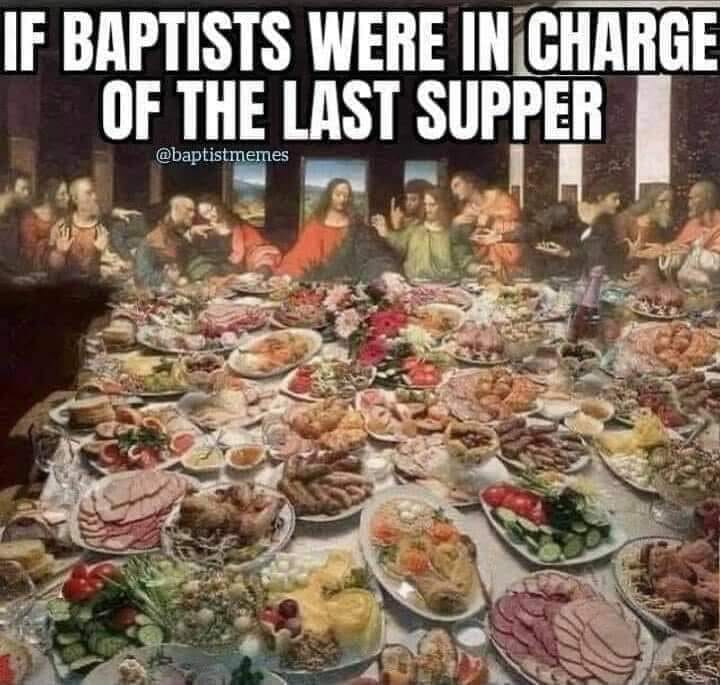
If you grew up Baptist back in the day, you knew that whenever there was a potluck, you were about to have your best worst day ever. By that I mean you were going to completely make yourself sick by eating way too much food. But it was going to be some of the best food ever.

There’s an unwritten rule that states in the event of a Baptist gathering where food is present, a chicken must die. In other words, you knew there will be multiple buckets of fried chicken — some store bought, some homemade. You knew you would see a plethora of casseroles. You also knew there would be nothing involving vegan or kale or anything remotely healthy.

It’s an interesting scientific fact that the smaller the size of the Baptist church, there would be an inverse increase in the amount and quality of potluck food available. Especially if said church had any number of “seasoned” ladies in the congregation. I can tell you that whenever I got invited to a small country church as a part of my college puppet ministry team, there was going to be some mighty good eatin’ later.

I miss those days. I miss the people who made those days so great. But I have good memories of good food and good times that have long outlasted any possible upset stomachs from overeating.

On Feelings and Faith

“I think the thrill of the Pagan stories and of romance may be due to the fact that they are mere beginnings—the first, faint whisper of the wind from beyond the world—while Christianity is the thing itself: and no thing, when you have really started on it, can have for you then and there just the same thrill as the first hint. For example, the experience of being married and bringing up a family cannot have the old bittersweet of first falling in love. But it is futile (and, I think, wicked) to go on trying to get the old thrill again: you must go forward and not backward. Any real advance will in its turn be ushered in by a new thrill, different from the old: doomed in its turn to disappear and to become in its turn a temptation to retrogression. Delight is a bell that rings as you set your foot on the first step of a new flight of stairs leading upwards. Once you have started climbing you will notice only the hard work: it is when you have reached the landing and catch sight of the new stair that you may expect the bell again. This is only an idea, and may be all rot: but it seems to fit in pretty well with the general law (thrills also must die to live) of autumn & spring, sleep and waking, death and resurrection, and ‘Whosoever loseth his life, shall save it'” (C. S. Lewis, Words to Live By).

You can’t live your live solely on feelings. It’s like trying to maintain a relationship based on that initial feeling of falling in love. Or trying to recreate that feeling of the first time of experiencing a great meal or a majestic view. You just can’t.

It’s like trying to make yourself feel happy all the time. It’s impossible. Eventually, you will get tired. You will get frustrated. You will feel anything but happy by the time you’re done trying to keep up the feeling of happiness.

In matters of faith, you can’t live on feelings. But you can do acts of love even when you don’t feel loving. You can do acts of obedience even when you don’t feel authentic. If you keep up the discipline of loving and obeying, eventually you will feel loving and truly obedient. But we do these things not to feel a certain way but because God says so. We do them because God did so much for us.

Ultimately, it’s God’s love in us that enables us to love at all. If we know that God’s love is present whether we feel it or not, whether we can sense God or not, then we can love others when we don’t feel like it or when they don’t love us back. God loving us made us lovable, so our loving the unlovable shows them more than just ordinary human love — it shows them God’s kind of love.

Anger, Holiness & Love

“We tend to be taken aback by the thought that God could be angry. How can a deity who is perfect and loving ever be angry?…We take pride in our tolerance of the excesses of others. So what is God’s problem? … But love detests what destroys the beloved. Real love stands against the deception, the lie, the sin that destroys. Nearly a century ago the theologian E.H. Glifford wrote: ‘Human love here offers a true analogy: the more a father loves his son, the more he hates in him the drunkard, the liar, the traitor.’… Anger isn’t the opposite of love. Hate is, and the final form of hate is indifference… How can a good God forgive bad people without compromising himself? Does he just play fast and loose with the facts? ‘Oh, never mind…boys will be boys’. Try telling that to a survivor of the Cambodian ‘killing fields’ or to someone who lost an entire family in the Holocaust. No. To be truly good one has to be outraged by evil and implacably hostile to injustice” (Rebecca Pippert).

In this day and age, a lot of us have come to believe that if you love someone, you must automatically endorse everything they do. If you dislike a behavior or a trait in a person, then you must hate the person. It must be that since you love the sinner, you must love the sin.

But God hates sin and loves the sinner. And His definition of love trumps all others. His love is the love we strive for and can’t hope to emulate without having experienced it first. In other words, we can only love Him (and others) because He loved us first.

We can love people and hate what some of their choices and behaviors do to them. We can hate the fact that sin promises the world but never delivers. Sin only leads to numbness, loss, and death. It may not be physical death. In the believer, it doesn’t mean spiritual death. But it leads to a deadening to the awareness of God and the ability to hear Him speaking.

But thanks be to God who can heal and restore. Thanks be to God whose holy love is greater than any sin or hate or indifference. It is a love that purifies and makes us whole, that makes new and alive, that will remain after sin and death are no more.