Enjoy

The last couple of days have been heavenly. It’s been in the low to mid 70s with sunshine and gentle breezes. If I had to pick just one weather setting to live in for the rest of my life, I think that would be it. But then again, I’d miss the chilly fall temperatures, so never mind.

The point is that today was one of those rare spring days in Tennessee that actually feels like true spring. Not late winter or early summer, but actual, honest to goodness spring.

Maybe I’m being flippant or sacrilegious, but I think of days like today as freebies from God. It’s like He’s saying, “Here’s one on the house. Enjoy. Compliments of God.”

I realize that everything good is a gift from God. Everything good about me is God in me, working in me. All that is good and wise and beautiful comes from God and finds its perfect realization and fulfillment in God.

Still, perfect spring days are like a God-wink, those small blessings that are easy to overlook or take for granted but are everywhere if you have your eyes open and are paying attention.

I think the best way to acknowledge the gift is living a life of gratitude and thanksgiving. Also, saying the occasional “thank you” to God never hurts.

A Resurrection Rerun

I call this a rerun because I’m 98% sure that I posted it previously. It’s one of my favorite quotes about the literal resurrection and what it means to faith:

WE CAN SAY THAT the story of the Resurrection means simply that the teachings of Jesus are immortal like the plays of Shakespeare or the music of Beethoven and that their wisdom and truth will live on forever. Or we can say that the Resurrection means that the spirit of Jesus is undying, that he himself lives on among us, the way that Socrates does, for instance, in the good that he left behind him, in the lives of all who follow his great example. Or we can say that the language in which the Gospels describe the Resurrection of Jesus is the language of poetry and that, as such, it is not to be taken literally but as pointing to a truth more profound than the literal. Very often, I think, this is the way that the Bible is written, and I would point to some of the stories about the birth of Jesus, for instance, as examples; but in the case of the Resurrection, this simply does not apply because there really is no story about the Resurrection in the New Testament. Except in the most fragmentary way, it is not described at all. There is no poetry about it. Instead, it is simply proclaimed as a fact. Christ is risen! In fact, the very existence of the New Testament itself proclaims it. Unless something very real indeed took place on that strange, confused morning, there would be no New Testament, no Church, no Christianity.

Yet we try to reduce it to poetry anyway: the coming of spring with the return of life to the dead earth, the rebirth of hope in the despairing soul. We try to suggest that these are the miracles that the Resurrection is all about, but they are not. In their way they are all miracles, but they are not this miracle, this central one to which the whole Christian faith points.

Unlike the chief priests and the Pharisees, who tried with soldiers and a great stone to make themselves as secure as they could against the terrible possibility of Christ’s really rising again from the dead, we are considerably more subtle. We tend in our age to say, ‘Of course, it was bound to happen. Nothing could stop it.’ But when we are pressed to say what it was that actually did happen, what we are apt to come out with is something pretty meager: this ‘miracle’ of truth that never dies, the ‘miracle’ of a life so beautiful that two thousand years have left the memory of it undimmed, the ‘miracle’ of doubt turning into faith, fear into hope. If I believed that this or something like this was all that the Resurrection meant, then I would turn in my certificate of ordination and take up some other profession. Or at least I hope that I would have the courage to” (Frederick Buechner, The Alphabet of Grace).

Seeing Jesus

“That very day, two of [the disciples] were going to a village called Emmaus, which lay about seven miles from Jerusalem. They were discussing with each other all the various things that had taken place.  As they were discussing, and arguing with each other, Jesus himself approached and walked with them.  Their eyes, though, were prevented from recognizing him” (Luke 24:13-16, NTE).

The passage speaks of two of Jesus’ disciples– one of whom was named Cleopas– walking down the road toward Emmaus. Somewhere in their journey, the risen Jesus joins them, but they’re kept from recognizing Him. The Bible never says how; it just says that they didn’t know that it was Jesus next to them the whole time.

The irony is that their whole state of mind and conversation centered around the Messiah who had so recently been crucified and buried. It just so happens that the actual Messiah was privy to the conversation.

They were probably some of the most despondent and sad people at the time of their journey. Little did they know that their despair was groundless. All that they had hoped for was walking next to them.

How many times have you and I been in the same place feeling the same kind of sadness and despair? How many have all but given up?

I wonder how many times you and I been unable to recognize Jesus in our midst. I wonder how often our own short-sighted fears and doubts kept us from seeing Him through eyes of faith.

In the story of the two disciples, nothing about their circumstances changed, save that they finally saw Jesus for who He was in their midst. It took the breaking of the bread, hearing Jesus repeat those familiar words: this is my body, broken for you . . . this is my blood, shed for you.

It’s interesting that Jesus took them to the Scriptures first. He spoke about how all the Bible up to that point pointed to the Messiah and all He would endure from the cross to the grave to the resurrection.

Maybe our hope is closer than we think. Maybe what we’ve longed for and dreamed for and hoped for is nearer than our own breath. Maybe the Spirit of Jesus has been with us all this time and we just didn’t know it.

Pet All The Dogs (and Cats)

I think that’s my new motto. I want . . . no, I need to pet as many cats and dogs as possible. That’s what I did today.

Today is the last full day of my wild and crazy extended weekend trip to Gatlinburg. I saw all my favorite places and ate all the food. I did a fair amount of shopping and a good deal of walking.

One of my favorite parts was revisiting a pottery shop on the Arts and Crafts loop. There’s a Great Pyranees who hangs out there. He’s a gentle old soul who’s nearly 11 years old. I was able to pet him one more time — although I hope he’ll be around next time. I feel like he recognized me, so that means we’ve bonded.

Maybe I’m too easily pleased, but petting the dog made my day. Plus, I ate a lot. I got my Gatlinburg/Pigeon Forge fix that should last me for awhile. I may have less in my checking account and sore feet, but it was way more than worth it.

Forgiveness

“I find that when I think I am asking God to forgive me I am often in reality (unless I watch myself very carefully) asking Him to do something quite different. I am asking Him not to forgive me but to excuse me. But there is all the difference in the world between forgiving and excusing. Forgiveness says “Yes, you have done this thing, but I accept your apology, I will never hold it against you and everything between us two will be exactly as it was before.” But excusing says “I see that you couldn’t help it or didn’t mean it, you weren’t really to blame . . . .

Real forgiveness means looking steadily at the sin, the sin that is left over without any excuse, after all allowances have been made, and seeing it in all its horror, dirt, meanness and malice, and nevertheless being wholly reconciled to the man who has done it” (C. S. Lewis, The Weight of Glory).

So very true.

The Way to Glory

“The Lord did not say, ‘I am going up to Jerusalem.’ He said, ‘We are going.’ It is this ‘we’ that we have to emphasize. For it does not apply only to those first disciples; it also applies to us insofar as we want to be his followers. For us, too, the way to glory passes through suffering and death. To suffer with Christ for sin in the obedience of faith; to give up all foolish wishes and vain hopes with our eyes fixed on him; with him and in love to him to give our old self up to death; to die with him in quiet confidence in a blessed resurrection when our last hour comes; and then to be with him forever in the heavenly Jerusalem – this is our task” (Johann Ernst von Holst, The Crucified Is My Love).

I went to a funeral for my brother-in-law’s mother today. It was sad, but also joyful. We grieve for the loss of a wife, mother, grandmother, and godly lady, but we don’t grieve as those who have no hope.

We believe that because of the resurrection, we will see her again. Death is not the end, and the grave will not have the last word. We hold fast to the promises of Jesus in the midst of a beautiful but broken world.

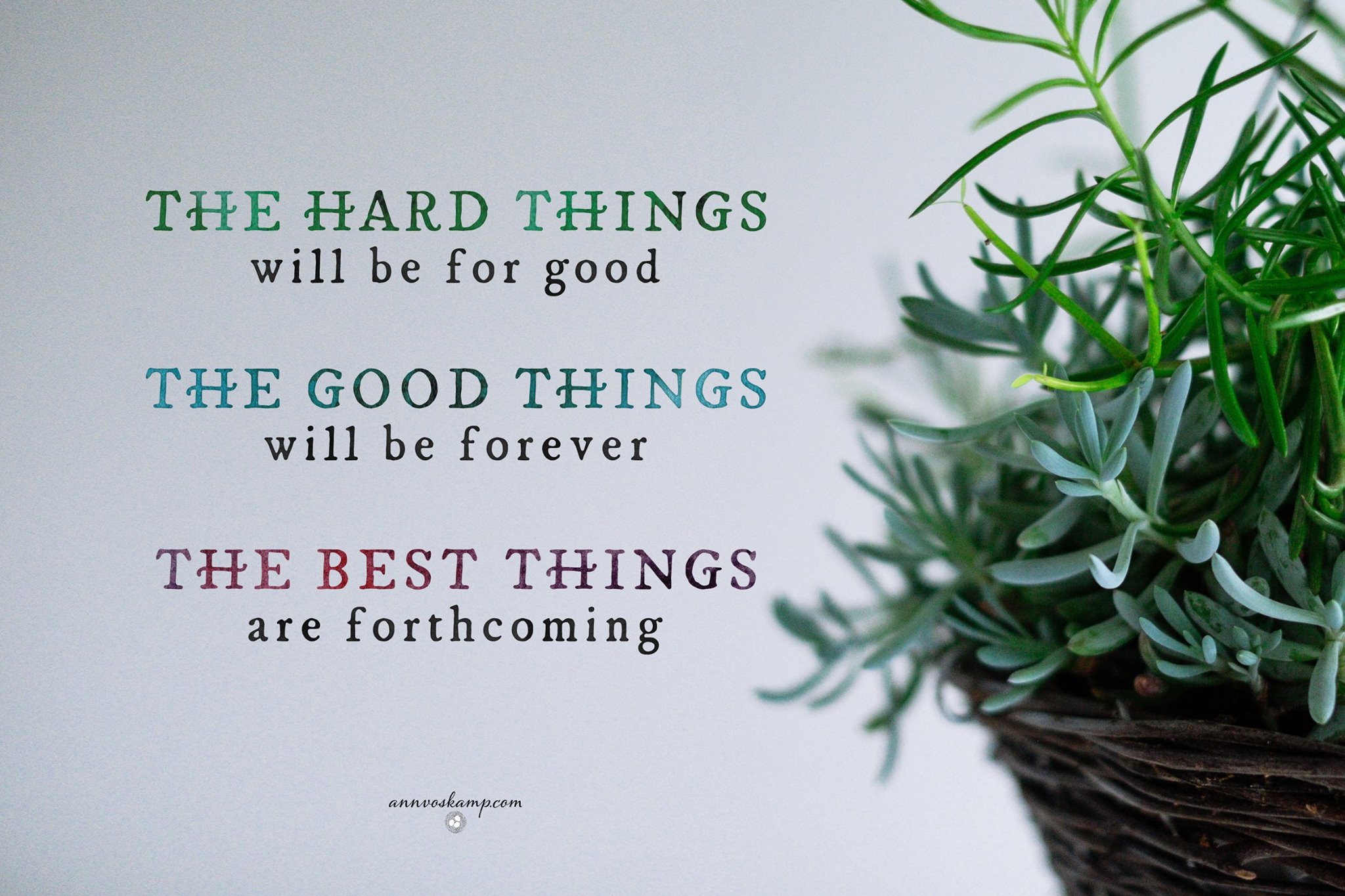
For us, the best is yet to come. For her, the best is right now.

Source: The Crucified Is My Love

It’s The Little Things

Recently, I was watching a Gilmore Girls panel from 2015 with the cast and creators. It’s always fascinating to me to see the inspirations behind shows and movies and where the ideas came from.

Amy Sherman-Palladino, the brainchild behind Gilmore Girls, talked at one point about getting her start on the Roseanne TV show. One of their philosophies that she took with her to Gilmore Girls was “Make the small things big, and make the big things small.”

I like that. That’s a good motto for life.

You think life is all about the big dramatic events that alter the course of your life, but really it’s the thousands of small moments that shape who you are and who you’re becoming. It’s the 10,000 steps you take every day– for some, more figurative than literal– toward your eventual destination.

Every day is filled with all sorts of minor inconveniences and frustrations, small joys and heartaches, and a multitude of minuscule blessings that so many miss because they are in too much of a hurry to notice.

God is often in the details and when we slow down enough to notice details, we find God in the ordinary moments of our days. God is in the early morning sunset that takes your breath away. He’s in the smile of a stranger you pass in Target. He’s in the random song on the radio that catches your attention and speaks to you.

Learn to celebrate those small moments. Slow down and pay attention to the details. Remember that God is working through every little thing for His glory and your good.

Random Weirdness

Today, I went to Goodwill. I came away with a t-shirt, a CD, and a small fan. I feel that encapsulates the weirdness that has been 2021. It’s not nearly as much of a dumpster fire as 2020, but it’s also not quite up to the standards of 2019 (if I can even remember that far back).

Thankfully, this is a vacation week, so tomorrow is my Friday. Sometimes you just need to get away for a bit. Sometimes a change of scenery is what you need.

So goodbye Nashville and hello Gatlinburg. Until Sunday. Then it’s return to “normal.” Good luck with that.

Enchanted

I went on my first hike at Radnor in a very long time. The weather was pitch perfect. Everything was just right.

Halfway, I saw a girl who got my attention. I don’t mean in the sense that she was pretty (she was), but it was something else. I caught her in a moment when she was completely un-self-aware, if that’s even a word. She was so completely captivated and enchanted by a deer she was watching that in that moment she was selfless.

I don’t know if you’ve ever been around someone like that– someone who is so focused on others that they’re hardly aware of their own existence, or whatever the opposite of self-absorbed is.

That’s so rare these days. Social media has turned us into narcissists. So much of the time so many of us are self-obsessed and self-centered. It’s hard not to be in a culture where all the advertising and media is about getting what you want and gratifying your own desires. It’s all about selfies and posting about me — even spouses and children are a reflection of me.

Yet when you see true selflessness, it’s a beautiful thing. Like the old saying about humility goes, it’s not about thinking less of yourself, but thinking less about yourself. It’s not false modesty where you want praise on your own terms. It’s not self-effacing when refuse to take a compliment at all.

I’m not sure I can describe it, but I know it when I see it. Maybe the best example of pure selflessness is found in Philippians 2:5-11:

“Think of yourselves the way Christ Jesus thought of himself. He had equal status with God but didn’t think so much of himself that he had to cling to the advantages of that status no matter what. Not at all. When the time came, he set aside the privileges of deity and took on the status of a slave, became human! Having become human, he stayed human. It was an incredibly humbling process. He didn’t claim special privileges. Instead, he lived a selfless, obedient life and then died a selfless, obedient death—and the worst kind of death at that—a crucifixion.

Because of that obedience, God lifted him high and honored him far beyond anyone or anything, ever, so that all created beings in heaven and on earth—even those long ago dead and buried—will bow in worship before this Jesus Christ, and call out in praise that he is the Master of all, to the glorious honor of God the Father” (The Message).

Maybe what I find so enchanting about selflessness is that it is a reflection of Jesus. It points me to the perfect sacrifice He made for me and how He took my mess and gave me His perfection. It’s that kind of sacrificial love that I long for but fall short of so often because I am so often selfish and self-serving. It’s what I hope and pray Jesus is transforming me into.

May we always seek the kind of selfless agape love that comes from God and may we reflect it to everyone, but especially to those who need it most and deserve it least.

But We Had Hoped

“That same day two of Jesus’ followers were walking to the village of Emmaus, seven miles from Jerusalem. As they walked along they were talking about everything that had happened. As they talked and discussed these things, Jesus himself suddenly came and began walking with them. But God kept them from recognizing him.

He asked them, “What are you discussing so intently as you walk along?”

They stopped short, sadness written across their faces. Then one of them, Cleopas, replied, “You must be the only person in Jerusalem who hasn’t heard about all the things that have happened there the last few days.”

“What things?” Jesus asked.

“The things that happened to Jesus, the man from Nazareth,” they said. “He was a prophet who did powerful miracles, and he was a mighty teacher in the eyes of God and all the people. But our leading priests and other religious leaders handed him over to be condemned to death, and they crucified him. We had hoped he was the Messiah who had come to rescue Israel. This all happened three days ago” (Luke 24:13-21, NLT).

But we had hoped. Those are some of the saddest words in all of the Bible. There are few things worse than dashed hopes and crushed dreams. I think most of us know from experience what it’s like to have hopes disappoint.

When you said “I do” in a marriage, you had hoped that it would last forever. When you started dating that special someone, you had hoped it would lead to marriage. When you had taken the job, you had hoped it would be fulfilling and challenging while utilizing your gifts and talents.

In this case, these disciples were in the presence of the fulfillment of all their hopes and dreams without realizing it. They didn’t recognize that the Messiah they had hoped for was standing right in front of them.

I have found in my own life that disappointment leads me to redirect my vision and reset my hopes. Not all hopes and dreams are bad. Most of them are good– in fact, some are very good. But ultimately, if my hope is in anything less than Jesus, I will be disappointed. Even if I get what I wanted, it will turn out not to be my heart’s true desire.

Those two disciples eventually recognized Jesus for who He truly was and worshipped. May we find in Jesus the ultimate fulfilling of our own hopes and dreams, knowing that every other good gift comes from Him and finds its ultimate fulfillment through Him.