Aslan is On the Move

“‘They say Aslan is on the move—perhaps has already landed.’

And now a very curious thing happened. None of the children knew who Aslan was any more than you do; but the moment the Beaver had spoken these words everyone felt quite different. Perhaps it has sometimes happened to you in a dream that someone says something which you don’t understand but in the dream it feels as if it had some enormous meaning— either a terrifying one which turns the whole dream into a nightmare or else a lovely meaning too lovely to put into words, which makes the dream so beautiful that you remember it all your life and are always wishing you could get into that dream again. It was like that now. At the name of Aslan each one of the children felt something jump in its inside. Edmund felt a sensation of mysterious horror. Peter felt suddenly brave and adventurous. Susan felt as if some delicious smell or some delightful strain of music had just floated by her. And Lucy got the feeling you have when you wake up in the morning and realize that it is the beginning of the holidays or the beginning of summer” (C. S. Lewis, The Lion, The Witch, and the Wardrobe).

Aslan is on the move. If you don’t know, I’d recommend reading the books. They’re great.

A Faith Like Betty Elliott’s

‘Lord, I give up my own plans and purposes, all my own desires, hopes and ambitions, and I accept Thy will for my life. I give up myself, my life, my all, utterly to Thee, to be Thine forever. I hand over to Thy keeping all of my friendships; all the people whom I love are to take second place in my heart. Fill me now and seal me with Thy Spirit. Work out Thy whole will in my life at any cost, for to me to live is Christ. Amen” (Betty Scott Stam).

I want the kind of faith that Betty Elliott had. And before I go on, I do realize that she was a flawed, sometimes insecure, follower of Christ. I also realize that the only one we’re truly called to be like is Jesus, but I think it’s helpful to have worthy examples to inspire us.

After listening to most of the biography Becoming Elisabeth Elliott, I see a faith that definitely is inspiring to me. This woman of God waited for marriage for a long time. She had wait while Jim wrestled with whether God was calling him to marriage in addition to a call to the mission field. After that, their marriage lasted all of two years before he was martyred.

Then she was willing to go to the very people who had murdered her husband and take them the gospel. It’s only through the power of the gospel of Christ that she was even able to forgive them, much less reach out to them in love. It’s that same amazing grace that later saw a majority of that tribe come to know Jesus as Lord and Savior.

That’s the kind of faith I want. Not so much the dramatic, in your face part, but the quiet and steady confidence in a God whose ways I may not always understand. I want the faith that can say at any moment, whatever the circumstances, “Thy will be done, even if it means that my will be undone.”

Her legacy lives on in the books she wrote, particularly Through Gates of Splendor and its account of Jim Elliott and four other missionaries’ attempts to reach the Huaorani people of Ecuador, an unreached people group, with the gospel and how it cost them their very lives.

I love this prayer of hers from when she was 21:

“My life is on Thy Alter, Lord – for Thee to consume. Set the fire, Father! Bind me with cords of love to the Alter. Hold me there. Let me remember the Cross.”

The Bread of Life

I ate dinner at The Cheesecake Factory with the family today. Yes, that place that has a menu the size of War and Peace. But they also have bread.

One of my favorite pleasures has to be freshly baked bread right out of the oven, covered in just the right amount of butter. The taste, the texture, and the way it melts in my mouth all make for happiness. I could live without a lot of things, but I seriously doubt I could live without bread.

And think about it. Bread is such a staple for so many parts of the world. Back in Jesus’ day, bread was a daily part of their lives and integral to every meal. So when Jesus said that He was the Bread of Life, he was saying more than He was one of the four food groups, spiritually speaking. He was saying that the more we know and love Jesus, the more we find Him completely satisfying on every level.

If I had let myself, I could have eaten basket after basket of bread and not had any room left for the entree. That would have been foolish. But when Jesus is the bread of life, we find that there’s no such thing as too much. The more we learn and the more we see, the more we want and the more our desire grows to know and love and serve Jesus. The more we want to share this Bread with others.

May the love of Jesus never grow old for any of us, but may we always savor Jesus and carry His aroma wherever we go to those around us in all the places we go.

Resting, Not Rusting

“To wait upon God is not to sit with folded hands and do nothing, but to wait as men who wait for the harvest. The farmer does not wait idly but with intense activity; he keeps industriously ‘at it’ until the harvest. To wait upon God is the perfection of activity. We are told to ‘rest in the Lord,’ not to rust” (Oswald Chambers, The Place of Help).

I love that image. Waiting on the Lord is like a farmer waiting for his crops to be ready for harvest. He has to prepare the soil to receive the rain so that the seeds will germinate and grow. There is no amount of idly sitting by with folded hands hoping for a good harvest.

While we may not know the outcome of what we’re waiting for, we at least know something that God has placed on our hearts. We know one step of obedience to take. We also know that it’s not until we stop taking about obedience and finally obey that God reveals the next step and illuminates the next part of our path.

May we be faithful to wait well and not idly. May we learn to rest in the Lord, not to rust.

Church Is Hard

I’d say Church is hard because we’re all broken and flawed people, scarred and marred by the ravages of sin. Church is filled with imperfect people. Yes, Church is filled with hypocrites because as much as we want, our lives never exactly line up with our words.

Let these words sink in and remember that while Church is hard, is where God has never failed to meet us:

“CHURCH IS HARD.

Church is hard for the person walking through the doors, afraid of judgement.

Church is hard for the pastor’s family, under the microscope of an entire body.

Church is hard for the prodigal soul returning home, broken and battered by the world.

Church is hard for the girl who looks like she has it all together, but doesn’t.

Church is hard for the couple who fought the entire ride to service.

Church is hard for the single mom, surrounded by couples holding hands, and seemingly perfect families.

Church is hard for the widow and widower with no invitation to lunch after service.

Church is hard for the deacon with an estranged child.

Church is hard for the person singing worship songs, overwhelmed by the weight of the lyrics.

Church is hard for the man insecure in his role as a leader.

Church is hard for the wife who longs to be led by a righteous man.

Church is hard for the nursery volunteer who desperately longs for a baby to love.

Church is hard for the single woman and single man, praying God brings them a mate.

Church is hard for the teenage girl, wearing a scarlet letter, ashamed of her mistakes.

Church is hard for the sinners.

Church is hard for me.

It’s hard because on the outside it all looks shiny and perfect. Sunday best in behavior and dress.

However, underneath those layers, you find a body of imperfect people, carnal souls, selfish motives.

But, here is the beauty of church—

Church isn’t a building, mentality, or expectation.

Church is a body.

Church is a group of sinners, saved by grace, living in fellowship as saints.

Church is a body of believers bound as brothers and sisters by an eternal love.

Church is a holy ground where sinners stand as equals before the Throne of Grace.

Church is a refuge for broken hearts and a training ground for mighty warriors.

Church is a converging of confrontation and invitation. Where sin is confronted and hearts are invited to seek restoration.

Church is a lesson in faith and trust.

Church is a bearer of burdens and a giver of hope.

Church is a family. A family coming together, setting aside differences, forgetting past mistakes, rejoicing in the smallest of victories.

Church, the body, and the circle of sinners-turned-saints, is where He resides, and if we ask, He is faithful to come.

So even on the hard days at church—

The days when I am at odds with a friend, when I’ve fought with my husband because we’re late once again. When I’ve walked in bearing burdens heavier than my heart can handle, yet masking the pain with a smile on my face. When I’ve worn a scarlet letter, under the microscope. When I’ve longed for a baby to hold, or fought tears as the lyrics were sung. When I’ve walked back in, afraid and broken, after walking away.

I’ll remember, He has never failed to meet me there” (Pat Smith).

Safe vs. Faithful

I read something recently that resonated with me (and also convicted me quite a bit). I’m someone who would rather be safe than sorry, and comfort is usually my end game. May these words challenge you like they did me.

God did not call us to be safe, but faithful. Safe means taking no risks and never trying anything new. Faithful means that wherever I go and whatever I do, God is with me, regardless of what happens to me.

Safe means blending in. Faithful means taking up my cross daily and laying down my life in the figurative (and possibly literal) sense. May we all have a blessed year where we witness the faithfulness of God rather than merely a safe year:

“I am no fan of this new trend, wishing people a “safe” new year.

“It seems this cult of safety is advancing further into our vocabulary.

“It is a terrible value to base your year on.

“Imagine if the greats of history had decided to live “safe” lives, instead of good ones? Simply take those listed in Hebrews 11 – Abraham, Moses, Joseph, Rahab, Samson, Gideon… The list speaks for itself.

“Living for safety first will see you rendered next to useless.

“It is my genuine hope that I’ll continue to do many things this year that are not very safe.

“Because I hope to do what is characterised as “good,” not what is characterised as “safe.”

“Living for what is good and right involves risk and it involves pain – plenty of both.

“But when you do what is right, you can confidently entrust your safety to God.

“That is, God who says continuously to those who do such things, “Fear not, for I am with you.”

“This emerging safety cult is best nipped in the bud. Stop saying it and don’t start believing it.

“Meanwhile, I wish you a year in which you, “seek first the Kingdom of God and His righteousness,” knowing that, “all these things shall be added unto you.” (even safety!) (Matt 6:33)

“Now, there’s something to base a year on.”
—Martyn Iles

New Year’s Day 2024

This is my favorite quote for the new year. It was written by Dietrich Bonhoeffer while he was in a concentration camp after a failed attempt to assassinate Adolf Hitler. He penned these words, knowing they might be some of his very last and that he probably would not live to see the next new year.

These words are timeless and just as needed in 2024 as they were in 1945:

“With every power for good to stay and guide me,
comforted and inspired beyond all fear,
I’ll live these days with you in thought beside me,
and pass, with you, into the coming year.

While all the powers of Good aid and attend us,
boldly we’ll face the future, be it what may.
At even, and at morn, God will befriend us,
and oh, most surely on each new year’s day

The old year still torments our hearts, unhastening:
the long days of our sorrow still endure.
Father, grant to the soul thou hast been chastening
that Thou hast promised—the healing and the cure.

Should it be ours to drain the cup of grieving
even to the dregs of pain, at thy command,
we will not falter, thankfully receiving
all that is given by thy loving hand.

But, should it be thy will once more to release us
to life’s enjoyment and its good sunshine,
that we’ve learned from sorrow shall increase us
and all our life be dedicate as thine.

To-day, let candles shed their radiant greeting:
lo, on our darkness are they not thy light,
leading us haply to our longed-for meeting?
Thou canst illumine e’en our darkest night.

When now the silence deepens for our harkening,
grant we may hear thy children’s voices raise
from all the unseen world around us darkening
their universal paean, in thy praise.

While all the powers of Good aid and attend us,
boldy we’ll face the future, be it what way.
At even, and at morn, God will befriend us,
And oh, most surely on each new year’s day!” (Dietrich Bonhoeffer).

The Father’s Business

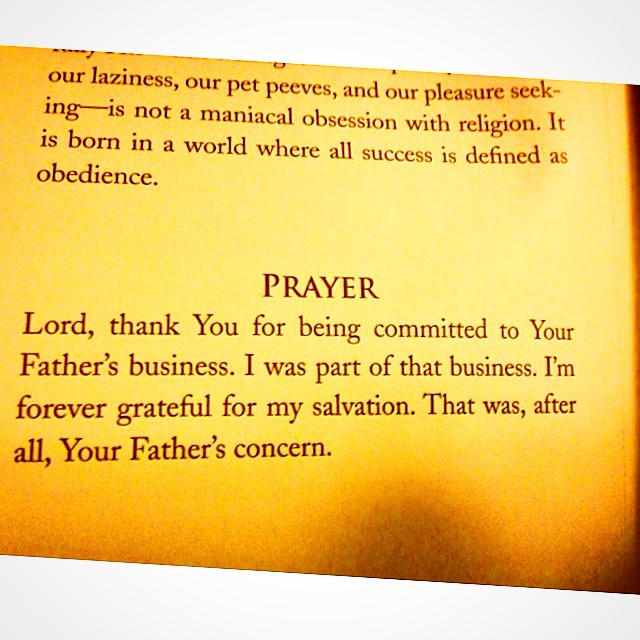
One of my favorite epiphanies about Jesus came when I heard (or read) that Jesus’ first recorded words came when His parents found Him in the temple after He went missing. He spoke of how He must be about His Father’s business. His last words before He died were, “It is finished.” Everything in between was His Father’s business — that means you and that means me and that means those for whom He came to seek and to save.

That’s our business. To seek out the lost and help them find their way to Jesus. Like Jacob Marley said to Scrooge that Christmas Eve, “Mankind was my business,” and not the obsessive hoarding of wealth and titles.

Tonight, I am thankful that I was my Father’s business. So were you. That mission that started in Bethlehem and ended in Jerusalem was to find and save us. Jesus wasn’t the one who was lost. Not really. We were.

Boxen

I started a new book recently. I’ve actually owned this book for a while, but for some reason or another have never gotten around to it. It was perpetually on my to-read-next list.

This is a collection of what C. S. Lewis, who preferred to be called Jack, wrote with his brother Warnie when they were kids growing up in Belfast in Northern Ireland. It wasn’t something they ever meant to be published but it was stories they wrote for each other to take their minds off of the outside world and losing their mother at an early age.

It feels a bit like the Beatrix Potter books (which they read as kids) where the animals wear clothes and talk and behave in human ways. If you’ve read the Narnia books, you can see where the seeds that led to those books came from.

These stories have typical childish spelling and grammar, but also they seem a bit advanced for children who were both under the age of 10. You can tell both these boys were intelligent and well-educated. I feel like these characters could have easily existed in the world that Kenneth Grahame created for The Wind in the Willows (which is a story that he also never originally meant to be published but wrote for his young son).

I’ve included a link to Amazon if you’re interested (although I think you could probably find it cheaper in a secondhand bookstore or through other book websites):

An Advent Prayer from Henri Nouwen

I realize that we are past Advent. If you follow the ancient ways, then you are aware that this is the third day of Christmas, so it still counts. Also, this time of the kingdom of God being now and not yet feels like an extended Advent season as we wait for Christ’s return:

“O Lord,

How hard it is to accept your way. You come to me as a small, powerless child born away from home. You live for me as a stranger in your own land. You die for me as a criminal outside the walls of the city, rejected by your own people, misunderstood by your friends, and feeling abandoned by your God.

As I prepare to celebrate your birth, I am trying to feel loved, accepted, and at home in this world, and I am trying to overcome the feelings of alienation and separation that continue to assail me. But I wonder now if my deep sense of homelessness does not bring me closer to you than my occasional feelings of belonging. Where do I truly celebrate your birth: in a cozy home or in an unfamiliar house, among welcoming friends or among unknown strangers, with feelings of well-being or with feelings of loneliness?

I do not have to run away from those experiences that are closest to yours. Just as you do not belong to this world, so I do not belong to this world. Every time I feel this way I have an occasion to be grateful and to embrace you better and taste more fully your joy and peace.

Come, Lord Jesus, and be with me where I feel poorest. I trust that this is the place where you will find your manger and bring your light. Come, Lord Jesus, come.

Amen” (Henri Nouwen).