The Glorious Impossible

“He by whom all time was made became Man in time; that He, in His eternity more ancient than the world, became inferior in age to many of His servants in the world; that He who made man became Man; that He was formed in the Mother whom He Himself formed, carried in the hands which He made, nourished at the breasts which He filled; that, in the manger in mute infancy, He the Word without whom all human eloquence is mute wailed?” (St Augustine of Hippo).

Somewhere out there on the interwebs is a much longer version of this homily. It goes into greater detail about how the creator of man became a man and He who formed life was born and died so that we could be made alive.

This begins to touch on what God did for us. He showed us through His incarnation that truly nothing is impossible to the one who believes. Christmas is proof that no darkness is too dark for light to overcome.

Philippians 2 says it best:

In other words, adopt the mind-set of Jesus the Anointed. Live with His attitude in your hearts. Remember:

Though He was in the form of God,
    He chose not to cling to equality with God;
But He poured Himself out to fill a vessel brand new;
    a servant in form
    and a man indeed.
The very likeness of humanity,
He humbled Himself,
    obedient to death—
    a merciless death on the cross!
So God raised Him up to the highest place
    and gave Him the name above all.
So when His name is called,
    every knee will bow,
    in heaven, on earth, and below.
And every tongue will confess
    ‘Jesus, the Anointed One, is Lord,’
    to the glory of God our Father!” (Philippians 2:5-11, The Voice).

Do Something

“When a truth of God is brought home to your soul, never allow it to pass without acting on it internally in your will. Record it with ink and with blood–work it into your life. The weakest saint who transacts business with Jesus Christ is liberated the second he acts and God’s almighty power is available on his behalf” (Oswald Chambers, My Utmost for His Highest).

My pastor often says at the end of his sermons that we need to take what we learned and determine to put it into practice or else it will stay in the room when we leave on Sunday. The Bible tells us not to be hearers only but doers of what we hear.

The best way to hear God’s voice is to do what you already know God has told you to do. You need to take that first step before God will show you the next one. You need to show yourself faithful with the smaller things before God trusts you with bigger ones.

Once you set yourself to obey, you find that you are operating in the strength and wisdom of the Almighty God. Once you surrender and commit to follow, God enables you to obey. You may be the least qualified to do what God has called you to do, but God’s strength is perfected in your weakness and as the old saying goes, He doesn’t call the qualified but He qualifies the called as they step out in faith and not as they sit in their recliners and talk about how they might one day be obedient when it’s convenient.

Following Jesus and falling on your face isn’t failure. Stepping out of the boat like Peter and sinking when you see the size of the storm isn’t failure. Staying in the boat and never taking a step is failure because you never get to see how God might have pulled you up and pushed you forward if you never step out of the boat.

Lord, help us not to read your Word to obtain more information. Transform us and renew our minds through Your word that we might be enabled and willing to obey and do what it says. Amen.

Whatever Is Necessary

“The greatest blessing God can give us is to put us in a position where we must trust him. This is our only path to joy. He will do whatever is necessary to disrupt our self-sufficiency and illusion of control” (Jim Dennison).

I find that both terrifying and comforting at the same time.

I’m terrified of “whatever is necessary” and what it might mean to my current level of comfort and familiarity. I pretty much like things to stay the same and not get too crazy. I have my own plans for how my life should go, and I sometimes want God to rubber stamp those plans, and anything else is a bit scary to think about.

But I’m also comforted. When I remember the goodness of God, I can trust that He knows what He’s doing. When I think back on all the times in the past where He’s safely led me through trials, I can see with my eyes of faith God providing for me in the future.

Self-sufficiency and control aren’t just illusions. They’re the default setting of our sin natures. We are born fighting to assert our own will over and against anyone else’s. We learn early how to make a clenched fist and cry if we don’t get our own way.

But learning to let go is harder. Learning to step out from the comfort of solid ground onto thin air is frightening. But the rewards to stepping out in faith into an unknown country as Abraham did so long ago is more than worth the cost. Learning to relinquish my will and to die to self is the most anti-American dream thing I can do but also the most freeing in terms of the kingdom of God.

God, I want what you want, period. At any cost. If it makes me more like You, it’s worth it. Amen.

Trim the Sails and Trust the Savior

“We talk about ‘circumstances over which we have no control.’ None of us have control over our circumstances, but we are responsible for the way we pilot ourselves in the midst of things as they are. Two boats can sail in opposite directions in the same wind, according to the skill of the pilot. The pilot who conducts his vessel on to the rocks says he could not help it, the wind was in that direction; the one who took his vessel into the harbour had the same wind, but he knew how to trim his sails so that the wind conducted him in the direction he wanted. The power of the peace of God will enable you to steer your course in the mix-up of ordinary life.

O Lord, unto You do I turn, unto You. I am but a homeless waif until You touch me with the security of Your peace, the sweet sense of Your love” (Oswald Chambers).

This reminds me of what Corrie ten Boom once said about riding on trains. She said when that train goes into a long dark tunnel, you don’t jump off the train. You stay on and trust the conductor. That’s how it is with life when the proverbial seas swell with storms. You stay on board and afloat and trust the Pilot.

I love the verse in Isaiah that speaks to those God will keep in perfect peace whose minds are stayed on Him. That’s not a haphazard kind of faith driven about by every wind of emotion and circumstance but a firm determination and a resolute mindset developed by years of discipline that remains unmoved by any amount of wind or wave.

That’s what it means to have God’s peace. It’s to have a calm assurance in the midst of unrest and turmoil that you are in good hands. In the best hands. In God’s hands.

No Matter What

“Our prayers for guidance (or for anything else) really begin here: I trust him. This requires abandonment. We are no longer saying, ‘If I trust him, he’ll give me such and such,’ but ‘I trust him. Let him give me or withhold from me what he chooses” (Elisabeth Elliot, God’s Guidance: A Slow & Certain Light).

It’s easy to fall into the trap of trying to bargain with God. Something along the lines of “I’ll trust you if you will give me a) a job, b) a spouse, or c) lots of money.”

It feels more like a transaction than faith. If God does X, then I’ll do Y. The trouble is that I’m in no position to bargain with God. He’s the Eternal Lord and King of the Universe who has every right to destroy me because of my sin, and I’m the one who’s only alive at this moment because of His grace.

The truth is that if all God ever did was to save me from an eternity in hell and leave me alone, that would be way more than I deserve. That alone would merit my praise from now until 10,000 X 10,000 years have passed.

But that’s not all God did. He has sustained me and blessed me and been with me through every kind of joy and sorrow, triumph and trial. All He asks in return is my allegiance. My loyalty. My surrender. Me.

It’s not wrong to ask God for things, but the more I spend time with God and in His word and the more I grow in Christlikeness, the things I ask for change and my desire to have them changes.

God doesn’t owe me anything. Even the next breath is a gift. I owe God everything, more than I could possibly ever pay in a million lifetimes. Yet all God asks for is me. I think that’s a good enough reason to trust Him no matter what.

Pure in Heart

“Who is pure in heart? Only those who have completely given their hearts to Jesus, so that he alone rules in them. Only those who do not stain their hearts with their own evil, but also not with their own good. A pure heart is the simple heart of a child, who does not know about good and evil, the heart of Adam before the fall, the heart in which the will of Jesus rules instead of one’s own conscience.… A pure heart is pure of good and evil; it belongs entirely and undivided to Christ; it looks only to him, who goes on ahead. Those alone will see God who in this life have looked only to Jesus Christ, the Son of God. Their hearts are free of defiling images; they are not pulled back and forth by the various wishes and intentions of their own. Their hearts are fully absorbed in seeing God. They will see God whose hearts mirror the image of Jesus Christ” (Dietrich Bonhoeffer).

I read one time that purity of heart is to will one thing. There is no divide between my will and God’s will or what I want versus what God wants for me. True purity of heart means living surrendered to the point where God’s will is my will and God’s desire for me is my desire.

That’s not something I think we completely achieve in this life, but as we have this Christ life continually formed inside of us, we get closer to being pure in heart. Also, maybe being pure in heart is to grow so transparent that people who look at us see less and less of us and eventually only Christ in us.

“God blesses those whose hearts are pure,
    for they will see God” (Matthew 5:8, NLT).

Reframing Your Past, Present & Future

I’ve never thought about gratitude like that before. I get that it changes the way you see your present and can shift how your future plays out, but to change your perspective on your past? That’s a game changer.

The old saying about grace is that it means that your past now serves a purpose instead of serving shame. Gratitude helps you to see how every part of your past, good and bad, has led you to the present moment. God was in all of it with you, taking those dark and painful moments to weave them in with the brighter colors.

Also, sometimes when you look at a famous painting too closely, it looks like a big chaotic mess. You can’t tell anything about it. But once you step back, it becomes clearer. The same applies for life — once you can step back after a few days or weeks or months, you can see more clearly what God was up to in that moment.

You don’t have to give thanks FOR those awful moments and tragedies. But you can give thanks IN them. Paul didn’t say give thanks FOR all circumstances but IN all circumstances, knowing God works all things together for good and there is a redemptive purpose for pain and loss.

I still think about that quote about muddy water becoming clear as it settles and is still. So do we. Everything becomes clear when we cease striving to make it make sense and can be still and know that God is God, to know that God is still in control and in charge.

And it all begins with gratitude.

Mountain Mover

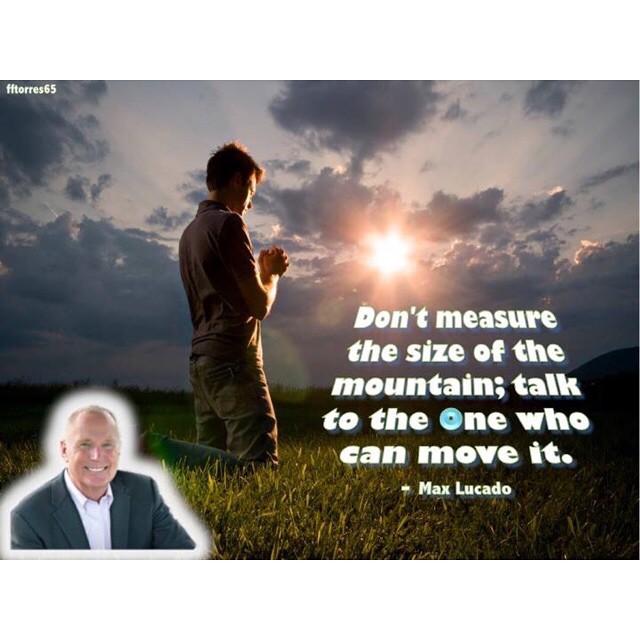
It’s easy to be intimidated and discouraged by the size of the mountain, isn’t it? Real mountains can be a pain, but those metaphorical mountains can seem impossible to overcome.

I was reading recently about Mount Everest and all those who have attempted the climb and died in the effort. They thought they were smart enough, strong enough, tough enough, etc., but the mountain proved to be too much.

Some obstacles in your life can seem like that. When you look ahead, all you can see is that mountain in the way. There’s no way around it or under it or over it. The thought of climbing it fills your heart with dread and fear.

But remember that every mountain has a maker. Jesus said that if we had enough faith, we could say to the mountain, be cast into the sea and it would obey. Basically, Jesus said that it’s not big faith that gets past the mountain but faith in a big God.

So don’t look at the mountain, but cast your eyes on the One who can move that mountain. Talk to the One who has already overcome all of death, hell, and the grave. What is it that you’re facing that is stronger than what Jesus has already overcome?

Mountains are scary, but remember that the taller the mountain, the better the testimony at the end.

Humbly Let Go

“Humbly let go. Let go of trying to do, let go of trying to control, let go of my own way, let go of my own fears. Let God blow His wind, His trials, oxygen for joy’s fire. Leave the hand open and be. Be at peace. Bend the knee and be small and let God give what God chooses to give because He only gives love and whisper a surprised thanks. This is the fuel for joy’s flame. Fullness of joy is discovered only in the emptying of will. And I can empty. I can empty because counting His graces has awakened me to how He cherishes me, holds me, passionately values me. I can empty because I am full of His love. I can trust” (Ann Voskamp, One Thousand Gifts: A Dare to Live Fully Right Where You Are).

I’m not advocating for a kind of “let go and let God” passive approach to spirituality. I think in this case I need to let go of my way of thinking of how God should act. I should stop setting up boundaries to put God in so that He will act according to what I have set up as my standard for Him to follow.

I can trust that God’s ways are not my ways. I can trust that I would want what God wants if I knew what He knew. I would understand what He does if I could see the whole entire big picture from eternity rather than my own specific limited viewpoint. If my brain could comprehend the infinite, I could begin to think like God.

But I can’t and I’m not. “Faith is the assurance of things you have hoped for, the absolute conviction that there are realities you’ve never seen” (Hebrews 11:1, The Voice).

I trust in what I can’t see and I believe what I can’t fully understand. Otherwise, it wouldn’t be faith. It would be seeing and understanding. But even if I have the teensiest amount of faith like that of a microscopic mustard seed, that’s enough.

Daily Bread Vs. a Lifetime Supply

Recently, a friend sent me an article about trusting God for daily bread versus really wanting God to dump a year’s worth of supply in one drop so I don’t have to worry. In my flesh, I’d rather be set for life than have to be like the Israelites of old and trust God for daily provision.

Speaking of those ol’ people of God, they didn’t always listen. When God said to gather only as much as manna as you need for that day, they thought they’d be oh so smart and oh so clever and gather two or three days’ worth. What happened? The excess manna rotted and smelled to high heaven, as did the people’s attitude.

God supplies our needs daily because He knows our ultimate need isn’t bread. What we need most isn’t physical. We need God, and when we learn to trust God for each day, our dependence deepens and grows as we see each day’s needs met.

I confess I’m not very good at that. I tend to be forgetful. Thankfully, God has a gentle way of reminding me of the last 10,000 times He’s provided for me (sometimes without me even knowing or asking). He’s faithful even when I’m faithless and forgetful.

Anyway, I included the original article if you want to be blessed as much as I was: