The Glorious Impossible

“He by whom all time was made became Man in time; that He, in His eternity more ancient than the world, became inferior in age to many of His servants in the world; that He who made man became Man; that He was formed in the Mother whom He Himself formed, carried in the hands which He made, nourished at the breasts which He filled; that, in the manger in mute infancy, He the Word without whom all human eloquence is mute wailed?” (St Augustine of Hippo).

Somewhere out there on the interwebs is a much longer version of this homily. It goes into greater detail about how the creator of man became a man and He who formed life was born and died so that we could be made alive.

This begins to touch on what God did for us. He showed us through His incarnation that truly nothing is impossible to the one who believes. Christmas is proof that no darkness is too dark for light to overcome.

Philippians 2 says it best:

In other words, adopt the mind-set of Jesus the Anointed. Live with His attitude in your hearts. Remember:

Though He was in the form of God,
    He chose not to cling to equality with God;
But He poured Himself out to fill a vessel brand new;
    a servant in form
    and a man indeed.
The very likeness of humanity,
He humbled Himself,
    obedient to death—
    a merciless death on the cross!
So God raised Him up to the highest place
    and gave Him the name above all.
So when His name is called,
    every knee will bow,
    in heaven, on earth, and below.
And every tongue will confess
    ‘Jesus, the Anointed One, is Lord,’
    to the glory of God our Father!” (Philippians 2:5-11, The Voice).
The Great Paradox

“The great paradox of life is that those who lose their lives will gain them. This paradox becomes visible in very ordinary situations. If we cling to our friends, we may lose them, but when we are nonpossessive in our relationships, we will make many friends. When fame is what we seek and desire, it often vanishes as soon as we acquire it, but when we have no need to be known, we might be remembered long after our deaths. When we want to be in the center, we easily end up on the margins, but when we are free enough to be wherever we must be, we find ourselves often in the center.

Giving away our lives for others is the greatest of all human arts. This will gain us our lives” (Henri Nouwen).

“If you refuse to take up your cross and follow Me on the narrow road, then you are not worthy of Me. To find your life, you must lose your life—and whoever loses his life for My sake will find it” (Matthew 10:38-39, The Voice).

That’s the paradox. You find your life by losing it. You gain love by giving it away. People notice you when you deflect the praise to the King of the universe instead of yourself. You’re blessed when you’re poor in spirit, meek, mourning, and pure in heart.

Instead of following the world’s path to success, Jesus went down the road of downward mobility. He gave up clinging to His rights of equality with God. He took on human form. He took the form of a servant. He was obedient to the point of death. His death was that of a common criminal’s crucifixion. Then God gave Him a name that is above every other name.

That’s our goal. To be unknown on earth but famous in heaven. Heavenly fame looks like faithfulness. Heavenly fame looks like denying yourself, taking up your cross daily, and following Jesus, no matter the cost.

That’s where you find your life. That’s where you find life.

Focus

I’m thankful every year for my social media break during Lent. I do like my Facebook and Instagram, but I also confess I get very tired of people being preachy on just about all of their posts. And by preachy, I don’t mean the kind where you offer the plan of salvation but the kind where you point out the faults of all these other people who just about always happen to be on the other side of the political spectrum.

These days, I see a lot of posts (even from people who profess to follow Jesus) about Karma. Usually, Karma is when other people get what they deserve, not me. Typically, these people will offer themselves more grace and wish karma for the others. I confess that I’ve been guilty of a double standard at times for me messing up versus someone else messing up.

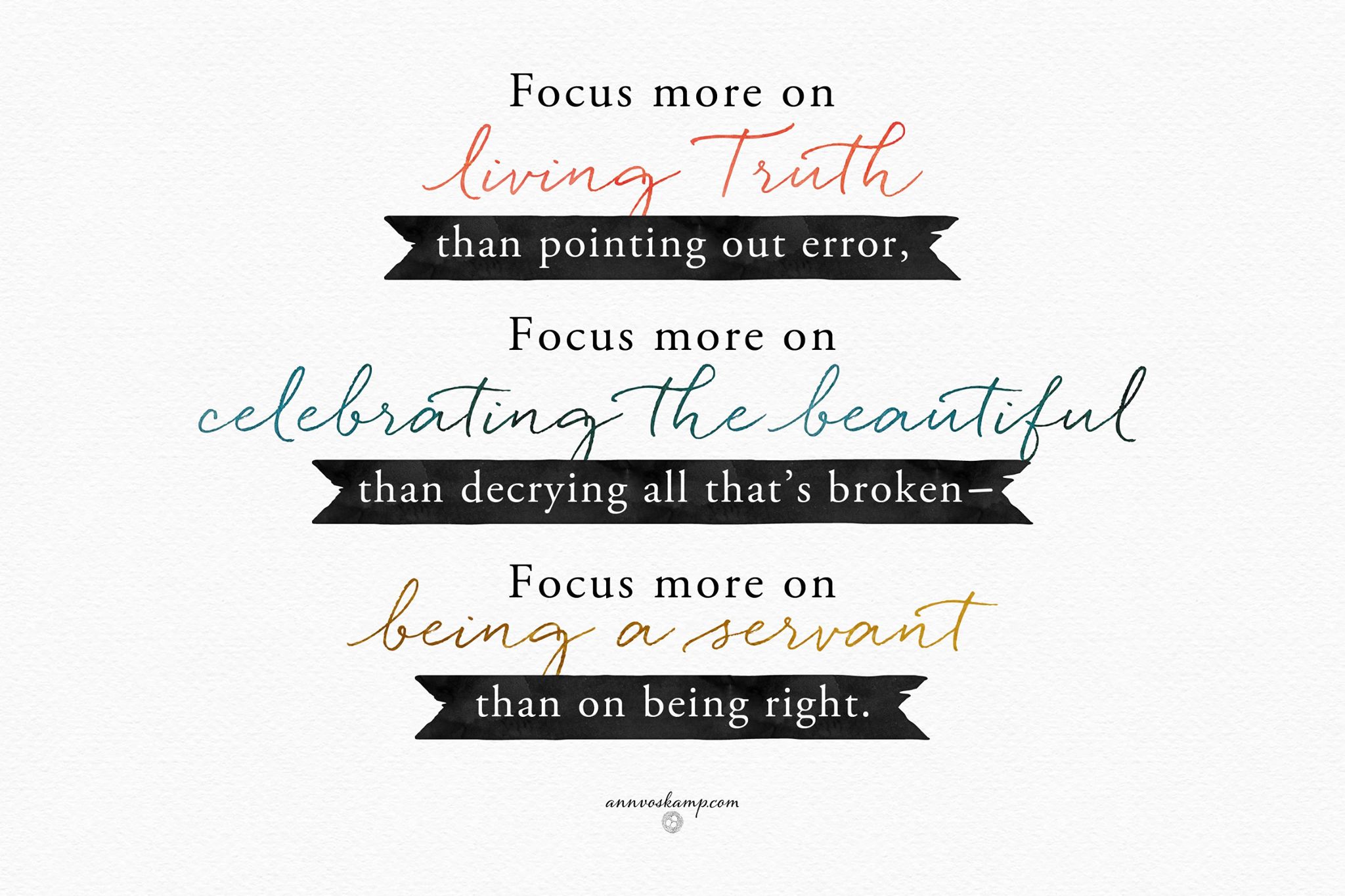
But if you’re living truth, you probably won’t have enough time to point out everyone else’s errors. If you look for ways to celebrate the beautiful, you won’t dwell on the broken. And if you focus on being a servant, you won’t need to win every argument and always be proven right.

If you and I are honest, we need a lot of work. We need a lot of grace. We’re too messed up to judge anyone else being messed up. We’re too spiritually broken to be all high and mighty when it comes to calling out other people’s motives and character. Instead of moralizing, we need to preach the gospel to ourselves and to others every single day.

“f you asked twenty good men today what they thought the highest of the virtues, nineteen of them would reply, Unselfishness.  But if you had asked almost any of the great Christians of old, he would have replied, Love.  You see what has happened?  A negative term has been substituted for a positive, and this is of more than philological importance.  The negative idea of Unselfishness carries with it the suggestion not primarily of securing good things for others, but of going without them ourselves, as if our abstinence and not their happiness was the important point.  I do not thik this is the Christian virtue of Love.  The New Testament has lots to say about self-denial, but not about self-denial as an end in itself.  We are told to deny ourselves and to take up our crosses in order that we may follow Christ; and nearly every description of what we shall ultimately find if we do so contains an appeal to desire.  If there lurks in most modern minds the notion that to desire our own good and earnestly to hope for the enjoyment of it is a bad thing, I submit that this notion has crept in from Kant and the Stoics and is no part of the Christian faith.  Indeed, if we consider the unblushing promises of reward and the staggering nature of the rewards promised in the Gospels, it would seem that Our Lord finds our desires not too strong, but too weak.  We are half-hearted creatures, fooling about with drink and sex and ambition when infinite joy is offered us, like an ignorant child who wants to go on making mud pies in a slum because he cannot imagine what is meant by an offer of a holiday at the sea.  We are far too easily pleased” (C. S. Lewis, The Weight of Glory).

Christian Celebrity

“Christian perfection is not, and never can be, human perfection. Christian perfection is the perfection of a relationship with God that shows itself to be true even amid the seemingly unimportant aspects of human life. God’s purpose is not to perfect me to make me a trophy in His showcase; He is getting me to the place where He can use me. Let Him do what He wants” (Oswald Chambers, My Utmost for His Highest).

I heard something on a podcast that’s been living in my head rent-free ever since. Basically, we weren’t made to be famous. It’s not something that most of us can handle well. To put people on a pedestal because of the ability to sing or act or preach is contrary to what the gospel of Jesus Christ is all about.

One thing we do is immediately upon finding out someone believes in Jesus and can sing is to put them in front of a lot of people without any kind of discipleship or even finding out what they actually believe. The result is a whole myriad of trainwrecks of people who derailed morally or have deconstructed to the point where they no longer believe anything or have watered down the faith to the point that it’s basically meaningless.

We weren’t called to be famous. We were called to be faithful. Maybe what we need are less singers and actors and dancers and people on a stage with a spotlight and more people behind the scenes serving and washing feet. We need less Christian celebrities and more servants.

Hopefully, this is not a bashing session. I hope it’s to get us to the point where we don’t seek to elevate people to the place that only God deserves and in the process put tremendous pressure on them to somehow be all things to all people and be perfect instead of allowing them to be human.

I still remember one year how I commented one year that so many celebrities were passing away. One friend wisely commented that every day a hero passes and very few people know about it. The real heroes are the ones who often go unnoticed and unacclaimed because they’re not seeking attention but to make the world better. So many are doing the faithful work of faith in secret and are themselves unaware of the eternal impact they’ve made.

I love that people get a chance to represent Jesus well in front of a camera or a crowd, but better yet is a live of sacrifice that that leads to the words, “Well done, good and faithful servant.”

Henri Nouwen and Lent in 2015

“O Lord, this holy season of Lent is passing quickly. I entered into it with fear, but also with great expectations. I hoped for a great breakthrough, a powerful conversion, a real change of heart; I wanted Easter to be a day so full of light that not even a trace of darkness would be left in my soul.

But I know that you do not come to your people with thunder and lightning. Even St. Paul and St. Francis journeyed through much darkness before they could see your light. Let me be thankful for your gentle way. I know you are at work. I know you will not leave me alone. I know you are quickening me for Easter – but in a way fitting to my own history and my own temperament.

I pray that these last three weeks, in which you invite me to enter more fully into the mystery of your passion, will bring me a greater desire to follow you on the way that you create for me and to accept the cross that you give to me. Let me die to the desire to choose my own way and select my own desire. You do not want to make me a hero but a servant who loves you.

Be with me tomorrow and in the days to come, and let me experience your gentle presence. Amen” (Henri Nouwen).

I think that says everything that’s in my heart in this season of Lent leading up to Easter Sunday on April 5, especially the part of dying to choosing my own way and selecting my own desire. That’s me. I have my own dreams and ideas of how my life should play out. God has different dreams and ideas for me. Seeing as how God’s ways are so much higher and better than mine, I would do well to yield to His ways over mine.

Lord, I lay my life at your feet. Make it shine brightly for You and for others to see You, regardless of the cost to me. Amen.

The Condescension of God

con·de·scen·sion

 [kon-duhsen-shuhn]  Show IPA

noun

1.

an act or instance of condescending.
2.

behavior that is patronizing or condescending.
3.

voluntary assumption of equality with a person regarded as inferior.
Ok, for the purposes of this blog, forget #1 and #2. Put them out of your mind. I want to focus on #3. Because that’s what God did for us.
Let me explain.
This is the God of whom Isaiah wrote, “‘For my thoughts are not your thoughts, neither are your ways my ways,’ declares the Lord. ‘As the heavens are higher than the earth, so are my ways higher than your ways and my thoughts than your thoughts.”
This God would be completely unknowable unless He had first chosen to reveal Himself to us. He would have remained completely incomprehensible unless He had chosen to reveal His nature and His character. And  He didn’t get all high and mighty with us or look down His celestial nose at us. He looked at us with pity and compassion. But mostly with love.
Truly, this God is not like one of us, only bigger, stronger, faster. He is not the ultimate $6 million dollar man. He is holy, set apart, wholly other.
Jesus is the ultimate example of God’s condescension to man. He who was infinitely higher than we could ever hope or aspire to be, voluntarily assumed equality with those who were His inferiors, i.e. us. He became one of us. Or as Paul puts it in Philippians,
Though He was in the form of God,
    He chose not to cling to equality with God;
But He poured Himself out to fill a vessel brand new;
    a servant in form
    and a man indeed.
The very likeness of humanity,
He humbled Himself,
    obedient to death—
    a merciless death on the cross!
So God raised Him up to the highest place
    and gave Him the name above all.
So when His name is called,
    every knee will bow,
    in heaven, on earth, and below.
And every tongue will confess
    ‘Jesus, the Anointed One, is Lord,’
    to the glory of God our Father!”
I’m thankful that when I couldn’t get to God, He came to me. I’m grateful that it wasn’t me who found God, but rather it was He who found me. He wasn’t lost. I was. I’m mostly glad that He didn’t (and doesn’t) leave me where He found me but constantly makes me a little bit more like Jesus every day.
So, yeah, I suppose I do like that word condescension now.

Easter Season Liturgy Part I

ko1

Tonight at Kairos we had a liturgical Easter service but with a Kairos-style twist. It was a very cool blend of modern and ancient forms of worship. I was particularly moved by the responsive reading we did at the start:

“Blest are you, Lord Jesus who came to us a little child 
one of us,
flesh and blood to share in our humanity
For God so loved the world
ALL: That all might have eternal life.

Blest are you, Lord Jesus who came to us as carpenter
and yet in whose creative hands a world was fashioned
For God so loved the world
ALL: That all might have eternal life.

Blest are you, Lord Jesus who came to us as fisherman
and yet pointed to a harvest that was yet to come
For God so loved the world
ALL: That all might have eternal life.

Blest are you, Lord Jesus who came to us as teacher
and opened eyes to truths that only 
the poor could understand
For God so loved the world
ALL: That all might have eternal life.

Blest are you, Lord Jesus who came to us as healer
and opened hearts to the reality of wholeness
For God so loved the world
ALL: That all might have eternal life.

Blest are you, Lord Jesus who came to us as prophet, priest and king
and yet humbled himself 
to take our place upon the cross
For God so loved the world
ALL: That all might have eternal life.

Blest are you, Lord Jesus who came to us as servant
and revealed to us the extent of his Father’s love 
for human kind
For God so loved the world
ALL: That all might have eternal life.

Blest are you, Lord Jesus, who rose 
from the ignominy of a sinner’s death
to the triumph of a Saviour’s resurrection
For God so loved the world
ALL: That all might have eternal life.

God so loved the world that he gave his only Son
for the sake of me
and you
and other sinners too
God so loved the world
Blest are you Lord Jesus, our Saviour and Redeemer.
ALL: Thanks be to the God of Love. Amen”

I think it’s good to step out of your comfort zone when it comes to worship. For me, that meant going to a Roman Catholic Ash Wednesday service last year. Whatever it is for you, it’s good to get out of your own faith tradition and see things from different points of view sometimes. It helps you to know what you believe and– better still– why you believe what you believe.

More on that to come tomorrow.


Stewardship

image

In ye olden castle days, stewards were the ones who took care of the finances and property management of the castle and surrounding village. The stewards didn’t own any of it, but they took care of it as though it were their own.

Most people, when they hear a preacher bring up the word “steward” or “stewardship,” automatically think, “Uh-oh. Here comes another sermon on tithing.”

Stewardship is about money. But it is so much more than that.

The truth is that nothing you have really belongs to you. The earth and everything in it, including you, belong to the Lord.

Your money? It really belongs to God.

Your career? Also God’s.

Your spouse? Ditto.

Your children? Not yours.

When you make Jesus Lord of your life, He takes over ownership of all that you call yours. But when you think about it, everything you have is really a gift from God anyway.

Your money and your ability to earn it come from God. He created you with unique talents and gifts to be able to start a career and earn a living.

Your spouse and your children? They belong to God, not you. God has entrusted them to your care and expects that you will present them back better than when He gave them to you.

It’s humbling when you realize you’re not the king of your castle. Even more so when you realize you don’t even own your own castle.

May we all remember that we are stewards of what really belongs to God. May we take good care of what– and who– He has entrusted into our care so that when He comes, He can say to us, “Well done, good and faithful servant.”

My two cents on spiritual warfare

A group of guys and I have been watching a DVD series on spiritual warfare by Chip Ingram called The Invisible War (and yes, that was a shameless plug). It got me thinking about the mindset of so many American believers (including me) regarding the whole topic of spiritual warfare. Plainly put, either most of us don’t believe there is an war going on with an enemy that is constantly seeking our destruction. If we believe, we sure don’t live like it much of the time. Again, me included.

The war is real. The enemy is real. In this world, we are not tourists on vacation, or passengers on some kind of luxury cruise, but soldiers engaged in battle. Our ignorance of the battle and our enemy can only do us harm. We need to wake up to realize that we are under attack. But here’s the best part.

The battle is already won. Chip Ingram said, “As believers in Christ, we don’t fight FOR victory. We fight FROM victory.” That’s the good news (which is why it’s called the gospel!). But there is still a battle.

We fight back by putting on the armor of God as described in Ephesians 6: the belt of truth, the breastplate of righteousness, the shoes of the gospel of peace, the shield of faith, the helmet of salvation and the sword of the Spirit. We should pray these on every morning and pray these for each other on a daily basis. We should pray with eyes wide open to the spiritual realm, asking God to give us eyes to see the battle around us like the Elijah prayed for his servant when they were surrounded by the Syrian army. We should pray for discernment and wisdom. Most of all, we should pray at all times to be Spirit-filled and Spirit-controlled, taking every thought captive and submitting them to the Lordship of Jesus Christ.

We must fight together. If you are fighting the enemy on your own, apart from other believers, you may succeed for a season, but you will ultimately grow weary and faint. You will stumble and fall. You need other believers praying God’s protection over you, encouraging you and keeping you honest.

We fight ultimately with one weapon– LOVE. Not as a feeling, but as a decisive act of the will. We fight by showing that Calvary’s love is stronger than hate and that love overcomes anything. Chip Ingram said, “Love is giving to another person what they need the most when they deserve it least.” Love is doing whatever you can, even to your own detriment, for the good of the beloved. It means dying to yourself and your rights and own ideas about how the world should work.

So live with eyes wide open, hands raised, side by side with your brothers and sisters in Christ. And remember that the battle is already won and that we have overcome!

As always, I believe. Help my unbelief.

Blessed are the meek

“Blessed are the meek, for they will inherit the earth” (Matthew 5:5).

To be meek is not to be a pushover. To be meek is to be strong, but under control. It’s strength with a purpose, focus and goal. Think of a bridled horse whose strength is harnessed for a race. John MacArthur states, “True meekness is power under control. We can see that in light of the different ways the Greek praos was used. Medicine taken in the proper dosage can be helpful, but an overdose may kill; a domesticated horse is useful but an undomesticated one is destructive; and a gentle breeze cools and soothes, but a hurricane kills.”

Again, I like the way The Message puts it: “You’re blessed when you’re content with just who you are—no more, no less. That’s the moment you find yourselves proud owners of everything that can’t be bought.” To have power under control is to be content. To not fight against God’s will, but instead fight against the things in your life that oppose God’s will. If you are not content with who you are, you will expend useless energy in striving to be someone you’re not and to meet the expectations you’ve projected onto others about yourself (which can’t be done. I know. I’ve tried)

The best example of meekness is Jesus in Philippians 2:5-11. He who was God and equal with God made himself nothing, becoming a slave. His strength was geared toward laying down His life for us on the cross. He had no other focus but doing the will of God.

John MacArthur writes that some of the ways that you know can know if you are meek are obedience to God’s word, becoming angry only when God is dishonored, making peace, gentle in how you teach others and– most importantly–receiving criticism in a loving spirit and loving those who are giving the criticism.

What is the result of meekness? We inheirit the earth. That means that we belong to the God who owns it all and has given us everything we need. It means that one day we will reign with Him (2 Timothy 2:12). The best part is still that we have God with us, for us, and in us. How could it possibly get any better than that?

As always, I believe. Help my unbelief.