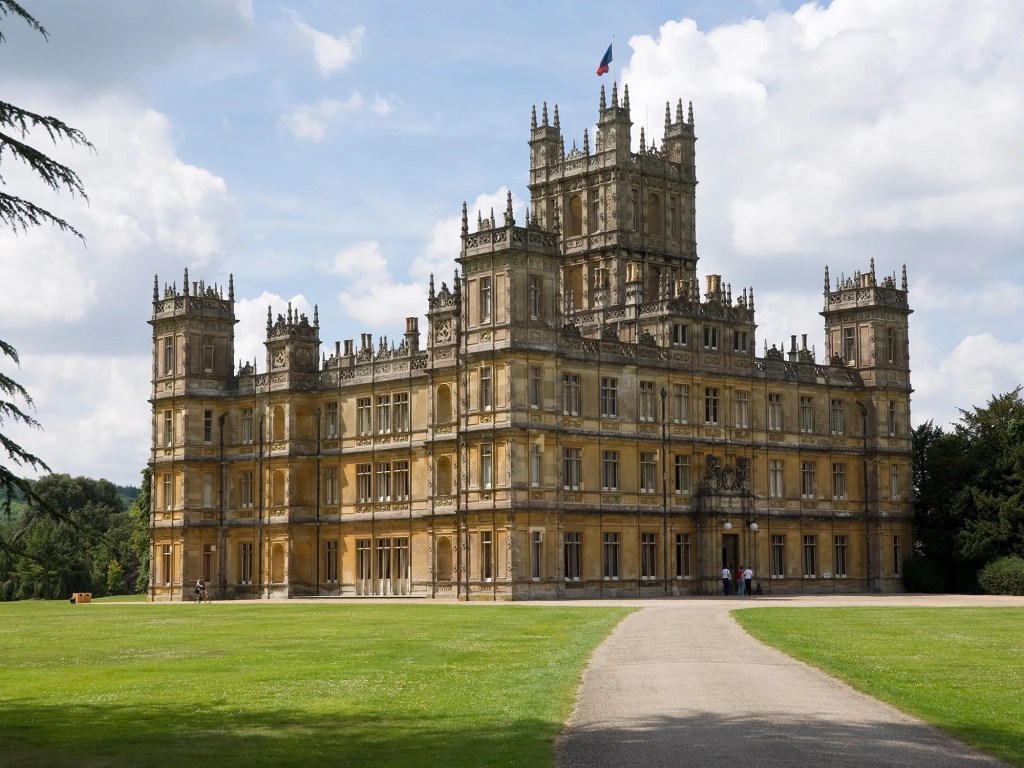
Revisiting Downton Abbey

Recently, I’ve started rewatching the Downton Abbey series from Season 1, Episode 1 to the very end. This time around, I have a bit of a different perspective because I have seen the series through all the way to the last movie, so I know how the story ends. And for those who still haven’t seen it, there are spoilers ahead (although if you still haven’t seen any episodes, it’s really not my fault, is it?)

That makes a difference. While I can commensurate with Bates and his early struggles, I’m not quite as anxious about his future. I see the daughters acting a bit spoiled, but I remember that’s not how they turn out in the end. That helps when I lowkey want to slap one or two of them upside the head.

The same applies for life. I’ve read the last pages of my Bible, so I know how it all turns out. I know that while the current struggles may seem interminable, they aren’t the last part of my story. As a very famous writer once said, your story won’t end with ashes.

For the believer in Christ, it only gets better from here. I don’t mean that all your pain and suffering instantly ceases in this life, and the rest is sunshine and roses, but we know that this life isn’t all there is. In fact, every part of what seems like forever in this world will only be light and momentary troubles compared to the eternal weight of glory that’s coming.

Another bonus for rewatching a series is anticipating some of my favorite moments from the first time around. In life, we have those moments as well, although they’re not as easy to predict. There will be fleeting glimpses of heaven on earth in this life that will only serve to make us long even more for the real heaven and the new earth.

A Narnian Excerpt

Because I’m sleepy and my brain is banana pudding, here’s an excerpt from one of my favorite books out of one of my favorite series. The book is The Horse and His Boy, and the series is The Chronicles of Narnia. Both are by C. S. Lewis, and I recommend both, whether you’ve never read them before or have read them each 100 times:

“Bree turned round at last, his face mournful as only a horse’s can be. ‘I shall go back to Calormen,’ he said.

‘What?’ said Aravis. ‘Back to slavery!’

‘Yes,’ said Bree. ‘Slavery is all I’m fit for. How can I ever show my face among the free Horses of Narnia?—I who left a mare and a girl and a boy to be eaten by lions while I galloped all I could to save my own wretched skin!’

“We all ran as hard as we could,” said Hwin.

‘Shasta didn’t!’ snorted Bree. ‘At least he ran in the right direction: ran back. And that is what shames me most of all. I, who called myself a war horse and boasted of a hundred fights, to be beaten by a little human boy—a child, a mere foal, who had never held a sword nor had any good nurture or example in his life!’

‘I know,’ said Aravis. ‘I felt just the same. Shasta was marvelous. I’m just as bad as you, Bree. I’ve been snubbing him and looking down on him ever since you met us and now he turns out to be the best of us all. . . .’

‘It’s all very well for you,’ said Bree. ‘You haven’t disgraced yourself. But I’ve lost everything.’

‘My good Horse,’ said the Hermit, who had approached them unnoticed because his bare feet made so little noise on that sweet, dewy grass. ‘My good Horse, you’ve lost nothing but your self-conceit. No, no, cousin. Don’t put back your ears and shake your mane at me. If you are really so humbled as you sounded a minute ago, you must learn to listen to sense. You’re not quite the great Horse you had come to think, from living among poor dumb horses. Of course you were braver and cleverer than them. You could hardly help being that. It doesn’t follow that you’ll be anyone very special in Narnia. But as long as you know you’re nobody very special, you’ll be a very decent sort of Horse, on the whole'” (C. S. Lewis, The Horse and His Boy).

Why I Love Narnia

“But between them and the foot of the sky there was something so white on the green grass that even with their eagles’ eyes they could hardly look at it. They came on and saw that it was a Lamb.

‘Come and have breakfast,’ said the Lamb in its sweet milky voice.

Then they noticed for the first time that there was a fire lit on the grass and fish roasting on it. They sat down and ate the fish, hungry now for the first time for many days. And it was the most delicious food they had ever tasted.

‘Please, Lamb,’ said Lucy, ‘is this the way to Aslan’s country?’

‘Not for you,’ said the Lamb. ‘For you the door into Aslan’s country is from your own world.’

‘What’ said Edmund. ‘Is there a way into Aslan’s country from our world too?’

“There is a way into my country from all the worlds,” said the Lamb; but as he spoke, his snowy white flushed into tawny gold and his size changed and he was Aslan himself, towering above them and scattering light from his mane.

‘Oh, Aslan,’ said Lucy. ‘Will you tell us how to get into your country from our world?’

‘I shall be telling you all the time,’ said Aslan. ‘But I will not tell you how long or short the way will be; only that it lies across a river. But do not fear that, for I am the great Bridge Builder. And now come; I will open the door in the sky and send you to your own land'” (C. S. Lewis, The Voyage of the Dawn Treader).

I know Narnia isn’t a real place. I also know Narnia represents and stands for so many things that are real. Narnia was Lewis’ way of writing a series of good children’s books, which he thought meant that any adult should be able to pick one up and enjoy it as well as any child. It just so happens that the stories ended up revolving around a Christ-like main figure named Aslan.

I think what I love about the Narnia series is that you see practical truths and lessons taught in a way where real people interact within a fantastical setting with real problems and find ways to solve them that work just as well in the real world. That’s why I also loved the Harry Potter series because it used magic as a metaphor for the challenges of growing from childhood to adulthood.

I still sometimes wish Narnia was real and there was a place where animals could talk. It would be so nice to be able to visit from time to time and come back to this reality with no time having passed. That sounds ideal to me.

But if you don’t know about Narnia, I can’t recommend those books highly enough. The best place to start is with The Magician’s Nephew, the book that starts the series with the creation of Narnia. They may have been written for kids but they’re good for kids of all ages — from 6 to 106. They’re that good.

Hangin’ with The Magician’s Nephew

SONY DSC

Some people like to spend their annual vacation in Panama City or Savannah or Gatlinburg. I myself like to visit Narnia on a yearly basis. So it’s that time again when I pick up The Magician’s Nephew and commence on re-reading The Chronicles of Narnia.

Back in the day, the series started with The Lion, The Witch, and The Wardrobe and went in the order in which C. S. Lewis wrote them. Now, the series starts with The Magician’s Nephew, which involves the creation of Narnia, and progresses chronologically in terms of the story line rather than in the order in which the books were published. Is that clear as mud?

Either way, they’re great books. They always encourage me and reaffirm my faith without being overly preachy. Even those who don’t care much for Christianity can read these books and find much to like. Or so I would imagine.

I highly recommend these books to anyone who likes allegorical fiction (even though these books aren’t really allegories in the strictest sense) or just good literature. They were written for children but anyone who is young at heart will love them.

I will keep you updated as I move through the seven books in the series.


Looking for New Good Reads

I have confessed before that I am a huge fan of both The Chronicles of Narnia and The Lord of the Rings series, both of which I read on an annual basis. I also read The Space Trilogy, another set of gems by C. S. Lewis.

I’m always on the lookout for more good reads along these lines. I really liked the Harry Potter series, as well as the Twilight series. I’ve also read my fair share of George MacDonald’s fantasy novels. Madeleine L’Engle is another recent discovery for me.

What do you recommend that I read next (after The Hobbit and The Lord of the Rings)? I prefer series, but I can also read standalone novels, too.

On a totally unrelated note, I really do love the new TV series Revolution. It reminds me quite a bit of Lost, because there’s so much mystery about it and so much that is not what it seems. I highly recommend it.

This blog comes to you from Edisto Beach, South Carolina, where I am currently on vacation with the family. There will probably be blogs to come about Charleston and other related South Carolinian shenanigans to follow. Keep your ears pinned to the ground and your eyes open. Maybe not at the same time.

Until next time, stay trusting in God and believing that anything is possible.