Why I Love Narnia

“But between them and the foot of the sky there was something so white on the green grass that even with their eagles’ eyes they could hardly look at it. They came on and saw that it was a Lamb.

‘Come and have breakfast,’ said the Lamb in its sweet milky voice.

Then they noticed for the first time that there was a fire lit on the grass and fish roasting on it. They sat down and ate the fish, hungry now for the first time for many days. And it was the most delicious food they had ever tasted.

‘Please, Lamb,’ said Lucy, ‘is this the way to Aslan’s country?’

‘Not for you,’ said the Lamb. ‘For you the door into Aslan’s country is from your own world.’

‘What’ said Edmund. ‘Is there a way into Aslan’s country from our world too?’

“There is a way into my country from all the worlds,” said the Lamb; but as he spoke, his snowy white flushed into tawny gold and his size changed and he was Aslan himself, towering above them and scattering light from his mane.

‘Oh, Aslan,’ said Lucy. ‘Will you tell us how to get into your country from our world?’

‘I shall be telling you all the time,’ said Aslan. ‘But I will not tell you how long or short the way will be; only that it lies across a river. But do not fear that, for I am the great Bridge Builder. And now come; I will open the door in the sky and send you to your own land'” (C. S. Lewis, The Voyage of the Dawn Treader).

I know Narnia isn’t a real place. I also know Narnia represents and stands for so many things that are real. Narnia was Lewis’ way of writing a series of good children’s books, which he thought meant that any adult should be able to pick one up and enjoy it as well as any child. It just so happens that the stories ended up revolving around a Christ-like main figure named Aslan.

I think what I love about the Narnia series is that you see practical truths and lessons taught in a way where real people interact within a fantastical setting with real problems and find ways to solve them that work just as well in the real world. That’s why I also loved the Harry Potter series because it used magic as a metaphor for the challenges of growing from childhood to adulthood.

I still sometimes wish Narnia was real and there was a place where animals could talk. It would be so nice to be able to visit from time to time and come back to this reality with no time having passed. That sounds ideal to me.

But if you don’t know about Narnia, I can’t recommend those books highly enough. The best place to start is with The Magician’s Nephew, the book that starts the series with the creation of Narnia. They may have been written for kids but they’re good for kids of all ages — from 6 to 106. They’re that good.

Always More

“When a servant comes in from plowing or taking care of sheep, does his master say, ‘Come in and eat with me’? No, he says, ‘Prepare my meal, put on your apron, and serve me while I eat. Then you can eat later.’ And does the master thank the servant for doing what he was told to do? Of course not.10 In the same way, when you obey me you should say, ‘We are unworthy servants who have simply done our duty’” (Luke 17:7-10, NLT).

That’s the secret to obedience and serving. There’s always more. You never get to the place where you’re done. It seems like one task leads to another, usually harder. But you find that if you remain faithful and available, God will equip you and empower you to fulfill the duty and the calling.

We forget sometimes that half the joy is in the journey. It’s not so much finishing what God calls us to do that energizes us and motivates us — we’re never really finished until God calls each of us home — but the process where we find we can do more than we thought and we find that God is bigger and stronger than we thought.

Obedience doesn’t lead to joy. For the one who serves not out of obligation but out of the overflow of God’s love in his or her heart, obedience is joy. We realize that serving God isn’t a “have to” as much as it is a “get to.” We get to participate in what God is doing, and we know that what God does always succeeds and has a good outcome. We can rest assured that our labors for God are never in vain.

Even the small stuff matters to God. Me showing up to serve in the parking lot at my church or someone else serving in the nursery is just as vital in the eyes of God as the pastor preaching the sermon or the worship leader calling us to worship. Every single act of obedience is a win for the kingdom and a blessing not only for the receivers but also for the person who obeys.

The harder the task, the more of God you get to do the job. The more your faith grows when you see it through. The more you want to serve God no matter what it looks like or how dirty you get. The more other people see it and want to know about this God that is worth our obedience.

More Pouring Out

“‘The water that I shall give him will become in him a fountain of water springing up into everlasting life.’ –John 4:14′

We are to be fountains through which Jesus can flow as ‘rivers of living water’ in blessing to everyone. Yet some of us are like the Dead Sea, always receiving but never giving. Whenever the blessings are not being poured out in the same measure they are received, there is a defect in our relationship with Him. Stay at the Source, closely guarding your faith in Jesus Christ and your relationship to Him, and there will be a steady flow into the lives of others with no dryness or deadness whatsoever” (Oswald Chambers, My Utmost for His Highest).

That’s the difference. The Dead Sea always takes but never gives. The result? No life, no benefit to anybody. Rivers give as continually as they take, and they are a constant source of life and blessing. We are blessed not in order to hoard but in order to give back. That way, our hands are always ready to receive more.

That’s the problem with most Christians in America. They sit and learn so much information but never put it into practice. They never take what they learn and pass it on to others. They consume but they never serve. All they do is take up a spot in a pew or a chair. But that’s not the Bible’s idea of being in a family of believers called a church.

The blessing comes to those who find a way to give back. The ones who only sit and absorb will inevitably find reasons to complain about how this or that isn’t done right or how they used to do it a different way. Those who are serving simply don’t have time for complaining. They’re too busy making a difference.

Mountains of Spices

“In acceptance lieth peace,
O my heart be still;
Let thy restless worries cease
And accept His will.
Though this test be not thy choice,
It is His—therefore rejoice.

In His plan there cannot be
Aught to make thee sad:
If this is His choice for thee,
Take it and be glad.
Make from it some lovely thing
To the glory of thy King.

Cease from sighs and murmuring,
Sing His loving grace,
This thing means thy furthering
To a wealthy place.
From thy fears He’ll give release,
In acceptance lieth peace” (Hannah Hurnard, Mountains of Spices).

For the unfamiliar, Hannah Hurnard was a missionary to what is now the state of Israel. She also did a bit of writing, including two allegorical novels that reference the Song of Solomon as well as the fruit of the Spirit and other biblical references. They’re both great.

In the first one, Hinds’ Feet on High Places, the story is the journey of Much Afraid and her journey to the Kingdom of Love in the High Places. The second is how she went back to try to reach some of her relatives with the same love she had received.

One phrase I took with me was acceptance with joy. That’s the key. To accept the good and the bad, not begrudgingly but with joy, is the secret to peace in the midst of turmoil. That does NOT mean that we celebrate tragedy or calamity but that we see God working even the worst into something good. We know that God uses pain and suffering as the means to make us more like the Good Shepherd and give us compassion for others who are hurting so that they can know the same love we have found.

There’s a kind of wisdom that only comes from trials and tempests. The wisest people are often the ones who have seen the most loss and grief and pain, yet have chosen joy and acceptance over bitterness and cynicism. These people are the ones who can save you from a lot of heartache if you will only listen to their hard-won advice.

Lord, make us Your servants who share the name Acceptance with Joy. Help us to see the joy that lies beyond the sorrow and the hope that lies beyond grief. Help us keep our eyes fixed firmly on You, the only author and perfecter of our faith. Amen.

Weak, Stretched Thin, and Out of Your Depth

“Hey Soul? Yeah, I hear you — there’s times you feel stretched way too thin, in way over your head. 
So every time you feel that stress rising today, just take a moment & take a deep breath —- and just be. Just Be Still — and know & feel & trust how He is God. 
Being weak makes you a cup for God’s power. 
Being stretched thin, makes you a canvas for God’s glory.
Being out of your depths, makes you touch the depths of the love of God. 
#Exhale #BeStill #GodHasGotThis#PreachingGospeltoMyself” (Ann Voskamp).

I know what it feels like to be stretched thin and out of my depth. I know back in the day, I probably would have panicked big-time and not done very well with it. Now, I still get anxious, but I’m learning how to work through worry instead of being consumed by it.

I love the analogy of an archer pulling back on the bow to shoot an arrow. He pulls and pulls as the bow thinks it can not possibly be stretched any further, yet still he stretches more and more. Finally, he sets his sights on the target and lets loose.

God is stretching you and me for a future and a target that only He can see right now. At the moment, the stretching may feel unbearable and you’d rather have it over. It’s tempting to want to take a shortcut to get out of being that uncomfortable. But staying in it rather than bolting is worth it. You have the satisfaction of knowing God will honor your obedience and you can see with eyes of faith that the end will make any hardships seem light and momentary.

Being weak and out of your depth is a place God often calls His children. That’s where God loves to show up. It’s the kind of testimony that is the best, because no human explanation will do. It’s a life that can only be explained in terms of God. We make God famous most of all by being faithful when it would be easier to quit.

Turning the Wine Back into Water

“Next to the Blessed Sacrament itself, your neighbor is the holiest object presented to your senses (C. S. Lewis, The Weight of Glory).

I’m guilty all the time of looking at people like they’re ordinary. I think that’s the default setting for the human race. We rarely if ever see anyone and see the image of God in him or her. We just don’t take the time to see beyond the surface labels of pretty, plain, fat, skinny, tall, short, etc.

I wonder what would happen if we could see people the way Jesus saw people. He didn’t see a stereotype or a caricature. Every time, He saw a unique individual with a story like no one else’s. He created each person with a one-of-a-kind purpose and plan that no one and nothing else can do.

He looked at you and me and thought we were worth dying for. Even at our worst moment in those times we wish we could take back or do over, Jesus still chose to go to the cross and lay down His life for us. While we were still sinners, the Bible says, Christ died for us.

I’ve been guilty of prejudging people before I’ve even had the chance to get to know them. Sometimes, I see the way they interact with others or maybe the expression on their faces. I’m sure I’m not the only one, but I’m also sure glad that Jesus didn’t judge me like that. He saw the absolute worst version of me and still loved me.

I wonder what would happen if we loved people like that. Maybe we wouldn’t have to hunt high and low for gospel conversations and opportunities to share our faith. Maybe people would seek us out and want to know more about this Jesus they see in us, even if they can’t put a name to what they see.

The Last Week

Today is Palm Sunday and marks the beginning of the last week of Jesus’ earthly ministry, the week leading up to Good Friday and Easter Sunday. I’ve been here before, but I feel like so many times I’ve rushed to get through it to what’s next.

This time, I want to slow down a bit and sit under the cross. I want to be still long enough to hear God speak a word over me about what this week means for me and for all those who call on the Messiah out of a genuine faith. I want to be moved to tears and fully take in the price that Jesus paid for me.

I finished an incredible devotional by one of my favorite writers, Charles Martin. It’s called It Is Finished and spends 40 days walking the path that led from Palm Sunday to Easter Sunday, sparing no details and leaving no stone unturned. It was one of the best books I’ve read in a long time, and I hope to read it again some day.

I want Easter to mean more than the Easter Bunny or Cadbury chocolate eggs (though I am very much a fan of both). I don’t want to look at the date on the calendar and miss the point of the day — Jesus who knew no sin became sin for me that I might become the righteousness of God in Christ.

I don’t want to be the same person in seven days as the person who is now writing these words. I want to be more like Jesus, more aware of the sacrifice He made, and more willing to count the cost and take up my own cross. I want to be more of a disciple and less of an admirer. I want to be more of a follower and less of a fan. I want to be a truly biblical Christian and not a watered-down, American Christian.

I’m thankful that God is far more patient with me than I am with Him and takes far more time with me than I ever have with Him. At this point, I say, “Lord, do whatever it takes to make me Yours, Your disciple, Your own. Have Your way in me. Amen.”

The Joy of the Hunt

I love a good afternoon spent thumbing through stack of vinyl. There’s just something about the joy of the unexpected, never knowing what you’ll find. Of course, I love finding those rare, hard to find, collectible records. But for me, finding LPs that take me back to my childhood are just as valuable.

I call my record player a turntable time machine, because music is the closest to being able actually to travel back in time to the year the album was created. So many dormant memories can reawaken upon the dropping of the record needle and the first notes of the first song on the first side.

If you didn’t grow up in the 70s, you may not be aware of a band called Candle that did a lot of Christian music for kids. The one I know best and love most is Music Machine, a sort of musical adventure through the fruits of the Holy Spirit. It’s good music for kids because it’s music that anyone can listen to, young or old.

Music that’s meant for only kids, just like books and television shows or anything else, usually aren’t good books. I think C. S. Lewis said that. I should be able to revisit a childhood favorite and still be engaged by it if it’s any good.

But for me, the best treasures are often the ones I find in the bargain bins or sometimes even in the free bins. So much of my collection is definitely in the $10 and under category. I think that’s because what determines value most isn’t always money. The price tag doesn’t automatically equate to worth or importance. And that goes for so many other things outside of music and records.

So the hunt will continue for me for a while. I hope you will share your own unique and interesting finds by posting in the comments. Happy listening!

Learning Something New Every Day

“In the beginning, the Word existed; and the Word was face to face with God; yea, the Word was God Himself. He is the One who was face to face with God in the beginning. It was through Him that everything came into existence, and apart from Him not a single thing came into existence. It was by Him that life began to exist, and that life was the light of mankind. So the light continues to shine in the darkness, for the darkness has never overpowered it” (John 1:1-5, Williams Translation).

A number of years ago, I picked up a copy of the New Testament: A Private Translation in the Language of the People by Charles B. Williams (not to be confused with the Charles Williams who was a member of the Inklings with C. S. Lewis and J. R. R. Tolkien). I loved the way it expressed the opening verses of the gospel of John.

Today, I learned that Williams taught at Union University as Professor of Greek and Ethics from 1925 to 1939. He was a part of the faculty at Union when he embarked on his translation of the New Testament. His goal was to make the Bible accessible to the average layman who might have had difficulty understanding the King James that was the only English translation available at the time (as far as I can tell).

I found all this out when I was trying to Google the first chapter of John. I had no success in finding those verses in the Williams translation, but I found a whole biography about the man and his work. You really do learn something new every day if you have an open and inquiring mind that never stops learning.

I love finding different translations of the Bible that bring out nuances to the text that traditional translations often overlook or miss. While I think it’s perfectly acceptable and probably preferred to have a go-to version of the Bible to use predominantly, it’s often helpful to read a passage out of several different translations to get all the meaning of the original Hebrew or Greek.

Sorry, that was me geeking on on you a bit. But I do think that God’s Word deserves more than a cursory glance once a day. I have been guilty of speed reading a chapter or two just to check off a box and later not remembering what I had just read. God speaks through His word when we allow it to penetrate our hearts and minds. It’s very beneficial to memorize it (which is something I need to work on going forward).

That’s the key. Never stop learning and growing. Never stop going deeper into God’s Word. Never stop seeking the voice of God every single day for as long as you live or until He returns.

Focus

I’m thankful every year for my social media break during Lent. I do like my Facebook and Instagram, but I also confess I get very tired of people being preachy on just about all of their posts. And by preachy, I don’t mean the kind where you offer the plan of salvation but the kind where you point out the faults of all these other people who just about always happen to be on the other side of the political spectrum.

These days, I see a lot of posts (even from people who profess to follow Jesus) about Karma. Usually, Karma is when other people get what they deserve, not me. Typically, these people will offer themselves more grace and wish karma for the others. I confess that I’ve been guilty of a double standard at times for me messing up versus someone else messing up.

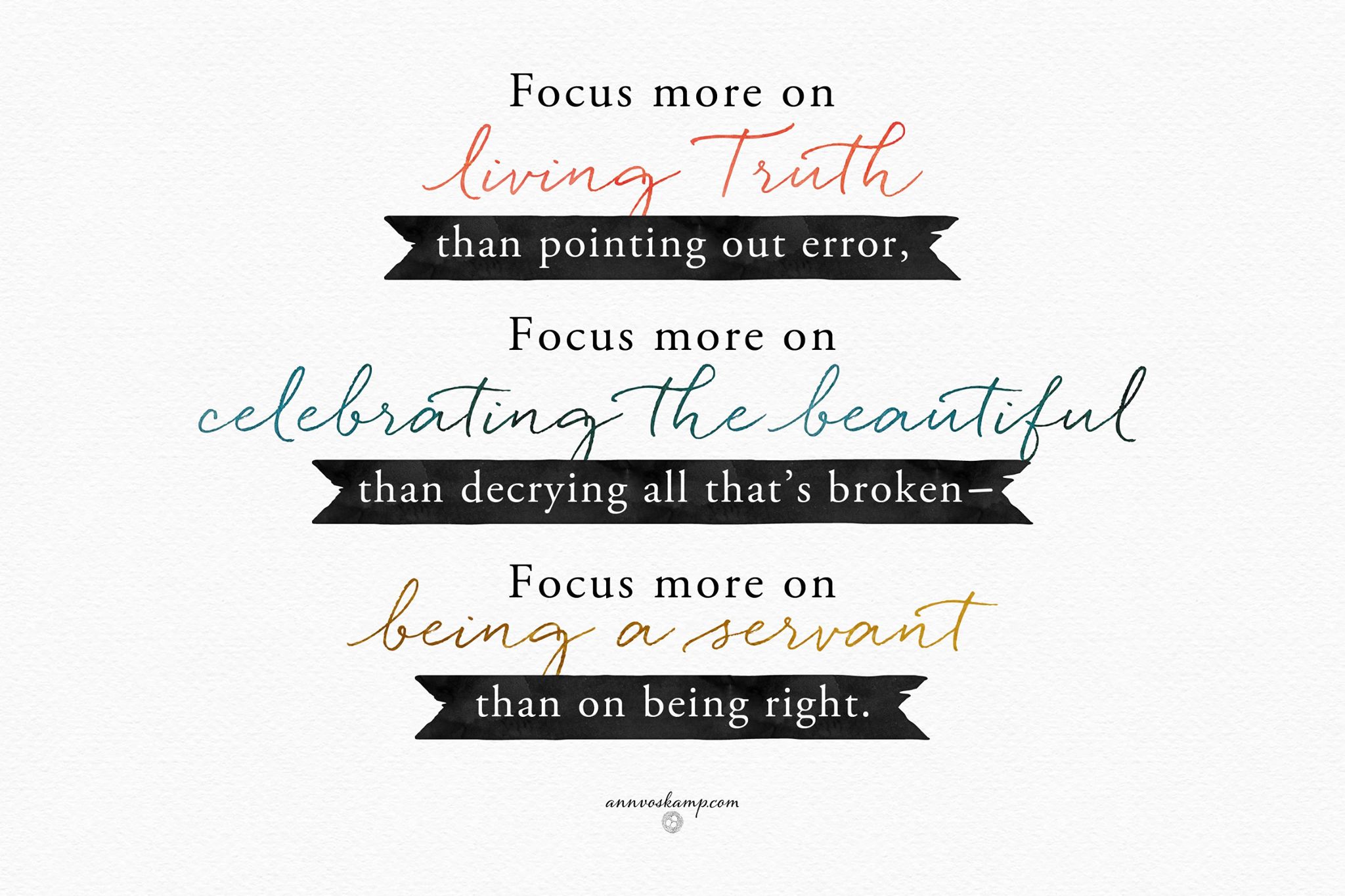
But if you’re living truth, you probably won’t have enough time to point out everyone else’s errors. If you look for ways to celebrate the beautiful, you won’t dwell on the broken. And if you focus on being a servant, you won’t need to win every argument and always be proven right.

If you and I are honest, we need a lot of work. We need a lot of grace. We’re too messed up to judge anyone else being messed up. We’re too spiritually broken to be all high and mighty when it comes to calling out other people’s motives and character. Instead of moralizing, we need to preach the gospel to ourselves and to others every single day.

“f you asked twenty good men today what they thought the highest of the virtues, nineteen of them would reply, Unselfishness.  But if you had asked almost any of the great Christians of old, he would have replied, Love.  You see what has happened?  A negative term has been substituted for a positive, and this is of more than philological importance.  The negative idea of Unselfishness carries with it the suggestion not primarily of securing good things for others, but of going without them ourselves, as if our abstinence and not their happiness was the important point.  I do not thik this is the Christian virtue of Love.  The New Testament has lots to say about self-denial, but not about self-denial as an end in itself.  We are told to deny ourselves and to take up our crosses in order that we may follow Christ; and nearly every description of what we shall ultimately find if we do so contains an appeal to desire.  If there lurks in most modern minds the notion that to desire our own good and earnestly to hope for the enjoyment of it is a bad thing, I submit that this notion has crept in from Kant and the Stoics and is no part of the Christian faith.  Indeed, if we consider the unblushing promises of reward and the staggering nature of the rewards promised in the Gospels, it would seem that Our Lord finds our desires not too strong, but too weak.  We are half-hearted creatures, fooling about with drink and sex and ambition when infinite joy is offered us, like an ignorant child who wants to go on making mud pies in a slum because he cannot imagine what is meant by an offer of a holiday at the sea.  We are far too easily pleased” (C. S. Lewis, The Weight of Glory).