Memorial Day

For some reason, Memorial Day always sneaks up on me. It’s not like other holidays where I’m counting down the days weeks and months in advance. Even on Memorial Day weekend, I feel like I should be prepped and ready to go to work on Monday.

Lately, Memorial Day has become a kind of National Cookout Day. While I do enjoy a good BBQ as much as the next guy, that’s not really the purpose. It’s about honoring all those who have laid down their lives in service to this country.

As I learned, the difference between Memorial Day and Veterans Day is that Memorial Day is for all the military members who have passed away either from being killed in the line of duty or who passed away after service. Veterans Day honors all military veterans living or dead.

It’s easy to take for granted the freedoms we have in the United States. It’s equally easy to forget that that freedom was bought with a price. Men and women have made the ultimate sacrifice for us to be able to vote, to participate in the governing process, to speak our minds freely, and to live our lives as we choose.

I remember something about sometimes what we take for granted can be taken from us. When we fail to appreciate the cost of our freedom, it becomes easy to discard or to let slip away through carelessness. But to lose our freedom would be dishonoring and disrespectful to those who died fighting for us.

I’m praying tomorrow that we can all remember those veterans at some point tomorrow. In the midst of all the partying and picnicking, may we all take a moment to pause and reflect and give thanks for those who died so that we could live in freedom.

What We Think About God

“What comes into our minds when we think about God is the most important thing about us. Worship is pure or base as the worshiper entertains high or low thoughts of God. For this reason the gravest question before the Church is always God Himself, and the most portentous fact about any man is not what he at a given time may say or do, but what he in his deep heart conceives God to be like” (A W Tozer).

Most people have the idea that God is like us — only bigger, stronger, faster, smarter, etc. He’s like the advanced, idealized version of us. But He’s not.

A lot of us have probably fallen into the trap of thinking that God would never do or say something because we would never do or say that. That’s a dangerous theology that puts me as the standard by which God must abide instead of the other way around.

God is not me on steroids. God is not like me. God is completely other. Apart from God’s divine initiative in revealing Himself to us, we could never ever in a million lifetimes know Him. But He revealed Himself generally through creation and specifically through Jesus. One famous author and theologian once said that Jesus was God spelling Himself out in a language humanity could understand.

All this talk about how religion is bad and we just need to follow Jesus is true to a degree. It depends on how you define the word religion. If it’s a set of rules that you need to follow to get to God, then it’s bad. But if it’s a way of understanding God, then it’s a good thing.

Believing in God is essential, but what you believe about God is vital. If you sincerely believe wrong things about God that don’t line up with the God of the Bible, then you’re sincerely wrong. You’ve chosen to follow a god of your own devising instead of the God of Abraham, Isaac and Jacob.

Who we are depends a lot on what we believe about God as much as if we believe in God. How we view God says a lot about how we view ourselves and others.

“I want neither a terrorist spirituality that keeps me in a perpetual state of fright about being in right relationship with my heavenly Father nor a sappy spirituality that portrays God as such a benign teddy bear that there is no aberrant behavior or desire of mine that he will not condone. I want a relationship with the Abba of Jesus, who is infinitely compassionate with my brokenness and at the same time an awesome, incomprehensible, and unwieldy Mystery” (Brennan Manning).

Life Is a Fairy Tale

I suppose whether you agree with this or not depends on your definition of what makes a fairy tale. Is it void of any true hardship or suffering? Then that’s not a true fairy tale. Does it need fantastical creatures? That’s debatable, but I think not.

What a fairy tale needs is a happy ending. You know going in that the main character is going to live happily ever after.

If you look at life strictly from this side of heaven, then it’s not a fairy tale. There’s so much suffering and evil that goes unresolved and unpunished. There are so many wrongs that never get put right.

But if you look through the lens of the resurrection, then you see the fairy tale. In fact, you could see the whole Bible story as a sort of true fairy tale where the King comes to rescue His beloved from imminent danger.

It all depends on perspective. If you see your life through the eyes of faith, you know that the happy ending is coming, even if you might not see it this side of eternity. But it is coming.

“It is a world of magic and mystery, of deep darkness and flickering starlight. It is a world where terrible things happen and wonderful things too. It is a world where goodness is pitted against evil, love against hate, order against chaos, in a great struggle where often it is hard to be sure who belongs to which side because appearances are endlessly deceptive. Yet for all its confusion and wildness, it is a world where the battle goes ultimately to the good, who live happily ever after, and where in the long run everybody, good and evil alike, becomes known by his true name….That is the fairy tale of the Gospel with, of course, one crucial difference from all other fairy tales, which is that the claim made for it is that it is true, that it not only happened once upon a time but has kept on happening ever since and is happening still”(Frederick Buechner, Telling the Truth: The Gospel as Tragedy, Comedy, and Fairy Tale).

In A Little While

“We are living in this ‘little while.’ We can live in it creatively when we live it out of solitude, that is, detached from the results of our work. And when we live it with care, that is, crying with those who weep and wail. But it is the expectation of his return which molds our solitude and care into a preparation for the day of great joy.

This is what we express when we take bread and wine in thanksgiving. We do not eat bread to still our hunger or drink wine to quench our thirst. We just eat a little bit of bread and drink a little bit of wine, in the realization that God’s presence is the presence of the One who came, but is still to come; who touched our hearts, but has not yet taken all our sadness away.

And so when we share some bread and wine together, we do this not as people who have arrived, but as men and women who can support each other in patient expectation until we see him again. And then our hearts will be full of joy, a joy that no one can take away from us” (Henri Nouwen, Out of Solitude).

“In a little while,
We’ll be with the father;
Cant you see him smile?
In a little while,
We’ll be home forever,
In a while
We’re just here to learn to love him
Well be home in just a little while” (Amy Grant / Brown Bannister / Gary Chapman / Shane Keister).

Yes, I’m thankful that in a little while all the hard and bad stuff will be over and only what’s good and true will remain. In a little while, our faith will be made sight and we’ll be reunited with all those we’ve loved and lost. In a little while, Jesus will come back and take us to our forever home.

Knowing God

“We know God but as men born blind know the fire: they know that there is such as thing as fire, for they feel it warm them, but what it is they know not. So, that there is a God we know, but what He is we know little, and indeed we can never search Him out to perfection; a finite creature can never fully comprehend that which is infinite” (Thomas Manton).

As I grow older, I become increasingly thankful that God has made Himself known. I realize more and more that apart from that revelation, I could never hope to know about God, much less know Him.

Romans 1 says that there is enough evidence in nature to prove there is a God. Romans 1 also says that because of sin, our minds are corrupted to the point where we can’t seek after God unless He seeks after us first. Until God shines a light on our hearts, we remain in the dark.

I love the idea that in heaven, we will never fully exhaust all there is to know about God. That’s what will keep our worship from becoming dull (plus having the experience of being in the presence of the living God).

Every time we worship God in heaven, He reveals another aspect of His character. Because God is infinite, there is no end to the joy of learning new things about God. After each time, our worship grows deeper and fuller and richer.

Here on earth, we’re still learning as well. Often because of the old sin nature that’s still within us, we have to unlearn some bad thinking about God in order to be able to fully grasp who He is. But God never tires of us or grows impatient with us or decides that we aren’t worth the effort anymore.

That should make Sunday worship a little sweeter. That hopefully will help you to sing a little louder and live a little bolder as you and I draw closer and closer to our faith one day being made sight.

Wimpy Faith

This is from Foxe’s Book of Martyrs:

“When sentence was read condemning [Mrs. Prest] to the flames, she lifted up her voice and praised God, adding, ‘This day have I found that which I have long sought.’ When they tempted her to recant, ‘That will I not (said she), God forbid that I should lose the life eternal, for this carnal and short life. I will never turn from my heavenly husband to my earthly husband; from the fellowship of angels to mortal children; and if my husband and children be faithful, then I am theirs. God is my father, God is my mother, God is my sister, my brother, my kinsman; God is my friend, most faithful.'”

I read something like that and my faith feels kinda wimpy. I don’t face anywhere near that kind of persecution. Compared to most believers around the world, my life is easy. Yet I can complain with the best of them.

I do believe there is a supernatural grace given to those undergoing extreme persecution. There’s an endowed strength given to those who are about to lay down their lives for the sake of the gospel. But I also believe one of the reasons the early church was so true and faithful was because they were the outsiders and the marginalized. They were the ones cast out and trodden down.

I definitely am not praying for persecution to come to America, but I think it’s inevitable. Persecution is the norm. America is the exception. Maybe that’s why we so often have such a watered-down gospel and diluted faith.

I recommend Foxe’s Book of Martyrs (preferably one with updated language). It’s hard to read sometimes, but also can be very encouraging to see those who endured torture and death because they like Jesus saw the joy that was laid out in front of them. May we be as faithful.

The Great Paradox

“The great paradox of life is that those who lose their lives will gain them. This paradox becomes visible in very ordinary situations. If we cling to our friends, we may lose them, but when we are nonpossessive in our relationships, we will make many friends. When fame is what we seek and desire, it often vanishes as soon as we acquire it, but when we have no need to be known, we might be remembered long after our deaths. When we want to be in the center, we easily end up on the margins, but when we are free enough to be wherever we must be, we find ourselves often in the center.

Giving away our lives for others is the greatest of all human arts. This will gain us our lives” (Henri Nouwen).

“If you refuse to take up your cross and follow Me on the narrow road, then you are not worthy of Me. To find your life, you must lose your life—and whoever loses his life for My sake will find it” (Matthew 10:38-39, The Voice).

That’s the paradox. You find your life by losing it. You gain love by giving it away. People notice you when you deflect the praise to the King of the universe instead of yourself. You’re blessed when you’re poor in spirit, meek, mourning, and pure in heart.

Instead of following the world’s path to success, Jesus went down the road of downward mobility. He gave up clinging to His rights of equality with God. He took on human form. He took the form of a servant. He was obedient to the point of death. His death was that of a common criminal’s crucifixion. Then God gave Him a name that is above every other name.

That’s our goal. To be unknown on earth but famous in heaven. Heavenly fame looks like faithfulness. Heavenly fame looks like denying yourself, taking up your cross daily, and following Jesus, no matter the cost.

That’s where you find your life. That’s where you find life.

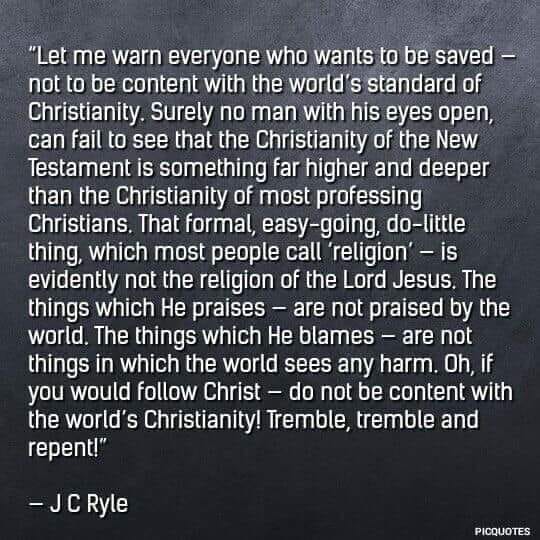
Tremble, Tremble and Repent

This isn’t supposed to be a brimstone and hellfire type post (although sometimes I do think we need to bring back preaching that isn’t afraid to step on a few toes while proclaiming the whole gospel for the whole person).

I do think that American Christianity has progressed to the point where it barely resembles New Testament Christianity. People can come to most churches and feel comfortable living in sin and not once feel convicted about their lifestyle choices and behaviors. There is very little accountability and next to no discipline at any given local church.

Yes, Jesus did say to the woman caught in adultery that He didn’t condemn her, but He also added “Go and sin no more.”

I think the American church needs to champion social justice AND personal holiness. It’s not an either/or, but a both/and. Read Isaiah 58 if you want to know what biblical social justice looks like, but also read Romans 12:1-2 (and many other passages) that compel us to be holy and set apart.

There’s a lot of emphasis on getting people saved, but not much on discipling them afterward. The result is that many people sitting in any given church service on Sunday know very little about the Bible or the faith they’ve professed to believe. Very few actually know how to live out that faith and apply it to every day situations.

I do think that the American church needs revival. Not the kind where people get saved (although that would be awesome) as much as the kind where the people who are saved start acting and living like it. Including yours truly.

It starts and ends with the Bible. It’s about preaching the gospel to yourself all day every day. It’s about falling at the feet of Jesus and declaring your dependence on Him once again. It’s about living a Romans 12:1-2 life of sacrificial worship that is radically different than the world. It’s about loving God and loving others the way God in Jesus has loved us.

The Sweetest Lesson

“Spread out your petition before God, and then say, ‘Thy will, not mine, be done.’ The sweetest lesson I have learned in God’s school is to let the Lord choose for me” (Dwight L Moody).

I love the imagery of spreading out my petition before God. It comes from 2 Kings 19 where King Hezekiah receives a threatening letter from the Assyrians who are poised to invade the land. Instead of rushing into rash action, Hezekiah takes it before the Lord, literally spreading it out as a kind of offering of submission.

I also think of King Jehoshaphat who faced another massive army, but responded with the prayer, “We do not know what to do, but our eyes are on you” (2 Chronicles 20:12, ESV).

In short, they both chose to let God fight for them. They decided to let God choose for them.

In my lifetime, I have had several instances where I chose for myself and it did not go well. I was like the greedy man who took the wrong grail cup in the Indiana Jones movie only to hear the words “You have chosen . . . poorly” and basically shrivel up and die.

But every time I have been wise enough and patient enough to let God decide, I have never regretted the outcome. That’s assuming my patience lasted long enough for me actually to wait on the outcome, no matter how long it seemed to take.

Maybe it’s a good idea to literally take whatever it is that is troubling you and spread it before the Lord. It could be unpaid bills or a jury summons or some other document that gives you great anxiety. Or maybe you can spread out your hands in a posture of surrender.

Either way, you and I both need to let God choose. The old prayer still works: Thy will be done. One of my favorite fictional characters, Father Tim Cavanaugh, calls it the prayer that never fails because you truly can’t go wrong asking for God’s will over and above your own.

Thy will be done, no matter what. Thy will be done, even if it means my will is undone (with a nod to Elisabeth Elliott). Thy will be done. Period.

Of All My Posts, This Is One of Them

Not every blog post will be a winner. Sometimes, there’s just nothing to write about. Or in my case, the ol’ noggin has shut down for the night. So you get a post like this.

I do think it’s important to fill at least part of your day with something that brings you joy. While it’s important to be aware of what’s going on in the world, it should become your whole day. Make time in your day for listening to music or going for a walk or simple sitting in silence and meditating on the goodness of God.

Also, you should periodically treat yourself to foods that you really like. And by periodically, I don’t mean periodically through the day, but every week or so. You don’t want to become diabetic (or pre-diabetic like me). As with most everything else, moderation is key.

It always helps to keep the big picture in mind. Sometimes, I get caught up in the minutae and forget that what I’m worrying over and obsessing about is finite and temporary. There’s no need to waste energy over something that you probably won’t remember a year from now.

It’s also helpful to keep a mindset of prayer throughout the day. That doesn’t mean you’re constantly in prayer, but as God prompts you through various events or people or memories, keep the conversation with God open.

And at the end of the day, it’s always nice to have a furry friend to come home to. In my case, it’s a very lovable tortoiseshell feline named Peanut, but you should have a dog or cat or hamster or something that will always be glad to see you when you walk through your front door.

Oh, and be sure to cultivate a grateful spirit. That goes a long way toward making your day better when you focus on the good and not the bad.