New Year’s Day 2024

This is my favorite quote for the new year. It was written by Dietrich Bonhoeffer while he was in a concentration camp after a failed attempt to assassinate Adolf Hitler. He penned these words, knowing they might be some of his very last and that he probably would not live to see the next new year.

These words are timeless and just as needed in 2024 as they were in 1945:

“With every power for good to stay and guide me,
comforted and inspired beyond all fear,
I’ll live these days with you in thought beside me,
and pass, with you, into the coming year.

While all the powers of Good aid and attend us,
boldly we’ll face the future, be it what may.
At even, and at morn, God will befriend us,
and oh, most surely on each new year’s day

The old year still torments our hearts, unhastening:
the long days of our sorrow still endure.
Father, grant to the soul thou hast been chastening
that Thou hast promised—the healing and the cure.

Should it be ours to drain the cup of grieving
even to the dregs of pain, at thy command,
we will not falter, thankfully receiving
all that is given by thy loving hand.

But, should it be thy will once more to release us
to life’s enjoyment and its good sunshine,
that we’ve learned from sorrow shall increase us
and all our life be dedicate as thine.

To-day, let candles shed their radiant greeting:
lo, on our darkness are they not thy light,
leading us haply to our longed-for meeting?
Thou canst illumine e’en our darkest night.

When now the silence deepens for our harkening,
grant we may hear thy children’s voices raise
from all the unseen world around us darkening
their universal paean, in thy praise.

While all the powers of Good aid and attend us,
boldy we’ll face the future, be it what way.
At even, and at morn, God will befriend us,
And oh, most surely on each new year’s day!” (Dietrich Bonhoeffer).

That Third Stanza

If you’re like me and grew up in Baptist churches, you probably remember those old Baptist hymnals. You might remember that we sang a select few out of those hymnals over and over. But if you’re above a certain age, you’ll certainly remember that we always sang the first, second, and fourth stanzas of any hymn. Never the third.

Today, most of us can still remember the words to any of the old standards. But if you want to stump a Baptist, request the third stanza of any hymn. Any. Hymn. It doesn’t matter. The younger ones will resort to Google while the older ones may have to dig up an old hymnal they saved when their churches went to digital and lyrics on a screen.

But every now and then, there’s a gem hiding in the third stanza. A friend posted one such from It Came Upon a Midnight Clear, a very familiar Christmas carol. But the third stanza hit me like it was brand new — probably because it WAS brand new to me:

“O ye, beneath life’s crushing load, whose forms are bending low
Who toil along the climbing way with painful steps and slow
Look now for glad and golden hours come swiftly on the wing
O rest beside the weary road and hear the angels sing.”

I love the idea of Christmas Day as a time to rest and hear the angels singing. It may not be feasible for some, but I think we should all at least try to make room to sit and ponder the mystery of Christmas — God became a baby, born to a virgin in a barn, who grew up to be the Savior of the world.

My Idea of Nirvana on a Spring Evening

Rainy_tea_and_book

Last night, it was on the brisk side, if not chilly, and overcast. As much as I’ve grown to covet sunshine these days, I didn’t mind too much. I had a picture come to mind of what I’d like to be doing at that moment. It’s not the most exciting or thrilling of possibilities, but it works for me.

I’d be at a local coffee shop, sipping on some organic tea (or maybe some kind of chai or an exotic latte if the mood strikes). I’d have a good book in hand, maybe a British murder-mystery or a book of poetry, and there’d be some mellow folksy music playing in the background (think Joni Mitchell, Peter Bradley Adams, or Carole King-type tunes). Or maybe some old-school jazz in the tradition of Miles Davis, Red Garland, or Wes Montgomery.

That would be my idea of peace and tranquility and a good time. Not watching a 24-hour news channel ad nauseum. Don’t get me wrong. If you watch Fox News or CNN non-stop, then go for it. I just get tired of talking heads talking about the same things for hours upon hours without variation. The same goes for most talk radio I’ve experienced in my life. Fiction, especially of the fantasy kind, is infinitely more interesting to me. I like my television to be as non-realistic as possible.

I like my Starbucks like the rest, but I’m thinking this needs to be a more local-type place, like Eighth and Roast or Edgehill Cafe. Actually, now that I think about it, sitting outside the Edgehill Cafe with my tea and my book and occasionally glancing up to watch the people passing by sounds perfect.

If I ever get the notion, you’re more than welcome to join me. I might even put my book down and we could have ourselves a good conversation.


Quotes I Love Part One

I think this says it all.

“WE CAN SAY THAT the story of the Resurrection means simply that the teachings of Jesus are immortal like the plays of Shakespeare or the music of Beethoven and that their wisdom and truth will live on forever. Or we can say that the Resurrection means that the spirit of Jesus is undying, that he himself lives on among us, the way that Socrates does, for instance, in the good that he left behind him, in the lives of all who follow his great example. Or we can say that the language in which the Gospels describe the Resurrection of Jesus is the language of poetry and that, as such, it is not to be taken literally but as pointing to a truth more profound than the literal.

Very often, I think, this is the way that the Bible is written, and I would point to some of the stories about the birth of Jesus, for instance, as examples; but in the case of the Resurrection, this simply does not apply because there really is no story about the Resurrection in the New Testament. Except in the most fragmentary way, it is not described at all. There is no poetry about it. Instead, it is simply proclaimed as a fact. Christ is risen! In fact, the very existence of the New Testament itself proclaims it. Unless something very real indeed took place on that strange, confused morning, there would be no New Testament, no Church, no Christianity.

Yet we try to reduce it to poetry anyway: the coming of spring with the return of life to the dead earth, the rebirth of hope in the despairing soul. We try to suggest that these are the miracles that the Resurrection is all about, but they are not. In their way they are all miracles, but they are not this miracle, this central one to which the whole Christian faith points.

Unlike the chief priests and the Pharisees, who tried with soldiers and a great stone to make themselves as secure as they could against the terrible possibility of Christ’s really rising again from the dead, we are considerably more subtle. We tend in our age to say, ‘Of course, it was bound to happen. Nothing could stop it.’ But when we are pressed to say what it was that actually did happen, what we are apt to come out with is something pretty meager: this ‘miracle’ of truth that never dies, the ‘miracle’ of a life so beautiful that two thousand years have left the memory of it undimmed, the ‘miracle’ of doubt turning into faith, fear into hope. If I believed that this or something like this was all that the Resurrection meant, then I would turn in my certificate of ordination and take up some other profession. Or at least I hope that I would have the courage to” (Frederick Buechner).

-Originally published in The Alphabet of Grace

Christmas Decorations

SONY DSC

One of my favorite parts of Christmas is decorating the ol’ family Christmas tree.

Most people have ornaments from places like Pier One and Hobby Lobby and all those trendy places, but most of the ornaments on this tree are anything but trendy.

A lot of these ornaments look like they were crafted by kids, because a lot of them were. Leigh (my sister) and I are represented on the tree by lots of those paper ornaments that probably wouldn’t mean anything to anyone else. But they mean a lot to me.

Many of the decorations have the year on them from when they first became a part of the infamous Johnson Family Tree. Some go back to the 80’s. A few even go back before that. Some are even older than I am.

We have ornaments for all the dead pets, too. That amounts to three dogs and one parakeet for those of you who are keeping score.

Each one taken individually, they are not really all that pretty. But each one holds memories that can’t be bought, so to me they are priceless.

Somehow, when they are all put together, they look beautiful.

I guess that’s kind of like the Church. Individually, we may not look like much. We may not even amount to much in the eyes of most people. But put together, we become something amazing and beautiful and powerful. We become the very hands and feet of God. We are the very body of Christ present to the world.

What most people would look at once and throw in the garbage, Jesus takes and makes into something grand. Ephesians 2:10 says that we are heaven’s poetry etched onto human lives.

All that from some old decorations. Wow. Maybe I’ll look at those old ornaments differently this year.


O Captain! My Captain! Part II

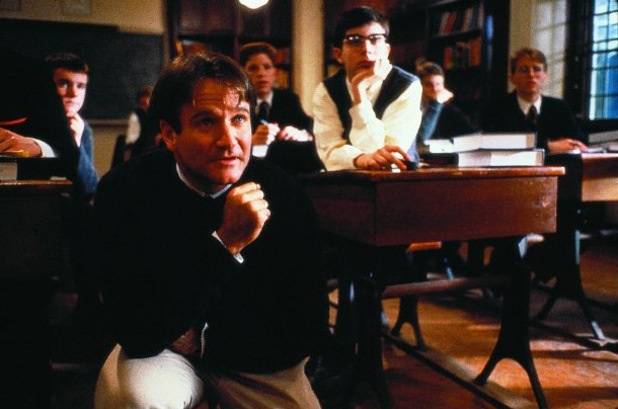
image

I’m currently watching Dead Poets Society, featuring the late Robin Williams. It’s one of my favorites but I hadn’t seen it in a very long time. I don’t have a good reason for that. I’m just stating a fact.

In it, Robin Williams references a poem by Walt Whitman written in honor of the late Abraham Lincoln just after his assasination. It seems very fitting in tribute to Mr. Williams now.

“O Captain! my Captain! our fearful trip is done,
The ship has weather’d every rack, the prize we sought is won,
The port is near, the bells I hear, the people all exulting,
While follow eyes the steady keel, the vessel grim and daring;

But O heart! heart! heart!
O the bleeding drops of red,
Where on the deck my Captain lies,
Fallen cold and dead.

O Captain! my Captain! rise up and hear the bells;
Rise up—for you the flag is flung—for you the bugle trills,
For you bouquets and ribbon’d wreaths—for you the shores a-crowding,
For you they call, the swaying mass, their eager faces turning;

Here Captain! dear father!
This arm beneath your head!
It is some dream that on the deck,
You’ve fallen cold and dead.

My Captain does not answer, his lips are pale and still,
My father does not feel my arm, he has no pulse nor will,
The ship is anchor’d safe and sound, its voyage closed and done,
From fearful trip the victor ship comes in with object won;

Exult O shores, and ring O bells!
But I with mournful tread,
Walk the deck my Captain lies,
Fallen cold and dead.”

A Thought or Two from Mr. Chesterton

I’ve been staring at my laptop screen for 45 minutes and I have come to one very astute conclusion: I got nothin’. I can’t think of anything to write about that would interest me, much less you.

The writer’s mental blank happens to me every so often, because thinking of something new to write about every single day is harder than it seems. At least for me.

So I’m borrowing some thoughts from a dead guy named G. K. Chesterton who wrote some pretty good books back in his day which you should check out if you have some free time to read and want something more to feast on than sparkly vampires in angst. These are his actual words that I’m borrowing, by the way.

“Literature is a luxury; fiction is a necessity.”

“I would maintain that thanks are the highest form of thought; and that gratitude is happiness doubled by wonder.”

“Poets have been mysteriously silent on the subject of cheese.”

“The true soldier fights not because he hates what is in front of him, but because he loves what is behind him.”

“The Bible tells us to love our neighbors, and also to love our enemies; probably because generally they are the same people.”

These go to show you that there is very little to say that hasn’t already been said at least once during the history of the written word. My job (or the job of anyone who communicates through writing) isn’t to reinvent the wheel– or in this case, the ink pen– but to more often than not remind you of what you already knew but forgot that you knew.