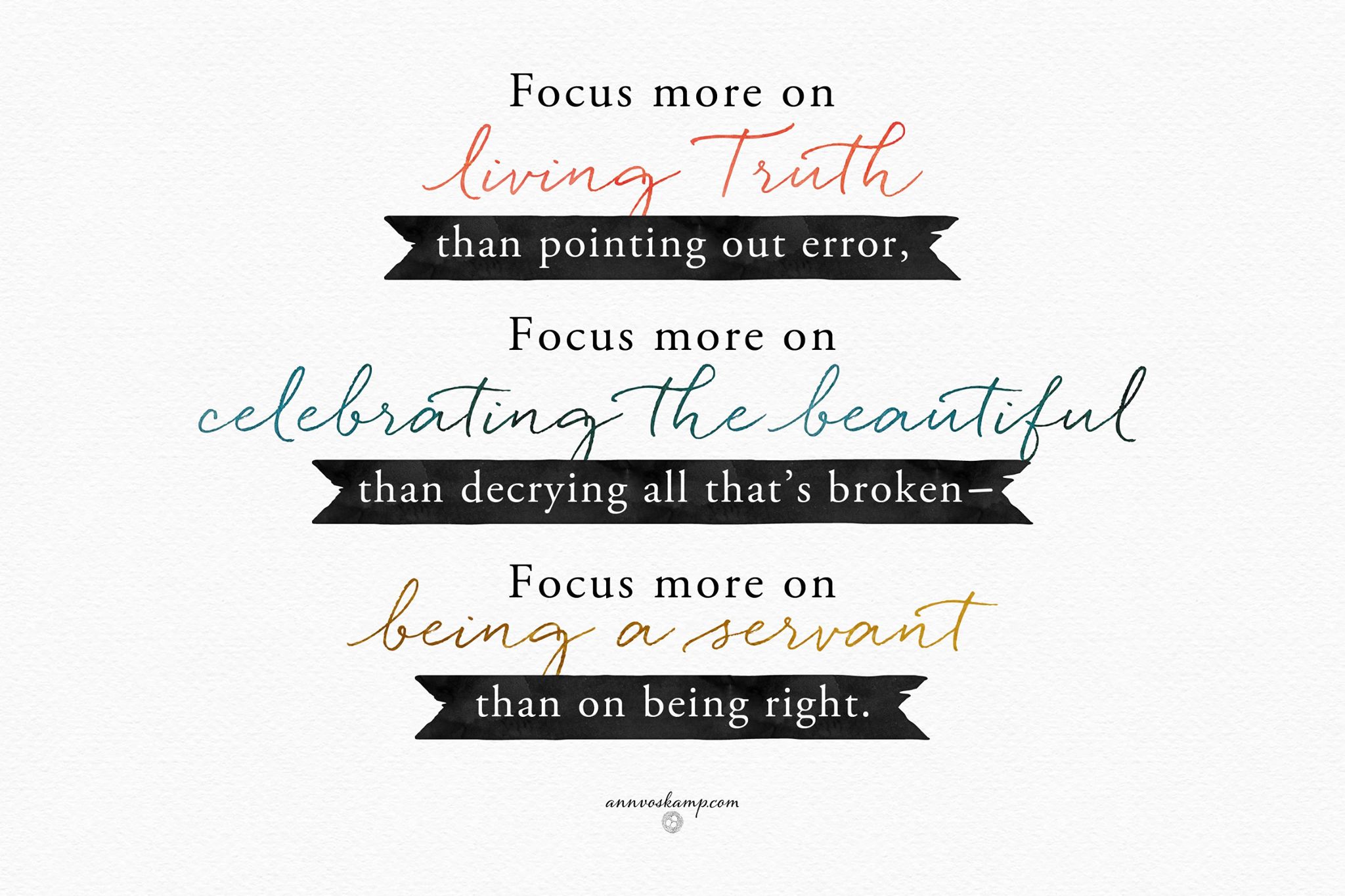
I’m thankful every year for my social media break during Lent. I do like my Facebook and Instagram, but I also confess I get very tired of people being preachy on just about all of their posts. And by preachy, I don’t mean the kind where you offer the plan of salvation but the kind where you point out the faults of all these other people who just about always happen to be on the other side of the political spectrum.
These days, I see a lot of posts (even from people who profess to follow Jesus) about Karma. Usually, Karma is when other people get what they deserve, not me. Typically, these people will offer themselves more grace and wish karma for the others. I confess that I’ve been guilty of a double standard at times for me messing up versus someone else messing up.
But if you’re living truth, you probably won’t have enough time to point out everyone else’s errors. If you look for ways to celebrate the beautiful, you won’t dwell on the broken. And if you focus on being a servant, you won’t need to win every argument and always be proven right.
If you and I are honest, we need a lot of work. We need a lot of grace. We’re too messed up to judge anyone else being messed up. We’re too spiritually broken to be all high and mighty when it comes to calling out other people’s motives and character. Instead of moralizing, we need to preach the gospel to ourselves and to others every single day.
“f you asked twenty good men today what they thought the highest of the virtues, nineteen of them would reply, Unselfishness. But if you had asked almost any of the great Christians of old, he would have replied, Love. You see what has happened? A negative term has been substituted for a positive, and this is of more than philological importance. The negative idea of Unselfishness carries with it the suggestion not primarily of securing good things for others, but of going without them ourselves, as if our abstinence and not their happiness was the important point. I do not thik this is the Christian virtue of Love. The New Testament has lots to say about self-denial, but not about self-denial as an end in itself. We are told to deny ourselves and to take up our crosses in order that we may follow Christ; and nearly every description of what we shall ultimately find if we do so contains an appeal to desire. If there lurks in most modern minds the notion that to desire our own good and earnestly to hope for the enjoyment of it is a bad thing, I submit that this notion has crept in from Kant and the Stoics and is no part of the Christian faith. Indeed, if we consider the unblushing promises of reward and the staggering nature of the rewards promised in the Gospels, it would seem that Our Lord finds our desires not too strong, but too weak. We are half-hearted creatures, fooling about with drink and sex and ambition when infinite joy is offered us, like an ignorant child who wants to go on making mud pies in a slum because he cannot imagine what is meant by an offer of a holiday at the sea. We are far too easily pleased” (C. S. Lewis, The Weight of Glory).

 Ragamuffingospelfan's Blog