The Difference Between Saul and David

Today’s sermon was all about David and Bathsheba. You don’t have to be a rocket surgeon to realize that David messed up. Badly. He wasn’t where he should have been, he let his eyes control his mind instead of the other way around, and he let his desires control his actions. Basically, he screwed up big time.

In order to cover up adultery, he added the murder of Bathsheba’s husband Uriah, as well as those who just happened to be nearby, to his rap sheet. At some point, he had become spiritually numb to sin and was heading down a path to swift destruction. But God had mercy.

Nathan confronted David about his sin. That was God’s mercy. God could have let David keep going down the road to where his desires were taking him to a tragic end, but God intervened. Were there natural consequences to David’s sin? Absolutely. But it was nowhere near as bad as it could have been had David continued on his original path.

The difference between David and his predecessor Saul was in the way they reacted to being confronted with sin. Saul’s heart was hardened and doubled down on his defense and self-justification. David’s heart was broken and he showed real remorse and repentance. He told God that ultimately his sin was only against Him because it was a kind of cosmic treason.

By no means does David’s sorrow negate the egregious nature of what he did. It was awful. Ultimately, it lead to a divided kingdom as the seeds were sown that would eventually lead to strife and conflict between Judah and the rest of the tribes. But if you continue to read your Bible, you’ll find that God called David “a man after my own heart.”

Every one of us will mess up at some point. Maybe our sin won’t be as obviously blatant as adultery and murder, but sin is sin and all sin is rebellion against a holy God. The key is what we do with our sin. What do we do when someone confronts us? Do we make excuses or do we make it right? Do we harden our hearts or do we let the Spirit break our hearts?

The beauty of it all is that the seed from David’s line, Jesus, took all of David’s sins upon Him on the cross. He took all of your sins and all of my sins. He paid the infinite and eternal punishment that those sins merited and gave forgiveness and freedom to all who would believe in His name.

I think David understood a little of this Messiah and put his faith in what he understood and that’s what saved him. We on the other side of the cross can believe in the fully revealed, fully finished work of Jesus on the cross. That is our salvation.

May we never become callous to sin or disregard the consequences to the choices we make. May we always seek accountability from others who will tell us the truth even when it’s uncomfortable or painful. May we seek above and pleasure or profit to be people who are after God’s own heart.

The Quiet Miracle

Today, I was listening to a podcast from Sally Lloyd-Jones, author of the Jesus Storybook Bible. She was conversing with Sir David Suchet, best known for his portrayal of Agatha Christie’s Poirot, about several topics of faith.

One topic of interest to me was when they talked about the miracle at Cana where Jesus turned the water into wine. David noted that one particular thing struck him about the miracle in that Jesus appeared to say or do nothing to bring it about. He didn’t offer a blessing. He didn’t wave His arms or lift up a prayer. He told the servants to fill up the large pitchers with water and when the taster got to them, the water had become wine.

It was a quiet miracle. Michael Card calls it the unmiraculous miracle. It’s notable that presumably no one at the wedding ever found out about the miracle except for the servants who poured the water. Not the wedding hosts or the guests. Not the bride or groom. Only the servants.

Jesus was quietly inaugurating His kingdom and only a few servants were in on it. I’m reminded of how the first people to witness the Incarnation were shepherds who had been out in the fields tending their flocks. The first witnesses of the resurrection were the same women whose testimony would not have counted in a court of law back in that day.

Again and again, Jesus chose the nobodies of the world to be the first to hear His good news. The gospel wasn’t given to the famous or the rich or the powerful at first, but to those discounted and outcast and disregarded by everyone else. But they were the ones Jesus chose.

Isn’t that how it works even now. To those who feel forgotten or left out, Jesus sees you. To those that nobody counts as worth anything, Jesus thought you were worth dying for. To those who sometimes feel like they’re taking up space in the world, Jesus has invited you to be a part of His Great Commission and to be His disciples. Even now, the gospel of Jesus is for you. Even you. Even me.

Easter Sunday 2026

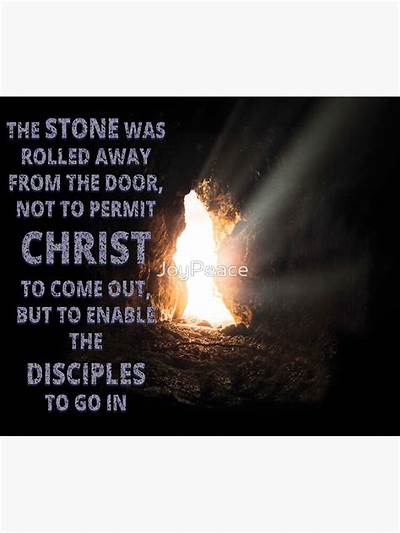
The empty tomb means everything. It means that Jesus is not dead and buried but alive and reigning. It means that Jesus defeated death, the grave, and hell forever. It means that there’s nothing you and I will ever face that hasn’t already been overcome by the cross and the empty tomb.

The Apostle Paul says that if Jesus isn’t alive and raised from the dead, it’s all meaningless. Our faith is futile and our hope is in vain. We’re the most pitiful people on the planet. He doesn’t make any allowances for a symbolic resurrection. If Jesus is only alive in our hearts and in our memories, then our faith is worthless and we might as well go and do what we like and believe in nothing at all.

But because Jesus is alive, our hope is alive. Our pain and suffering now have a purpose as well as an expiration date. Those we lost in the Lord are not gone forever. All the wrong and evil in the world will one day be made right and good. We can survive anything because we look to Jesus who endured the cross and despised the shame because He was looking at the joy just over the horizon beyond the tomb.

Easter gives meaning to Christmas (and everything else). Jesus is not a good teacher who gave us good morals and examples to follow. He is Messiah who fulfilled all the prophecies ever made about Him. He is Lord of all who demands our ultimate allegiance. He is God incarnate, 100% man and 100% God. He is the only one who can take our place on the cross and our punishment for the sins we’ve committed.

If Jesus is dead, then Easter is nothing but a hollow holiday with no meaning. But if He is alive — and He is — then Easter is the day we celebrate the best good news ever. That means that we who were dead can be made alive again. We who were guilty and deserving of death can be forgiven and pardoned and set free. We who were condemned and estranged from God can now become sons and daughters of God and heirs to the promise. Thank You, Lord, for Easter Sunday!

Palm Sunday 2026

Something I read today has stuck with me all day. Today we celebrate Palm Sunday, when the crowds were yelling and singing as Jesus rode into Jerusalem on a donkey in clear fulfillment of an Old Testament Messianic prophecy. Yet those were the same ones who were weeping over His death just a few days later.

I wonder what they were expecting. Were they hoping that Jesus would somehow lead an overthrow of Rome and restore independence to Israel? Were they hoping He would set Himself up as a King over Israel?

He didn’t have an army that they could see. He never once spoke about raising up an army. He never told them they needed to rebel against Roman rule. In fact, He’s the one who told them to pay their raxes because the coins which bore Ceasar’s likeness belonged to Caesar.

I wonder how many understood that the kingdom Jesus kept talking about was not one of this world. It wasn’t defined by boundaries or geography. It was God’s active rule in the hearts of all who would believe in His name and have eternal life and be indwelled by His Holy Spirit. It was the Church that would explode in numbers after He ascended back into heaven.

But most of them didn’t get it. Jesus even said they wouldn’t. Their hardness of heart and spiritual blindness kept them from seeing what was right in front of them. Only a few understood, and even they didn’t fully realize what was happening until after Jesus rose from the dead. Even the twelve were most likely expecting what the crowds were expecting.

No one could have foreseen a suffering Messiah. No one predicted that instead of leading a rebellion against Rome, He would lay down His life for them and His own people and the whole world. No one was prepared for Him to die, especially not on a cross reserved for the worst of criminals in a manner that was the worst kind of torture the human mind could conceive.

But to those who believed, He gave the right to become sons and daughters of the living God.

The God Who Gives and Takes Away

“Oh Lord our God, before we ask anything from your hands, we desire to praise and magnify your name; for you are good in yourself, and in all your thoughts, and all your acts, and in all that you do toward us. You are good when you lay us low, when the bed of sickness becomes hard, and our bones are weary. You are good when you strip us of all earthly comforts; good when we stand at the grave’s mouth and bury our dearest love. You are good in everything. Shall we not bless the God who takes, as well as the God who gives? We would not follow you as a dog follows a stranger for a bone; but we would love you as loving children, who love even a chastising Father and have learned to say, “Though he slay me yet will I trust in him.” If ever, even for a moment, the thought of complaint should flit across our spirit, we beg to be forgiven.
Amen” (Charles Spurgeon).

I heard about a panel of godly leaders who were leading a conference. Someone in the crowd asked the question of all questions — how would they define Christianity in one word.

They huddled together for a bit before coming up with the answer. What they came up with is probably not what I would have come up with but it certainly makes more and more sense as I think about it.

The one word for Christianity is wilderness. Mind blown.

That certainly does seem to sum up our experience this side of heaven. While there are moments and seasons of blessing and joy, there is so much that is just plain wrong. So much is broken and distorted in this post-sin world. So much hate, disease, hunger, suffering, war, pain, and death.

The more I see, the more I pray the last verse of the Bible. “Even so, come, Lord Jesus.”

The world only seems to get weirder and crazier and harder to figure out as I get older. There seems to be less holding me here as so many people I love have passed away and so much of what I have known is fading away. But I know the story’s not ending just yet.

The wilderness is definitely not a prime vacation spot. But it is a place for testing and preparation. Think of Moses spending 40 years in the wilderness. Think of those Israelites wandering around in the desert for the next 40 years. Think of Jesus fasting 40 days in the wilderness.

The wilderness is God’s school for growing up up and making us more like Jesus. It’s where God shows up in burning bushes and pillars of fire and in a very hungry and thirsty yet very obedient Messiah. It’s where we learn the most intimate name of God – YHWH – and learn to speak with God face to face as a man speaks with his friend.

God, help us to remain steadfast wherever we are, whether in the valley or the mountaintop, in harvest or in the wilderness. God, be present to us wherever we are so that we will always know the way to go and who is leading us.

Resurrecting Hope

“Easter was when Hope in person surprised the whole world by coming forward from the future into the present” (N. T. Wright, Surprised by Hope).

That was the topic of today’s sermon at The Church at Avenue South– that after being crucified and buried, Jesus actually and physically rose from the grave.

The Apostle Paul says that if Jesus didn’t rise from the grave, then our faith is useless and futile and we are all still dead in our sins.

If there is no resurrection, then Jesus’ death was meaningless and He wasn’t who He claimed to be, but just another in a long line of those so-called “Messiahs” whose words were forgotten and whose followers immediately abandoned them after death to look for the newest “Messiah.”

But Jesus stepped out of the tomb on Easter Sunday morning, forever proving that He is the ultimate God-Man, Savior of the world, the true Messiah.

Our hope is in more than a great teacher who gave us some great ideals to live by before he died. It’s in more than Jesus being “resurrected” by keeping His memory alive in the hearts of His disciples.

Our hope is in the Jesus who made the ultimate sacrifice on our behalf and died on the cross, then bodily rose from the grave and appeared to the apostles as well as over 500 other witnesses.

Because Jesus lives, our hope is alive. Because He lives, we live and can face any tomorrow that comes. Because He lives, we know that there is nothing that comes up against us– illness, death, or the grave– that can separate us from the love He has for us.

“We could cope—the world could cope—with a Jesus who ultimately remains a wonderful idea inside his disciples’ minds and hearts. The world cannot cope with a Jesus who comes out of the tomb, who inaugurates God’s new creation right in the middle of the old one” (N. T. Wright, Surprised by Hope).


Darkness

Occasionally, I like to invite guest bloggers to write my blog posts. What I mean by that is that there are some nights when I am just too lazy to do any original thinking, so I “borrow” from some of my favorite writers who have expressed my own thoughts better than I could.

This is another one of those nights. The writer is Frederick Buechner and the topic is darkness. Here goes:

“The Old Testament begins with darkness, and the last of the Gospels ends with it.

‘Darkness was upon the face of the deep,’ Genesis says. Darkness was where it all started. Before darkness, there had never been anything other than darkness, void and without form. At the end of John, the disciples go out fishing on the Sea of Tiberias. It is night. They have no luck. Their nets are empty. Then they spot somebody standing on the beach. At first they don’t see who it is in the darkness. It is Jesus.

The darkness of Genesis is broken by God in great majesty speaking the word of creation. ‘Let there be light!’ That’s all it took.

The darkness of John is broken by the flicker of a charcoal fire on the sand. Jesus has made it. He cooks some fish on it for his old friends’ breakfast. On the horizon there are the first pale traces of the sun getting ready to rise.

All the genius and glory of God are somehow represented by these two scenes, not to mention what Saint Paul calls God’s foolishness.

The original creation of light itself is almost too extraordinary to take in. The little cookout on the beach is almost too ordinary to take seriously. Yet if Scripture is to be believed, enormous stakes were involved in them both, and still are. Only a saint or a visionary can begin to understand God setting the very sun on fire in the heavens, and therefore God takes another tack. By sheltering a spark with a pair of cupped hands and blowing on it, the Light of the World gets enough of a fire going to make breakfast. It’s not apt to be your interest in cosmology or even in theology that draws you to it so much as it’s the empty feeling in your stomach. You don’t have to understand anything very complicated. All you’re asked is to take a step or two forward through the darkness and start digging in” (Frederick Buechner, Whistling in the Dark).

Only One Thing Matters

“Jesus continued from there toward Jerusalem and came to another village. Martha, a resident of that village, welcomed Jesus into her home. Her sister, Mary, went and sat at Jesus’ feet, listening to Him teach. Meanwhile Martha was anxious about all the hospitality arrangements.

Martha (interrupting Jesus): Lord, why don’t You care that my sister is leaving me to do all the work by myself? Tell her to get over here and help me.

Jesus: Oh Martha, Martha, you are so anxious and concerned about a million details, but really, only one thing matters. Mary has chosen that one thing, and I won’t take it away from her” (Luke 10:38-42, The Voice).

This Advent season may find you stretched too thin. You might feel like you’re being pulled in a hundred different directions toward a hundred different destinations, each one seemingly as important as the rest.

I believe the word from God for this season is this: the best place to be is at the feet of Jesus. Only one thing matters as we approach Christmas– creating margins and spaces in your life and heart to be able to hear the voice of your Good Shepherd.

Only one thing matters– seeing the Christ in Christmas an adoring the infant King, wrapped snugly and laying in a manger. As the worship song says, everything else can wait. Some of those to-do list tasks can even be left undone.

If you achieve all your holiday goals and purchase every last present and miss Jesus, you’ve missed Advent.

The best witness you can give this Advent season is to say no to the excess spending and the tyranny of the urgent while being still before the presence of God, wherever you are and whatever you’re doing.

You don’t have to be idle to be still. You can go about your daily life with a sense of urgent expectancy and waiting with hope. You can adore the Christ by your Christlike attitude in the midst of all the hustle and bustle, by your kindness and patience toward others, remembering that the one thing that matters most is not in your wallet or in your shopping bags or in your day planner but rather in the middle of your Nativity scene, laying in that manger.

Busted Brackets

I did my civic duty tonight. No, I didn’t vote. I filled out my NCAA basketball tournament brackets (nine in all).

Some of them I played straight. I picked all the #1 seeds to win. On some others, I just went plain crazy. I picked just about every game to be an upset.

It hit me as I was filling in these brackets. As you know, no 16 seed has ever beaten a 1 seed in the NCAA tournament. Ever.

There have been a few #15 seeds upset the #2 seeds and a few more #14 seeds pull a shocker over their 3 seed counterpart, but no 16 seed has ever beaten a 1 seed since the tournament expanded to 64 teams back in the 80’s.

What hit me was this: what God did for me in saving me was the equivalent of a #16 seed winning the whole enchilada. Or if you will, the 64th best team (think Austin Peay) winning the national championship.

I’m definitely not saying that God’s the underdog in this story. I am. On my own, I had absolutely no shot of making it out of the first round. I was the equivalent of a team of corpses.

But God made me alive in Christ. He raised me up with supernatural power. in Jesus, I have become more than a conqueror. My salvation story is akin to that Austin Peay team reaching the finals and beating those mighty Kansas Jayhawks in the national championship game.

A pipe dream? Maybe. But I know that in God what seems impossible to me and you is possible for God. In fact, it’s not even remotely difficult for God (thanks again to Pete Wilson for that one).

I have a feeling that most of my brackets will be busted and broken by the Sweet Sixteen. I know that spiritually speaking, my life in God will never ever be busted and broken because I serve a God who knows the way out of hell and the grave.

The end.


Waiting Patiently

“While fulfilling these sacred obligations at the temple, they encountered a man in Jerusalem named Simeon. He was a just and pious man, anticipating the liberation of Israel from her troubles. He was a man in touch with the Holy Spirit. The Holy Spirit had revealed to Simeon that he would not die before he had seen the Lord’s Anointed One.  The Spirit had led him to the temple that day, and there he saw the child Jesus in the arms of His parents, who were fulfilling their sacred obligations.  Simeon took Jesus into his arms and blessed God.

Simeon: Now, Lord and King, You can let me, Your humble servant, die in peace.
    You promised me that I would see with my own eyes
        what I’m seeing now: Your freedom,
     Raised up in the presence of all peoples.
    He is the light who reveals Your message to the other nations,
        and He is the shining glory of Your covenant people, Israel.

 His father and mother were stunned to hear Simeon say these things. Simeon went on to bless them both, and to Mary in particular he gave predictions.

Simeon: Listen, this child will make many in Israel rise and fall. He will be a significant person whom many will oppose.  In the end, He will lay bare the secret thoughts of many hearts. And a sword will pierce even your own soul, Mary” (Luke 2: 25-35).

Picture Simeon. He’s an old man, nearing the end of his days. He’s been waiting for the promised Messiah for as long as he can remember. In fact, the prophecies of that coming Anointed One date back to hundreds and thousands of years before he was born.

Simeon waited almost his entire life to see a promise of God fulfilled.

How long are you willing to wait?

Every advertisement tells us that we are due to get what’s ours right now. No waiting. We live in a world of instant gratification where waiting isn’t looked upon in a good light.

Are you willing to wait as long as it takes? Simeon was, and the payoff made it so much more than worth it.

Wait for the Lord. His promises are sure and true. They are coming, even if they don’t arrive on your timetable. They will come.

Don’t give up.