In His Own Words

image

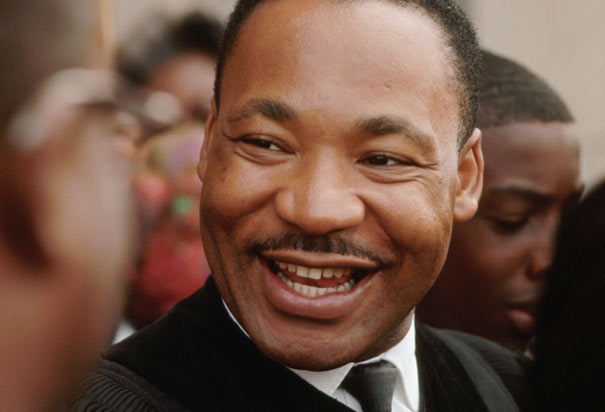
I thought it fitting on a day set apart to celebrate the legacy of one Dr. Martin Luther King, Jr., I shouldn’t try to speak for him, but instead let his own words speak for themselves.

I found this excerpt of a speech he gave in accepting the Nobel Peace award in 1964. I hope it resonates with you like it did with me:

“I refuse to accept despair as the final response to the ambiguities of history. I refuse to accept the idea that the ‘isness’ of man’s present nature makes him morally incapable of reaching up for the eternal ‘oughtness’ that forever confronts him. I refuse to accept the idea that man is mere flotsom and jetsom in the river of life, unable to influence the unfolding events which surround him. I refuse to accept the view that mankind is so tragically bound to the starless midnight of racism and war that the bright daybreak of peace and brotherhood can never become a reality.

I refuse to accept the cynical notion that nation after nation must spiral down a militaristic stairway into the hell of thermonuclear destruction. I believe that unarmed truth and unconditional love will have the final word in reality. This is why right temporarily defeated is stronger than evil triumphant. I believe that even amid today’s mortar bursts and whining bullets, there is still hope for a brighter tomorrow. I believe that wounded justice, lying prostrate on the blood-flowing streets of our nations, can be lifted from this dust of shame to reign supreme among the children of men. I have the audacity to believe that peoples everywhere can have three meals a day for their bodies, education and culture for their minds, and dignity, equality and freedom for their spirits. I believe that what self-centered men have torn down men other-centered can build up. I still believe that one day mankind will bow before the altars of God and be crowned triumphant over war and bloodshed, and nonviolent redemptive good will proclaim the rule of the land. ‘And the lion and the lamb shall lie down together and every man shall sit under his own vine and fig tree and none shall be afraid.’ I still believe that WE SHALL OVERCOME!”

Another Dangerous Prayer (from Kairos Tonight)

I am mulling over tonight’s message from Kairos on a stomach full of chips and salsa and tortilla soup from Chuy’s. That’s my favorite meal there and I recommend it if you haven’t tried it already. Shameless Tex-Mex plug.

One of the most dangerous and liberating prayers you can pray is: Lord, use me.

It’s dangerous because you never know how God will answer it. You never know where or to whom He will send you. Most likely, it will be a place out of your comfort zone to people you wouldn’t normally associate with. It may not be the safest part of town and it may mean you miss a concert or a party you’d rather be going to.

It will mean that you suddenly are on the radar screen of the enemy. Satan will throw everything he’s got at you if you pray this prayer and really and truly mean it. Probably, those who are most vehemently against what you’re doing will be fellow Christians and the ones criticizing you the most will be churchgoers. But if God is for you, as the song says, who will be able to stand against you?

“Use me” is also the most liberating prayer. Namely, because you realize that God can use you. In fact, God can take any surrendered vessel and any person who has a heart of service and obedience and work mightily through them. If God can use a few fishes and a few loaves of bread to feed a multitude, He can use your life to bless your world. I love what Martin Luther King, Jr, said:

“Everybody can be great…because anybody can serve. You don’t have to have a college degree to serve. You don’t have to make your subject and verb agree to serve. You only need a heart full of grace. A soul generated by love.”

May God give us hearts full of grace and souls generated by love. May He use us to go where no one else will go to the people no one else wants to touch. May we be a blessing everywhere we go, every place we are to everyone we meet.


The Kingdom of God Is Like . . .

The Kingdom of God is throwing a birthday party for a prostitute who has never had one in her life and giving her a birthday cake with candles and the gift of unconditional love.

The Kingdom of God is leaving the safety and comfort of the suburbs and going to the unsafe part of town to share a meal with homeless people.

The Kingdom of God is forgiving the person who took a part of you that you can never get back, whose wounds still have scars, and whose words still cut.

The Kingdom of God is hate turning into love, enemies turning into friends, the lost becoming found, the dead coming alive, and the hopeless rising up with new hope.

The Kingdom of God is a feast where the guests are the blind, the lame, the poor, the outcast, the forgotten, and the nobodies and where the least of these have the best seats in the house.

The Kingdom of God is wherever the people of God choose to be malajusted (to borrow a phrase from Dr. Martin Luther King, Jr.)  to a world that prizes sex over love, greed over compassion, votes over justice, war and weapons over peace, religion over Christ, and where life is regarded as cheap.

The Kingdom of God is more than taking back our country; it’s about taking back the world and turning it right-side up again and filling it with justice that runs like a river and mercy that flows like a neverending stream.

The Kingdom of God is those who aren’t satisfied with climbing corporate ladders or making more money, but instead want to make a difference by embracing a lifestyle of downward mobility where they choose to lead through serving and counting others as better than themselves.

The Kingdom of God is an unstoppable force, because it’s main power is stronger than all the bombs and armies and weapons and strategies that have ever come against it– and that power is love.

The Kingdom of God is the faith of a little child who believes unquestioningly and trusts Abba unswervingly.

The Kingdom of God is you and me.

The Kingdom of God is now.

Prophetic words on the Church from Martin Luther King, Jr.

Wow. This is increcibly prophetic for the Church in America in 2010. This is from Martin Luther King, Jr. in his “Letter from a Birmingham Jail.”

“In deep disappointment I have wept over the laxity of the church. But be assured that my tears have been tears of love. There can be no deep disappointment where there is not deep love. Yes, I love the church. How could I do otherwise? l am in the rather unique position of being the son, the grandson and the great-grandson of preachers. Yes, I see the church as the body of Christ. But, oh! How we have blemished and scarred that body through social neglect and through fear of being nonconformists.

There was a time when the church was very powerful in the time when the early Christians rejoiced at being deemed worthy to suffer for what they believed. In those days the church was not merely a thermometer that recorded the ideas and principles of popular opinion; it was a thermostat that transformed the mores of society. Whenever the early Christians entered a town, the people in power became disturbed and immediately sought to convict the Christians for being “disturbers of the peace” and “outside agitators”. But the Christians pressed on, in the conviction that they were “a colony of heaven,” called to obey God rather than man. Small in number, they were big in commitment. They were too God intoxicated to be “astronomically intimidated.” By their effort and example they brought an end to such ancient evils as infanticide and gladiatorial contests.

Things are different now. So often the contemporary church is a weak, ineffectual voice with an uncertain sound. So often it is an archdefender of the status quo. Far from being disturbed by the presence of the church, the power structure of the average community is consoled by the church’s silent and often even vocal sanction of things as they are.

But the judgment of God is upon the church as never before. If today’s church does not recapture the sacrificial spirit of the early church, it will lose its authenticity, forfeit the loyalty of millions, and be dismissed as an irrelevant social club with no meaning for the twentieth century. Every day I meet young people whose disappointment with the church has turned into outright disgust.”