On the Third Day of Christmas

This culture has gotten really good at moving on. Not even two whole days since Christmas Day, and already some stores have erased every evidence of Christmas festivity. Now I suppose everywhere will be decorated for the upcoming Valentine’s Day.

I don’t want to rush through the seasons anymore. I want to sit and savor and remember. I don’t want to spend the rest of my life speeding on to the next big holiday, the next big life event. I want to live in today while it is still today.

I’ve been re-reading my Advent devotional from the writings of G. K. Chesterton, and I think he had it right. There’s something to this 12 days of Christmas business. They didn’t speed through Christmas in 24 hours. They took their time and made it last for almost two whole weeks. They didn’t tear through their gifts in one setting. They spaced them out over 12 days.

We are a culture perpetually in a hurry and teaching the next generation to be just as insanely busy or even busier. Ultimately, the only place you ever get to in a hurry is an early grave and a deathbed full of regret over the life that you missed. And I for one surely don’t want to miss my life.

To be fair, to celebrate the incarnation takes more than 24 hours or even 2 weeks. It should take the rest of the our lives to contemplate and celebrate and live thankful lives as a result of God’s gift to us in the person of Jesus.

Christmas and Easter should perpetually be the themes of our lives and everything we say and do should be from the goal of letting people know that God loves them and wants them to know Him. People need to know that Christmas is more than Santa Claus and that Easter is more than the Easter Bunny. They need to know that Jesus loves them and can give them new and eternal life in exchange for their old and broken lives. They need to know that no one is ever too lost for Jesus to find and save.

The Cross, the Manger, and the Tomb

“How proper it is that Christians should look toward the future…for the manger is situated on Golgotha and the Cross has already been raised in Bethlehem” (attributed to Dag Hammarskjold).

I heard a sermon once where the pastor drew a parallel between the stone manger that Mary and Joseph laid Jesus in as a baby and the stone tomb that Nicodemus and Joseph of Arimathea laid Jesus’ body in after He was crucified. Note: the manger was more likely made of stone because the animals would have destroyed a wooden feeding trough.

When we see a sweet little Jesus baby in the manger of our nativity, we can forget that the purpose of Him being born into this world was to die for our sins. Simeon even prophesied to Mary that a sword would pierce her heart, pointing to the moment she would witness her own Son on the cross.

Really, Christmas and Easter aren’t two different events. They are the beginning and ending of one event. God planned before the foundation of the world that Jesus would die for us in our place. Before sin even existed, a remedy was already in place. Jesus slain from the foundation of the world is how the Bible puts it.

It’s just as important to remind people (including ourselves) of our need for the gospel just as much on Christmas as on Easter. While it might seem more appropriate to preach an evangelistic sermon after we celebrate the empty tomb, it works just as well when we bow before the manger with the child born to be a sacrifice.

I hope this Christmas we don’t just celebrate part of the story of the incarnation. While it’s more pleasant to focus only on Jesus as a tiny infant during this Advent season, we must remember that that infant became the man who perfectly obeyed God’s law at every point and fulfilled God’s righteous requirements in our place. He then took the punishment for our sin that we deserved and died in our place. That’s the whole Christmas story just as much as it is the whole Easter story.

Thank You, Jesus, that you were born to die so that we who have died in our sin might be born again and have eternal and abundant life forever. Amen.

Focus

I’m thankful every year for my social media break during Lent. I do like my Facebook and Instagram, but I also confess I get very tired of people being preachy on just about all of their posts. And by preachy, I don’t mean the kind where you offer the plan of salvation but the kind where you point out the faults of all these other people who just about always happen to be on the other side of the political spectrum.

These days, I see a lot of posts (even from people who profess to follow Jesus) about Karma. Usually, Karma is when other people get what they deserve, not me. Typically, these people will offer themselves more grace and wish karma for the others. I confess that I’ve been guilty of a double standard at times for me messing up versus someone else messing up.

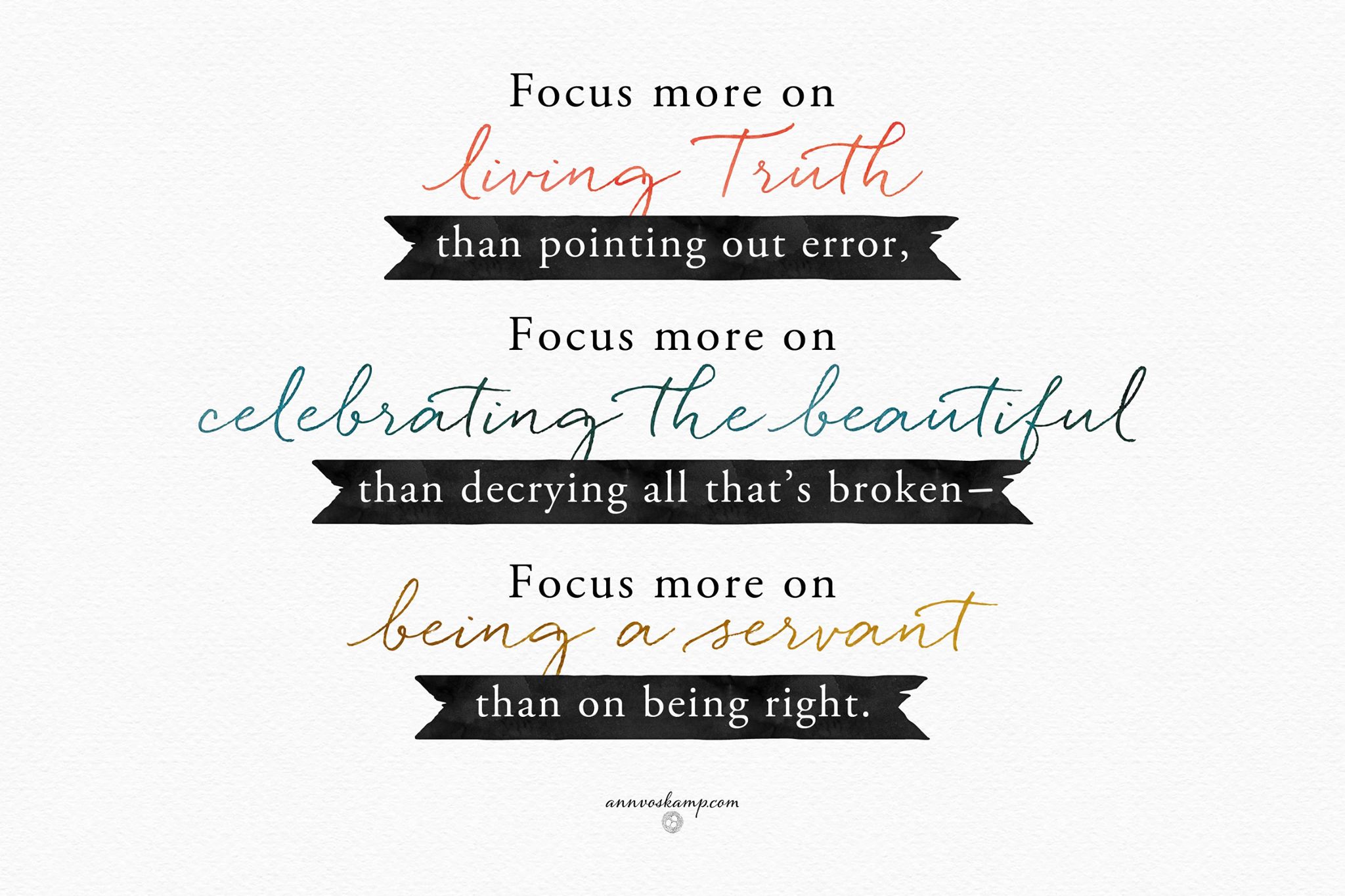
But if you’re living truth, you probably won’t have enough time to point out everyone else’s errors. If you look for ways to celebrate the beautiful, you won’t dwell on the broken. And if you focus on being a servant, you won’t need to win every argument and always be proven right.

If you and I are honest, we need a lot of work. We need a lot of grace. We’re too messed up to judge anyone else being messed up. We’re too spiritually broken to be all high and mighty when it comes to calling out other people’s motives and character. Instead of moralizing, we need to preach the gospel to ourselves and to others every single day.

“f you asked twenty good men today what they thought the highest of the virtues, nineteen of them would reply, Unselfishness.  But if you had asked almost any of the great Christians of old, he would have replied, Love.  You see what has happened?  A negative term has been substituted for a positive, and this is of more than philological importance.  The negative idea of Unselfishness carries with it the suggestion not primarily of securing good things for others, but of going without them ourselves, as if our abstinence and not their happiness was the important point.  I do not thik this is the Christian virtue of Love.  The New Testament has lots to say about self-denial, but not about self-denial as an end in itself.  We are told to deny ourselves and to take up our crosses in order that we may follow Christ; and nearly every description of what we shall ultimately find if we do so contains an appeal to desire.  If there lurks in most modern minds the notion that to desire our own good and earnestly to hope for the enjoyment of it is a bad thing, I submit that this notion has crept in from Kant and the Stoics and is no part of the Christian faith.  Indeed, if we consider the unblushing promises of reward and the staggering nature of the rewards promised in the Gospels, it would seem that Our Lord finds our desires not too strong, but too weak.  We are half-hearted creatures, fooling about with drink and sex and ambition when infinite joy is offered us, like an ignorant child who wants to go on making mud pies in a slum because he cannot imagine what is meant by an offer of a holiday at the sea.  We are far too easily pleased” (C. S. Lewis, The Weight of Glory).

My Lent Readings

So I may have gone a tad overboard with my readings for Lent. I suppose technically, some of them are specifically for Lent and some are devotionals for the entire year. Here’s what I’m reading. Hopefully it will inspire you to add these books (or others like them) to your to-read list at some point:

  1. God’s Message for Each Day – Eugene Peterson. This one is a daily devotional book from the author of the Message, more of a paraphrase than a translation of the Bible but still worth using. This little devotional has short readings for each day and has been very helpful.
  2. 365 Pocket Prayers – Ronald A. Beets. I don’t know if Ronald wrote these or compiled them, but there are 365 prayers, each with a different theme. There’s also a handy index listing the prayers by category in case you want to find a prayer for guilt or shame or anxiety or such.
  3. A Barclay Prayer Book – William Barclay. This is a prayer book that follows the Christian Year and Holy Days in the Book of Common Prayer and also has prayers for all seasons. There were a couple of phrasings in there that gave me a bit of pause, but overall, I’ve liked it enough to recommend it.
  4. It Is Finished: A 40-Day Pilgrimmage Back to the Cross – Charles Martin. This one is blowing my mind with new insights about Jesus’ journey to the cross. It’s very reverent and biblical in its retelling of the scenes of Jesus’ last week before the crucifixion. Another book I highly recommend.
  5. The Book of Common Prayer (1928 edition) – This book helps get me in the proper frame of mind for both Christmas and Easter with all the Advent and Lent readings leading up to Christmas Day and Easter Sunday. Plus, there are so many beautiful collects and other readings for all the Holy Days and other important days in the Christian calendar. It makes me want to be liturgical.

All that plus reading through the Bible in a year is a lot. So proceed with caution if you dare. Or you can recommend your own Advent and/or Lent readings that have encouraged and inspired you and maybe I’ll read them next year.

He Suffered for Us

“I could never myself believe in God, if it were not for the cross. The only God I believe in is the one Nietzsche ridiculed as “God on the Cross.” In the real world of pain, how could one worship a God who was immune to it? I have entered many Buddhist temples and stood respectfully before the statue of Buddha, his legs crossed, arms folded, eyes closed, the ghost of a smile playing round his mouth, a remote look on his face, detached from the agonies of the world. But each time after a while I have had to turn away. And in imagination I have turned instead to that lonely, twisted, tortured figure on the cross, nails through hands and feet, back lacerated, limbs wrenched, brow bleeding from thorn-pricks, mouth dry and intolerably thirsty, plunged in Godforsaken darkness. That is the God for me! He laid aside his immunity to pain. He entered our world of flesh and blood, tears and death. He suffered for us” (John Stott).

Every other religion is about working our way to God and somehow managing to be good enough or obey enough rules or simply to be lucky enough to get to heaven or nirvana or whatever they believe exists after death. But Christianity is the story about how God in Jesus has come to us (and I hear Mike Glenn’s voice as I type these words). Jesus knew that man could never climb high enough to get to heaven, so He came from heaven to live among us and die for us.

It’s still a few weeks away from Lent Season and Easter, but I still think it’s good to remember that God doesn’t watch us suffering from a distance. He’s with us in our suffering. Best of all, He became one of us and suffered for us more than anyone before or since to provide redemption and salvation and freedom to all who would receive Him.

That’s a good thought for Easter, but it’s also good for any time of the year. It’s good especially for times like these when pain and suffering are the norm rather than the exception. Your King knows all about suffering and He is still here and He still reigns. One day, He will make all things right. This is our God, and Jesus is His name.

Another Year, Another Bible Reading Plan

Last year, my church and all the other campuses of Brentwood Baptist Church read through the Bible in a year with the Day by Day Chronological Bible. It was a bit different reading the Bible chronologically with Genesis followed by Job as an example. But it was a great help for my faith as each daily reading had an introduction, as well as a synopsis for each week.

This year, we’re following the M’Cheyne One Year Reading Plan. I’m using the YouVersion app and the Complete Jewish Bible translation. So far, so good.

I can’t tell you how many times I’ve read through the Bible. Partly, it’s because I really can’t remember. But every year, I can’t wait to start over. The meta-narrative is so compelling as a story of God setting out to rescue His own after they sinned and rebelled against Him.

The older I get, the more I understand that the real heroes aren’t Abraham or Moses or David or Joshua. They’re the ones God chose and used, but they were as fallen and flawed as anyone else. They simply chose to take God at His word.

The real hero of these stories is God Himself. God is the one who orchestrated history to raise up a people through which would come a Redeemer to be the Savior of the world. He was able to work through both the good and bad and even the ugly to accomplish His purposes which led to both Jews and Gentiles alike having access to this redemption and salvation story.

Today, I read Genesis 1, Matthew 1, Ezra 1, and Acts 1. It was a bit of an unexpected start, but I’m excited to see where it leads. Plus, my church is going through a guided 40 Days of Prayer to start the year. I’m anticipating God to do great things through these prayers and petitions.

Also, I’m still tackling The Book of Common Prayer. It’s such a helpful prayer guide, especially during the Lent and Advent seasons. I’m thankful to have access to so many amazing resources when it comes to my faith.

I don’t know what to expect in 2025, but I know God already knows. He’s gone ahead to meet us there and He goes there with us. Whatever it is, I know God is good, and that is enough.

Beauty from Ashes

“To all who mourn in Israel,
    he will give a crown of beauty for ashes,
a joyous blessing instead of mourning,
    festive praise instead of despair” (Isaiah 61:3, NLT).

On my weekly Radnor Lake hike, I saw something that took a minute to register. There were these beautiful yellow flowers growing out of a pond of green scum. If I knew anything about botany, I could tell you what kind of flowers or maybe what kind of green scum was covering the pond.

I do know that what stuck me is that out of something I perceived as ugly grew something that I saw was beautiful. But isn’t that just God’s way?

The prophet Isaiah speaks about God bringing beauty from ashes. I honestly can’t think of anything more hopeless than ashes. Ashes are what’s left after the destruction of fire. There’s literally nothing left to restore.

But God can take these ashes and turn them into something beautiful the same way He could take a valley of dry bones and make them into a living army.

I heard a pastor say once that what seems impossible for us isn’t even remotely difficult for God. That means even the most hopeless of circumstances can be transformed into the most amazing outcomes. He can make miracles from mud (just ask the blind man Jesus healed).

It’s easy to forget God’s goodness when you’re staring at a pile of the ashes that are what’s left of your life. But God can turn even those into something beautiful, something better than before, something that will always be a reminder of God’s faithful love for you.

Holy Saturday Hope

“O God, Creator of heaven and earth: Grant that, as the crucified body of your dear Son was laid in the tomb and rested on this holy Sabbath, so we may await with him the coming of the third day, and rise with him to newness of life; who now lives and reigns with you and the Holy Spirit, one God, for ever and ever. Amen” (from The Book of Common Prayer).

I don’t think I’ve ever participated in any kind of church service centered around Holy Saturday. Typically, every church I’ve ever attended makes a really big deal about Easter Sunday (and with good reason). More recently, I’ve seen some Maundy Thursday and Good Friday services.

But nothing for Holy Saturday.

Maybe that’s because there really isn’t much to celebrate or commemorate. At this point, Jesus is dead and in the tomb. The disciples are scared to death, grief-stricken, and hiding out. There is nothing in Scripture about anything happening on this day at all.

But we as believers with the gift of history and hindsight know what’s coming. We know that the worst moment in history is about to give way to the greatest. From absolute despair and sadness will come overwhelming amazement and joy.

In the Jewish culture of Jesus’ day, Saturday was a day of rest. So possibly it’s good not to have yet another service in an already packed holy week. Perhaps we need to take time to meditate and reflect on what has happened up to this point and what is yet to come.

On Holy Saturday, we learn once more how to wait well.

Two Weeks Before Easter

Today is the fifth Sunday in Lent, a week before Palm Sunday, and two weeks before Easter. I found this prayer that reminds me of what Lent and Easter are all about:

“You whose eternal love for our weak and struggling race was most perfectly shown forth in the blessed life and death of Jesus Christ our Lord, enable me now so to meditate upon my Lord’s passion that, having fellowship with Him in His sorrow, I may also learn the secret of His strength and peace.

  • I remember Gethsemane
  • I remember how Judas betrayed Him
  • I remember how Peter denied Him
  • I remember how they all forsook Him and fled
  • I remember the scourging
  • I remember the crown of thorns
  • I remember how they spat upon Him
  • I remember how they smote Him on the head with a reed
  • I remember His pierced hands and feet
  • I remember His agony on the Cross
  • I remember His thirst
  • I remember how He cried, My God, my God, why have You forsaken me?

We may not know, we cannot tell,
What pains He had to bear;
But we believe it was for us
He hung and suffered there.

Grant, O most gracious God, that I who now kneel before You may be embraced in the great company of those to whom life and salvation have come through the Cross of Christ. Let the redeeming power that has flowed from His sufferings through so many generations flow now into my soul. Here let me find forgiveness of sin. Here let me learn to share with Christ the burden of the suffering of the world. Amen” (John Baillie, A Diary of Private Prayer, Sixteeth Day Evening, updated and revised by Susanna Wright).

I think remembering what Jesus went through on the road to Gethsemane is important. I don’t mean so much dwelling on the gory details, but remembering that He suffered more than anyone has ever or will ever suffer.

The why is important. It’s not that He was the victim of oppression and injustice. Actually, it’s way more than that. It’s that He willingly laid down His life for us, taking all that punishment that we deserved, paying the penalty for sins we committed. He became the ultimate passover lamb, sacrificed for the sins of the world.

When I by my sin tried to take the place of God, God Christ for my salvation took my place. The resurrection from the dead proves that He was no mere victim but a victor over sin, death, the grave, and hell. That’s my Jesus!

A Lenten Prayer

“O Lord, this holy season of Lent is passing quickly,
I entered into it with fear, but also with great expectations.
I hoped for a great breakthrough, a powerful conversion, a real change of heart;
I wanted Easter to be a day so full of light that not even a trace 
of darkness would be left in my soul.
But I know that you do not come to your people with thunder and lightning.
Even St. Paul and St. Francis journeyed through much darkness
before they could see your light.
Let me be thankful for your gentle way.
I know you are at work.
I know you will not leave me alone, 
I know you are quickening me for Easter – 
but in a way fitting to my own history and my own temperament.
I pray that these last three weeks, in which you invite me to enter 
more fully into the mystery of your passion,
will bring me a greater desire to follow you on the way you create for me
and to accept the cross that you give to me.
Let me die to the desire to choose my own way and select my own cross.
You do not want to make me a hero but a servant who loves you.
Be with me tomorrow and in the days to come,
and let me experience your gentle presence.
Amen” (Henri Nouwen).

Lord, may the last three weeks of Lent not be wasted. Help me to use my time away from social media to create margins of unhurried space within my day for me to hear Your voice speaking to me. Give me a quiet heart and a calm mind to receive Your words. Above all, grant me the ability and willingness to obey what I hear. Amen.