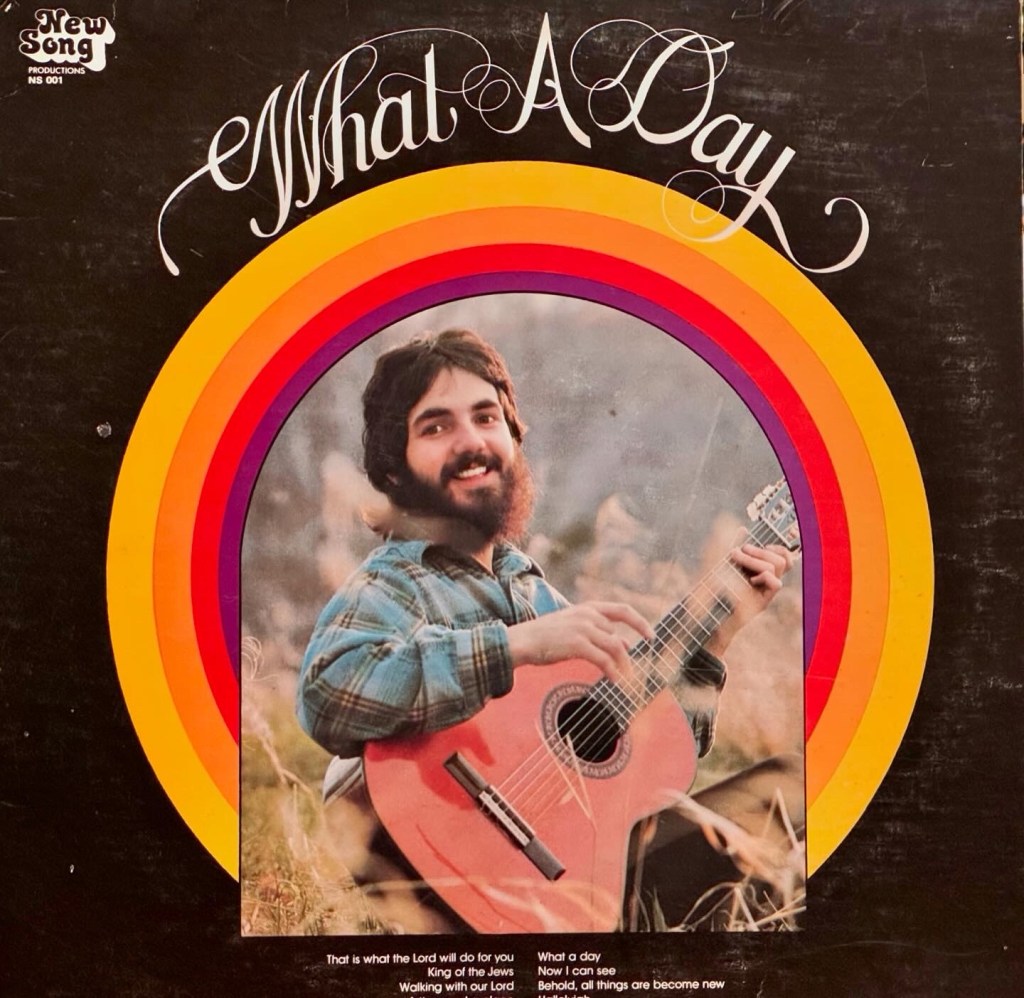
My Favorite Decade for Music

If I had to pick a decade that had the best music, you’d think I’d go with the 80s because so many songs from that decade are tied to my memories and are part of the soundtrack to my life.

But you’d be wrong. My favorite decade for music is the 70s. There was such a diverse amount of artists and styles hitting the radio then, usually all on the same stations. So many genres were fusing with other genres to create new sounds.

I’ve been digging me some 70s Christian music, especially the early years when it was known as Jesus Music. That music has a vibe that’s both worshipful and relaxing. I honestly hope that music in heaven sounds a bit like the music from back then.

I think part of it is because I consider the 70s to be my womb years. It sounds weird even to me, but hopefully I can explain. I don’t remember much about the 70s and the memories I do have sometimes verge on the dreamlike. Sometimes I wonder if something I remember from back then actually happened or if I dreamed it.

I love the fact that there’s all sorts of new worship music being created currently. I really like some of it. But for me, sometimes it can have kind of a sameness to it and the lyrics can have a generic quality with all the references to storms and chains breaking.

So much of it is me-focused, as in “I’m gonna lift up my hands” and “I’m praising your name” and “I won’t be shaken.” I suppose that’s all well and good. But for me, it can turn into worshipping worship or worshipping the experience instead of worshipping the one true God.

70s Christian music wasn’t perfect, but it was God-honoring and God-centered. And yes, it does sound better on vinyl, which is good because most of it never made it to CDs or streaming. Maybe I’m getting older, but I do think that sometimes older is better. Not all the time, but sometimes.

Homesick

I was listening to an 80s Truth record I picked up recently. I got to the song Homesick. It sounded vaguely familiar, but I felt I had heard or read the lyrics before very recently. Then I remembered I had seen a post with the very same song lyrics less than a week ago.

The song is the heartbeat of any believer who knows this world isn’t really home. A former pastor of mine once compared this life to a very nice, very clean bus station (or airport terminal, if you will). It’s not supposed to be your forever place to live, but a place to be until you can get to your forever home.

“They say home is where the heart is
And I’m finding out it’s true
‘Cause I long to be in heaven
Since my heart is there with You
Reading over letters
That You’ve written to me
Telling me of all You have in store
Makes me start to dreaming
Of the place I want to be
And I get that lonely feeling
Like so many times before

I get homesick
Longing for my home
And for Your open arms
Of lovе and comfort
Waiting for me there
I gеt homesick
Yearning for my home
And for the day
When all Your family
Gets together forever
Our eternal home sweet home

Lord, You living truth within me
Keeps me safe and warm
All its strength and all its beauty
Rise through every storm
Without its presence in my soul
I could not carry on
To face the many battles I find here
Lord, you keep the promises
I build my life upon
And as time goes by, I know
That I will always keep them near

I get homesick
Longing for my home
And for Your open arms
Of love and comfort
Waiting for me there
I get homesick
Yearning for my home
And for the day
When all Your family
Gets together forever
Our eternal home sweet home” (Larry Bryant, Lesa Bryant & Justin Peters).

It’s interesting to be homesick for a home we’ve never known, but that’s what it is. That’s why nothing here will ever completely satisfy the deep longing of our souls. Only God can do that. And our experience of God here is cloudy and partial. One day it will be clear and complete. We will know as we are fully known. And we will be truly home.

Dog Sitting on the 4th of July

It seems to be a tradition for me lately that I’m dog sitting on Independence Day. Not that I mind. I’d rather be hanging out with two sweet old pups than waiting on fireworks with the masses in the sweaty hot summer air.

I’m thankful for each opportunity that I get to take care of these two. There used to be three, but one crossed the rainbow bridge a few years ago. But I don’t want to take for granted that I’ll always be able to go back to Bellevue and take care of these critters.

Tonight, I hopefully can be a calming presence in the midst of all the fireworks going off up and down the street. I don’t think the pups mind much. So far, they’ve napped through all the good parts. Or at least the really loud parts.

I actually did get to see some very decent fireworks a couple of weeks ago at my church’s VBS Finale Night. Maybe they’re not up to downtown Nashville standards, but I’ll take slightly less spectacular fireworks over waiting the rest of my natural born life to get out of downtown Nashville at 1 am afterward.

Ultimately, today isn’t really about food or fireworks. It’s about freedom. It’s about men and women who shed their blood and laid down their lives so that we could have independence and the liberty to live and dress and speak and think as we want. Ideally, freedom means that we can be our best selves the way God created us to be.

Of course, we celebrate the ultimate sacrifice on Easter Sunday, remembering the cross and the empty tomb. But it’s helpful to remember Jesus laying down His life for those He loved on this day as well. All true freedom traces itself back to that Friday afternoon and that Sunday morning eventually.

I can be thankful for that sitting in a room with two very sleepy dogs away from the madding crowds waiting to see the pyrotechnics begin. I call that a win.

Holding on to the Gospel

“Too many times we give away the one thing the world needs from us to secure the shallow security of ‘fitting in'” (Mike Glenn).

“One of the most striking evidences of sinful human nature lies in the universal propensity for downward drift.

 In other words, it takes thought, resolve, energy, and effort to bring about reform.

In the grace of God, sometimes human beings display such virtues. But where such virtues are absent, the drift is invariably toward compromise, comfort, indiscipline, sliding disobedience and decay that advances, sometimes at a crawl and sometimes at a gallop, across generations.

People do not drift toward holiness. Apart from grace-driven effort, people do not gravitate toward godliness, prayer, and obedience to Scripture, faith, and delight in the Lord.

We drift toward compromise and call it tolerance;

we drift toward disobedience and call it freedom;

we drift toward superstition and call it faith.

We cherish the indiscipline of lost self-control and call it relaxation;

we slouch toward prayerlessness and delude ourselves into thinking we have escaped legalism;

we slide toward godlessness and convince ourselves we have been liberated” (Don Carson, For the Love of God, p. 23).

I remember in ye olden days when I first heard the plan of salvation. I can’t remember the exact details, but it involved a loving God, sin separating me from God, Jesus shedding His blood on a cross to make a way for me to be right with God, and eternal life that comes from salvation.

Now a lot of churches are preaching a gospel of “I’m okay, you’re okay, there’s no sin or need of salvation.” There’s no such thing as hell and God accepts everyone, regardless of lifestyle choices or addictive behavior. Churches are bending over backward to accommodate a culture we’re supposed to be trying to reach for Jesus. We’re blending in when we should be standing out, as I’ve heard it said.

We’ve traded in the gospel that is the power of salvation for something that has the form of godliness but without any actual power to do anything other than make people comfortable in their sin. The Apostle Paul would call such a gospel false and would say that anyone who preaches such a gospel, even an angel from heaven, is anathema or cursed.

The point was never to fit in. We’ll never fit in. Eventually, we’ll look and sound so much like the world that we’ll be unrecognizable as a church and cease to have any anointing or authority. When churches host pride events or have nights that celebrate people like Beyonce instead of Jesus, they have stopped being churches.

I think nothing short of revival will do. Nothing short of a supernatural movement of God in American churches will stop the drift away from true and orthodox faith. But God is still able. All we need to do is humble ourselves and pray.

Fear

“It is said that before entering the sea
a river trembles with fear.

She looks back at the path she has traveled,
from the peaks of the mountains,
the long winding road crossing forests and villages.

And in front of her,
she sees an ocean so vast,
that to enter
there seems nothing more than to disappear forever.

But there is no other way.
The river can not go back.

Nobody can go back.
To go back is impossible in existence.

The river needs to take the risk
of entering the ocean
because only then will fear disappear,
because that’s where the river will know
it’s not about disappearing into the ocean,
but of becoming the ocean” (Khalil Gibran).

I’ve learned over the years that all fear is just looking at the future and seeing the mountain but not the Mountain Mover. It’s seeing the stormy waves but not seeing the One who walks on water. It’s basically looking at life’s problems and eliminating God from the equation.

I’ve also learned that 98% of what I worry about never happens. That dreaded scenario never takes place. I find that when I get to the place where my fear is greatest . . . and take one more step, that’s when God’s strength shows up in my weakness. God’s faithfulness shows up in my obedience, regardless of whether my motives are wholly pure or not.

“Jesus Christ is like a vast ocean, He is too immense to fully explore, and too rich to fathom. You are like a bottle. The wonder of the gospel is that the bottle is in the ocean, and the ocean is in the bottle” (Jesus Manifesto, Leonard Sweet and Frank Viola).

Refiner’s Fire

“There was once a group of women studying the book of Malachi in the Old Testament. As they were studying chapter three, they came across verse three, which says: ‘He will sit as a refiner and purifier of silver.’ This verse puzzled the women, and they wondered what this statement meant about the character and nature of God. One of the women offered to find out about the process of refining silver and get back to the group at their next Bible study.

That week this woman called up a silversmith and made an appointment to watch him at work. She didn’t mention anything about the reason for her interest beyond her curiosity about the process of refining silver. As she watched the silversmith, he held a piece of silver over the fire and let it heat up. He explained that in refining silver, one needed to hold the silver in the middle of the fire where the flames were hottest as to burn away all the impurities.

The woman thought about God holding us in such a hot spot – then she thought again about the verse, that he sits as a refiner and purifier of silver. She asked the silversmith if it was true that he had to sit there in front of the fire the whole time the silver was being refined.

The man answered “Yes”, and explained that he not only had to sit there holding the silver, but he had to keep his eyes on the silver the entire time it was in the fire. If the silver was left even a moment too long in the flames, it would be damaged.

The woman was silent for a moment. Then she asked the silversmith, ‘How do you know when the silver is fully refined?’

He smiled at her and answered, ‘Oh, that’s easy. When I see my image in it.’

If today you are feeling the heat of this world’s fire, just remember that God has His eyes on you” (Anne Kephart).

Let that sink in. The refining process is complete when the maker can see his image in what is being refined. The end result is worth the pain.

Ready for Spooky Season

The way I look at it, Tennessee has four seasons. I’m not talking about winter, spring, summer, and fall. I’ve come up with my own names for these seasons to help me cope with the one I’m currently stuck in.

Winter is snowy season.

Spring is sneezy season.

Summer is sweaty season.

Fall is spooky season.

No, those aren’t four of the seven dwarves who hung out with Snow White. Those are my experience of each of the seasons.

I guess you’ve figured out which is my favorite.

Winter is alright for a couple of weeks and is pretty when there’s snow. Plus, it technically has Christmas, although winter doesn’t normally hit Tennessee until mid-January.

Spring is when my sinuses explode and my allergies go haywire. It does have the benefit of seeing everything bloom and blossom and turn green, but also, all the bugs wake up and start terrorizing humanity.

Summer is also nice for a few weeks until the heat and humidity kick in. If it were just hot, I could handle it. It’s the humidity that makes my hair explode and also makes me feel like I’m constantly walking around in a sauna.

Fall is the best. All the good holidays are there. All the bugs have gone back to hell where they belong. All the leaves turn all the colors, and I can finally breathe normally again. Plus, I get to wear flannel.

So, while I’m doing my best to enjoy sweaty season, I’m letting you know that I’ll be ready for spooky season when it gets here.

PS I didn’t invent the term spooky season. I can’t claim it as my own, even though I really want to.

Caring for the Elderly

“To care for the elderly means then that we allow the elderly to make us poor by inviting us to give up the illusion that we created our own life and that nothing or nobody can take it away from us. This poverty, which is an inner detachment, can make us free to receive the old stranger into our lives and make that person into a most intimate friend.

When care has made us poor by detaching us from the illusion of immortality, we can really become present to the elderly. We can then listen to what they say without worrying about how we can answer. We can pay attention to what they have to offer without being concerned about what we can give. We can see what they are in themselves without wondering what we can be for them. When we have emptied ourselves of false occupations and preoccupations, we can offer free space to old strangers, where not only bread and wine but also the story of life can be shared” (Henri Nouwen).

I think I remember reading about different cultures in the past where two or three generations of the same family lived under one roof, and when one got older, the family would take care of that person. I understand that times have changed. I also understand that we live in a very modern Western society where we have facilities for caring for those who can no longer care for themselves.

This is not bashing those institutions or those who place their aging loved ones in such places. This is about how there is a kind of joy that comes from taking care of the elderly. They have so much wisdom from having lived so long. They have stories and pictures and memories to share.

I’d give anything right now to have at least one of my grandparents alive again to be able to listen to them talk for as long as they wanted, to look at old photo albums, listen to old music. I’d even take hearing the same stories told again and again.

This society doesn’t value age very much. We tend to glamorize youth and desperately seek ways to prolong looking and acting young rather than to teach about how blessed it is to grow old gracefully and embrace each stage of your life.

I’m 52, and as much as I want to think I’m still in my 20s, my body reminds me that I’m not. My brain may think I can stay up until 2 am and be okay the next morning, but the rest of me is like, “Are you kidding me right now?”

My church advocates for mentoring between young adults and older adults. I can think of no better way to gain wisdom than from someone who has a lifetime of learning by trial and error and from knowledge and understanding passed down through generations. Hopefully, I can be of value to the next generations as the older generations have been to me.

The best way to learn to love and follow Jesus is to spend time with those who have loved and followed Jesus for a lifetime. My pastor talks about how his love of the Bible and prayer came from watching his own father spend time in the Word preparing for and praying over Sunday School lessons.

That’s not a bad idea.

In the Waiting

I’ve never thought about it that way before. I suppose it could be a bit of a stretch to make a connection between waiting on God and working at a restaurant, but it works. When you wait tables at a restaurant, you wait for people to make up their minds on the menu. You wait on the kitchen to prepare the food for you to take to the tables. You wait on the people to finish their meals before you present them with the check.

But it’s not a passive waiting. The whole time, you’re serving. You’re bringing baskets of bread and drink refills. You’re always available to take food back to the kitchen if it’s not cooked right or if it’s the wrong order. You’re never sitting still while you’re waiting.

I think the same applies for waiting on God. Typically, God has revealed something to you that you then need to apply. In Hebrew, hearing and obeying come from the same word. In other words, you can’t hear from God apart from doing what He said. Part of waiting is obedience.

I think part of waiting is also making yourself ready to be used the moment God calls for you. That means you don’t have distractions or detours to keep you from responding to God’s call. As I mentioned before, maturity is the distance between God’s call and your ability to obey. Waiting is where you narrow that gap.

May we learn to wait well. May we learn to worship in the waiting as loudly as after the waiting is over, to sing the same way in the hallway as when we get to where God opens the door to the fulfillment of His promises. Then the waiting will have been worth it.

Never the Same

“The mind, once stretched by a new idea, never returns to its original dimensions” (Ralph Waldo Emerson).

You can say the same for the heart. There are certain experiences in life that stretch your heart, like marriage, having a child, death, or a loved one moving away. Once your heart is stretched, it can never go back to what it used to be.

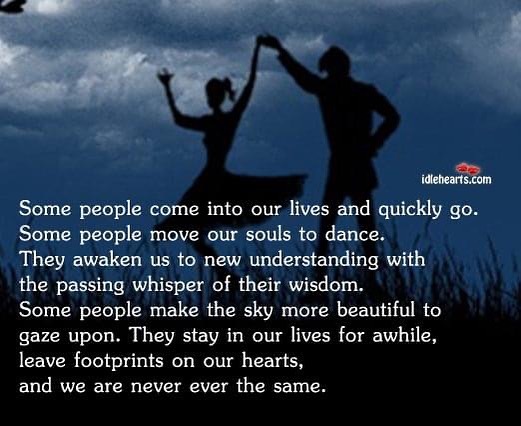
I can honestly say that I have known people in my life that have left imprints in my mind and in my heart. Some are no longer living. Some have moved on to different places or different phases of their lives. I may never see these people again this side of heaven, but I know that I am different and better because of them.

You never know sometimes when it’s the last time you’ll ever see someone. You think there will be more time, more experiences like this one. Sometimes, you get closure and a chance to process the grief of a goodbye, even if it’s not the grieving of death. Other times, you don’t.

One option is to be bitter and to focus on what was that will never be again. Or you could be thankful for what was because it made you who you are now. God never promised that every single person in your life would be there indefinitely. Some are only meant for a season. Some are to teach you a lesson. Some are like angels used by God to minister to you in a particularly difficult passage.

The best way to pay it forward is to be that kind of person to someone else. Just as someone was once God with skin on to you, so you can do your best to be that to someone else. You can’t be Jesus, but you can be the physical manifestation of God ministering to that person as His hands and feet, His voice.

Some of you might be reading these words right now. To you I say, “Thank you. I am more like Jesus because of you.”