Just About Everything About Your Nativity is Wrong (But Not Everything)

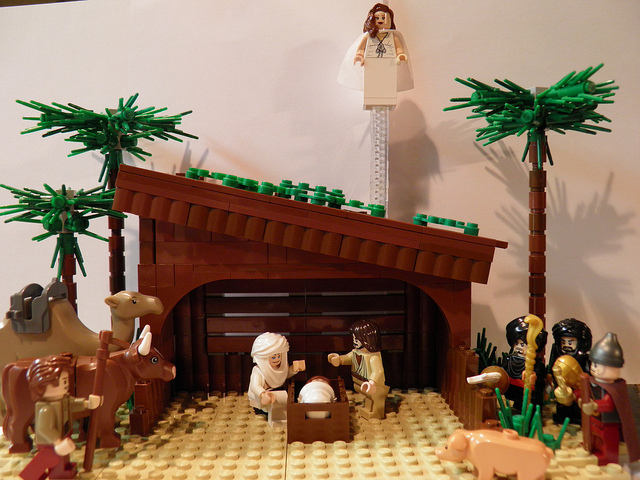
lego nativity scene

Disclaimer: if you love your nativity scene and don’t want anybody messing with it, you might want to stop reading here. Just FYI. Otherwise, keep goin’. Fun times are ahead.

First of all, the wise men were not at the birth scene. According to Matthew, they didn’t arrive until Joseph, Mary, and Jesus were living in a house and Jesus was probably 2 years old. Already, your nativity scene is getting less crowded.

Also, there was no mean inn-keeper (sorry to burst your bubble, all of you whose dramatic career consisted of playing this one character in the church Christmas pageant). There was probably no inn, either. According to what I’ve learned, the Greek word used for inn in Luke 2 is probably better rendered as “guest room” and was most likely in back of the ancestral home where the family beast of burden would normally stay.

That means there weren’t animals at the birth scene. Again, not 100% for certain, but more than likely not. I don’t know if any little boy showed up and serenaded the Christ child with a drum solo, but it’s doubtful.

As far as the wise men are concerned, there’s no indication in Scripture that there were three of them. Just because there were three gifts doesn’t mean that there were three of them. And they may or may not have been named Gaspar, Melchior,  and Balthasar. For all we know, they could have been named Larry, Curly, and Moe.

The one thing that’s right about your nativity scene is that Jesus is there. The Word became flesh and pitched his tent among us. God took on human skin and became Immanuel– “God with us.” The Almighty became an embryo and the Creator became a helpless infant boy.

So you can keep that part of your nativity scene. You can even add in snow if the spirit leads. But remember that Jesus was probably born in spring, not December, so there was likely no snow that night. I just burst yet another bubble of yours. You’re welcome.

God’s YES

“Whatever God has promised gets stamped with the Yes of Jesus. In him, this is what we preach and pray, the great Amen, God’s Yes and our Yes together, gloriously evident. God affirms us, making us a sure thing in Christ, putting his Yes within us. By his Spirit he has stamped us with his eternal pledge—a sure beginning of what he is destined to complete” (2 Cor. 1:20-22).

So many people think that Christians are all about what and who we’re against. And honestly, we  haven’t done a very good job in dispelling that sentiment. We’re sometimes too eager to condemn the sin and not nearly as willing to love the sinner.

But I have to look at a guy like Adam Lanza and say with all honesty, “That could have been me. But for the grace of God and different circumstances, that could have been me.”

That scares me and comforts me at the same time.

It scares me because it means that I’m not nearly as good as I sometimes think I am. It means that I am just as in need of a Savior now as ever and just as prone to wander from the One I love as ever.

But it comforts me because God has promised to stick with me through everything. He’s stamped his YES on me through Christ and nothing will ever change that.

I think we would do better to show love instead of judgment. We’d do better to reach out to those in trouble instead of later saying thing like “I could have told you that boy would end up like this. I could see it coming a mile away,”

While we were yet sinners, while we were at our most unlovable worst, Christ died for us. He reconciled us to God and now gives us a chance to be a part of reconciling others, too.

I don’t know about you, but I want people to know what and who I’m for. More importantly, I really want people to know that God is for me and for them and has a new start for anyone who’s willing to take him up on it.

That’s all.


A Christmas Prayer

Lord, the time approaches yet again when we celebrate your arrival in human skin to make your home among us as one of us. We celebrate that you became Immanuel, “God with us,” and took your place among us, sharing our joys and sorrows, weaknesses and pains.

We confess that we have so often lost sight of why we celebrate this day. We have made it into the giving and receiving of gifts and of excessive shopping and spending. We have forgotten that at the heart of Christmas, it is your birthday.

Help us also to remember those for whom Christmas isn’t such a happy time. So many mourn the loss of loved ones and live in the midst of family strife and turmoil. So many are facing tough days ahead as many are without jobs, some without homes and even the basic necessities.

Help us to walk along side those who are hurting in this Christmas season. May they find you, O God, to be their burden bearer, their refuge, their safe dwelling, and their peace in the midst of storms. Comfort them, bring healing to their strife, and be in the midst of them as the Prince of Peace.

Help us to remember those less fortunate than we and to be generous to those around us who have needs, both physical and spiritual. May we serve you by serving one of the least of these.

May we remember Christmas every day by being living incarnations of your presence everywhere we go, for you are not only God with us, but you are God in us, too. May we never forget that what started out in a manger ended on a cross, and that we are alive and free because of that terrible price you paid.

So as we get into the days of celebration and merriment, help us to remember that you are the reason for it all. May the best gift we give anyone be to show them your love and point them to you this holiday season.

Why Jesus Came

“Tis the season to celebrate. Everybody knows that this is a season for festivity and merriment, but not everybody knows why. Most people know that Christmas involves the arrival of an infant born to peasants and laid in a feeding trough, but do we really know why that’s so significant?

We sing songs about the coming of Jesus to Bethlehem as a baby boy, but do we really know why he came?

Jesus didn’t come to tell us, “I’m OK, you’re OK.” I think that each of us can honestly admit deep down that we are deeply flawed, as evidenced by broken homes, broken relationships, and broken lives. We have to confess at some point that we can’t fix ourselves and that we need someone to step in and do for us what we can’t do for ourselves.

Jesus didn’t come to make us better people. To borrow something a friend said, Jesus didn’t come to build a better me. He didn’t come to make good people better. Or even bad people good.

Jesus came to make dead people alive. He came for the nobodies to make them somebodies. He came to the lost to find them. He came to the worthless to make them priceless. He came to the hopeless to give them hope.

Jesus didn’t come as an example of a better way to live or with a new philosophy to follow. He didn’t come to show us the way, but to be the way, the truth and the life.

It’s not about Jesus helping me to be the best Greg Johnson I can be. That’s not it at all.

Jesus Christ came to totally transform me into his own likeness. Not an improvement, but a new creation.

Remember that when you see the festive lights and decorations everywhere you go. Remember that of all the gifts you and I receive, the one we celebrate most is the gift of Jesus himself. The gift of life.


Whatever you did to the least of these, you did it to Me.

“The King will reply, ‘I tell you the truth, whatever you did for one of the least of these brothers of mine, you did for me” (Matthew 25:40).

I have been thinking about that verse quite a bit today. Not so much in the sense of the poor and downtrodden, which is obviously the main ones Jesus is talking about here. But what if at one point I am the least of these. Or what if you are the least of these. How would you treat me? How would I treat you?

I’d like to think I would treat you with respect and dignity and be Jesus to you. The truth is that whatever I do or don’t do to you at that moment of your utmost weakness, I do to Jesus. It’s interesting that Jesus always identifies with the broken and downcast and outcasts rather than identifying with those who are socially acceptable (like I tend to do nearly all the time).

Am I ignoring Jesus in someone else because He doesn’t look or act like me? Am I brushing past Him when I walk past someone who is less polished and more socially awkward? If I am harsh and critical with myself when I am at my lowest ebb, what am I saying to Jesus? Whatever you and I did or didn’t do to the least of these, my brothers and sisters, you and I did or didn’t do to Jesus.

So treat everyone you meet like you would treat Jesus, all of us go through times in our lives when we can identify with the least of these through our brokenness and weakness. In the end, what will matter most will be what we did or didn’t do for the least of these, whether they were living in a cardboard box in the slums or in a mansion.