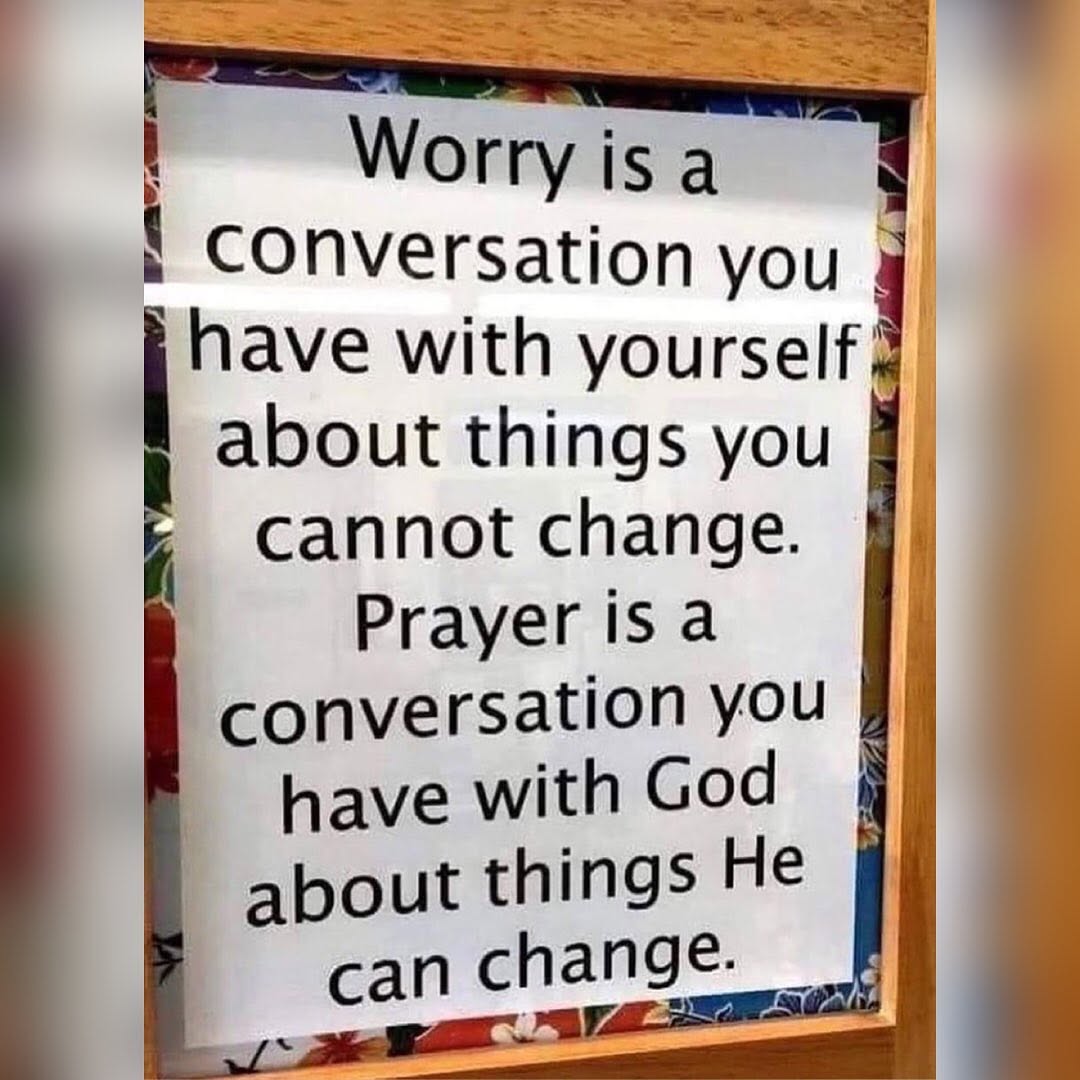
Worry vs. Prayer

Ann Voskamp said to be a prayer warrior and not a panicked worrier. I think about that a bit lately. One does absolutely no good but only keeps you up at night and keeps you from focusing on what matters. One is the way to the throne of grace where we find help in time of need.

Worry changes nothing. Prayer changes everything.

Worry makes you sick. Literally. Over time, your body will start to manifest symptoms of sickness if you let worry consume you constantly. Prayer on the other hand transforms you. It changes the way you see everything, including your problems.

Worry is a way of looking at the world without God in it. It’s funny how all your anxiety-laden possible outcomes end up with it being completely up to you to fix everything. Prayer shows that not only is God in the picture, but He has already made a way through. He has already overcome. The victory is not only possible but certain.

Worry comes natural. It’s a default setting for every single person born after the Fall. We’re hard-wired to worry and fret and to be anxious over every little thing. But prayer is a discipline that requires work. To get better at praying, you have to pray. You have to learn from others who are older and wiser and who have spent a lifetime learning how to pray. You have to be immersed in the Word of God to know the will of God to pray in the name of Jesus.

But the good news is that you don’t have to be good at praying to pray. You can choose today to pray instead of worrying. Today can be the day that you say to Jesus, “Teach me to pray as you taught the disciples.” And He will do it.

In the words of the great theologian M. C, Hammer, “You got to pray just to make it today.”

Good words.

Continuing to Trust

I ran across something recently that floored me. It’s one of those Paul Harvey-type of stories that always end with something along the lines of “and now you know the rest of the story.”

The gist is that you can trust God when life doesn’t play out like you thought it would or even how you planned for it to go. You can script your plans down to the nth degree, but still life happens and plans change and you end up in a place you never thought you’d be. What then?

Stay the course and trust God. Or better yet, trust God more than you trust in your plans. God is the only one who never changes. He’s the only one who sits outside of history and knows all of it. He sees the big picture, including how it’s all going to play out. Trust Him.

“A young Dutch apprentice named Wilhelm wanted to become a preacher. In 1879, his zeal brought him to the coal fields of southern Belgium as a missionary. Miners and their families were captivated by the young man’s selflessness. As often happened, there was a mining disaster, and scores were injured. No one fought harder to save the miners than Wilhelm. Afterward, villagers flocked to hear his sermons. When a church official visited the village, they found Wilhelm living in a tiny hut, dressed in tattered clothes. When questioned about what he had done with his salary, Wilhelm said he had given it to the miners and their families. The church official determined Wilhelm had misused the funds and dismissed him from his position. He felt dejected—perhaps even abandoned by God.

Late one afternoon, Wilhelm watched an old miner bending beneath the enormous weight of a full sack of coal. He pulled an old tattered envelope from his pocket and began sketching the figure of the man. Every day, he used his pencil and paper to sketch more of the villagers, whom he had come to love. Through the majesty of his art, he was able to share God with the villagers. Much later, his sketches and other artworks found a wider audience. The young man who wanted to be a minister was Vincent Wilhelm Van Gogh.

Through the circumstances of his life, Van Gogh came to know the sovereignty of God in a very personal way. The Lord’s plan for the young Dutchman was different from what he had anticipated, and it was revealed to him little by little as the minister-turned-artist continued to live out his faith in the Lord. He had not been abandoned, and neither have you. God is near, always loving, always ready to offer His mercy and compassion in your need. Just as He had a plan for Wilhelm, He has a plan for you and for this nation. Continue to trust Him.”

Different Kinds of Friends

I wrote this a while back, but it’s still true. God places people in your life for different purposes and for different seasons. Not everyone who is in your life will stay there. Some were meant only to stay for a little while and teach you a specific lesson. Some are meant for a lifetime, but they are precious and few:

You will have several different kinds of friends over your lifetime. God uses each kind to play a part in your life.

You have specialty friends, like work friends or church friends that you only see at specific places (like work or church).

You have seasonal friends that come into your life for a short season to help you grow, to help you through a trial, or to teach you a lesson.

You will have social media friends who you only interact with over Facebook or Instagram. Most of these you will never actually meet in person.

You have secondary friends where you step in when their regular friends aren’t around.

Each friendship is valid and each one can be a blessing if you can appreciate it for what it is instead of wishing it were something else or something more.

But best of all are the special friends. Those are the ones who will go out of their way to make time for you, who will always seek you out and make you feel welcome no matter where you are. Those are for a lifetime.

You can appreciate your specialty, seasonal, and secondary friends, but you cherish and honor your special friends, because they are precious and rare.

Above all, you can even be a friend without receiving friendship in return. You can love and give, expecting nothing in return but the knowledge that God loved you like that when you were least deserving and lovable.

Enter His Gates

“Enter his gates with thanksgiving;
    go into his courts with praise.
    Give thanks to him and praise his name” (Psalm 100:4, NLT).

I must have read this Psalm at least a hundred times before and never noticed that the first verse is not a suggestion but a command. Enter his gates with thanksgiving is God telling us not to wait until the Sunday service starts to begin worship.

The problem with so many of us is that we enter into the presence of God with anything but God on our minds. We’re thinking about what to have for lunch, what Monday’s workload will look like, how to get the kids ready quicker next Sunday, how not to stay up so late on a Saturday again, etc.

The key is having an attitude of worship the other 167 hours of the week and not just the one hour a week that we meet on Sundays. Worship needs to be more than just the four or five songs we sing in any given church service. It should encompass everything we are and everything we do. That’s worship.

If you break down the word, worship = worth + ship. We’re declaring the worth of God, or shipping His worth if you want to use more current vernacular. We’re letting people around us know that God is worth our sacrifice, our serving, and even our very selves. God is worth everything we are and everything we have , , , and then some.

I believe that if we wait until 9:00 am on a Sunday to decide to worship. we’ve missed worship. We’ve turned it into what someone aptly described as Christian karaoke. We’re singing words to songs about God — some songs we know well and don’t have to think about what we’re singing and others we don’t sing because we don’t know them well enough.

My prayer is that our worship is 24/7 and consists of more than singing songs and lifting hands. Lord, make our entire lives an offering of worship to You as living sacrifices that bless and glorify your name. Amen.

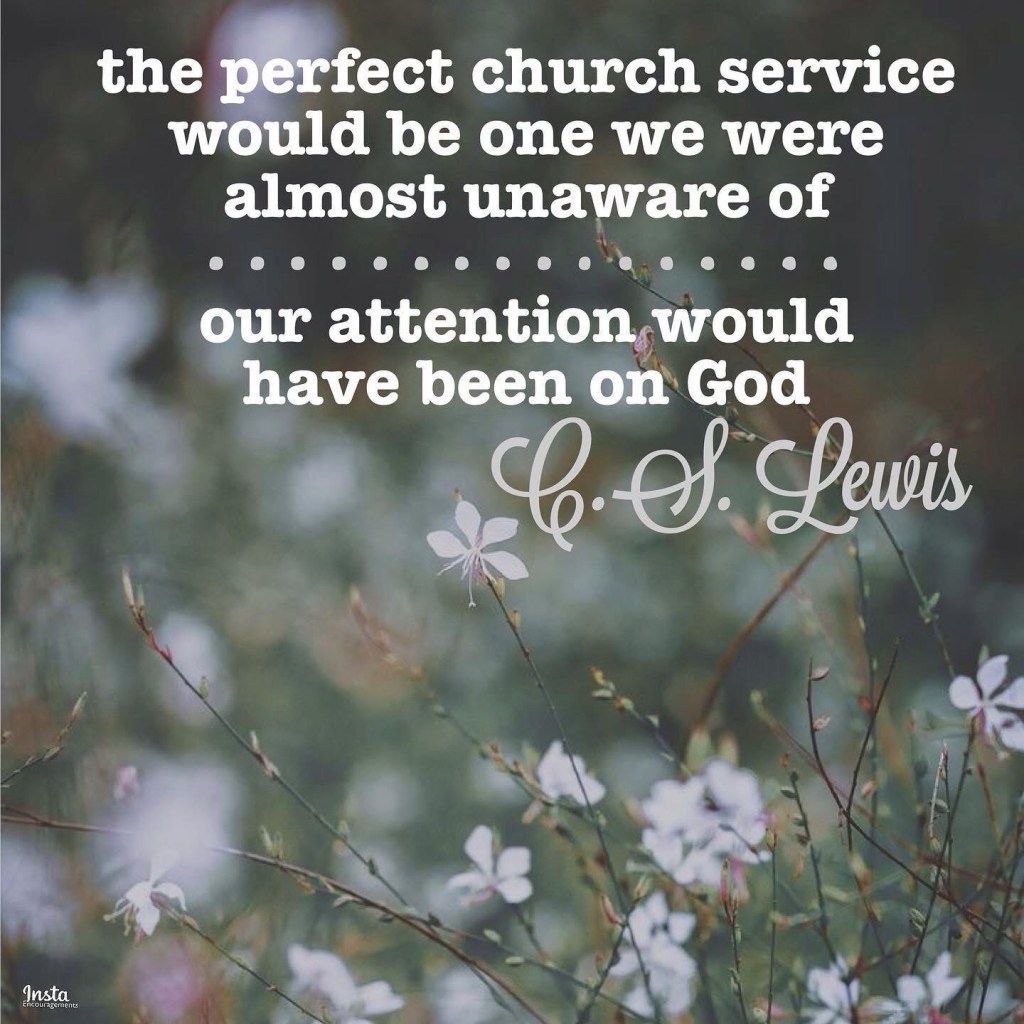
The Perfect Church Service

Jim Cymbala in his book Fresh Wind, Fresh Fire said something that floored me. If you walk away from any church service praising the sermon or the music, then that church has failed. If you’re focusing on the human elements of any worship gathering, the church has not done its job.

Ideally, the response to any worship service isn’t how great we are as a congregation or how great our ministry staff is, but how great is our God. As I read recently, our Sunday meetings can easily slip into Christiak karaoke followed by Ted talks with tithes if we’re not careful.

The key is to allow room for the Holy Spirit to move. Too many churches have programmed their services down to the last second leaving no space for the Holy Spirit to speak to people’s hearts and minds. I for once am not advocating for two hour services, but I do think that sometimes we could be just as attentive to the gentle whisper of the Spirit as we are to the worship schedule.

I also think that we (especialy me) need a shift in our mentality about worship. If our goal is to meet with God, then it shouldn’t matter if the songs were hundred year old hymns or the latest CCLI worship songs. It shouldn’t matter that the pastor made all his points start with the same letter or not.

Our goal is not a great sermon or a deeper worship experience through carefully cultivated worship playlists but to encounter the living and holy God. He’s the true audience of any worship service, not us. Otherwise, it’s just another concert or music event with no more benefit than if we’d stayed home and listened to a Christian Spotify playlist or watched a televised sermon from some famous preacher.

Lord, as we prepare to meet You tomorrow in our places of worship, move in our hearts to yearn for You and You only. Give us eyes to see You and ears to hear from You that You might speak a word to us tomorrow and we could walk away from the gathering different than when we arrived. Speak, Lord, for Your servants are listening. Amen.

Another Day, Another Psalm

“You’re all I want in heaven!
    You’re all I want on earth!
When my skin sags and my bones get brittle,
    God is rock-firm and faithful.
Look! Those who left you are falling apart!
    Deserters, they’ll never be heard from again.
But I’m in the very presence of God—
    oh, how refreshing it is!
I’ve made Lord God my home.
    God, I’m telling the world what you do!” (Psalm 73:25-28, The Message).

It struck me that one thing David did very well was to express gratitude for the goodness of God. Sure, he was vocal about some of the hardships he went through. He was very honest about his own struggles. But never forget that a large part of the Psalms is David singing God’s praises.

I think if believers were as loud about God’s goodness as we are about what’s wrong with everything, people might be more inclined to listen to what we have to say. As my old pastor used to say all the time, Christians are more known for what we’re against than what we’re for.

Worship is a way of expressing gratitude. It’s giving God His breath back, as I heard it put recently. That means we acknowledge that everything we are and everything we own, including the very breath in our lungs, comes from God. When we give thanks, we’re saying that God is God, and we’re not. We’re declaring our dependence on God that He will continue to be good to us.

I think expressing praise builds our faith muscles. When we verbalize our gratitude, we are testifying to God’s faithfulness and giving the most effective sermon anyone could ever hear. People can argue our politics, our theology, and our doctrines all day long, but they can never refute the genuine testimony of someone who has seen and experienced the goodness of God.

Lord, open our mouths to declare Your praises all day long as Your servant David did so long ago. Help us to be as faithful to share You with others as You were faithful to share with us by revealing Yourself to us and give us all things pertaining to life and godliness, Amen.

Gut-Level Honest Prayers

“God, listen to me shout, bend an ear to my prayer.
When I’m far from anywhere,
down to my last gasp,
I call out, “Guide me
up High Rock Mountain!”

“You’ve always given me breathing room,
a place to get away from it all,
A lifetime pass to your safe-house,
an open invitation as your guest.
You’ve always taken me seriously, God,
made me welcome among those who know and love you.

“Let the days of the king add up
to years and years of good rule.
Set his throne in the full light of God;
post Steady Love and Good Faith as lookouts,
And I’ll be the poet who sings your glory—
and live what I sing every day” (Psalm 61, The Message).

I’m up to the Psalms in my yearly Bible reading. They were originally the equivalent of a hymnal for God’s people back in the days before Jesus. You could also call the Psalms the prayer book of the Bible. Many of them were penned by King David, who never was one to mince words with God. They’re honest. They’re raw. They’re confessional. They’re sometimes not very pretty.

I think we lose something when we try to “pretty up” our prayers to make them more presentable before God. After all, He already knows what you’re thinking when you’re heart is breaking and you’re still trying to use flowery language because you somehow think those kinds of prayers are more acceptable to God. I confess I’m guilty of that one.

Prayer is the one place you can be honest. You can be real. I do think that you should still be reverent and not make Jesus your homeboy, but I also think God can handle your emotions and your frustrations.

Prayer doesn’t have to be pretty. Prayer doesn’t have to be proper. What prayer does need to be is authentic. Don’t tell God what you think He wants to hear. Tell Him where you are and how you feel and where you want to be. The key in every prayer is to say, “Not my will but Thine.”

That’s the prayer that never fails. You’re saying to God, “I know that You know better than I do what’s good for me and what will make me more like Jesus. You still work all things together for good, so I can trust You with my life.”

The best way to get good at praying isn’t to read more books about praying (although that can be super helpful). The best way isn’t to attend all sorts of seminars and listen to all kinds of sermons about prayer (which again can be useful). The best way to get good at praying is to pray.

I mean pray all the time. Pray whenever it comes to mind. Pray when you feel like it. Pray when you don’t. Pray when the words flow. Pray when there are no words. To borrow the old Nike slogan, just pray.

Revisiting Rivendell

Lately, I’ve been listening to a lot of Audible. The latest listen is The Lord of the Rings, one of my favorite books ever. I can’t tell you how many times I’ve either read or listened to this trilogy (which technically is really one book divided into three parts). I always forget how incredible the story is and how Tolkien created an entire world complete with mythology and languages out of his own imagination.

For me, revisiting a favorite book is like going to a familiar spot on vacation. You know what to expect. You know what’s coming. Yet there are those moments you forgot that come back to mind once you start the book. And this is one case where as much as I really liked the movies, the books were way better.

I always used to imagine what it would be like to go on a quest like the one Frodo and friends end up on. Part of me still thinks it might be exciting, but the whole sleeping on the ground is a bit less appealing than it used to be. I’d prefer the comfy dwellings of Bag End with all its Hobbit furnishings and multiple meals and so forth. I do feel that I am a Hobbit at heart.

But also there is so much of the gospel in these books. So many of the characters have Christlike qualities and make noble sacrifices for the good of the company. Plus, there’s the whole good versus evil theme that never grows old.

I recommend starting with The Hobbit (or if you’re really adventurous and brave, start with The Silmarillion, which gives you a rich and detailed historyfor how Middle Earth came into being). It helps if you’re reading to find a hardback copy with good illustrations. It help to visualize what you’re reading.

If that makes me a nerd, so be it. At least for the next few weeks, I’m a happy nerd.

The Covenant Story

I don’t know how many of you remember an old Rich Mullins song that talks about Leah and Rachel. It says that Jacob loved Rachel, and Rachel loved Jacob, and Leah was just there for dramatic effect. Rachel was the pretty one. Leah had “weak eyes,” which I’ve always been led to believe meant that she had a really great personality. You know what that means.

Leah was the pawn in Laban’s cruel practical joke on Jacob. Neither one of them loved her very much to treat her the way they did. It’s obvious that Rachel was the favorite child. Also, remember that this is just another in a long line of examples that show how polygamy in the Bible never had a positive outcome, yet God worked through these broken people with broken relationships to bring about the salvation plan for the world.

I read something recently that completely flipped my perspective on the whole Jacob-Leah-Rachel story in Genesis. I confess that I was a full-on Rachel fan for most of my life. She was the one I would have chosen, and Leah came across as whiny. But now I think that Leah was God’s chosen instrument to carry on the lineage that lead to the Messiah. Jesus didn’t come through Rachel, but Leah.

Read these words and remember that when you feel rejected by the world and by those you love, that God has a different story in mind for you. As Paul says in 1 Corinthians 1:27, “Isn’t it obvious that God deliberately chose men and women that the culture overlooks and exploits and abuses, chose these ‘nobodies’ to expose the hollow pretensions of the ‘somebodies’? (1 Cor. 1:27, The Message).

“Did you know Jacob was buried with Leah, not Rachel?
Not the woman he loved.
Not the one he cried for.
Not the one he labored fourteen years to have.
Leah.
In Genesis 49:29–31, when Jacob was about to die, he gave a clear instruction:
“Bury me… in the cave… where Abraham and Sarah are… Isaac and Rebekah… and there I buried Leah.”
Pause.
Rachel was his passion.
Leah was his alignment.
Rachel was the love story.
Leah was the covenant story.
Rachel had his emotions.
Leah carried the promise.
Rachel was buried on the roadside (Genesis 35:19).
Leah was laid in the ancestral grave of covenant—the lineage of God’s dealings.
And here is the mystery:
Leah was the rejected one.
The one Jacob didn’t choose.
The one he endured, not desired.
But heaven chose her.
From Leah came Judah.
From Judah came Jesus Christ.
Let that settle in your spirit—
The woman rejected by a man
became central to God’s redemptive plan.
This is where many people miss it:
We are all trying to be “Rachel”—
seen, desired, celebrated.
But God builds legacy through “Leah seasons”—
hidden places, painful processes, quiet obedience.
Jacob’s final decision was not emotional—
it was spiritual alignment.
At the end of his life,
he didn’t choose love…
he chose covenant.
And that is the gospel pattern:
God does not build His purposes on human preference.
He builds on grace and election.
So if you feel overlooked…
if you feel like second choice…
if life has not chosen you first—
hear this clearly:
God’s choice overrides man’s rejection” (Joanne Macfarlan Pharo)

Declaration of Dependence

“We have to realize that we cannot earn or win anything from God; we must either receive it as a gift or do without it. The greatest blessing spiritually is the knowledge that we are destitute; until we get there Our Lord is powerless. He can do nothing for us if we think we are sufficient of ourselves; we have to enter into His Kingdom through the door of destitution. As long as we are rich, possessed of anything in the way of pride or independence, God cannot do anything for us. It is only when we get hungry spiritually that we receive the Holy Spirit” (Oswald Chambers, My Utmost for His Highest).

I think Jesus said something about this. Blessed are the poor in spirit? That seems to ring a bell. It’s only when I realize that I am spiritually bankrupt that I can open my hands to receive what God has for me. It’s only when I confess my own destitution that I can be useful to God. As long as I think I bring something to the table when it comes to serving the Lord, I get in my own way.

The way to blessing is through a declaration of dependence. We can go to God and say that we are completely helpless and can do nothing apart from Jesus. We confess that our own righteousness is like filthy rags. We declare that it’s only through abiding in the Vine that we can grow and flourish.

Lord, I commit myself to You. I know that apart from You I have nothing and I am nothing. Everything good in me is from You. I make my declaration of dependence in You and want to live from now on in the freedom of being nothing other than Your beloved child in whom You are well pleased because when You look at me You see Jesus. Amen.