Spinning the Christmas Spirit

For those who keep up with these blog posts of mine, you know my new favorite hobby is spinning vinyl. In non-hipster lingo, that means playing records. Now that we’re in Advent season, I love being able to drop the needle on a Christmas LP and let it take me away.

I have a mix of old and new, standard and obscure, secular and sacred. It’s the soundtrack for the season. So many of these songs take me back to my earliest memories of when I was little and hearing them for the first time. Suddenly, I can see some of the faces that had faded from my memory. I remember names I’d forgotten and miss those whom I loved who aren’t here anymore.

I love how even the most secular of artists will include a sacred selection or two. After all, it’s impossible to have Christmas without the Christ-child smack dab in the center of it all. I get that the season has been secularized and commercialized into insanity, but the music always seems to bring me back to the true meaning of what Christmas is all about.

I’m sure one of the reasons so many love music is that music originated in heaven and will be one of the first things to greet the new arrivals in heaven the moment they slip into eternity. Music is the language of heaven, so any music, no matter how far removed from its sacred origins, is a shadow and a reminder of what’s to come. I believe the best of the music here will be among the songs we’ll hear and sing around the throne of God.

So I’ll be spinning those Christmas records from now through Christmas until at least the Epiphany on January 6. Maybe even beyond if I don’t get tired of them by then. And I’ll be loving every minute of it.

A Prayer for Humility and Sincerity in our Faith

“We long for a humble and sincere faith in our divine Lord. Lord, if it is necessary to break our hearts in order that we may have it, then let them be broken.If we have to unlearn a thousand things to learn the sweet secret of faith in him, let us become fools that we may be wise, only bring us surely and really to stand upon the Rock of Ages—so to stand there as never to fall, but to be kept by the power of God, through faith, unto salvation.
As Christians, we should be humble. Lord take away our proud look; take away the spirit of ‘stand by, for I am holier than thou;‘ make us condescend to people of low morals. May we seek them out and seek their good. Give to the church of Christ an intense love for the souls of men. May it make our hearts break to think that they will perish in their sin. May we grieve every day because of the sin of this city. Set a mark upon our forehead and let us be known to you as people who sigh and cry for all the abominations that are done in the midst of the city.
Amen” (Charles Spurgeon).

Lord, make us humble in our relations to others and to You. Keep us sincere as we seek Your face and serve our brothers and sisters in Christ. May our compassion never cancel out our convictions nor our convictions cancel our compassion.

Jesus, just as You told the woman caught in the act of adultery that He didn’t condemn her, so may our hearts be far from judging with an eye to condemn. And just as You told her to go and sin no more, may we also be zealous to stir one another to holiness in all our words and deeds.

Help us to love with a holy love that seeks nothing less than the best from the beloved, just as You settle for nothing less in us than for us to be made like Christ in every aspect of our lives. Amen.

Learning to Pray

This one is from Dr. Mike Glenn (but for all the Kairos folks out there, he will always be Uncle Mikey):

“In Luke 11, we have his version of the Lord’s Prayer. To introduce the prayer, Luke tells us the disciples came to Jesus and asked Him to teach them how to pray.

I’ve always been fascinated with their request.

For one thing, I’m not sure it’s what I would’ve asked Jesus.

Knowing me, I would’ve asked Him to teach me to walk on water (we know how that worked for Peter) or to raise the dead. I would’ve gone for something impressive, something flashy.

But this isn’t what the disciples wanted.

Why?

I think they could tell there was something powerful yet intimate in the way Jesus prayed. Things happened when Jesus prayed. People changed when Jesus prayed.

And the disciples knew if they could learn to pray like this, they would be able to do more than they had ever imagined.

Too many times we treat prayer casually. It’s something we do before we go to sleep or before we eat, but we rarely pray knowing there’s potential in our prayer to change the world, to change someone’s life.

This is what the disciples wanted to learn how to do.

It’s what we in the postmodern church need to learn as well.”

Prayer isn’t a last resort when all else has failed. It should be first on the agenda of any major (or minor) undertaking. As Oswald Chambers said, prayer isn’t preparation for great and mighty spiritual battles. Prayer is the battle. Everything else is akin to cleaning up the spoils after the victory has been won.

Jesus, teach us to pray as you taught your disciples. Let us always remember the words you taught them so that we can use them to guide our own requests and petitions or simply fall back on them in time of need:

“Our Father in heaven,
Reveal who you are.
Set the world right;
Do what’s best—
    as above, so below.
Keep us alive with three square meals.
Keep us forgiven with you and forgiving others.
Keep us safe from ourselves and the Devil.
You’re in charge!
You can do anything you want!
You’re ablaze in beauty!
    Yes. Yes. Yes.” (Matthew 6:9-13, The Message).

In the Furnace

“One day we took the children to see a goldsmith refine gold after the ancient manner of the East. He was sitting beside his little charcoal fire. (‘He shall sit as a refiner’; the gold- or silversmith never leaves his crucible once it is on the fire.) In the red glow lay a common curved roof tile; another tile covered it like a lid. This was the crucible. In it was the medicine made of salt, tamarind fruit and burnt brick dust, and imbedded in it was the gold. The medicine does its appointed work on the gold, ‘then the fire eats it,’ and the goldsmith lifts the gold out with a pair of tongs, lets it cool, rubs it between his fingers, and if not satisfied puts it back again in fresh medicine. This time he blows the fire hotter than it was before, and each time he puts the gold into the crucible, the heat of the fire is increased; ‘it could not bear it so hot at first, but it can bear it now; what would have destroyed it then helps it now.’ ‘How do you know when the gold is purified?’ we asked him, and he answered, ‘When I can see my face in it [the liquid gold in the crucible] then it is pure’ (Amy Carmichael, Gold Cord).

Some of you are in the furnace right now. It might be the furnace of affliction, suffering, and pain. It might be the furnace of rejection and loneliness. Or it might be the furnace of unfulfilled hopes and dreams. Whatever it is, you can probably think of a million places you’d rather be than in that furnace.

But remember in the furnace is where you’re purified and sanctified. As much as I want it to be true, holiness doesn’t come from happiness. All those glorious spiritual mountaintop experiences aren’t what make you more like Jesus. It’s trudging through the valley where you learn and grow and become who God made you to be.

In one of my favorite books, Hinds’ Feet on High Places, the main character Much Afraid is sent out on a quest by the Shepherd and given two companions to help her on her way. Their names are Pain and Suffering. At first, she recoils and almost rejects them, but after some thought and reflections on the goodness of her Shepherd, she accepts their guidance. In the end, they are as much transformed as she is.

God takes what the world means to destroy us to strengthen us. He takes what was meant to set us back to move us forward. He takes what the enemy meant for evil, and He turns it for good (as the worship song goes). He’s working all things together for your and my good (even the crappy sucky stuff we’d rather move past and not have to deal with).

The end goal is for Jesus to see His likeness in us. For God to see His reflection in us and for the world to see God’s reflection in us as well. Then we know that we are truly being purified.

Known by Name

The old saying goes something like this: Satan knows your name but calls you by your sin. God knows your sin but calls you by name.

We live in a world that preaches a watered-down god that tolerates anything and everything but has no real power to do anything about real evil. In such a culture, it’s easy to take for granted that God loves me.

But when you look at the real God from the Bible who knows every single thing about you including all those hidden sins and secret pasts, and He still loves you? And not only that, but this love isn’t a benign and vague feeling but a love demonstrated in Christ laying down His life for us.

That is an infinite love. It means He loves each and every one of us as if we were the only ones to love. He loves us with a purifying love that doesn’t merely tolerate us and cover over what’s wrong with us. His love transforms us and removes anything that is unworthy of God’s holiness or keeps us from being who God made us to be.

If we really understood and believed in that kind of love, we’d live different. We’d be different. The ones who get the love of God are the ones who love God and others well. They seek to know and do what Jesus says, not out of obligation but out of adoration. Their lives are a testimony to others and a kind of thank you back to God.

“My response is to get down on my knees before the Father, this magnificent Father who parcels out all heaven and earth. I ask him to strengthen you by his Spirit—not a brute strength but a glorious inner strength—that Christ will live in you as you open the door and invite him in. And I ask him that with both feet planted firmly on love, you’ll be able to take in with all followers of Jesus the extravagant dimensions of Christ’s love. Reach out and experience the breadth! Test its length! Plumb the depths! Rise to the heights! Live full lives, full in the fullness of God” (Ephesians 3:14-19, The Message).

An Evening Prayer

“Lord, we come to You not because you are our last hope, but because You are our first love.

We’re not waiting to come to You only when we think there’s nothing else we can do. We’re coming to You *before we do anything at all* because waiting on You is *wisest* of all. We trust You to work all this out in Your good time — because that will be the best time, and You are only good and You hold all time. *Kneeling the most lets us stand the bravest.* Tonight we kneel and lay our painful problems in Your hands and thank You for the perfect peace You put in our hearts.

In Jesus’ name, Amen. #EveningPrayer#RestinginHisWord” (Ann Voskamp).

Lord, I confess that I only come to You when I need something. Often, You are my last resort. I acknowledge that when everything is going well, I simply don’t see my need for You. It’s only when life gets difficult and stressful that I finally manage to look up to You.

Thank You for being patient with me. You have shown me more mercy than I deserve. If You treated me the way I treat You most of the time, I probably wouldn’t be here. I’d definitely be a lot worse off than I am.

But Your word says that You are faithful even when I’m faithless. You continue to work in me even when I don’t work at all. You honor Your promise to complete what You started in me even when I make promises to You that I don’t keep.

I know that I can look back and see growth. I can see change. I can see that in the past, my lackadaisical faith wouldn’t have bothered me nearly as much as it does now. I can see that I am more committed to You than I was last year or in the last decade.

Lord, make me more like You. Period.

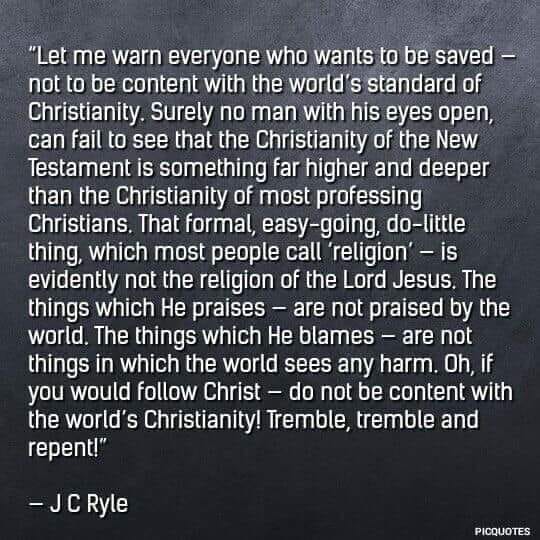
Tremble, Tremble and Repent

This isn’t supposed to be a brimstone and hellfire type post (although sometimes I do think we need to bring back preaching that isn’t afraid to step on a few toes while proclaiming the whole gospel for the whole person).

I do think that American Christianity has progressed to the point where it barely resembles New Testament Christianity. People can come to most churches and feel comfortable living in sin and not once feel convicted about their lifestyle choices and behaviors. There is very little accountability and next to no discipline at any given local church.

Yes, Jesus did say to the woman caught in adultery that He didn’t condemn her, but He also added “Go and sin no more.”

I think the American church needs to champion social justice AND personal holiness. It’s not an either/or, but a both/and. Read Isaiah 58 if you want to know what biblical social justice looks like, but also read Romans 12:1-2 (and many other passages) that compel us to be holy and set apart.

There’s a lot of emphasis on getting people saved, but not much on discipling them afterward. The result is that many people sitting in any given church service on Sunday know very little about the Bible or the faith they’ve professed to believe. Very few actually know how to live out that faith and apply it to every day situations.

I do think that the American church needs revival. Not the kind where people get saved (although that would be awesome) as much as the kind where the people who are saved start acting and living like it. Including yours truly.

It starts and ends with the Bible. It’s about preaching the gospel to yourself all day every day. It’s about falling at the feet of Jesus and declaring your dependence on Him once again. It’s about living a Romans 12:1-2 life of sacrificial worship that is radically different than the world. It’s about loving God and loving others the way God in Jesus has loved us.

Focus

I’m thankful every year for my social media break during Lent. I do like my Facebook and Instagram, but I also confess I get very tired of people being preachy on just about all of their posts. And by preachy, I don’t mean the kind where you offer the plan of salvation but the kind where you point out the faults of all these other people who just about always happen to be on the other side of the political spectrum.

These days, I see a lot of posts (even from people who profess to follow Jesus) about Karma. Usually, Karma is when other people get what they deserve, not me. Typically, these people will offer themselves more grace and wish karma for the others. I confess that I’ve been guilty of a double standard at times for me messing up versus someone else messing up.

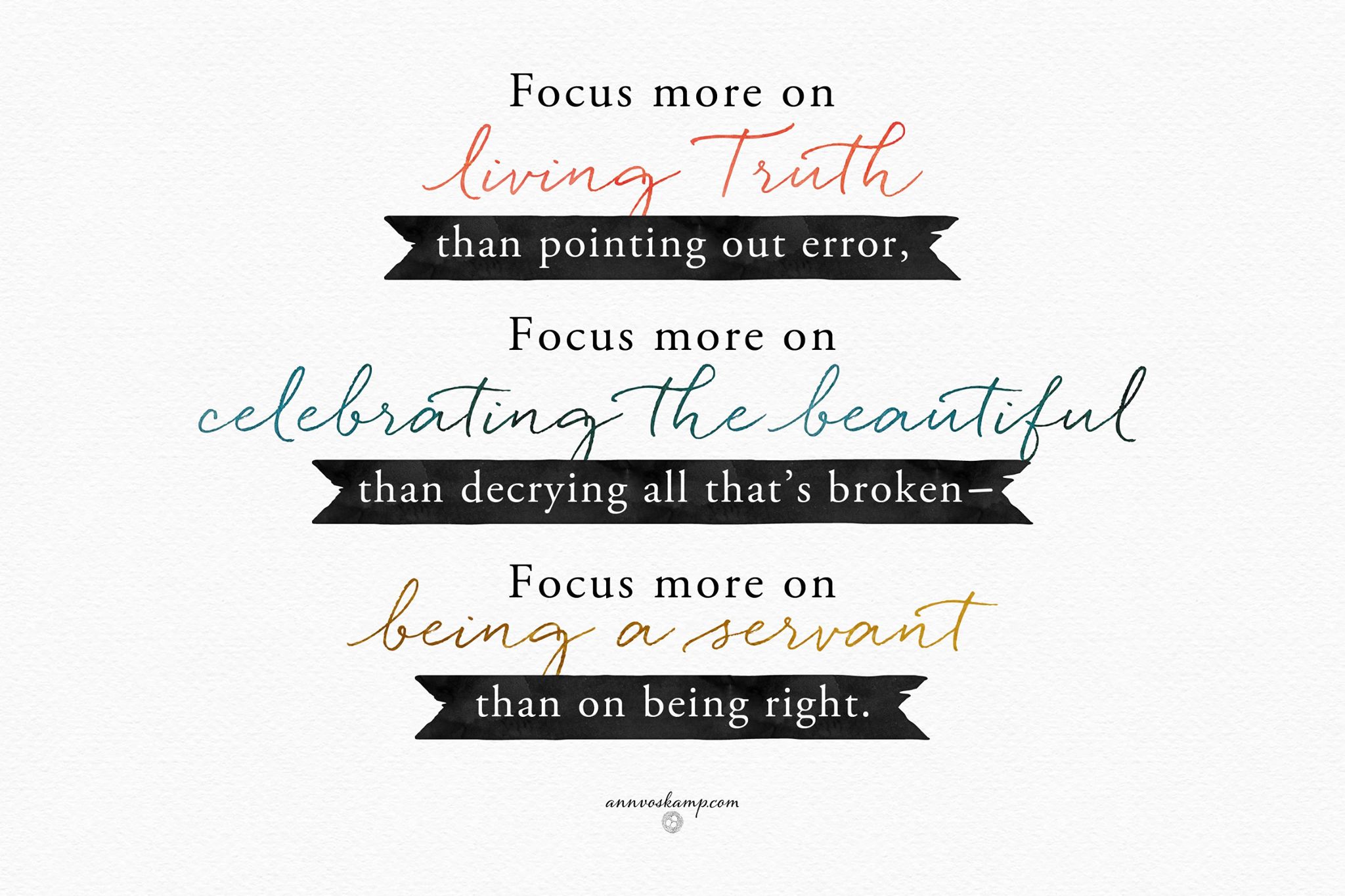
But if you’re living truth, you probably won’t have enough time to point out everyone else’s errors. If you look for ways to celebrate the beautiful, you won’t dwell on the broken. And if you focus on being a servant, you won’t need to win every argument and always be proven right.

If you and I are honest, we need a lot of work. We need a lot of grace. We’re too messed up to judge anyone else being messed up. We’re too spiritually broken to be all high and mighty when it comes to calling out other people’s motives and character. Instead of moralizing, we need to preach the gospel to ourselves and to others every single day.

“f you asked twenty good men today what they thought the highest of the virtues, nineteen of them would reply, Unselfishness.  But if you had asked almost any of the great Christians of old, he would have replied, Love.  You see what has happened?  A negative term has been substituted for a positive, and this is of more than philological importance.  The negative idea of Unselfishness carries with it the suggestion not primarily of securing good things for others, but of going without them ourselves, as if our abstinence and not their happiness was the important point.  I do not thik this is the Christian virtue of Love.  The New Testament has lots to say about self-denial, but not about self-denial as an end in itself.  We are told to deny ourselves and to take up our crosses in order that we may follow Christ; and nearly every description of what we shall ultimately find if we do so contains an appeal to desire.  If there lurks in most modern minds the notion that to desire our own good and earnestly to hope for the enjoyment of it is a bad thing, I submit that this notion has crept in from Kant and the Stoics and is no part of the Christian faith.  Indeed, if we consider the unblushing promises of reward and the staggering nature of the rewards promised in the Gospels, it would seem that Our Lord finds our desires not too strong, but too weak.  We are half-hearted creatures, fooling about with drink and sex and ambition when infinite joy is offered us, like an ignorant child who wants to go on making mud pies in a slum because he cannot imagine what is meant by an offer of a holiday at the sea.  We are far too easily pleased” (C. S. Lewis, The Weight of Glory).

Speak, Lord

Right now, I’m having a random memory. I don’t know why, but the words that Chris Brooks always spoke before reading a Bible passage are coming back to me. He’d pray, “Lord, would you go before us in this text and make a way. And together we say, ‘Speak, Lord, for your servants are listening.'”

Sometimes, I invite God into my Bible reading. Sometimes, I just plow right in. Sometimes, it feels like God is speaking to me as if He’s been reading my diary. Sometimes, it’s like reading words off of a page that I forget as soon as I’ve read them. Hmm, I wonder if there’s a connection.

I don’t necessarily think that there are magic words that force God to give us new insights into Scripture. There’s not an Abracadabra and then suddenly you understand everything about John 3:16 or 2 Timothy 3:16. But I think praying God’s blessing over the reading of His word helps us to understand that these are His words we’re reading more than simply being an ancient text.

There are lots of ancient texts. Especially religious ones. But none of the others are living and active. None of them can transform. In none of them can a passage you might have read hundreds of times suddenly jump out at you with new insight and application.

I’ve loved reading through the Bible again this year. Even the parts that aren’t always easy reading are divinely inspired. I know that in the more depressing moments that the meta-narrative is still leading me to Jesus. As badly as God’s people fail, that’s how much grace Jesus showed us when He arrived. More and more, I can relate to all the bone-headed decisions and choices that these people made. More and more, I see my need to preach the gospel to myself over and over because I still see my deep need of it every day.

So as we open the pages of the Bible to seek God’s face more than gain new knowledge, we invite You, Lord, to speak, for we are listening.

Be Ready

“If with heart and soul you’re doing good, do you think you can be stopped? Even if you suffer for it, you’re still better off. Don’t give the opposition a second thought. Through thick and thin, keep your hearts at attention, in adoration before Christ, your Master. Be ready to speak up and tell anyone who asks why you’re living the way you are, and always with the utmost courtesy. Keep a clear conscience before God so that when people throw mud at you, none of it will stick. They’ll end up realizing that they’re the ones who need a bath. It’s better to suffer for doing good, if that’s what God wants, than to be punished for doing bad. That’s what Christ did definitively: suffered because of others’ sins, the Righteous One for the unrighteous ones. He went through it all—was put to death and then made alive—to bring us to God (1 Peter 3:13-18).

That’s the key. Be ready. If you live a godly life (or even make the attempt in the Spirit of God to live a godly life) it will draw attention. I heard once that believers should live questionable lives, but not in the sense of believing one way and living another but in such a way that the way we speak and behave will draw questions as to why we’re different (in a good way, hopefully).

I also think we should be praying at every moment for opportunities to have gospel conversations, especially with the family and friends we love and hold dear. I know the famous quote attributed to Saint Francis says to preach the gospel at all times and use words if necessary. I think from the Great Commission, words are always necessary. We simply need wisdom and discernment as to the timing of when we’re supposed to speak up and tell our gospel story.

The more the world slips further away from God, the more we will stand out. The more those not of God will hate us and mistreat us and try to trip us up. But also the more people will see something about us that they don’t have — peace under pain , joy in the midst of sorrow, patience under suffering, hope that never fails. Then some will want to know about that hope that we have. Then we should be ready to give an answer.

I found something that every believer should pray called the Three Open Prayer: “1) Lord, open a door to share the gospel. 2) Lord, open the heart of the lost to receive the gospel. 3) Lord, open my mouth to share the gospel.”