Trusting in the Wrong Things

“A man was meant to be doubtful about himself, but undoubting about the truth; this has been exactly reversed. Nowadays the part of a man that a man does assert is exactly the part he ought not to assert – himself. The part he doubts is exactly the part he ought not to doubt – the Divine Reason” (G. K. Chesterton, Orthodoxy).

These days, the problem is always with THEM. It’s always someone else’s fault. In politics, the blame has gone to either Trump or Harris supporters, depending on which side of the aisle you sit. It has become very fashionable (and very easy) to point the finger from a high and lofty position with which to judge others.

Even in this, I have to point the finger at myself as well. I can’t tell you how many times I read a passage in my Bible and thought how this or that person needed to hear it. They’re the ones who need straightening out.

But then God gently reminds me that this word I’m reading is not for anyone else but me. The reason for my time in God’s Word isn’t so I can use it to point out other peoples’ flaws. If there’s any finger pointing, it’s me pointing back at me.

In this culture, it’s also popular to redefine truth and Christianity to fit into societal norms rather than transforming society by biblical truth. So many people and churches and even denominations have watered down the gospel to the point that it’s only a kind of feel good self-help doctrine where no one’s really lost and sin doesn’t really exist and everyone’s going to heaven and it really doesn’t matter how you live.

But the problem is that there’s no hope in that kind of gospel. There’s no deliverance or transformation or future. Jesus talked about the blind leading the blind, and that fits a lot of current theology. But Jesus came to set us free and not just make us better human beings but brand new creations. He came to die for us while we were yet sinners that we might truly become the sons and daughters of God.

The Bible talks about working out your salvation in trembling and fear. Maybe that looks like preaching the gospel to yourself and each other every single day. Maybe it looks like not trusting in your own understanding but in all your ways leaning on God’s revealed truth and on God Himself. Maybe it looks like not accepting everything that comes from a pulpit or position of authority but exercising discernment by checking everything against the Word of God to see that it matches.

Reframing Your Past, Present & Future

I’ve never thought about gratitude like that before. I get that it changes the way you see your present and can shift how your future plays out, but to change your perspective on your past? That’s a game changer.

The old saying about grace is that it means that your past now serves a purpose instead of serving shame. Gratitude helps you to see how every part of your past, good and bad, has led you to the present moment. God was in all of it with you, taking those dark and painful moments to weave them in with the brighter colors.

Also, sometimes when you look at a famous painting too closely, it looks like a big chaotic mess. You can’t tell anything about it. But once you step back, it becomes clearer. The same applies for life — once you can step back after a few days or weeks or months, you can see more clearly what God was up to in that moment.

You don’t have to give thanks FOR those awful moments and tragedies. But you can give thanks IN them. Paul didn’t say give thanks FOR all circumstances but IN all circumstances, knowing God works all things together for good and there is a redemptive purpose for pain and loss.

I still think about that quote about muddy water becoming clear as it settles and is still. So do we. Everything becomes clear when we cease striving to make it make sense and can be still and know that God is God, to know that God is still in control and in charge.

And it all begins with gratitude.

A God We Can’t Exaggerate

“Many Spirit-filled authors have exhausted the thesaurus in order to describe God with the glory He deserves. His perfect holiness, by definition, assures us that our words can’t contain Him. Isn’t it a comfort to worship a God we cannot exaggerate?” (Francis Chan)

There’s a beautiful old book by J. B. Phillips called Your God Is Too Small. I think that’s the case for anyone who has ever lived who tried to conceive the idea of God. We always fall short. We always make God way too small.

The problem with a lot of deconstruction is that we make ourselves the standard by which God and truth are measured. We are definitely too finite and small to be any kind of measuring stick to which God must conform (thanks to Frances Chan for that one as well). It’s putting ourselves above God, essentially saying that God would never [fill in the blank] because I would never [fill in the blank].

God not only above us, He is so far beyond us that our minds could never have fathomed God at all apart from God revealing Himself to us. That blows my mind. It also humbles me whenever I get to the place where I think I have God figured out.

We can’t possibly exaggerate God. How cool is that? The biggest, grandest, wildest picture we can dream up or draw or sing about or write about falls short of who God is by far. All we can do is sit at the brink and adore the depth, to borrow from Matthew Henry.

God is never too small. Only our conception of Him is. But God made Himself incarnate and came near and became a tiny infant. That’s my favorite part.

Homesick for God?

“How many people have you made homesick for God?” (Oswald Chambers, Disciples Indeed)

That’s the key to evangelism, I think. It’s not constantly reminding people how sinful they are or ridiculing their worldview. I think in that approach we forget that we too were once sinful and had wrong beliefs about the universe.

What was it that won you over? What was it that made you want to know and love God? Was it really someone telling you what an awful person you were? Was it someone constantly berating your beliefs?

I think the key is to make people long for God to the point where they’re homesick for God. I think people seeing you loving God and living out of the overflow of God’s love for you will want to know God. People who see you loving others well the way God loved you well will crave that kind of love, even if they don’t have a name for it.

The way the early Church drew people was in how those believers loved each other. They loved lost people as well, but mainly it was in their love for each other that made people want to hear their gospel message.

If all you have is a well-defined set of doctrines and beliefs, no one cares. If all you have is a passion for making people as moral as you are, then no one wants to hear about it. But when you live transformed and let the life of Christ in you permeate everything you do, then people can’t help but see and be drawn to what they don’t have.

The key is to make people homesick for a home they’ve never known but want to go to more than anything or anywhere else. Make them homesick for God.

Come Out from Among Them

“Therefore go out from their midst,
    and be separate from them, says the Lord” (2 Corinthians 6:17,ESV).

I think the time is coming when true followers of Jesus will have to “come out from among them and be separate,” as the old King James puts it.

I think for some of us, it will mean leaving churches and denominations that no longer teach the Bible or the true gospel of Jesus. It might mean distancing yourself from a political party (or both of them) that no longer follows biblical morality.

I have to tread carefully here because I don’t want to be judgmental, but I think America has a lot of people who identify as Christians but a lot less who actually follow Jesus. Many are spiritual or religious but far fewer have been truly born again and are regenerate new creations.

The answer to the moral free fall the country is in is not to get “our” people elected or to get “our” platform made into law. It’s not even to get lost people to act right. It’s to get Christians back to believing and acting like Christians. It’s to get churches back to the whole gospel of Jesus and the whole Bible, teaching those old-fashioned concepts like hell, sin, atonement, and salvation.

We probably need to learn how to believe in the gospel again apart from the American Dream that we’ve woven into the redeeming narrative of the cross. We need to return to being the prophetic voice of God instead of vying for political power. We could do with a present day John the Baptist or two to tell people to repent because the Kingdom of God is coming.

We need to get back to the gospel that is for all people. Not a gospel of God loves you just as you are and wants you to stay that way, but God loves you too much to let you live in anything less than His absolute best for you. We also need to love the least of these like Jesus did, remembering when we serve one of these, we serve Jesus Himself.

We need a true revival not of showy emotions and signs and wonders but of confessing sin and repenting and turning from our way and following God’s way. We need to stop conforming with the world and letting it teach us theology and return to being transformed by the renewing of our minds by God’s word.

At this point, I think it will take a miraculous act of God to turn us around. You did it in the past, Lord. Do it again, God. Do it again.

Seek God First

“We know God too little. In our prayers, we are concerned less with His Presence, than the thing on which our heart is set.  We think mostly of ourselves, our need, and our weakness, our desire and prayer. But we forget that in every prayer God must be First, must be ALL” (Andrew Murray).

I forget that sometimes. My prayer life can easily become a laundry list of wants or a kind of cosmic letter to Santa about what I want for Christmas. I can get so wrapped up in my requests that I forget that God is so much more than what He can give me.

I forget that God can’t give me anything apart from Himself (with much thanks to C. S. Lewis for that one). Besides, what I really desire can’t be found outside of God anyway. What I really in my deepest heart of hearts need is God.

If I in my prayer life seek God first, strive after God’s Kingdom (which is no more or less than God’s active rule and reign more than a location), then God said He would give me the rest. In pursuing God whole-heartedly and solely, I end up finding everything I need without even looking for it.

I read something that shook me a bit. If I got everything I ever prayed for, would the whole world be better off or would just my little world be better? Am I praying for my own wants and need or am I seeking God’s blessings for those around the world who have yet to hear the gospel? Am I praying for those in my sphere of influence who don’t yet know Jesus?

I think if I seek God that way, I won’t care about a lot of what I pray for now. I also believe that my own needs will be met and God will give me what I would have asked for had I known what He knows and seen what He sees.

Burdens

I wonder how many of us are carrying secret burdens because we have this mentality of “I don’t want to be a burden to anyone else” and “I have to bear this alone.”

I do think that’s one of the negative consequences of this kind of Lone Ranger/ pull yourself up by your own bootstraps kind of individualized American Christianity. Not only is it okay to share your burdens, it’s actually commanded both bear one another’s burdens.

That means you occasionally take someone else’s burden. Also, that means that another sometimes takes your burden. It works both ways. Not only are you making your own life harder by bearing unnecessary burdens but you also deprive someone else of the joy of fulfilling God’s command in that way.

That’s the most tangible way we have of showing our love for each other. And oh, by the way, how we love each other is the greatest witness to the saving power of Christ and the gospel that we have. The early Church turned the known world upside down by how they loved each other. Also by how they loved their neighbors but mainly by their sacrificial love for each other.

My prayer is that churches become places where we can unburden and find rest, not a place where more burdens are added. Part of it starts with the Church but part of it starts with you and I being willing to share our burden and let it be known that we’re struggling instead of the pat answer of “I’m fine” whenever anyone asks how we’re doing.

I think when I let you share my burden and you share mine, we learn a little more of what it means when Jesus bore all our burdens to Calvary. We understand more of what it means about His yoke is easy to carry and His burden is light. And the world sees a love that it simply cannot resist.

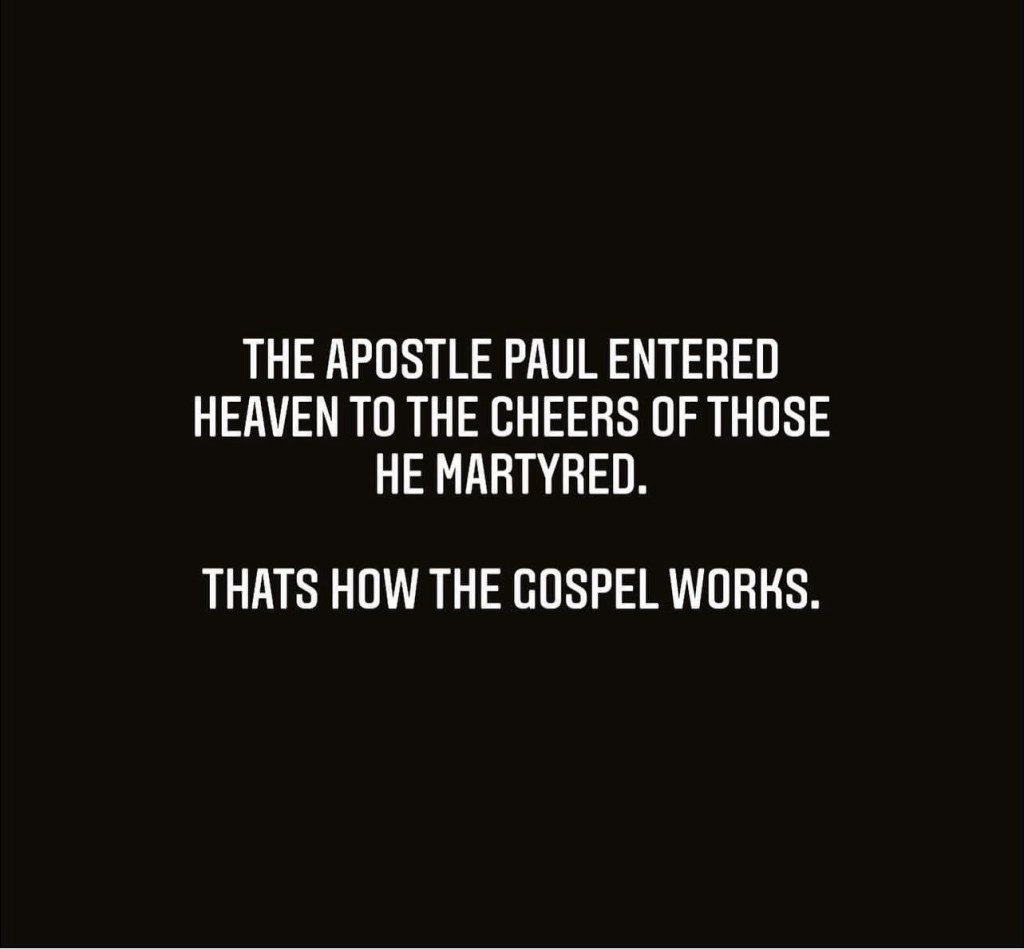
That’s How the Gospel Works

That’s not how I would have done it. If I’d had my way, probably Paul would have gotten his just desserts. He’d have received the same as he gave — that’s how Hollywood typically plays it. I can see his death scene playing out like Hans Gruber falling from the top of the Nakatomi Tower at the end of Die Hard.

But thankfully God’s ways are not like my ways. That same Paul went from being enemy #1 to Jesus and the faith to being the biggest champion of Christianity and spreading the gospel. God turned the bad guy into one of the good guys, as we’d say in old Hollywood.

That’s how the gospel works. The very worst of humanity can be transformed into a saint. And by saint, I don’t mean someone who is a notch above the rest of us and super holy. As I’ve heard it said, a saint isn’t someone who is good but who has seen and embraced the goodness of God.

It’s a bit of an ironic twist that the man who formerly persecuted the Church and made so many martyrs ended up himself becoming a martyr for the very faith he once tried to destroy. Again, that’s how the gospel works. That is something only explainable by the mercy of God.

That’s why I think a lot of the current political rhetoric is foolishness. Neither Biden or Trump are beyond the grace of God. That’s why I pray for the salvation of both every single night. Who knows? What an amazing testimony either one (or both) could have. And yes, I also pray for the salvation of Kamala Harris as well.

Who knows what any of us could be apart from the grace of God? Who knows that any of us could descend further than any Hitler or Stalin or Bin Laden? All of us are capable of any kind of evil apart from God’s continuous mercy.

I know that I’m not a believer because I was so very smart to choose Christ. I know it’s not because I was better than anyone else in the world. It’s only because God chose me first and set His love on me that I could even choose Jesus in the first place.

Billy Joel said, ““If I ever reach heaven I expect to find three wonders there: first, to meet some I had not thought to see there; second, to miss some I had expected to see there; and third, the greatest wonder of all, to find myself there.”

I think that any of us who end up in heaven will spend eternity amazed that we somehow made it in despite all our unworthiness and all the rest of that eternity will be our endless gratitude and praise for being there and for Jesus who got us there.

Holding on to the Gospel

“Too many times we give away the one thing the world needs from us to secure the shallow security of ‘fitting in'” (Mike Glenn).

“One of the most striking evidences of sinful human nature lies in the universal propensity for downward drift.

 In other words, it takes thought, resolve, energy, and effort to bring about reform.

In the grace of God, sometimes human beings display such virtues. But where such virtues are absent, the drift is invariably toward compromise, comfort, indiscipline, sliding disobedience and decay that advances, sometimes at a crawl and sometimes at a gallop, across generations.

People do not drift toward holiness. Apart from grace-driven effort, people do not gravitate toward godliness, prayer, and obedience to Scripture, faith, and delight in the Lord.

We drift toward compromise and call it tolerance;

we drift toward disobedience and call it freedom;

we drift toward superstition and call it faith.

We cherish the indiscipline of lost self-control and call it relaxation;

we slouch toward prayerlessness and delude ourselves into thinking we have escaped legalism;

we slide toward godlessness and convince ourselves we have been liberated” (Don Carson, For the Love of God, p. 23).

I remember in ye olden days when I first heard the plan of salvation. I can’t remember the exact details, but it involved a loving God, sin separating me from God, Jesus shedding His blood on a cross to make a way for me to be right with God, and eternal life that comes from salvation.

Now a lot of churches are preaching a gospel of “I’m okay, you’re okay, there’s no sin or need of salvation.” There’s no such thing as hell and God accepts everyone, regardless of lifestyle choices or addictive behavior. Churches are bending over backward to accommodate a culture we’re supposed to be trying to reach for Jesus. We’re blending in when we should be standing out, as I’ve heard it said.

We’ve traded in the gospel that is the power of salvation for something that has the form of godliness but without any actual power to do anything other than make people comfortable in their sin. The Apostle Paul would call such a gospel false and would say that anyone who preaches such a gospel, even an angel from heaven, is anathema or cursed.

The point was never to fit in. We’ll never fit in. Eventually, we’ll look and sound so much like the world that we’ll be unrecognizable as a church and cease to have any anointing or authority. When churches host pride events or have nights that celebrate people like Beyonce instead of Jesus, they have stopped being churches.

I think nothing short of revival will do. Nothing short of a supernatural movement of God in American churches will stop the drift away from true and orthodox faith. But God is still able. All we need to do is humble ourselves and pray.

Being the Easter People

Easter is over, according to all the stores and calendars. There are no more cute little bunny displays at your local Hallmark or Cadbury eggs or wicker baskets at the grocery store. Seemingly just about everybody has moved on to the next big holiday, which I believe is Mother’s Day in May.

But for those who celebrate Easter as Resurrection Day, the celebration goes on. We know that Jesus is still risen and alive. Plus, if you follow the Book of Common Prayer you know there is still Ascension Day and Pentecost to come.

I’m not against all the Easter bunnies and baskets and Easter egg hunts and all the candy. I’m especially not against the candy. But when you reduce Easter to these symbols and turn it into just one day, it cheapens the meaning.

Just as the birth of Jesus ushered in a new way of counting the years (as we moved from B.C. to A.D.), so Easter is equally a marker in history where everything changed. Many Old and New Testament prophecies came to pass on that day.

I hope that we won’t go back to business as usual next Sunday. I hope we will retain the message of Resurrection Day through all the weeks and months to come. The worst moment, the worst day, the worst part of your life is never the final defining moment in your life because Jesus is alive and the tomb is empty. Your hope is never in vain because Jesus conquered sin, death, hell, and everything else that will ever come against you to defeat you.

Easter isn’t just a day but a mindset. As Pope John Paul II said, “Do not abandon yourselves to despair. We are the Easter people and hallelujah is our song.”