Wimpy Faith

This is from Foxe’s Book of Martyrs:

“When sentence was read condemning [Mrs. Prest] to the flames, she lifted up her voice and praised God, adding, ‘This day have I found that which I have long sought.’ When they tempted her to recant, ‘That will I not (said she), God forbid that I should lose the life eternal, for this carnal and short life. I will never turn from my heavenly husband to my earthly husband; from the fellowship of angels to mortal children; and if my husband and children be faithful, then I am theirs. God is my father, God is my mother, God is my sister, my brother, my kinsman; God is my friend, most faithful.'”

I read something like that and my faith feels kinda wimpy. I don’t face anywhere near that kind of persecution. Compared to most believers around the world, my life is easy. Yet I can complain with the best of them.

I do believe there is a supernatural grace given to those undergoing extreme persecution. There’s an endowed strength given to those who are about to lay down their lives for the sake of the gospel. But I also believe one of the reasons the early church was so true and faithful was because they were the outsiders and the marginalized. They were the ones cast out and trodden down.

I definitely am not praying for persecution to come to America, but I think it’s inevitable. Persecution is the norm. America is the exception. Maybe that’s why we so often have such a watered-down gospel and diluted faith.

I recommend Foxe’s Book of Martyrs (preferably one with updated language). It’s hard to read sometimes, but also can be very encouraging to see those who endured torture and death because they like Jesus saw the joy that was laid out in front of them. May we be as faithful.

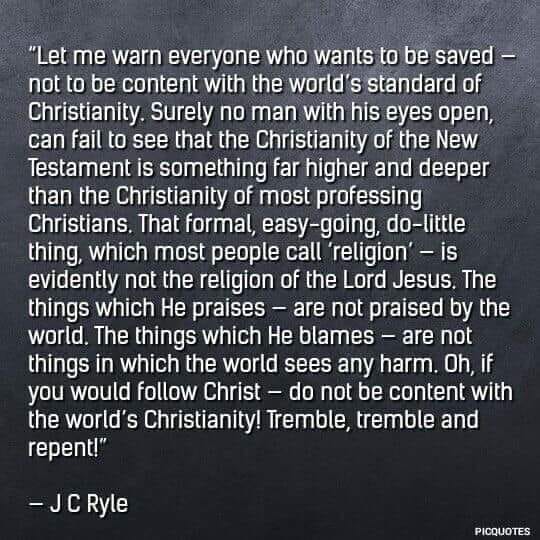
Tremble, Tremble and Repent

This isn’t supposed to be a brimstone and hellfire type post (although sometimes I do think we need to bring back preaching that isn’t afraid to step on a few toes while proclaiming the whole gospel for the whole person).

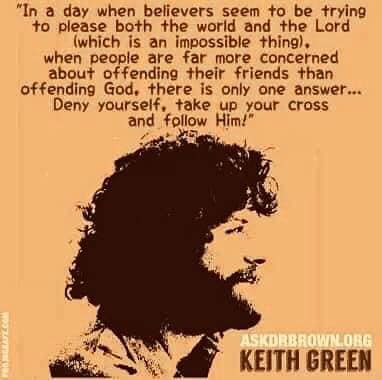
I do think that American Christianity has progressed to the point where it barely resembles New Testament Christianity. People can come to most churches and feel comfortable living in sin and not once feel convicted about their lifestyle choices and behaviors. There is very little accountability and next to no discipline at any given local church.

Yes, Jesus did say to the woman caught in adultery that He didn’t condemn her, but He also added “Go and sin no more.”

I think the American church needs to champion social justice AND personal holiness. It’s not an either/or, but a both/and. Read Isaiah 58 if you want to know what biblical social justice looks like, but also read Romans 12:1-2 (and many other passages) that compel us to be holy and set apart.

There’s a lot of emphasis on getting people saved, but not much on discipling them afterward. The result is that many people sitting in any given church service on Sunday know very little about the Bible or the faith they’ve professed to believe. Very few actually know how to live out that faith and apply it to every day situations.

I do think that the American church needs revival. Not the kind where people get saved (although that would be awesome) as much as the kind where the people who are saved start acting and living like it. Including yours truly.

It starts and ends with the Bible. It’s about preaching the gospel to yourself all day every day. It’s about falling at the feet of Jesus and declaring your dependence on Him once again. It’s about living a Romans 12:1-2 life of sacrificial worship that is radically different than the world. It’s about loving God and loving others the way God in Jesus has loved us.

Driven to Tears

Tonight at Room in the Inn, we had our annual Q & A instead of the usual Bible study for the homeless guests. There were four of us who each took one theological question and gave a roughly five-minute answer. The one that stays with me is when Tommy Woods did the question on what is the gospel and why does it matter.

It wasn’t so much in what he said but how even talking about the gospel got him emotional. Talking about the magnitude of what Jesus did for us on the cross brought him to tears. I was moved by the passion behind the emotion.

I sometimes wonder if we really understood what Christ went through on the cross, how much he really suffered, and how great the pain of bearing a whole world of sin felt, wouldn’t it bring us to tears every single time? How could I not be moved by the One who moved heaven and earth to get to me in my lostness and rescue me from my own rebellion?

I think if we knew how much God really paid for the free gift of our salvation, we’d sing a lot louder. We’d worship more boldly. We’d live more sacrificially. We’d never stop being a thankful people instead of a grumbling and complaining people.

Jesus once told the story of two debtors: one owed $50 and the other owed $500. He said this to defend the woman who broke a jar of expensive perfume to bathe Jesus’ feet while using her hair as a towel. He said the one forgiven much is the one who loves much.

If we think we’re basically good people with a few minor hangups and faults, we might feel a little entitled about our salvation. If we think we’re bad people who needed to be made good, we might offer up a token prayer of gratitude. But if we know that we were dead in sin and God in Jesus made us alive, we’d spend all eternity in thankful praise. And one day, we will.

Be Ready

“If with heart and soul you’re doing good, do you think you can be stopped? Even if you suffer for it, you’re still better off. Don’t give the opposition a second thought. Through thick and thin, keep your hearts at attention, in adoration before Christ, your Master. Be ready to speak up and tell anyone who asks why you’re living the way you are, and always with the utmost courtesy. Keep a clear conscience before God so that when people throw mud at you, none of it will stick. They’ll end up realizing that they’re the ones who need a bath. It’s better to suffer for doing good, if that’s what God wants, than to be punished for doing bad. That’s what Christ did definitively: suffered because of others’ sins, the Righteous One for the unrighteous ones. He went through it all—was put to death and then made alive—to bring us to God (1 Peter 3:13-18).

That’s the key. Be ready. If you live a godly life (or even make the attempt in the Spirit of God to live a godly life) it will draw attention. I heard once that believers should live questionable lives, but not in the sense of believing one way and living another but in such a way that the way we speak and behave will draw questions as to why we’re different (in a good way, hopefully).

I also think we should be praying at every moment for opportunities to have gospel conversations, especially with the family and friends we love and hold dear. I know the famous quote attributed to Saint Francis says to preach the gospel at all times and use words if necessary. I think from the Great Commission, words are always necessary. We simply need wisdom and discernment as to the timing of when we’re supposed to speak up and tell our gospel story.

The more the world slips further away from God, the more we will stand out. The more those not of God will hate us and mistreat us and try to trip us up. But also the more people will see something about us that they don’t have — peace under pain , joy in the midst of sorrow, patience under suffering, hope that never fails. Then some will want to know about that hope that we have. Then we should be ready to give an answer.

I found something that every believer should pray called the Three Open Prayer: “1) Lord, open a door to share the gospel. 2) Lord, open the heart of the lost to receive the gospel. 3) Lord, open my mouth to share the gospel.”

Pray for Ramadan

One thing I started this year that will hopefully become a tradition is praying for Muslims during this time of Ramadan, a holy time in Islam where Muslims are encouraged to fast during the day and immerse themselves in Qu’ran reading.

There is a very helpful prayer guide that the International Mission Board has created to encourage believers to pray for Muslims during this time. There is a daily prayer guide that gives specific prayer points for people groups and practices so that we can better pray for God to reach out to these Muslims.

The website is https://pray4digital.com/prayforramadan. You can sign up to pray at certain times during the day throughout Ramadan. I have committed to pray daily from 7:05 to 7:20 pm (though I confess I have yet to pray during my allotted time slot. I usually end up praying later in the evening).

I truly believe all great movements of God start with prayer. I also believe that we have not because we ask not, so I think we should all be praying for a multitude of Muslims to come to faith in Jesus during this time. After all, Jesus is prominent in the Qu’ran, so it’s natural that they could easily be inclined to want to know more about Him.

I’m fairly certain that God is present when two or more are gathered in His name, but I would love to see multitudes of believers who love their Muslim neighbors and friends enough to pray for them. Remember that the same Paul who wrote 1/3 of the New Testament was originally a terrorist against the faith until an encounter with Jesus made Him the biggest champion of Christianity. Anything is possible when it comes to God.

I hope and pray that you will join me in this endeavor in praying for God to move mightily in the Muslim world. Above all, I echo the cry of every believer when I say, “Come quickly, Lord Jesus!”

Cloud of Witnesses

“Therefore, since we also have such a large cloud of witnesses surrounding us, let us lay aside every hindrance and the sin that so easily ensnares us. Let us run with endurance the race that lies before us, keeping our eyes on Jesus, the pioneer and perfecter of our faith. For the joy that lay before him, he endured the cross, despising the shame, and sat down at the right hand of the throne of God” (Hebrews 12:1-2, CSB).

I had the honor of being invited to the premiere of a short film directed by a friend of mine at the Franklin Theater last night. It was mind-blowing to see the place packed out and to see everyone clapping and cheering when she came up to the microphone to introduce the film.

My favorite part was after the film when we all gave her a standing ovation that made her cry a bit. It was such a moment of celebration and joy that culminated a long process to get this short film from her mind to paper to the screen.

Then I remembered the verse in Hebrews that talks about the cloud of witnesses surrounding us. In my own sanctified imagination, I can see them — everyone we’ve ever known and loved — watching us from above and clapping and cheering for us when we finally cross that heavenly finish line.

I don’t know if my vision is entirely biblical, but I like to think that heaven is invested in our earthly race. We never run alone and there is not a moment when we’re not loved and supported and cheered on. I know for certain that we have an advocate in Jesus who prays for us and watches us and encourages us onward. It’s not out of the realm of possibility that all the saints who’ve gone before us have ringside seats to see God’s people living out the Great Commission.

I know that my church has a small cloud of witnesses that cheers us on as we reach out to our neighborhood, city, state, nation, and world. I imagine Ron, Matt, and Rick (and probably others I’ve forgotten to mention) cheering and clapping as we continue to take the gospel to wherever we live, work, and play.

One day, maybe we will be in that cloud of witnesses and get to be the ones who will clap and cheer for others as they finish their race and get to hear the longed for words of Jesus to them: “Well done, good and faithful servant.”

Trusting in the Wrong Things

“A man was meant to be doubtful about himself, but undoubting about the truth; this has been exactly reversed. Nowadays the part of a man that a man does assert is exactly the part he ought not to assert – himself. The part he doubts is exactly the part he ought not to doubt – the Divine Reason” (G. K. Chesterton, Orthodoxy).

These days, the problem is always with THEM. It’s always someone else’s fault. In politics, the blame has gone to either Trump or Harris supporters, depending on which side of the aisle you sit. It has become very fashionable (and very easy) to point the finger from a high and lofty position with which to judge others.

Even in this, I have to point the finger at myself as well. I can’t tell you how many times I read a passage in my Bible and thought how this or that person needed to hear it. They’re the ones who need straightening out.

But then God gently reminds me that this word I’m reading is not for anyone else but me. The reason for my time in God’s Word isn’t so I can use it to point out other peoples’ flaws. If there’s any finger pointing, it’s me pointing back at me.

In this culture, it’s also popular to redefine truth and Christianity to fit into societal norms rather than transforming society by biblical truth. So many people and churches and even denominations have watered down the gospel to the point that it’s only a kind of feel good self-help doctrine where no one’s really lost and sin doesn’t really exist and everyone’s going to heaven and it really doesn’t matter how you live.

But the problem is that there’s no hope in that kind of gospel. There’s no deliverance or transformation or future. Jesus talked about the blind leading the blind, and that fits a lot of current theology. But Jesus came to set us free and not just make us better human beings but brand new creations. He came to die for us while we were yet sinners that we might truly become the sons and daughters of God.

The Bible talks about working out your salvation in trembling and fear. Maybe that looks like preaching the gospel to yourself and each other every single day. Maybe it looks like not trusting in your own understanding but in all your ways leaning on God’s revealed truth and on God Himself. Maybe it looks like not accepting everything that comes from a pulpit or position of authority but exercising discernment by checking everything against the Word of God to see that it matches.

Reframing Your Past, Present & Future

I’ve never thought about gratitude like that before. I get that it changes the way you see your present and can shift how your future plays out, but to change your perspective on your past? That’s a game changer.

The old saying about grace is that it means that your past now serves a purpose instead of serving shame. Gratitude helps you to see how every part of your past, good and bad, has led you to the present moment. God was in all of it with you, taking those dark and painful moments to weave them in with the brighter colors.

Also, sometimes when you look at a famous painting too closely, it looks like a big chaotic mess. You can’t tell anything about it. But once you step back, it becomes clearer. The same applies for life — once you can step back after a few days or weeks or months, you can see more clearly what God was up to in that moment.

You don’t have to give thanks FOR those awful moments and tragedies. But you can give thanks IN them. Paul didn’t say give thanks FOR all circumstances but IN all circumstances, knowing God works all things together for good and there is a redemptive purpose for pain and loss.

I still think about that quote about muddy water becoming clear as it settles and is still. So do we. Everything becomes clear when we cease striving to make it make sense and can be still and know that God is God, to know that God is still in control and in charge.

And it all begins with gratitude.

A God We Can’t Exaggerate

“Many Spirit-filled authors have exhausted the thesaurus in order to describe God with the glory He deserves. His perfect holiness, by definition, assures us that our words can’t contain Him. Isn’t it a comfort to worship a God we cannot exaggerate?” (Francis Chan)

There’s a beautiful old book by J. B. Phillips called Your God Is Too Small. I think that’s the case for anyone who has ever lived who tried to conceive the idea of God. We always fall short. We always make God way too small.

The problem with a lot of deconstruction is that we make ourselves the standard by which God and truth are measured. We are definitely too finite and small to be any kind of measuring stick to which God must conform (thanks to Frances Chan for that one as well). It’s putting ourselves above God, essentially saying that God would never [fill in the blank] because I would never [fill in the blank].

God not only above us, He is so far beyond us that our minds could never have fathomed God at all apart from God revealing Himself to us. That blows my mind. It also humbles me whenever I get to the place where I think I have God figured out.

We can’t possibly exaggerate God. How cool is that? The biggest, grandest, wildest picture we can dream up or draw or sing about or write about falls short of who God is by far. All we can do is sit at the brink and adore the depth, to borrow from Matthew Henry.

God is never too small. Only our conception of Him is. But God made Himself incarnate and came near and became a tiny infant. That’s my favorite part.

Homesick for God?

“How many people have you made homesick for God?” (Oswald Chambers, Disciples Indeed)

That’s the key to evangelism, I think. It’s not constantly reminding people how sinful they are or ridiculing their worldview. I think in that approach we forget that we too were once sinful and had wrong beliefs about the universe.

What was it that won you over? What was it that made you want to know and love God? Was it really someone telling you what an awful person you were? Was it someone constantly berating your beliefs?

I think the key is to make people long for God to the point where they’re homesick for God. I think people seeing you loving God and living out of the overflow of God’s love for you will want to know God. People who see you loving others well the way God loved you well will crave that kind of love, even if they don’t have a name for it.

The way the early Church drew people was in how those believers loved each other. They loved lost people as well, but mainly it was in their love for each other that made people want to hear their gospel message.

If all you have is a well-defined set of doctrines and beliefs, no one cares. If all you have is a passion for making people as moral as you are, then no one wants to hear about it. But when you live transformed and let the life of Christ in you permeate everything you do, then people can’t help but see and be drawn to what they don’t have.

The key is to make people homesick for a home they’ve never known but want to go to more than anything or anywhere else. Make them homesick for God.