Unselfishness Vs. Love

“If you asked twenty good men today what they thought the highest of the virtues, nineteen of them would reply, Unselfishness. But if you had asked almost any of the great Christians of old, he would have replied, Love. You see what has happened? A negative term has been substituted for a positive, and this is of more than philological importance. The negative idea of Unselfishness carries with it the suggestion not primarily of securing good things for others, but of going without them ourselves, as if our abstinence and not their happiness was the important point. I do not think this is the Christian virtue of Love. The New Testament has lots to say about self-denial, but not about self- denial as an end in itself. We are told to deny ourselves and to take up our crosses in order that we may follow Christ; and nearly every description of what we shall ultimately find if we do so contains an appeal to desire. If there lurks in most modern minds the notion that to desire our own good and earnestly to hope for the enjoyment of it is a bad thing, I submit that this notion has crept in from Kant and the Stoics and is no part of the Christian faith. Indeed, if we consider the unblushing promises of reward and the staggering nature of the rewards promised in the Gospels, it would seem that Our Lord finds our desires not too strong, but too weak. We are half-hearted creatures, fooling about with drink and sex and ambition when infinite joy is offered us, like an ignorant child who wants to go on making mud pies in a slum because he cannot imagine what is meant by the offer of a holiday at the sea. We are far too easily pleased” (C. S. Lewis, The Weight of Glory).

I heard someone wise once say that it’s not enough to resist temptation, unlearn bad habits, and give up unhealthy thoughts and actions. You need to replace all these with good habits, healthy choices, and obedience. Otherwise, you end up with a different set of bad habits and vices.

I remember my pastor commented on how old-school Baptists were known more for what they were against than what they were for. He said they used to show up in church and brag about not having done anything bad — or actually anything at all.

To be unselfish just to be unselfish is missing the mark. You’re likely to pick up bitterness (from all that you gave up) or self-righteousness (at how much better you are than those who still indulge in what you gave up).

Love is the opposite of selfishness, not unselfishness, because it is self-less. We don’t need to think less of ourselves as the antidote to thinking too much of ourselves. We just need to think about ourselves less and more about others and God.

We miss the mark when we make it about modifying our behavior and being more moral when it’s about emptying of self so there’s more room for God and His ways. It’s not about becoming a slightly better version of me but about becoming a brand new me, one that looks and acts like Jesus.
Nothing Else Will Do

I’m excited. My church is weeks away from moving to a permanent campus where everything will be brand new and shiny. I’m reminded of the metaphor Jesus used about believers being a city on a hill, because this new location is literally sitting on a hill over looking the intersection.

I’m super hyped, but I’m also smart enough to know that the honeymoon won’t last. More accurately, I’ve hopefully learned by now through lots of times where I got excited only to see the enthusiasm fade and normalcy fade in.

I can remember all those Christmas gifts that I was thrilled to get. I remember how I felt, but looking back, I can’t remember the specific gifts any more. They lost their luster and faded from my memory. Some of them even ended up in garage sales a few years later.

That’s how it goes with anything I set my heart on this side of eternity. Anything less than God won’t fill that God-shaped yearning in me. Or as C. S. Lewis put it, anything that isn’t eternal is eternally out of date and obsolete.

I look forward to our move-in date in late May. I hope I will always be grateful for this gracious gift on God’s part. But I know that at some point, it will be just a building. More than likely, it will require maintenance and updating and repairs. And at some point, it will be no more.

But what it represents and what our church is all about (and every true Bible-believing church is all about) won’t ever fade or get stolen or moth-eaten or rust. The hope of God-with-us revealed in Jesus will only get better and more wonderful and more glorious over time, past time, and into eternity.

The Birthdays Keep Coming

At some point, I wish the birthdays would just stop.

I don’t mean I don’t want any more birthdays. I definitely don’t mean that I don’t want to live any longer.

What I do mean is that I wish that I could get to a comfortable age number and stop there. I think 35 would have been a good age to remain for a while. Maybe now I can stay 52 for a few years.

But then I remember people like my friend Nathan or my cousin Timothy who won’t get to see 52. They never got the opportunity to grow old because they left so young.

So I’m thankful for another birthday. It means I got to live. It means I got to experience God’s world and especially God in the world for another 365 days. I got to take for granted that I would wake up every morning.

As much as I enjoy opening birthday gifts, the biggest gift I get every single year is the gift of being alive and being loved. I’m reminded that I have a physical birthday on February 28, but I also have a spiritual birthday on which I prayed the sinner’s prayer and invited Jesus into my heart.

That was the day that I went from being lost to found, from being dead in sin to being alive to God. It was the day that I became a new creation and a follower of Jesus, not because I was especially deserving or good. It was because God is good and full of grace.

I think my friend Nathan or my cousin Timothy could have the chance to say some final words, they’d say that the most important gift anyone could ever receive is the gift of knowing Jesus and receiving what He did by taking our punishment on the cross, dying, and then being raised from the dead.

If anyone reading this wants to know more about following Jesus, I’ve included this link that shares the plan of salvation:

Chariots of Fire

One of my favorite movies of all time, Chariots of Fire, is based on an actual true story. The film is an account of the life of Eric Liddell, or at least the part of his life where he chooses between going to China to be a missionary and training for the Olympic games.

The movie hit theaters back in 1981. I can’t say with 100% confidence that everything portrayed in the movie is the way it actually happened. Hollywood does tend to take liberties for the sake of dramatic tension and for those feel-good moments.

I can say that the real Eric Liddell was willing to live and die for the sake of the gospel. He ended up going to China after the 1924 Olympics (spoiler alert), where he remained until his death in 1945. He literally sacrificed his life at age 43 for Christ because he felt that to lose your life is to gain it and to die for Christ is gain.

These are his actual words that reflect the heart of a true missionary and follower of Jesus Christ:

“I believe in God the Father, Almighty, Creator, infinitely holy and loving, who has a plan for the world, a plan for my life, and some daily work for me to do. I believe in Jesus, the Christ, the Son of God, as Example, Lord, and Savior. I believe in the Holy Spirit who is able to guide my life so that I may know God’s will; and I am prepared to allow him to guide and control my life. I believe in God’s law that I should love the Lord my God with all my heart, and with all my soul, and with all my mind, and with all my strength; and my neighbor as myself. I believe it is God’s will that the whole world should be without any barriers of race, color, class, or anything else that breaks the spirit of fellowship. To believe means to believe with the mind and heart, to accept, and to act accordingly on that basis” (Eric Liddell).

Befriending Your Pain

Note: this was originally posted on October 10, 2021:

“I want to say to you that most of our brokenness cannot be simply taken away. It’s there. And the deepest pain that you and I suffer is often the pain that stays with us all our lives. It cannot be simply solved, fixed, done away with. . . . What are we then told to do with that pain, with that brokenness, that anguish, that agony that continually rises up in our heart? We are called to embrace it, to befriend it. To not just push it away . . . to walk right over it, to ignore it. No, to embrace it, to befriend it, and say that is my pain and I claim my pain as the way God is willing to show me his love” (Henri Nouwen).

C. S. Lewis said that God speaks to us through our pain. Oftentimes, pain is the only way for God to get our attention, distracted as we are by our pleasures and pursuits. Living in a beautiful but broken world, it’s not hard to find pain. God simply uses that pain to speak to us, to gently remind us that He is near, to mold us into something closer to His likeness.

God of this City

I confess that I have had a certain worship song on my mind for quite some time. The song is God of This City, as recorded by Chris Tomlin in 2011 for his Hello, Love album. My church is in the middle of a Pursue campaign, part of which is for the purchase and renovation of a facility for my campus, The Church at Avenue South.

The song originated from a mission trip to Pattaya, Thailand and speaks to how where God is present, better things are still to come. It fits with what I believe God is doing in the city of Nashville. I believe God will use all nine of Brentwood Baptist Church’s regional campuses, including The Church at Avenue South, to start an awakening in this city.

Also, I can’t believe this song is already 13 years old.

“You’re the God of this city
You’re the King of these people
You’re the Lord of this nation
You are

You’re the light in this darkness
You’re the hope to the hopeless
You’re the peace to the restless
You are

There is no one like our God

For greater things have yet to come
And greater things are still to be done in this city
Greater things have yet to come
And greater things are still to be done in this city

You’re the God of this city
You’re the King of these people
You’re the Lord of this nation
You are

You’re the light in this darkness
You’re the hope to the hopeless
You’re the peace to the restless
You are

There is no one like our God

For greater things have yet to come
And greater things are still to be done in this city
Greater things have yet to come
And greater things are still to be done in this city

Greater things have yet to come
And greater things are still to be done here

There is no one like our God
There is no one like you, God

For greater things have yet to come
And greater things are still to be done in this city
Greater things have yet to come
And greater things are still to be done

We believe, we believe in you, God

Greater things have yet to come
And greater things are still to be done in this city
Greater things have yet to come
And greater things are still to be done here
Greater things, still to be done here” (Aaron Boyd / Andrew Mccann / Ian Jordan / Peter Comfort / Peter Kernaghan / Richard Bleakley).

The Smallest Blessing

“Be thankful for the smallest blessing, and you will deserve to receive greater. Value the least gifts no less than the greatest and simple graces as especial favors. If you remember the dignity of the Giver, no gift will seem small or mean, for nothing can be valueless that is given by the most high God” (Thomas a Kempis).

First off, you should find a copy of The Imitation of Christ by Thomas a Kempis and read it as soon as humanly possible. This book is a timeless classic that has stood the proverbial test of time and remains relevant.

But also, if you want to step into all the fullness of God’s provision and blessing, you need to appreciate what you have. You need to learn how to give thanks for the smallest blessings that are easy to miss and take for granted. And by you, I mean me. I need to do these things.

Also, if you feel stuck in a phase of your life, you might want to see if there are any areas in your life where you are being disobedient to a command of God. There’s probably something that God wants you do to but that you have not done because you simply don’t want to do it. And again, by you I mean me.

The most clear part of God’s will is in 1 Thessalonians 5:17 where it says to rejoice always, give thanks in everything, and pray without ceasing (not necessarily in that order). The verse explicitly says that this is God’s will for you in Christ Jesus.

In other words, learn to cultivate an attitude of joy, prayer, and thanksgiving. Learn to love what God loves and love who God loves. Always put others ahead of you and God above all. And remember that Christianity is not like all those other religions where the key word is DO, as in what must I DO to appease the deity, how can I make sure I’m good with my higher power, but Christianity’s key word is DONE, as in Jesus already fulfilled everything you need for heaven and all you need to DO is receive that gift of salvation by faith.

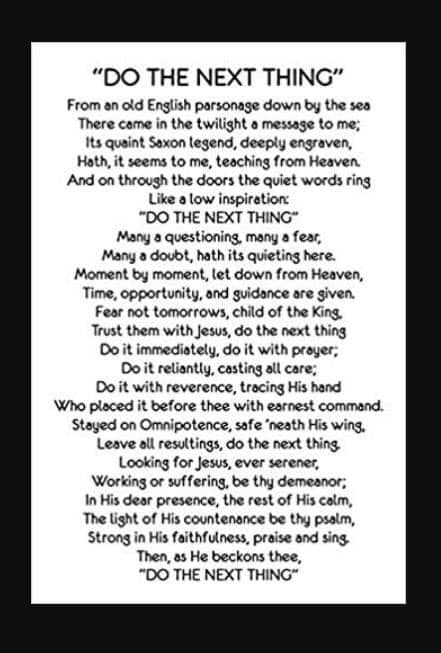
Do the Next Thing

In case you couldn’t read the picture, here’s the poem in a little bigger font:

From an old English parsonage down by the sea
There came in the twilight a message to me;
Its quaint Saxon legend, deeply engraven,
Hath, it seems to me, teaching from Heaven.
And on through the doors the quiet words ring
Like a low inspiration: “DO THE NEXT THING.”

Many a questioning, many a fear,
Many a doubt, hath its quieting here.
Moment by moment, let down from Heaven,
Time, opportunity, and guidance are given.
Fear not tomorrows, child of the King,
Trust them with Jesus, do the next thing

Do it immediately, do it with prayer;
Do it reliantly, casting all care;
Do it with reverence, tracing His hand
Who placed it before thee with earnest command.
Stayed on Omnipotence, safe ‘neath His wing,
Leave all results, do the next thing.

Looking for Jesus, ever serener,
Working or suffering, be thy demeanor;
In His dear presence, the rest of His calm,
The light of His countenance be thy psalm,
Strong in His faithfulness, praise and sing.
Then, as He beckons thee, do the next thing.

That’s the key. As Oswald Chambers said, trust God and do the next thing. It’s not about figuring out God’s complete will for your life or knowing how the next six months or six years are going to play out.

Just be faithful with the next thing you know God wants you to do, be obedient to what you know Jesus has asked of you (pray always, be anxious for nothing, give thanks, stay grounded in God’s word), and keep your eyes on the next step on the walk of faith.

I don’t know who wrote the poem. I know Elisabeth Elliott quoted it. I know the words speak truth that I need to remember and heed.

Trust God and do the next thing.

Wise Words from Amy Carmichael

Amy Carmichael was a missionary to India for over 50 years without ever taking a furlough. She was involved in rescuing women and children from temple prostitution, so basically she was on the front lines against human trafficking way before that was a term.

She also wrote some beautiful and profound books. Here’s a taste of something she wrote that many of us will find helpful and timely in this day and age:

“Let us end on a very simple note: Let us listen to simple words; our Lord speak simply: “Trust Me, My child,” He says. ‘Trust Me with a humbler heart and a fuller abandon to My will than ever thou didst before. Trust Me to pour My love through thee, as minute succeeds minute. And if thou shouldst be conscious of anything hindering that flow, do not hurt My love by going away from Me in discouragement, for nothing can hurt so much as that. Draw all the closer to Me; come, flee unto Me to hide thee, even from thyself. Tell Me about the trouble. Trust Me to turn My hand upon thee and thoroughly to remove the boulder that has choked they river-bed, and take away all the sand that has silted up the channel. I will not leave thee until I have done that which I have spoken to thee of. I will perfect that which concerneth thee. Fear thou not, O child of My love; fear not.’

And now…to gather all in one page:

Beloved, let us love.

Lord, what is love?

Love is that which inspired My life, and led Me to My Cross, and held Me on My Cross. Love is that which will make it thy joy to lay down thy life for thy brethren.

Lord, evermore give me this love.

Blessed are they which do hunger and thirst after love, for they shall be filled” (Amy Carmichael).

A Prayer for Anxiety

“Dear God, as I lay me down to sleep, relax the tension of my body; calm the restlessness of my mind; still the thoughts which worry and perplex me. Help me to rest myself and all my problems in your strong and loving arms. Let your Spirit speak to my mind and heart while I am asleep, so that, when I wake up in the morning, I may find that I have received in the night-time, light for my way; strength for my tasks; peace for my worries; forgiveness for my sins. Grant me sleep tonight, and tomorrow power to live” (Author Unknown).

Sometimes, the anxiety just won’t go away. The sad truth is that worry is the default setting for most of us. We don’t how to train ourselves on how to fret — that comes naturally. We do have to discipline and train ourselves in ways to relax and destress.

But we have the promise of the Prince of a peace that passes all understanding. We have Jesus’ invitation for all who are burdened and heavy-laden to come and find rest. We know that God’s truth is more real than anything that we think or feel.

The best news is that any anxiety is temporary but the true peace and joy that comes from God is forever. This light and momentary affliction will soon yield to an eternal weight of glory far beyond anything we endure that brings anxiety. Hope and help are on the way.