Blessed

“IN A SENSE WE are all hungry and in need, but most of us don’t recognize it. With plenty to eat in the deep freeze, with a roof over our heads and a car in the garage, we assume that the empty feeling inside must be just a case of the blues that can be cured by a weekend in the country or an extra martini at lunch or the purchase of a color TV.

The poor, on the other hand, are under no such delusion. When Jesus says, ‘Come unto me all ye who labor and are heavy laden, and I will give you rest’ (Matthew 11:28), the poor stand a better chance than most of knowing what he’s talking about and knowing that he’s talking to them. In desperation they may even be willing to consider the possibility of accepting his offer. This is perhaps why Jesus on several occasions called them peculiarly blessed” (Frederick Buechner, Wishful Thinking).

I think the key is not that being poor in spirit is a quality we need to emulate, but it’s a recognition that brings us closer to God in Jesus. We’re more likely to understand that all our efforts have been exhausting and futile and that we need not to try harder but to rest.

It comes down to desperation. If I think I can be good enough or smart enough or rich enough on my own, I will never depend on God. I will never reach out to God except on some rare emergency. But if I know my poverty of spirit, that I bring absolutely nothing to God, then I will learn to lean on God for everything.

I love how Jesus says that unless we become like little children, we can never enter the Kingdom of God. That’s not a license to be childish, but to be childlike. The key is that little kids are dependent on their parents for everything. They don’t pretend to be self-sufficient. They don’t hide their need. They have a trust that Mom and Dad will give them what they need when they need it. And that’s how our faith should be.
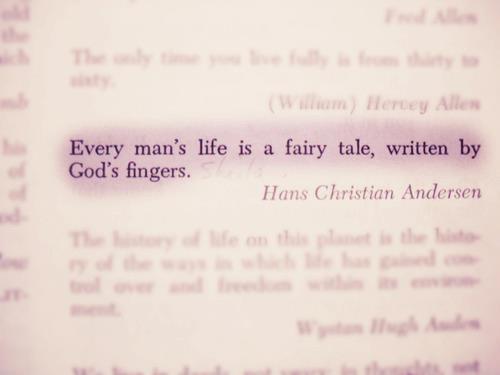
Life Is a Fairy Tale

I suppose whether you agree with this or not depends on your definition of what makes a fairy tale. Is it void of any true hardship or suffering? Then that’s not a true fairy tale. Does it need fantastical creatures? That’s debatable, but I think not.

What a fairy tale needs is a happy ending. You know going in that the main character is going to live happily ever after.

If you look at life strictly from this side of heaven, then it’s not a fairy tale. There’s so much suffering and evil that goes unresolved and unpunished. There are so many wrongs that never get put right.

But if you look through the lens of the resurrection, then you see the fairy tale. In fact, you could see the whole Bible story as a sort of true fairy tale where the King comes to rescue His beloved from imminent danger.

It all depends on perspective. If you see your life through the eyes of faith, you know that the happy ending is coming, even if you might not see it this side of eternity. But it is coming.

“It is a world of magic and mystery, of deep darkness and flickering starlight. It is a world where terrible things happen and wonderful things too. It is a world where goodness is pitted against evil, love against hate, order against chaos, in a great struggle where often it is hard to be sure who belongs to which side because appearances are endlessly deceptive. Yet for all its confusion and wildness, it is a world where the battle goes ultimately to the good, who live happily ever after, and where in the long run everybody, good and evil alike, becomes known by his true name….That is the fairy tale of the Gospel with, of course, one crucial difference from all other fairy tales, which is that the claim made for it is that it is true, that it not only happened once upon a time but has kept on happening ever since and is happening still”(Frederick Buechner, Telling the Truth: The Gospel as Tragedy, Comedy, and Fairy Tale).

Grace (by Frederick Buechner)

“After centuries of handling and mishandling, most religious words have become so shopworn nobody’s much interested anymore. Not so with grace, for some reason. Mysteriously, even derivatives like gracious and graceful still have some of the bloom left.

Grace is something you can never get but can only be given. There’s no way to earn it or deserve it or bring it about any more than you can deserve the taste of raspberries and cream or earn good looks or bring about your own birth.

A good sleep is grace and so are good dreams. Most tears are grace. The smell of rain is grace. Somebody loving you is grace. Loving somebody is grace. Have you ever tried to love somebody?

A crucial eccentricity of the Christian faith is the assertion that people are saved by grace. There’s nothing YOU have to do. There’s nothing you HAVE to do. There’s nothing you have to DO.

The grace of God means something like: “Here is your life. You might never have been, but you are, because the party wouldn’t have been complete without you. Here is the world. Beautiful and terrible things will happen. Don’t be afraid. I am with you. Nothing can ever separate us. It’s for you I created the universe. I love you.”

There’s only one catch. Like any other gift, the gift of grace can be yours only if you’ll reach out and take it.

Maybe being able to reach out and take it is a gift too” (Frederick Buechner, Wishful Thinking).

I always like the acronym for GRACE – God’s Riches at Christ’s Expense.

That means it is undeserved.

It’s the flip side of mercy. If grace is getting what you don’t deserve, then mercy is not getting what you deserve. And salvation involves both.

May we be a people of mercy and grace in 2025.

A Love that Conquers the World

“The love for equals is a human thing–of friend for friend, brother for brother. It is to love what is loving and lovely. The world smiles.

The love for the less fortunate is a beautiful thing–the love for those who suffer, for those who are poor, the sick, the failures, the unlovely. This is compassion, and it touches the heart of the world.

The love for the more fortunate is a rare thing–to love those who succeed where we fail, to rejoice without envy with those who rejoice, the love of the poor for the rich, of the black man for the white man. The world is always bewildered by its saints.

And then there is the love for the enemy–love for the one who does not love you but mocks, threatens, and inflicts pain. The tortured’s love for the torturer. This is God’s love. It conquers the world” (Frederick Buechner, The Magnificent Defeat).

I think I know what kind of love I want. It’s the same kind of love that I need every single day. It’s the kind of love that infuriates the world, but also the kind of love that can save the world. Give me that kind of love.

Worshipping Through Weeping

“Weeping may last through the night,
    but joy comes with the morning” (Psalm 30:5, NLT).

Today as a deacon, I attended the celebration of life service for one of our members who tragically lost his life at age 42. He had been married only 16 months when his life was unexpectedly cut short.

The funeral was beautiful and God-honoring. My favorite part of the entire service was when the worship leader sang the first song, the widow of the deceased stood up alone and raised her hands in worship, grieving and praising at the same time.

That’s an image I will carry with me as long as I live, I think. She had her world utterly wrecked like a rug pulled out from underneath her and still was able to declare like Job, “The Lord gave, and the Lord has taken away; blessed be the name of the Lord” (Job 1:21, ESV).

There is so much evil in the world and so much that makes no sense. If this life is all there is, then there is no hope, no future, and no reason to keep going. But if we have the promise of God for something better coming (and we do), then we know that this is what the Apostle Paul calls a light and momentary affliction compared to the joy that’s coming.

Not that grief is nothing. Not that the pain isn’t real. But the coming joy will overwhelm us and seem so much greater than any sorrow that went before, like a woman holding her newborn baby after the agony of giving birth only is thinking of new life and not pain.

My brain has no compartment for comprehending the level of suffering this woman is currently undergoing and how radically different her life will be from now on. There will always be a void where her husband should be and a dull ache that never completely goes away, but there will always be a Father’s love that grows deeper and sweeter with the passing of time.

“Yea, though walk through the valley of the shadow of death, I will fear no evil.” The psalm does not pretend that evil and death do not exist. Terrible things happen, and they happen to good people as well as to bad people. Even the paths of righteousness lead through the valley of the shadow. Death lies ahead for all of us, saints and sinners alike, and for all the ones we love. The psalmist doesn’t try to explain evil. He doesn’t try to minimize evil. He simply says he will not fear evil. For all the power that evil has, it doesn’t have the power to make him afraid” Frederick Buechner, The Clown in the Belfry).

I Shall Not Want

“‘I SHALL NOT WANT,’ the psalm says. Is that true? There are lots of things we go on wanting, go on lacking, whether we believe in God or not. They are not just material things like a new roof or a better paying job, but things like good health, things like happiness for our children, things like being understood and appreciated, like relief from pain, like some measure of inner peace not just for ourselves but for the people we love and for whom we pray. Believers and unbelievers alike we go on wanting plenty our whole lives through. We long for what never seems to come. We pray for what never seems to be clearly given. But when the psalm says ‘I shall not want,’ maybe it is speaking the utter truth anyhow. Maybe it means that if we keep our eyes open, if we keep our hearts and lives open, we will at least never be in want of the one thing we want more than anything else. Maybe it means that whatever else is withheld, the shepherd never withholds himself, and he is what we want more than anything else” (Frederick Buechner, The Clown in the Belfry).

Did that ever hit the nail on the head for me. If I have the Shepherd, I have everything I need. I think what God might be speaking to me tonight is that the verse doesn’t say, “I might occasionally be in want” or “I’m currently in want but not for long.”

It says, “I shall not want,” meaning that there will never be a time when God’s supply is insufficient for me, when God Himself is not enough. I think what I need more than a job, more than a steady paycheck, more than anything in the world is Jesus.

So many in this world have just about everything money and fame can buy but without Jesus, they have nothing but a castle of sand. If I have Jesus and nothing else, I have everything that could ever satisfy that no amount of money could buy or no amount of power could procure. I have enough.

Stop the Insanity!

“Stop trying to protect, to rescue, to judge, to manage the lives around you . . remember that the lives of others are not your business. They are their business. They are God’s business . . . even your own life is not your business. It also is God’s business. Leave it to God. It is an astonishing thought. It can become a life-transforming thought . . . unclench the fists of your spirit and take it easy . . . What deadens us most to God’s presence within us, I think, is the inner dialogue that we are continuously engaged in with ourselves, the endless chatter of human thought. I suspect that there is nothing more crucial to true spiritual comfort . . . than being able from time to time to stop that chatter . . . ” (Frederick Buechner, Telling Secrets).

I suspect that this little gem of a quote will hit home with many of you as it did with me.

I quite agree that being able to still the inner dialogue and the endless chatter of human thought to recognize God’s presence and find true peace. Sometimes, that’s easier said than done.


Today’s Word is . . .

Grace.

“After centuries of handling and mishandling, most religious words have become so shopworn nobody’s much interested anymore. Not so withgrace, for some reason. Mysteriously, even derivatives like gracious and graceful still have some of the bloom left.

Grace is something you can never get but can only be given. There’s no way to earn it or deserve it or bring it about any more than you can deserve the taste of raspberries and cream or earn good looks or bring about your own birth.

A good sleep is grace and so are good dreams. Most tears are grace. The smell of rain is grace. Somebody loving you is grace. Loving somebody is grace. Have you ever tried to love somebody?

A crucial eccentricity of the Christian faith is the assertion that people are saved by grace. There’s nothing YOU have to do. There’s nothing you HAVE to do. There’s nothing you have to DO.

The grace of God means something like: “Here is your life. You might never have been, but you are, because the party wouldn’t have been complete without you. Here is the world. Beautiful and terrible things will happen. Don’t be afraid. I am with you. Nothing can ever separate us. It’s for you I created the universe. I love you.”

There’s only one catch. Like any other gift, the gift of grace can be yours only if you’ll reach out and take it.

Maybe being able to reach out and take it is a gift too” (Wishful Thinking and later in Beyond Words” (Frederick Buechner).

We sure could use a lot more grace, especially in the social media arena. Most especially when it comes to Presidents and politics (for both sides).

I still prefer grace to the concept of karma. Deep down, I know that karma giving me what I deserve is not what I want, because I know what I truly deserve. That’s why I love grace so much.


Post-Thanksgiving Pre-Advent Thoughts

Apparently, this will be one of those odd years where Advent doesn’t immediately follow Thanksgiving. According to my understanding, Advent begins next Sunday. I’m not exactly an expert on these things, so it may very well be that I’m wrong about this. If so, be gentle.

Today seemed like a good day to look at old memories on Facebook and Timehop. I’m reminded that two years ago I was dog-sitting in McKay’s Mill for a very lovable and friendly dog named Millie who has since crossed the rainbow bridge.

I also see pictures of my late beloved Lucy, who was looking very contented and well-fed at the time. Part of me still wonders if I missed a clue that might have helped her live a little longer. Most of me knows that she was deeply loved and had a very good life. I was blessed to have her for those 17 years.

I also finally got around to one of the classics of modern cinema. I’m talking about Weekend at Bernie’s. No, it was not a great piece of filmmaking by any stretch, but it was a good representation of the good and bad of 80’s movies.

Today ends the extended version of the weekend known as Thanksgiving/Black Friday. I got caught up on my sleep, made it through a migraine on Saturday, and had a lovely day today.

I’m not sure what to read out of The Book of Common Prayer next. I guess I’ll get a head start on the Advent readings. It’s never too early to start getting my heart ready for the celebration of the promised Messiah.

Here’s a little taste:

“What is coming upon the world is the Light of the World. It is Christ. That is the comfort of it. The challenge of it is that it has not come yet. Only the hope for it has come, only the longing for it. In the meantime we are in the dark, and the dark, God knows, is also in us. We watch and wait for a holiness to heal us and hallow us, to liberate us from the dark. Advent is like the hush in a theater just before the curtain rises. It is like the hazy ring around the winter moon that means the coming of snow which will turn the night to silver. Soon. But for the time being, our time, darkness is where we are” (Frederick Buechner, The Hungering Dark).

Finding God in the Valley

“‘Yea, though I walk through the valley of the shadow of death, I will fear no evil.’ The psalm does not pretend that evil and death do not exist. Terrible things happen, and they happen to good people as well as to bad people. Even the paths of righteousness lead through the valley of the shadow. Death lies ahead for all of us, saints and sinners alike, and for all the ones we love. The psalmist doesn’t try to explain evil. He doesn’t try to minimize evil. He simply says he will not fear evil. For all the power that evil has, it doesn’t have the power to make him afraid.

And why? Here at the very center of the psalm comes the very center of the psalmist’s faith. Suddenly he stops speaking about God as ‘he,’ because you don’t speak that way when the person is right there with you. Suddenly he speaks to God instead of about him, and he speaks to him as ‘thou.’ ‘I will fear no evil,’ he says, ‘for thou art with me.’ That is the center of faith. Thou. That is where faith comes from” (Frederick Buechner, Secrets in the Dark).

The valley of the shadow of death is where you go from knowing about God to really knowing God, where faith goes from intellectual assent to confident trust and heart-yielded allegiance.

Some of you are in that valley right now. You are walking through the shadow of death. You can cling to the hope of the God who does not see you from afar, but who walks beside you through that valley.

God in Jesus knows all about walking through that valley, because Jesus’ goal led through a valley to a cross on a hill. He walks with you. Therefore, you can fear no evil, for He is with you.