In the Furnace

“One day we took the children to see a goldsmith refine gold after the ancient manner of the East. He was sitting beside his little charcoal fire. (‘He shall sit as a refiner’; the gold- or silversmith never leaves his crucible once it is on the fire.) In the red glow lay a common curved roof tile; another tile covered it like a lid. This was the crucible. In it was the medicine made of salt, tamarind fruit and burnt brick dust, and imbedded in it was the gold. The medicine does its appointed work on the gold, ‘then the fire eats it,’ and the goldsmith lifts the gold out with a pair of tongs, lets it cool, rubs it between his fingers, and if not satisfied puts it back again in fresh medicine. This time he blows the fire hotter than it was before, and each time he puts the gold into the crucible, the heat of the fire is increased; ‘it could not bear it so hot at first, but it can bear it now; what would have destroyed it then helps it now.’ ‘How do you know when the gold is purified?’ we asked him, and he answered, ‘When I can see my face in it [the liquid gold in the crucible] then it is pure’ (Amy Carmichael, Gold Cord).

Some of you are in the furnace right now. It might be the furnace of affliction, suffering, and pain. It might be the furnace of rejection and loneliness. Or it might be the furnace of unfulfilled hopes and dreams. Whatever it is, you can probably think of a million places you’d rather be than in that furnace.

But remember in the furnace is where you’re purified and sanctified. As much as I want it to be true, holiness doesn’t come from happiness. All those glorious spiritual mountaintop experiences aren’t what make you more like Jesus. It’s trudging through the valley where you learn and grow and become who God made you to be.

In one of my favorite books, Hinds’ Feet on High Places, the main character Much Afraid is sent out on a quest by the Shepherd and given two companions to help her on her way. Their names are Pain and Suffering. At first, she recoils and almost rejects them, but after some thought and reflections on the goodness of her Shepherd, she accepts their guidance. In the end, they are as much transformed as she is.

God takes what the world means to destroy us to strengthen us. He takes what was meant to set us back to move us forward. He takes what the enemy meant for evil, and He turns it for good (as the worship song goes). He’s working all things together for your and my good (even the crappy sucky stuff we’d rather move past and not have to deal with).

The end goal is for Jesus to see His likeness in us. For God to see His reflection in us and for the world to see God’s reflection in us as well. Then we know that we are truly being purified.

Known by Name

The old saying goes something like this: Satan knows your name but calls you by your sin. God knows your sin but calls you by name.

We live in a world that preaches a watered-down god that tolerates anything and everything but has no real power to do anything about real evil. In such a culture, it’s easy to take for granted that God loves me.

But when you look at the real God from the Bible who knows every single thing about you including all those hidden sins and secret pasts, and He still loves you? And not only that, but this love isn’t a benign and vague feeling but a love demonstrated in Christ laying down His life for us.

That is an infinite love. It means He loves each and every one of us as if we were the only ones to love. He loves us with a purifying love that doesn’t merely tolerate us and cover over what’s wrong with us. His love transforms us and removes anything that is unworthy of God’s holiness or keeps us from being who God made us to be.

If we really understood and believed in that kind of love, we’d live different. We’d be different. The ones who get the love of God are the ones who love God and others well. They seek to know and do what Jesus says, not out of obligation but out of adoration. Their lives are a testimony to others and a kind of thank you back to God.

“My response is to get down on my knees before the Father, this magnificent Father who parcels out all heaven and earth. I ask him to strengthen you by his Spirit—not a brute strength but a glorious inner strength—that Christ will live in you as you open the door and invite him in. And I ask him that with both feet planted firmly on love, you’ll be able to take in with all followers of Jesus the extravagant dimensions of Christ’s love. Reach out and experience the breadth! Test its length! Plumb the depths! Rise to the heights! Live full lives, full in the fullness of God” (Ephesians 3:14-19, The Message).

Worship Music

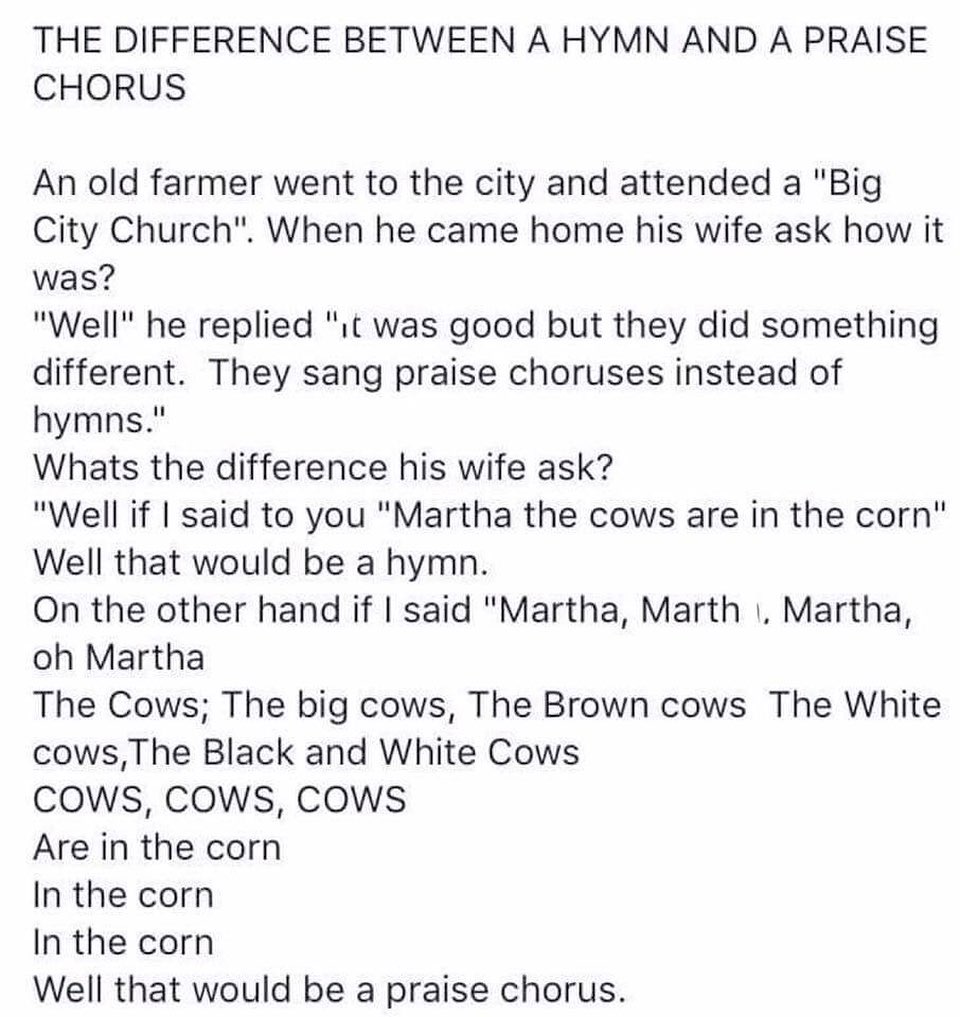
Back in the day, the debate was whether to use hymns or praise choruses in church. Lately, a lot of churches have decided that it doesn’t have to be an either/or proposition. You can do both.

As a child of the 80s and 90s, I have a nostalgic love for all the old praise choruses, but lately, I seem to be drawn back to hymns. I really love when you can take a hymn and give it a little more modern arrangement. That really makes the powerful words stand out even more.

I will say that if you pay attention to the rhyme scheme of the old hymns, they were always dead on. Every line rhymed exactly. Praise choruses? Not so much, but at least it was close most of the time. With the later modern worship music, not so much.

I really like some of the new songs, but I have to confess that some of the rhymes are really forced and don’t really rhyme at all. But that’s probably me being a little OCD. Besides, that’s not really the point of a worship song.

C. S. Lewis said that a good worship service is one where you were so focused on God that you don’t remember the sermon or the songs as much as you know that God was there. I’d add that a true worshipper knows that worship is more than just singing songs. He or she can truly sing from a heart of gratitude and praise, regardless of whether the song is an ancient hymn or a recent worship song because what matters isn’t the style or the arrangements but the God we’re singing about.

Maybe next Sunday will be another 90s throwback worship set. Maybe it will be all hymns. Or maybe it will be a blend of new and old. Regardless, I want my eyes to be on Jesus, not the setlist. That’s what truly matters, after all.

The Books that Built Me

I had a random thought just now. Maybe I’d list some of the books I’ve read that challenged and changed me the most. It’s nowhere near a comprehensive list because I’ll think of one or two more that I should have added at 2 or 3 am.

But here is a list coming straight off the top of my head (including some series):

  1. The Valley of Vision – a collection of Puritan Prayers
  2. Hinds’ Feet on High Places – Hannah Hurnard
  3. The Normal Christian Life – Watchman Nee
  4. The Divine Conspiracy – Dallas Willard
  5. To Kill a Mockingbird – Harper Lee
  6. Les Miserables – Victor Hugo
  7. My Utmost for His Highest – Oswald Chambers
  8. 1000 Gifts – Ann Voskamp
  9. The Chronicles of Narnia – C. S. Lewis
  10. The Lord of the Rings – J. R. R. Tolkien
  11. The Space Trilogy – C. S. Lewis
  12. The Book of Common Prayer
  13. The Calvary Road – Roy Hession
  14. Any of the Mitford books by Jan Karon
  15. Foxes’ Book of Martyrs
  16. The Mark of a Man – Elisabeth Elliott
  17. Evidence not Seen – Darlene Deibler Rose
  18. Morning and Evening – Charles Spurgeon
  19. Telling the Truth – Frederick Beuchner
  20. The Princess & the Goblin/The Princess & Curdie – George MacDonald
  21. The Hiding Place – Corrie ten Boom
  22. Gold by Moonlight – Amy Carmichael
  23. Imitation of Christ – Thomas a Kempis
  24. The Return of the Prodigal – Henri Nouwen
  25. Ragamuffin Gospel – Brennan Manning
  26. Fresh Wind, Fresh Fire- Jim Cymbala

If I tried really hard (and really wanted to), I could have made this list ten times as long. I could probably name at least twice as many books that altered the course of my life and forever changed the way I think. But one that I left out on purpose but see as the ultimate #1 book is the Bible. Every other book influences me by how it restates and translates biblical themes in a new and fresh way.

Maybe one day, I’ll do another list. Or maybe I’ll list all the music and movies that influenced me. I’d love to hear some of the books that changed you for the better. I’m always looking for a new read, so maybe I’ll add your suggestions to my ever-growing list of books to read.

Heading South

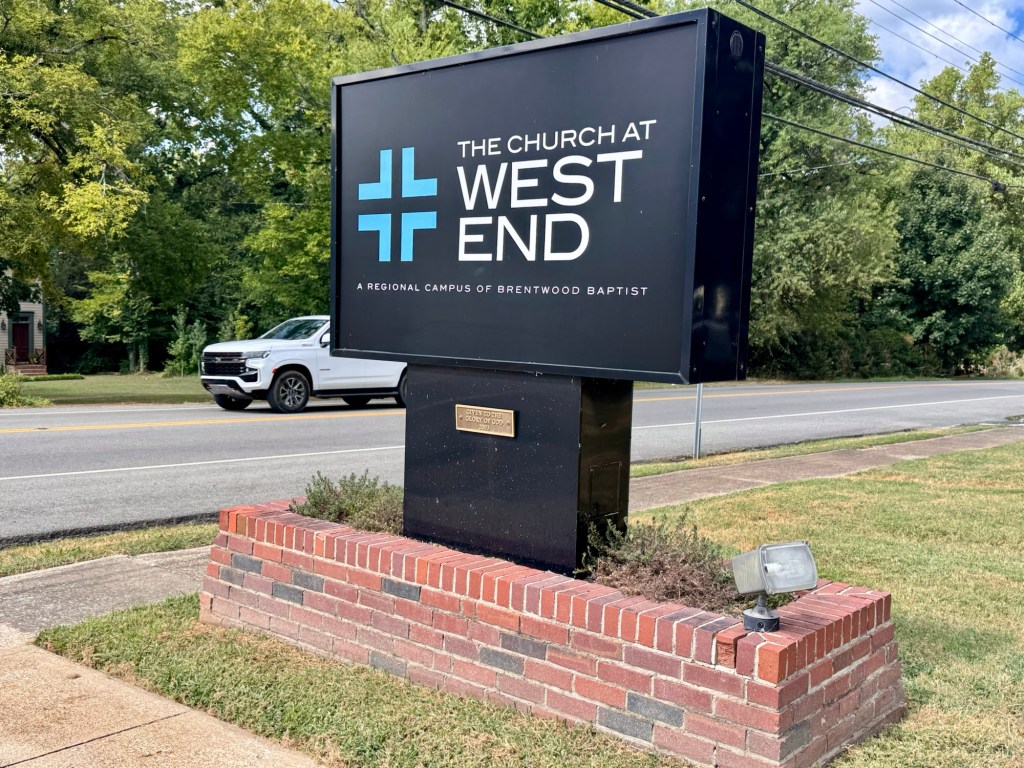
I finally got around to it. After months of thinking about it and finally deciding to make it happen, I visited the latest regional campus of Brentwood Baptist Church, The Church at West End in Columbia.

It was a bit of a drive from Brentwood to Columbia. Even on a Sunday, it took 45 minutes. But it was so worth it. I loved seeing this congregation worshipping and celebrating the Lord’s Day together.

I love how each of the campuses has a unique flavor and how each fits the community very well. Each one is a different expression of what a biblical Church should look like.

Several years ago, my goal was to visit each of the current campuses of Brentwood Baptist. At the time, there were 8, but I managed to get to each one. Now, I’m thankful that I’ve been to all 9. Maybe at some point, there will be another for me to visit.

I’m praying for the Church. It seems like more and more these days, the true Church that holds to the true faith will have to be more united than ever to survive. We will have to cross denominational lines and work together. We have to see other churches not as rivals or competition but allies and fellow saints.

God is at work. Whether it’s a massive structure that hosts thousands or a small room with a handful of people, God is present in the midst of them. People are getting saved and baptized. God is calling out faithful men and women to the ministry and the mission field.

Lord, keep us faithful to your true gospel. Bring back Your wayward churches and denominations that have strayed from Your truth. Bring back the prodigals that have wandered away and deconstructed. May we be true to all that You ask of us, and may we be one just as You, the Holy Trinity, are one.

Good Words from Dietrich Bonhoeffer

“Do not worry! Earthly goods deceive the human heart into believing that they give it security and freedom from worry. But in truth, they are what cause anxiety. The heart which clings to goods receives with them the choking burden of worry. Worry collects treasures, and treasures produce more worries. We desire to secure our lives with earthly goods; we want our worrying to make us worry-free, but the truth is the opposite. The chains which bind us to earthly goods, the clutches which hold the goods tight, are themselves worries.

Abuse of earthly goods consists of using them as a security for the next day. Worry is always directed toward tomorrow. But the goods are intended only for today in the strictest sense. It is our securing things for tomorrow which makes us so insecure today. It is enough that each day should have its own troubles. Only those who put tomorrow completely into God’s hand and receive fully today what they need for their lives are really secure. Receiving daily liberates me from tomorrow” (Dietrich Bonhoeffer).

That reminds me of something Jesus taught His disciples to pray. It was something about God giving us each day our daily bread. Something like that.

Of course, I jest a bit. We are told to ask daily for daily bread. Just like the manna in the desert for the children of God, we can’t stockpile or horde our daily bread. We only get enough for today. Tomorrow will take care of itself.

Worry doubts tomorrow’s provision. Worry doubts the heart of God. Worry forgets about all the days up to this one where God provided. But faith trusts not in the daily bread but in the Bread of Life.

Lord, give me today exactly what I need for today. Help me to trust you in the present and leave tomorrow’s troubles until tomorrow. Help me remember that you are already there and have already made provisions for me there. Amen.

An Evening Prayer

“Lord, we come to You not because you are our last hope, but because You are our first love.

We’re not waiting to come to You only when we think there’s nothing else we can do. We’re coming to You *before we do anything at all* because waiting on You is *wisest* of all. We trust You to work all this out in Your good time — because that will be the best time, and You are only good and You hold all time. *Kneeling the most lets us stand the bravest.* Tonight we kneel and lay our painful problems in Your hands and thank You for the perfect peace You put in our hearts.

In Jesus’ name, Amen. #EveningPrayer#RestinginHisWord” (Ann Voskamp).

Lord, I confess that I only come to You when I need something. Often, You are my last resort. I acknowledge that when everything is going well, I simply don’t see my need for You. It’s only when life gets difficult and stressful that I finally manage to look up to You.

Thank You for being patient with me. You have shown me more mercy than I deserve. If You treated me the way I treat You most of the time, I probably wouldn’t be here. I’d definitely be a lot worse off than I am.

But Your word says that You are faithful even when I’m faithless. You continue to work in me even when I don’t work at all. You honor Your promise to complete what You started in me even when I make promises to You that I don’t keep.

I know that I can look back and see growth. I can see change. I can see that in the past, my lackadaisical faith wouldn’t have bothered me nearly as much as it does now. I can see that I am more committed to You than I was last year or in the last decade.

Lord, make me more like You. Period.

The Whole Gospel

“There is no doctrine which I would more willingly remove from Christianity than this, if it lay in my power. But it has the full support of Scripture and, specially, of Our Lord’s own words; it has always been held by Christendom; and it has the support of reason. If a game is played, it must be possible to lose it. If the happiness of a creature lies in self-surrender, no one can make that surrender but himself (though many can help him to make it) and he may refuse. I would pay any price to be able to say truthfully “All will be saved.” But my reason retorts, ‘Without their will, or with it?’ If I say ‘Without their will’ I at once perceive a contradiction; how can the supreme voluntary act of self-surrender be involuntary? If I say ‘With their will,’ my reason replies ‘How if they will not give in?’. . .

The doors of Hell are locked on the inside. I do not mean that the ghosts may not wish to come out of Hell, in the vague fashion wherein an envious man ‘wishes’ to be happy: but they certainly do not will even the first preliminary stages of that self-abandonment through which alone the soul can reach any good. They enjoy forever the horrible freedom they have demanded, and are therefore self-enslaved: just as the blessed, forever submitting to obedience, become through all eternity more and more free” (C. S. Lewis, The Problem of Pain).

If we want to be true to the true gospel, we have to be true to the Word of God. If we are true to the Word of God, then we must believe that there is a hell as much as there is a heaven. There is no universal salvation. Some will be saved, some will not.

Jesus mentions that the road to life is narrow, and few find it. He then proceeds to say that the road to destruction is broad, and many are on it. As much as I want to believe that everyone is on their way to heaven, I can’t deny these words of Jesus.

That’s why the offer of the gospel still stands. To whomever will repent of their sins and receive Jesus as Lord and Savior, God will grant them eternal life. God will save anyone who calls on Him in faith. God is not willing that you should perish but that you should be saved.

You can pray a prayer like this: “Jesus, I know I’m a sinner. I know I’m separated from you. I deeply regret and repent of my sin. I turn to You in faith and receive you now as my Lord and Savior. I commit myself to following You for the rest of my days and to obeying whatever You ask of me from now until eternity. Thank You for saving me. Amen”

A Mic Drop Moment

“Whenever the insistence is on the point that God answers prayer, we are off the track. The meaning of prayer is that we get hold of God, not of the answer” (Oswald Chambers, My Utmost for His Highest).

I almost want to make this a mic drop moment and end this post here. There’s such a misconception about prayer being a way to inform God of what He didn’t already know or to ask Him for things He wasn’t aware that I needed.

Prayer isn’t about getting God to see things from my point of view but getting me to see things from God’s point of view. It’s not so much about answers as it is about awareness of God’s presence. When I pray, I’m acknowledging in that moment my deep need and God’s deeper provision.

What would I want from God apart from Himself anyway? As the old song says, “I’d rather have Jesus than riches untold.”

It’s like when Job asks all these questions to God. When God responds, He doesn’t answer a single one of those questions. Instead, God asks Job some of His own questions. At the end, what Job realized was that he needed not answers but God’s presence. He needed to know God hadn’t left him or forgotten about him.

My own prayers can easily become rote and full of requests. They can almost sound like the letters I used to write to Santa Claus before Christmas with my list of everything I wanted under the tree that year. They can be very me-focused when the idea of prayer is to get me very God-focused. It’s to help me see God’s purposes and plans for His entire creation and not just my own little world.

Sure, God answers prayer, but that’s not the main point of prayer. My character being transformed into the character of God and my will being transformed into His is.

The Divine Purpose

“Our lives mean much more than we can tell; they fulfill some purpose of God about which we know nothing; our part is to trust in the Lord with all our heart and not lean to our own understanding. Earthly wisdom can never come near the threshold of the Divine; if we stop short of the Divine we stop short of God’s purpose for our lives” (Oswald Chambers, Bringing Sons Unto Glory).

I’m guilty of trying to decipher God’s overall plan for me and whether or not I feel like I’m living up to it. What God calls me isn’t to figure it all out but to be faithful in the minutiae and the mundane from moment to moment. It’s to be in a constant attitude of prayerful mindfulness and paying attention to God’s voice wherever I am and whatever I’m doing.

Ultimately, it’s presenting myself as a living sacrifice with everything I do as a spiritual offering of worship to God my King. That looks a lot like doing the small stuff and the daily routine like it matters to God, because it does.

It means that the janitor is as much of a sacred office as the minister. It means that sweeping floors and scrubbing toilets can be just as much an act of worship as singing hymns. For me, it means doing my best in everything as if I were doing it directly for God.

Being faithful looks like showing up and staying prayed up and never giving up, no matter what. It means reminding yourself of God’s promises and thanking God for them in advance while you’re still waiting on their fulfillment. It means preaching the gospel to yourself every day, several times a day, until you remember that it starts and ends with God, not you.

Sometimes, being faithful isn’t about the next 24 hours. It could be the next two hours. It could be the next 15 minutes. It could be the next breath. But it’s all about remembering the God who is forever faithful.