Living on this Side of the Election

  • “It’s not about how the worship music makes us feel on Sunday morning, but how we live poured-out lives of worship from Monday to Saturday.
  • It’s not about how many verses we can quote to defend our political viewpoints, but how well we embody the Word made flesh to our politically opposite next-door neighbors.
  • It’s not about how pious our prayers sound during Sunday School, but how our hearts hear the whisper of God both in our hidden rooms and in our lived-out interactions with others” (Asheritah Ciuciu).

Now that we’re past the dreaded elections (or at least they were for me), we can hopefully return to normal. We can hopefully reach out across party lines to embrace and love those who voted differently than we did. We can understand that there is room in the Kingdom of God for blue and red (as well as many other colors).

The point is that we’re called to love our enemies, period. It doesn’t say to love them if they show remorse for their bad behavior. It doesn’t say to love them if they promise to reform. It says to love them the way Jesus loved those who crucified Him. And how did He do that? He forgave them. He died for them.

We’re also called to honor our leaders, according to Romans 13. That doesn’t mean only those who share my political ideology. It doesn’t mean those we like and admire and can respect. Remember when Paul wrote those words, the ruler was Nero, who was just about as bad and corrupt as they come. Nero was responsible for the martyring of many followers of Jesus. But Paul said to honor him because God in His infinite purposes sets up rulers, good and bad, to accomplish His will.

Ultimately, it helps to remember that we’re all broken. The problem isn’t just out there. We all have sinned and fallen short of the glory of God and can share the blame for the problems of this country. We would be wise to drop those stones we want to throw at the Trumps and Harrises of the world and their followers unless we can prove that we’re sinless.

If we live out of love as citizens of a Kingdom more than of a country, we do well. Our ultimate allegiance isn’t to any president or to any flag or any political party or ideology. It’s to a King and a Kingdom. It’s to Jesus who will still be on His throne long after all the presidents and kings and emperors are long gone.


Reframing Your Past, Present & Future

I’ve never thought about gratitude like that before. I get that it changes the way you see your present and can shift how your future plays out, but to change your perspective on your past? That’s a game changer.

The old saying about grace is that it means that your past now serves a purpose instead of serving shame. Gratitude helps you to see how every part of your past, good and bad, has led you to the present moment. God was in all of it with you, taking those dark and painful moments to weave them in with the brighter colors.

Also, sometimes when you look at a famous painting too closely, it looks like a big chaotic mess. You can’t tell anything about it. But once you step back, it becomes clearer. The same applies for life — once you can step back after a few days or weeks or months, you can see more clearly what God was up to in that moment.

You don’t have to give thanks FOR those awful moments and tragedies. But you can give thanks IN them. Paul didn’t say give thanks FOR all circumstances but IN all circumstances, knowing God works all things together for good and there is a redemptive purpose for pain and loss.

I still think about that quote about muddy water becoming clear as it settles and is still. So do we. Everything becomes clear when we cease striving to make it make sense and can be still and know that God is God, to know that God is still in control and in charge.

And it all begins with gratitude.

The Only Path to Joy

“The greatest blessing God can give us is to put us in a position where we must trust him. This is our only path to joy. He will do whatever is necessary to disrupt our self-sufficiency and illusion of control” (Jim Dennison).

That doesn’t sound like much of a path to joy to me. I can think of a million other ways to joy other than by having my plans thwarted and my comfortable routine altered. In fact, I’d like very much to continue to live under the illusion that I’m in at least a little bit of control over my life.

But what I want isn’t necessarily what’s good for me. If I had the opportunity, I could eat my weight right now in those Reese’s Peanut Butter Pumpkin-shaped thingies. You know what I mean. They’re like the peanut butter cups, only they’re in spooky shapes.

Anyway, as long as I think I’m in control, I will never seek out God. I will continue to do my daily autopilot where I think about God on Sundays but about me for the rest of the week. I will pat myself on the back and think how good I have it made with nary a thank you to God for actually providing everything that’s good in my life.

But when the job goes away, that’s when I have to look up. When there’s a new normal, that’s when I recognize how much I’ve needed God this whole time. I remember that what I really crave beyond all the toys and comforts is what only God can give me — namely, God Himself.

So thank you, God, for all those disruptions. Thanks for shattering my delusions of independence and self-sufficiency into smithereens. Now I can see beyond my own little made-up pretend world to find You there and to find out You’ve been there all along.

Am I Unoffendable?

““Choosing to be unoffendable, or relinquishing my right to anger, does not mean accepting injustice. It means actively seeking justice, and loving mercy, while walking humbly with God. And that means remembering I’m not Him. What a relief” (Brant Hansen, Unoffendable).

This book is one of those that comes along and does a seismic shift on your thinking. I’ve always grown up believing that we’re supposed to be righteously angry about injustice and wrongs and sin, but this book is showing me that you can be actively against all those things without giving in to anger.

Based on what I understand, the Bible never calls for us to be angry. It does say that in your anger not to sin. It also says that anger does not produce the righteousness of God. I think when it says to be angry but don’t sin, it’s making allowances for the natural human tendency to anger. It also says not to stay there.

The only one allowed to be truly angry is God — and of course, Jesus — because God can have pure anger rooted in a holiness and righteousness that we don’t have. We can choose not to give in to anger without also giving in to all the wrongs and oppression in the world. We can fight those things out of love rather than anger.

I don’t want to give too much of the book away. It’s worth reading and says all the things I just said but way better than I just said them. Plus, if you get the audio version you get the book read by the author, which is almost always a bonus (and it is in this case).

A lot of our anger comes from the misguided view of calling out the sin in others while ignoring our own sin. We can easily become Pharisee-ical in seeing evil and wrong as being “out there” and “in them” rather than acknowledging my own sinful depravity and capacity for evil apart from the grace of God.

I’m a little over halfway there, so those are my takeaways thus far. My assignment for you is to find the actual book or the audio book and to devour it in short order. It’s an easy read (or an easy listen if you prefer). I’m even going through all the trouble of providing a link to the book on amazon.com. You’re welcome.

https://www.amazon.com/Unoffendable-Change-Better-updated-chapters/dp/1400333598/ref=sr_1_1?dib=eyJ2IjoiMSJ9.CCApAzLdwJEJ_bILerbPnP92PX4ePbEFxUdfzlwKQuQp8W7M9XUk146MAeiZVMFn_gCWS1YcpqnZy9olfkdcAfSWcn5iw6qDCNSMfQHhWM4EdxijLEVgmtywazlTVSyAjhJq8cHtUVNdhY2iyqRj5RPo8i-hjYAd2LH_aHTRyJG9DkQ7VkckmFOCsXjPi3Xs1hSaBdb8kGdBR9qVSFqkSUFMAdfYgPn_TY8uuyNJF1s.loHWjW318gTjgxlSS8Hem4fAJ5QuDVig1J42IDbTcCk&dib_tag=se&keywords=unoffendable&qid=1730083531&sr=8-1

Got to Have Faith, Faith, Faith

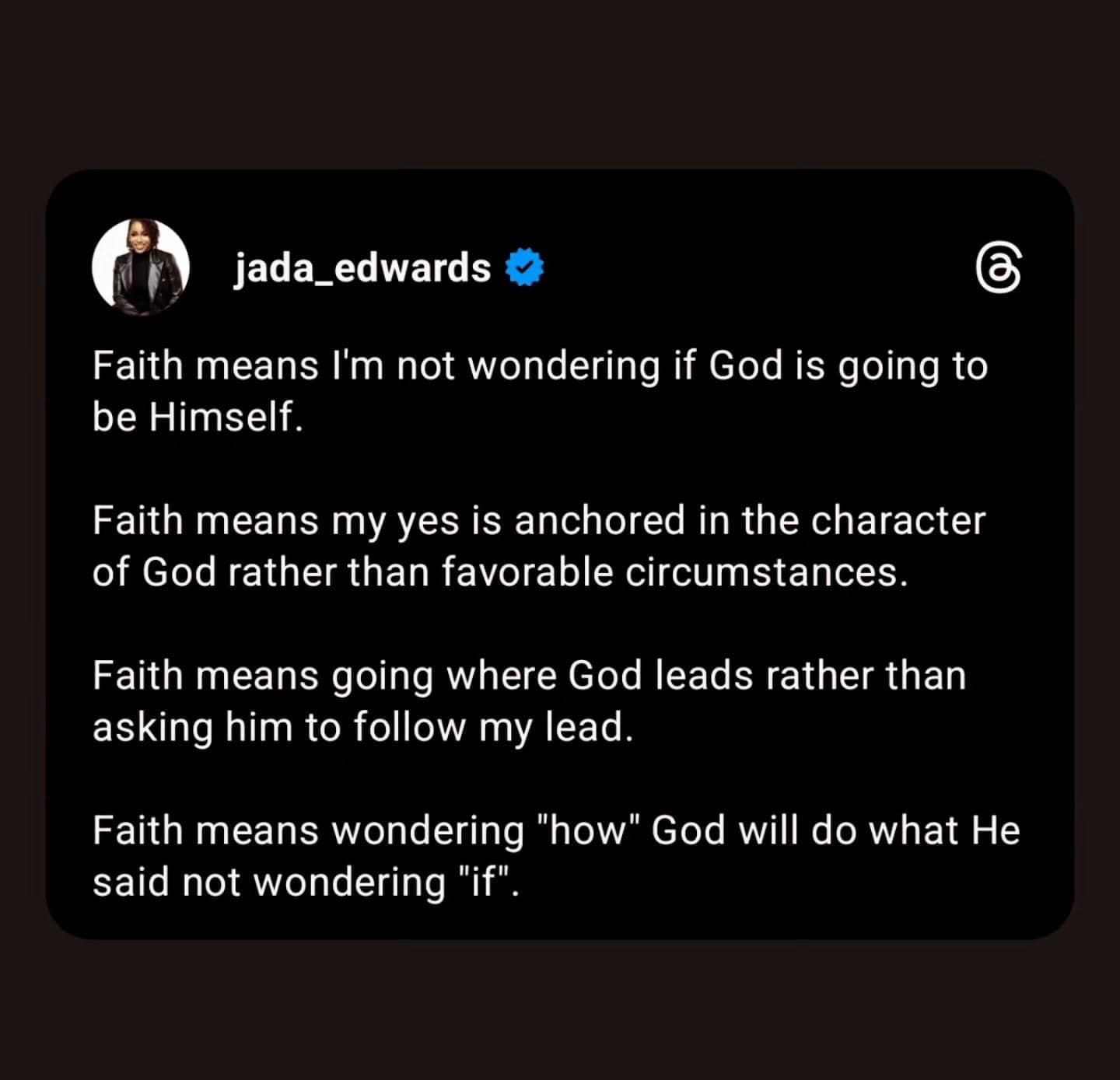
I think I read that faith means trusting an unknown future to a known God, although sometimes, God seems as unknowable as the future. I understand God as much as He has revealed Himself to me, but there’s so much more to know and even some that will never be known on this side of heaven.

I think faith means trusting what I know of me to what I know about God, giving what I know about my circumstances and my future into His Hands. I almost said understand instead of know, but faith goes beyond understanding. I trust when I do not understand because what I know of God proves His trustworthiness.

I keep thinking about that character in the Bible who said to Jesus, “I believe. Help my unbelief.”

I get that. I relate to that 1000%.

My faith doesn’t have to be complete or perfect. I don’t have to have faith the size of a mountain to move God. All I need is faith the size of a mustard seed for God to move the mountain. Again, it’s not my big faith in God but my faith in a big God who is bigger than my fears, my doubts, and my circumstances.

I confess that sometimes I wonder IF God will show up, despite having seen Him never fail to show up at the right moment. In my best moments, my faith says, “I can’t wait to see how You pull this one off, because I know You will.”

I can’t wait for the day when my faith will be made sight. Until then, I will echo the words, “I believe, help my unbelief.”

And that will always be enough.

Another Dose of Spurgeon

I love getting a daily dose of Charles Spurgeon in my emails. There’s a soundness to the theology of those old-school preachers and writers that’s missing from a lot of pulpits and books today. They weren’t afraid to step on a few toes and speak the unvarnished truth. They weren’t also shy about proclaiming the goodness of God. Here’s today’s gem from Spurgeon:

“DAILY PRAYER (BY SPURGEON)

Oh Lord, in looking back we are obliged to remember with the greatest gratitude the many occasions in which you have heard our cry. We have been brought into deep distress and our heart has sunk within us, and then have we cried to you and you have never refused to hear us. You have rejected the prayers of our lusts, but the prayers of our necessities you have granted. Not one good thing has failed of all that you have promised. Blessed be the name of the Lord forever, our inmost heart is saying. Amen, blessed be his name.

Amen.

VERSE OF THE DAY (COMMENTARY BY SPURGEON)

“Now if any of you lacks wisdom, he should ask God—who gives to all generously and ungrudgingly—and it will be given to him. But let him ask in faith without doubting.” (James 1:5–6)

We cannot ask of a person of whose existence we have any doubt and we will not ask of a person of whose hearing we have serious suspicions of. Who would stand in the desert of Sahara and cry aloud, where there is no living ear to hear? Now, my dear hearer, you believe that there is a God. Ask, then! Do you not believe that he is here, that he will hear your cry, that he will be pleased to answer your cry to give you what you ask for? Now, if you cannot believe that there is a God, that he is here and that he will hear you, then confess your ignorance, and ask him now to give you the promised wisdom for Jesus’ sake.”

The Lord Has Need

“When he drew near to Bethphage and Bethany, at the mount that is called Olivet, he sent two of the disciples, saying, “Go into the village in front of you, where on entering you will find a colt tied, on which no one has ever yet sat. Untie it and bring it here. If anyone asks you, ‘Why are you untying it?’ you shall say this: ‘The Lord has need of it.’’ So those who were sent went away and found it just as he had told them” (Luke 19:29-32, ESV).

I heard something tonight that blew my mind a little. It definitely got me thinking the story of Jesus riding into Jerusalem in a different way.

Have you considered the story from the point of the colt? Have you thought that God appointed that a man should go and buy a donkey to take care of it and raise it and feed it? That donkey then proceeded to give birth to a colt, which the man also raises and feeds, all for the moment when Jesus sends His disciples to fetch the colt, saying “The Lord has need of it.”

Have you thought that maybe God placed you and me where we are in the time and place we’re in so that one day, you can be in the place to hear the words “The Lord has need of you”?

We don’t really think about all the time that passed before Jesus needed the colt. All that time that seemed wasted or useless was a time of preparation for one single event that led to the event that changed the entire world.

You may be in a season of preparation that proceeds the moment when God will say to you, “I have need of you.”

I get that in one sense God doesn’t really need you or me or anyone else. But I also know that God places you in the exact moment and location where He will be able to best mold you into the person He can use. Maybe it’s for a lifetime calling or maybe it’s a moment in time. But God will use you. All He asks of you and me is that we are available.

A God We Can’t Exaggerate

“Many Spirit-filled authors have exhausted the thesaurus in order to describe God with the glory He deserves. His perfect holiness, by definition, assures us that our words can’t contain Him. Isn’t it a comfort to worship a God we cannot exaggerate?” (Francis Chan)

There’s a beautiful old book by J. B. Phillips called Your God Is Too Small. I think that’s the case for anyone who has ever lived who tried to conceive the idea of God. We always fall short. We always make God way too small.

The problem with a lot of deconstruction is that we make ourselves the standard by which God and truth are measured. We are definitely too finite and small to be any kind of measuring stick to which God must conform (thanks to Frances Chan for that one as well). It’s putting ourselves above God, essentially saying that God would never [fill in the blank] because I would never [fill in the blank].

God not only above us, He is so far beyond us that our minds could never have fathomed God at all apart from God revealing Himself to us. That blows my mind. It also humbles me whenever I get to the place where I think I have God figured out.

We can’t possibly exaggerate God. How cool is that? The biggest, grandest, wildest picture we can dream up or draw or sing about or write about falls short of who God is by far. All we can do is sit at the brink and adore the depth, to borrow from Matthew Henry.

God is never too small. Only our conception of Him is. But God made Himself incarnate and came near and became a tiny infant. That’s my favorite part.

Weeping Prayers

This is not me currently, but I know a few people who are navigating the process of grieving a loved one. It’s never an easy process and even though I’ve been around a while, I still can’t say that grief is a natural process because death really isn’t natural. It’s a product of the fall brought about by sin and not in God’s original design.

I do believe that God hears weeping as a prayer as much as He will hear your words and desires of your heart. The Bible says that God collects our tears in a bottle. I know that someone in deep grief may not have anything more than tears to offer to God, and that is enough.

As a reminder, there is no time limit on grief, because grief is the price of love this side of heaven. It will never be right that the person isn’t here. It will never be right that you will never hear that familiar voice or see that face again until heaven.

I love the fact that Jesus, knowing He was about to call His friend Lazarus out of the grave, still wept over his death. He wept over the grief of his friends who had no inkling of the coming miracle. He wept to show that we can believe in heaven and the resurrection and still be sad at the same time.

So I’m saying that there’s no shame in grief. Sometimes tears can be the only prayers we have.

Why Go to Church?

I stole this from a Facebook post. It’s not a perfect answer, but I think it does make a point:

A Church goer wrote a letter to the editor of a newspaper and complained that it made no sense to go to church every Sunday.

He wrote: ‘I’ve gone for 30 years now, and in that time I have heard something like 3,000 sermons, but for the life of me, I can’t remember a single one of them. So, I think I’m wasting my time, the preachers and priests are wasting theirs by giving sermons at all.’

This started a real controversy in the ‘Letters to the Editor’ column.

Much to the delight of the editor, it went on for weeks until someone wrote this clincher:

‘I’ve been married for 30 years now. In that time my wife has cooked some 32,000 meals. But, for the life of me, I cannot recall the entire menu for a single one of those meals.

But I do know this: They all nourished me and gave me the strength I needed to do my work. If my wife had not given me these meals, I would be physically dead today.

Likewise, if I had not gone to church for nourishment, I would be spiritually dead today!'”

I get the point of what the author is trying to say, but if hearing sermons at church is the equivalent of eating, then that means those who get all their spiritual knowledge on Sunday are only eating once a week. That’s not enough.

If you don’t have a consistent time of Bible reading and devotion every day, you’re just as spiritually malnourished as you would be physically if you ate one meal at the beginning of the week and didn’t eat again until the next week.

Church is for gathering together to encourage each other. The sermon is part of that. So is the worship. But that can’t be all the spiritual nourishment you get to last you for 7 days.

On the contrary, if you neglect that gathering together on Sunday, you miss out on the benefit of being around God’s people. Also, you’re disobedient to God’s command for believers to gather together. You don’t get that edification and encouragement and (sometimes) gentle reproof.

It’s not an either/or but a both/and. You need Sundays and you need to feed on God’s word every day. We all do.