Like a Dream

Remember when the Eternal brought back the exiles to Zion?
    It was as if we were dreaming—
Our mouths were filled with laughter;
    our tongues were spilling over into song.
The word went out across the prairies and deserts,
    across the hills, over the oceans wide, from nation to nation:
“The Eternal has done remarkable things for them.”
We shook our headsAll of us were stunned—the Eternal has done remarkable things for us.
    We were beyond happy, beyond joyful” (Psalm 126:1-3, The Voice).

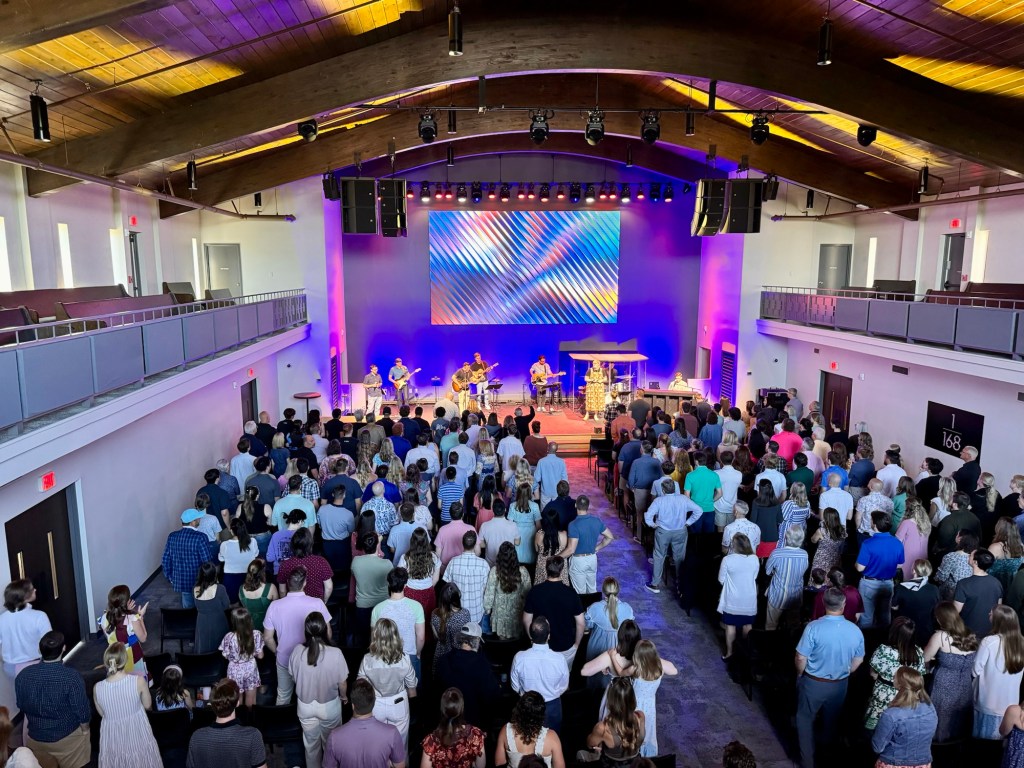
We had our very first worship service today in our newly renovated, fully paid for building. It really was like a dream. I kept expecting to wake up and find myself going to the old campus.

But God knew. Even before The Church at Avenue South was a dream in the minds of those who had a goal of reaching the city of Nashville for Jesus, God saw this day. God planned this day.

Long before creation, God orchestrated that one day there would be a church that met on the hill overlooking the intersection of Elliott and Acklen, a virtual city on a hill.

For a while, it didn’t seem possible. We were told that there was nothing available and even if there was, we couldn’t afford it. Some developers would swoop in and pay in cash way more than we could hope to match.

Then we found the property and ran into red tape. For a while, it seemed improbable. I was beginning to think we’d never get the necessary paperwork to even get started on the renovations and additions.

But God showed up. Any time you see a passage in the Bible that starts with “but God,” then you know something good is about to go down. Something amazing. Something miraculous.

Every time we meet, we are standing in the faithfulness of God. We are standing on the promises of God — literally as many of us wrote Scripture on the floors and walls before the carpet and pain went in.

Hudson Taylor said it best: “There are three stages to every great work of God; first it is impossible, then it is difficult, then it is done.”

I’m reminded of something I heard at another church: what seems impossible to us isn’t even remotely difficult for God.

I can look back and see the hand of God all over this new property, starting on day one. I can’t wait to see what God will do in the weeks and months and years to come at 901 Acklen Ave.


Wanting and Willing

What follows was originally penned by Elisabeth Elliott. It speaks to the distinction between wanting to obey and willing to obey. The key is that you obey even when you don’t feel like it. You do the acts of love and then the feelings of love will follow:

“We don’t always have complete control over what we want to do because ‘wants’ are determined by circumstances, feelings, other people, social climate, times in which we live. Nobody ever wanted a pair of Reebok tennis shoes before Reebok tennis shoes were invented. The fact that you want it doesn’t mean you go and buy it. It’s a matter of ‘willing’.

The same thing is true of the will of God. We can determine to will to do the will of God. It’s a conscious choice. You may not w’ant’ to do what you know God wants you to do, but you can will to do what He wants you to do.

Don’t ever allow the devil to take you in with the argument, “You gotta do what you gotta do because if you do something that you don’t wanna do or you don’t do something that you wanna do, You’re being a hypocrite.” That’s rubbish! Do you think a mother changes a baby’s diaper only when she wants to, when she feels like it? No, she does it when the baby’s diaper needs to be changed. She WILLS to do it. It has nothing to do with whether she feels good about it.

Here is a poem I came across:

[ I believe the author was Anna J. Graniss.]

“I saw a little child
With bandaged eyes
Put up its hands
To feel its mother’s face.

She bent and took
The tender, gropy palms
And pressed them to her lips
A little space.

I know a soul
Made blind by its desires
And yet its faith keeps feeling
For God’s face.

Bend down, O Mighty Love
And let that faith
One little moment
Touch Thy lips of grace.”

The same thing as what our loving God does. Even if we are made blind by desires, the things that we want–yet faith–which is a willed act, keeps feeling for God’s face. And when we will to come to Him, will to seek His face, then He in tender love reaches down and takes our hands and leads us to Him.

George McDonald said, ‘f I felt my heart as hard as a stone, if I did not love God, or man, or woman, or little child, I would yet say to God in my heart, ‘Oh, God, see how I trust Thee because Thou art perfect and not changeable like me. I do not love Thee. I love nobody. I am not even sorry for it. Thou seest how much I need Thee to come close to me, to put Thy arm around me, to say to me, ‘My child’. For the worse my state, the greater need of my Father Who loves me.’

If anyone feels he/she has no religious feeling whatsoever, but still desires God, believe me, the Father waits for your slightest move in His direction and He will meet you” (Elisabeth Elliot).

Stories from Scars

I have a scar on my left hand. It goes back to when I was 18 or 19 years old. I was driving down Poplar Avenue in Memphis, Tennessee to Cat’s Music to do some trading of music. At some point, I passed my destination. Later on, I came to a two-way flashing red light stop.

The problem was that I didn’t know it was a two-way stop. Even if I had known, I probably still wouldn’t have known what to do. The result was me pulling out in front of a full-sized truck and getting hit in the driver’s side door.

In case you’re wondering, I survived. I ended up with a rather garish wound on my left hand. At first, I could see clear to the bone. That’s when I realized that it hurt. A lot.

Thankfully, that was the extent of my injuries. Unfortunately, my car did not survive the encounter. But to this day, I carry the scar as a reminder of the foolishness of my youth and the ever-present and ever-protective grace of God.

Scars tell stories. They speak to wounds that have healed but left visible reminders. As much as the memorial stones set up by the people of God in olden times, scars are a kind of memorial to a time when you survived. They are a testimony to how God met you in the moment of your wounding and carried you through it.

Every time I see my scar, I see God’s goodness. Every time my hand cramps up when I’m writing, I think back to how close I came to not being here. I’m still thankful.

Scars can be shameful if you focus on the wound and the hurt, but they can be sacred if you choose to see how God turned that painful moment into something beautiful and good.

“Darkest water and deepest pain
I wouldn’t trade it for anything
‘Cause my brokenness brought me to you
And these wounds are a story you’ll use

So I’m thankful for the scars
‘Cause without them I wouldn’t know your heart
And I know they’ll always tell of who you are
So forever I am thankful for the scars” (Ethan Hulse, Jon McConnell, Matthew Armstrong, Matthew Hein).

The Mosaic of Community

This is most likely a repeat, but I’m too tired for original thought, so I’m posting something from Henri Nouwen that spoke volumes to me about the importance of community and how we together reflect God and make Him visible in the world:

“A mosaic consists of thousands of little stones. Some are blue, some are green, some are yellow, some are gold. When we bring our faces close to the mosaic, we can admire the beauty of each stone. But as we step back from it, we can see that all these little stones reveal to us a beautiful picture, telling a story none of these stones can tell by itself.

That is what our life in community is about. Each of us is like a little stone, but together we reveal the face of God to the world. Nobody can say: ‘I make God visible.’ But others who see us together can say: ‘They make God visible.’ Community is where humility and glory touch.”

I think stained glass window work essentially the same way. They are made up of bits of broken glass that only make sense when fitted together into a whole. We are that mosaic and that stained glass window that tells the story of God’s love for His people. That’s why community matters so much.

Beauty from Ashes

“To all who mourn in Israel,
    he will give a crown of beauty for ashes,
a joyous blessing instead of mourning,
    festive praise instead of despair” (Isaiah 61:3, NLT).

On my weekly Radnor Lake hike, I saw something that took a minute to register. There were these beautiful yellow flowers growing out of a pond of green scum. If I knew anything about botany, I could tell you what kind of flowers or maybe what kind of green scum was covering the pond.

I do know that what stuck me is that out of something I perceived as ugly grew something that I saw was beautiful. But isn’t that just God’s way?

The prophet Isaiah speaks about God bringing beauty from ashes. I honestly can’t think of anything more hopeless than ashes. Ashes are what’s left after the destruction of fire. There’s literally nothing left to restore.

But God can take these ashes and turn them into something beautiful the same way He could take a valley of dry bones and make them into a living army.

I heard a pastor say once that what seems impossible for us isn’t even remotely difficult for God. That means even the most hopeless of circumstances can be transformed into the most amazing outcomes. He can make miracles from mud (just ask the blind man Jesus healed).

It’s easy to forget God’s goodness when you’re staring at a pile of the ashes that are what’s left of your life. But God can turn even those into something beautiful, something better than before, something that will always be a reminder of God’s faithful love for you.

Balloons

“Sharing what a dear friend once posted:

A professor gave a balloon to every student, who had to inflate it, write their name on it and throw it in the hallway. The professor then mixed all the balloons. The students were then given 5 minutes to find their own balloon. Despite a hectic search, no one found their balloon.

At that point, the professor told the students to take the first balloon that they found and hand it to the person whose name was written on it. Within 5 minutes, everyone had their own balloon.

The professor said to the students: ‘These balloons are like happiness. We will never find it if everyone is looking for their own. But if we care about other people’s happiness, we’ll find ours too'” (William Groce).

I think that’s what the goal of evangelism and missions really is. It’s to help people find true joy and happiness in Jesus. The purpose of this Christian life is to glorify God, love Jesus, and love others. In other words, you get fulfillment when you help others find theirs.

Jesus said it to the effect that if you work to save your own life, you lose it, but if you lose it by giving it away for others, you actually gain it in the end. The best way to rediscover joy is selfless service and helping others find joy.

A Puritan Prayer

This is most likely a repeat, but it’s worth reading again. It’s from The Valley of Vision, a collection of Puritan prayers that is one of the best books I have ever read outside of the Bible:

“O God of Grace,
Thou hast imputed my sin to my substitute,
and hast imputed his righteousness to my soul,
clothing me with bridegroom’s robe,
decking me with jewels of holiness.
But in my Christian walk I am still in rags;
my best prayers are stained with sin;
my penitential tears are so much impurity;
my confessions of wrong are so many aggravations of sin;
my receiving the Spirit is tinctured with selfishness.
I need to repent of my repentance;
I need my tears to be washed;
I have no robe to bring to cover my sins,
no loom to weave my own righteousness;
I am always standing clothed in filthy garments,
and by grace am always receiving change of raiment,
for thou dost always justify the ungodly;
I am always going into the far country,
and always returning home as a prodigal,
always saying, Father, forgive me,
and thou art always bringing forth the best robe.
Every morning let me wear it,
every evening return in it,
go out to the day’s work in it,
be married in it,
be wound in death in it,
stand before the great white throne in it,
enter heaven in it shining as the sun.
Grant me never to lose sight of
the exceeding sinfulness of sin,
the exceeding righteousness of salvation,
the exceeding glory of Christ,
the exceeding beauty of holiness,
the exceeding wonder of grace” (The Valley of Vision – A collection of Puritan Prayers & Devotions, Edited by Arthur Bennett).

Why God Allows Evil

I read the following a few days ago and it blew my mind, especially when I got to the end and read the payoff. It’s a bit long, but worth the effort because the answers are so spot on:

“Why did God create evil? The answer struck me to the core of my soul!

A professor at the university asked his students the following question:

– Everything that exists was created by God?

One student bravely answered:

– Yes, created by God.

– Did God create everything? – a professor asked.

‘Yes, sir,’ replied the student.

The professor asked :

– If God created everything, then God created evil, since it exists. And according to the principle that our deeds define ourselves, then God is evil.

The student became silent after hearing such an answer. The professor was very pleased with himself. He boasted to students for proving once again that faith in God is a myth.

Another student raised his hand and said:

– Can I ask you a question, professor?

‘Of course,’ replied the professor.

A student got up and asked:

– Professor, is cold a thing?

– What kind of question? Of course it exists. Have you ever been cold?

Students laughed at the young man’s question. The young man answered:

– Actually, sir, cold doesn’t exist. According to the laws of physics, what we consider cold is actually the absence of heat. A person or object can be studied on whether it has or transmits energy.

Absolute zero (-460 degrees Fahrenheit) is a complete absence of heat. All matter becomes inert and unable to react at this temperature. Cold does not exist. We created this word to describe what we feel in the absence of heat.

A student continued:

– Professor, does darkness exist?

— Of course it exists.

– You’re wrong again, sir. Darkness also does not exist. Darkness is actually the absence of light. We can study the light but not the darkness. We can use Newton’s prism to spread white light across multiple colors and explore the different wavelengths of each color. You can’t measure darkness. A simple ray of light can break into the world of darkness and illuminate it. How can you tell how dark a certain space is? You measure how much light is presented. Isn’t it so? Darkness is a term man uses to describe what happens in the absence of light.

In the end, the young man asked the professor:

– Sir, does evil exist?

This time it was uncertain, the professor answered:

– Of course, as I said before. We see him every day. Cruelty, numerous crimes and violence throughout the world. These examples are nothing but a manifestation of evil.

To this, the student answered:

– Evil does not exist, sir, or at least it does not exist for itself. Evil is simply the absence of God. It is like darkness and cold—a man-made word to describe the absence of God. God did not create evil. Evil is not faith or love, which exist as light and warmth. Evil is the result of the absence of Divine love in the human heart. It’s the kind of cold that comes when there is no heat, or the kind of darkness that comes when there’s no light.

The student’s name was Albert Einstein.”

Prone to Wander

“Robert Robinson had been saved out of a tempestuous life of sin through George Whitfield’s ministry in England. Shortly after that, at the age of twenty-three, Robinson wrote the hymn, ‘Come, Thou Fount. Come, Thou Fount of ev’ry blessing, Streams of mercy, never ceasing, Call for songs of loudest praise’.

Sadly, Robinson wandered far from those streams and like the Prodigal Son, journeyed into the distant country of carnality. Until one day—he was traveling by stagecoach and sitting beside a young woman engrossed in her book. She ran across a verse she thought was beautiful and asked him what he thought of it. ‘Prone to wander— Lord, I feel it— Prone to leave the God I love’. Bursting into tears Robinson said, ‘Madam, I am the poor unhappy man who wrote that hymn many years ago, and I would give a thousand worlds, if I had them, to enjoy the feelings I had then.’

Although greatly surprised, she reassured him that the ‘streams of mercy’ mentioned in his song still flowed. Mr. Robinson was deeply touched. Turning his ‘wandering heart’ to the Lord, he was restored to full fellowship” (Kenneth W. Osbeck, 101 Hymn Stories).

I love a good back story, especially when it comes to how hymns were composed. It’s no coincidence that the very words Robert Robinson penned were exactly the words he needed to hear when he had wandered from his faith. God used his own words to speak to him and woo him back.

God still speaks to us in a variety of ways, but primarily through His word. I think so many of us — me included — will go through the day with our Bibles closed and wonder why we haven’t heard from God.

I remember when I got my very first Bible as a first grader, the pastor wrote in the inside of the cover, “This Book will keep you from sin, or sin will keep you from this book.”

How true that has been. We need God’s word and God’s people around us to help us find the way back when we’ve wandered. We may be prone to wander, but God is always faithful to bring His wayward child back.

Trusting Beyond Knowing

“Faith never knows where it is being led, but it loves and knows the One Who is leading. It is a life of faith, not of intellect and reason, but a life of knowing Who makes us ‘go.’ The root of faith is the knowledge of a Person, and one of the biggest snares is the idea that God is sure to lead us to success.

The final stage in the life of faith is attainment of character. There are many passing transfigurations of character; when we pray we feel the blessing of God enwrapping us and for the time being we are changed, then we get back to the ordinary days and ways and the glory vanishes. The life of faith is not a life of mounting up with wings, but a life of walking and not fainting. It is not a question of sanctification; but of something infinitely further on than sanctification, of faith that has been tried and proved and has stood the test. Abraham is not a type of sanctification, but a type of the life of faith, a tried faith built on a real God. ‘Abraham believed God’ (Oswald Chambers).

I heard a sermon today that talked about trusting beyond knowing. Basically, the idea is that faith goes beyond understanding. If I knew everything and saw the whole picture, I wouldn’t need faith.

But the life of faith is one where you only see the next step in front of you, not the entire path. You have to take that first step in order to see the next one. There is no magic word or secret formula that will allow you to skip the difficult parts or to forego being obedient in the present.

There’s no guarantee that being faithful will always lead to prosperity and blessing. Sometimes, the path of obedience leads through the valley of the shadow of death. But the promise we have is that our Shepherd is with us when we go down that road. His rod and staff will comfort us.

We have no promise of material reward for our obedience. We do know that God is faithful to be with us and to fight for us and to never leave or forsake us. We know that God will provide for every need and He Himself will be our inheritance and our reward.

“When a train goes through a tunnel and it gets dark, you don’t throw away the ticket and jump off. You sit still and trust the engineer” (Corrie ten Boom).

May we sit still and trust our Engineer, no matter where He leads us.