My Favorite Ending

“And as He spoke, He no longer looked to them like a lion; but the things that began to happen after that were so great and beautiful that I cannot write them. And for us this the end of all the stories, and we can most truly say that they all lived happily ever after. But for them it was only the beginning of the real story. All their life in this world and all their adventures in Narnia had only been the cover and the title page: now at last they were beginning Chapter One of the Great Story which no one on earth has read: which goes on for ever: in which every chapter is better than the one before” (C.S. Lewis, The Last Battle).

That’s what I think heaven will be like. It won’t be the same old same old. It will keep getting better. We won’t just sing the same old songs about God. I believe that there’s so much to learn about an infinite God that we will still be learning new attributes to His character and singing new songs throughout eternity.

Sometimes I envy those who have gone to glory because their faith has now been made sight. They behold with their eyes what they had prayed about and sang about and wrote about and longed for with all their might. I know for me it’s just up the road and around the bend a bit. Whatever happens from here, heaven will be so amazing that whatever I go through to get there will have been worth it.

And Jesus will be there. As much as I long to see those I love who have gone before me, none comes close to the longing in my heart to behold my Savior face to face and hopefully hear the words “Well done, good and faithful servant.”

Why I Love Narnia

“But between them and the foot of the sky there was something so white on the green grass that even with their eagles’ eyes they could hardly look at it. They came on and saw that it was a Lamb.

‘Come and have breakfast,’ said the Lamb in its sweet milky voice.

Then they noticed for the first time that there was a fire lit on the grass and fish roasting on it. They sat down and ate the fish, hungry now for the first time for many days. And it was the most delicious food they had ever tasted.

‘Please, Lamb,’ said Lucy, ‘is this the way to Aslan’s country?’

‘Not for you,’ said the Lamb. ‘For you the door into Aslan’s country is from your own world.’

‘What’ said Edmund. ‘Is there a way into Aslan’s country from our world too?’

“There is a way into my country from all the worlds,” said the Lamb; but as he spoke, his snowy white flushed into tawny gold and his size changed and he was Aslan himself, towering above them and scattering light from his mane.

‘Oh, Aslan,’ said Lucy. ‘Will you tell us how to get into your country from our world?’

‘I shall be telling you all the time,’ said Aslan. ‘But I will not tell you how long or short the way will be; only that it lies across a river. But do not fear that, for I am the great Bridge Builder. And now come; I will open the door in the sky and send you to your own land'” (C. S. Lewis, The Voyage of the Dawn Treader).

I know Narnia isn’t a real place. I also know Narnia represents and stands for so many things that are real. Narnia was Lewis’ way of writing a series of good children’s books, which he thought meant that any adult should be able to pick one up and enjoy it as well as any child. It just so happens that the stories ended up revolving around a Christ-like main figure named Aslan.

I think what I love about the Narnia series is that you see practical truths and lessons taught in a way where real people interact within a fantastical setting with real problems and find ways to solve them that work just as well in the real world. That’s why I also loved the Harry Potter series because it used magic as a metaphor for the challenges of growing from childhood to adulthood.

I still sometimes wish Narnia was real and there was a place where animals could talk. It would be so nice to be able to visit from time to time and come back to this reality with no time having passed. That sounds ideal to me.

But if you don’t know about Narnia, I can’t recommend those books highly enough. The best place to start is with The Magician’s Nephew, the book that starts the series with the creation of Narnia. They may have been written for kids but they’re good for kids of all ages — from 6 to 106. They’re that good.

Always More

“When a servant comes in from plowing or taking care of sheep, does his master say, ‘Come in and eat with me’? No, he says, ‘Prepare my meal, put on your apron, and serve me while I eat. Then you can eat later.’ And does the master thank the servant for doing what he was told to do? Of course not.10 In the same way, when you obey me you should say, ‘We are unworthy servants who have simply done our duty’” (Luke 17:7-10, NLT).

That’s the secret to obedience and serving. There’s always more. You never get to the place where you’re done. It seems like one task leads to another, usually harder. But you find that if you remain faithful and available, God will equip you and empower you to fulfill the duty and the calling.

We forget sometimes that half the joy is in the journey. It’s not so much finishing what God calls us to do that energizes us and motivates us — we’re never really finished until God calls each of us home — but the process where we find we can do more than we thought and we find that God is bigger and stronger than we thought.

Obedience doesn’t lead to joy. For the one who serves not out of obligation but out of the overflow of God’s love in his or her heart, obedience is joy. We realize that serving God isn’t a “have to” as much as it is a “get to.” We get to participate in what God is doing, and we know that what God does always succeeds and has a good outcome. We can rest assured that our labors for God are never in vain.

Even the small stuff matters to God. Me showing up to serve in the parking lot at my church or someone else serving in the nursery is just as vital in the eyes of God as the pastor preaching the sermon or the worship leader calling us to worship. Every single act of obedience is a win for the kingdom and a blessing not only for the receivers but also for the person who obeys.

The harder the task, the more of God you get to do the job. The more your faith grows when you see it through. The more you want to serve God no matter what it looks like or how dirty you get. The more other people see it and want to know about this God that is worth our obedience.

Turning the Wine Back into Water

“Next to the Blessed Sacrament itself, your neighbor is the holiest object presented to your senses (C. S. Lewis, The Weight of Glory).

I’m guilty all the time of looking at people like they’re ordinary. I think that’s the default setting for the human race. We rarely if ever see anyone and see the image of God in him or her. We just don’t take the time to see beyond the surface labels of pretty, plain, fat, skinny, tall, short, etc.

I wonder what would happen if we could see people the way Jesus saw people. He didn’t see a stereotype or a caricature. Every time, He saw a unique individual with a story like no one else’s. He created each person with a one-of-a-kind purpose and plan that no one and nothing else can do.

He looked at you and me and thought we were worth dying for. Even at our worst moment in those times we wish we could take back or do over, Jesus still chose to go to the cross and lay down His life for us. While we were still sinners, the Bible says, Christ died for us.

I’ve been guilty of prejudging people before I’ve even had the chance to get to know them. Sometimes, I see the way they interact with others or maybe the expression on their faces. I’m sure I’m not the only one, but I’m also sure glad that Jesus didn’t judge me like that. He saw the absolute worst version of me and still loved me.

I wonder what would happen if we loved people like that. Maybe we wouldn’t have to hunt high and low for gospel conversations and opportunities to share our faith. Maybe people would seek us out and want to know more about this Jesus they see in us, even if they can’t put a name to what they see.

Worship Music

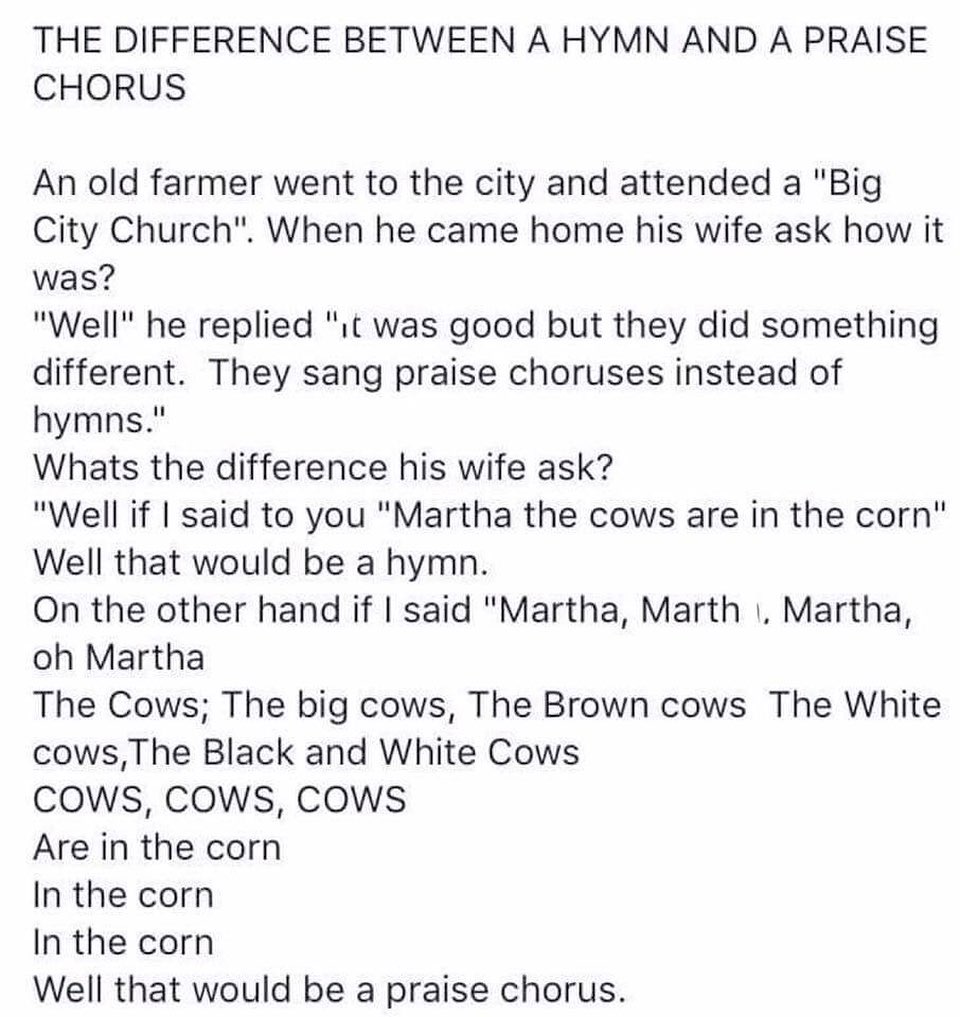
Back in the day, the debate was whether to use hymns or praise choruses in church. Lately, a lot of churches have decided that it doesn’t have to be an either/or proposition. You can do both.

As a child of the 80s and 90s, I have a nostalgic love for all the old praise choruses, but lately, I seem to be drawn back to hymns. I really love when you can take a hymn and give it a little more modern arrangement. That really makes the powerful words stand out even more.

I will say that if you pay attention to the rhyme scheme of the old hymns, they were always dead on. Every line rhymed exactly. Praise choruses? Not so much, but at least it was close most of the time. With the later modern worship music, not so much.

I really like some of the new songs, but I have to confess that some of the rhymes are really forced and don’t really rhyme at all. But that’s probably me being a little OCD. Besides, that’s not really the point of a worship song.

C. S. Lewis said that a good worship service is one where you were so focused on God that you don’t remember the sermon or the songs as much as you know that God was there. I’d add that a true worshipper knows that worship is more than just singing songs. He or she can truly sing from a heart of gratitude and praise, regardless of whether the song is an ancient hymn or a recent worship song because what matters isn’t the style or the arrangements but the God we’re singing about.

Maybe next Sunday will be another 90s throwback worship set. Maybe it will be all hymns. Or maybe it will be a blend of new and old. Regardless, I want my eyes to be on Jesus, not the setlist. That’s what truly matters, after all.

The Books that Built Me

I had a random thought just now. Maybe I’d list some of the books I’ve read that challenged and changed me the most. It’s nowhere near a comprehensive list because I’ll think of one or two more that I should have added at 2 or 3 am.

But here is a list coming straight off the top of my head (including some series):

  1. The Valley of Vision – a collection of Puritan Prayers
  2. Hinds’ Feet on High Places – Hannah Hurnard
  3. The Normal Christian Life – Watchman Nee
  4. The Divine Conspiracy – Dallas Willard
  5. To Kill a Mockingbird – Harper Lee
  6. Les Miserables – Victor Hugo
  7. My Utmost for His Highest – Oswald Chambers
  8. 1000 Gifts – Ann Voskamp
  9. The Chronicles of Narnia – C. S. Lewis
  10. The Lord of the Rings – J. R. R. Tolkien
  11. The Space Trilogy – C. S. Lewis
  12. The Book of Common Prayer
  13. The Calvary Road – Roy Hession
  14. Any of the Mitford books by Jan Karon
  15. Foxes’ Book of Martyrs
  16. The Mark of a Man – Elisabeth Elliott
  17. Evidence not Seen – Darlene Deibler Rose
  18. Morning and Evening – Charles Spurgeon
  19. Telling the Truth – Frederick Beuchner
  20. The Princess & the Goblin/The Princess & Curdie – George MacDonald
  21. The Hiding Place – Corrie ten Boom
  22. Gold by Moonlight – Amy Carmichael
  23. Imitation of Christ – Thomas a Kempis
  24. The Return of the Prodigal – Henri Nouwen
  25. Ragamuffin Gospel – Brennan Manning
  26. Fresh Wind, Fresh Fire- Jim Cymbala

If I tried really hard (and really wanted to), I could have made this list ten times as long. I could probably name at least twice as many books that altered the course of my life and forever changed the way I think. But one that I left out on purpose but see as the ultimate #1 book is the Bible. Every other book influences me by how it restates and translates biblical themes in a new and fresh way.

Maybe one day, I’ll do another list. Or maybe I’ll list all the music and movies that influenced me. I’d love to hear some of the books that changed you for the better. I’m always looking for a new read, so maybe I’ll add your suggestions to my ever-growing list of books to read.

The Whole Gospel

“There is no doctrine which I would more willingly remove from Christianity than this, if it lay in my power. But it has the full support of Scripture and, specially, of Our Lord’s own words; it has always been held by Christendom; and it has the support of reason. If a game is played, it must be possible to lose it. If the happiness of a creature lies in self-surrender, no one can make that surrender but himself (though many can help him to make it) and he may refuse. I would pay any price to be able to say truthfully “All will be saved.” But my reason retorts, ‘Without their will, or with it?’ If I say ‘Without their will’ I at once perceive a contradiction; how can the supreme voluntary act of self-surrender be involuntary? If I say ‘With their will,’ my reason replies ‘How if they will not give in?’. . .

The doors of Hell are locked on the inside. I do not mean that the ghosts may not wish to come out of Hell, in the vague fashion wherein an envious man ‘wishes’ to be happy: but they certainly do not will even the first preliminary stages of that self-abandonment through which alone the soul can reach any good. They enjoy forever the horrible freedom they have demanded, and are therefore self-enslaved: just as the blessed, forever submitting to obedience, become through all eternity more and more free” (C. S. Lewis, The Problem of Pain).

If we want to be true to the true gospel, we have to be true to the Word of God. If we are true to the Word of God, then we must believe that there is a hell as much as there is a heaven. There is no universal salvation. Some will be saved, some will not.

Jesus mentions that the road to life is narrow, and few find it. He then proceeds to say that the road to destruction is broad, and many are on it. As much as I want to believe that everyone is on their way to heaven, I can’t deny these words of Jesus.

That’s why the offer of the gospel still stands. To whomever will repent of their sins and receive Jesus as Lord and Savior, God will grant them eternal life. God will save anyone who calls on Him in faith. God is not willing that you should perish but that you should be saved.

You can pray a prayer like this: “Jesus, I know I’m a sinner. I know I’m separated from you. I deeply regret and repent of my sin. I turn to You in faith and receive you now as my Lord and Savior. I commit myself to following You for the rest of my days and to obeying whatever You ask of me from now until eternity. Thank You for saving me. Amen”

Grieving a Furry Friend

“I will never laugh at anyone for grieving over a loved beast. I think God wants us to love Him more, not to love creatures (even animals) less. We love everything in one way too much (i.e., at the expense of our love for Him), but in another way we love everything too little.

No person, animal, flower, or even pebble has ever been loved too much—i.e., more than every one of God’s works deserves” (C. S. Lewis, The Collected Letters of C.S. Lewis, Volume III).

Over the years, we’ve lost a number of pets. It never gets easy. Even when they get to be old and full of years, you think that final goodbye will be easier, but it never is. It’s like they take a piece of us with them when they go.

I remember when Lucy passed, I grieved more over her than over some people I had lost. I don’t think it was because I loved her more than I loved them but because she was always nearby, an immediate presence. I would never make fun of anyone who grieves over losing a dog or a cat (or any other kind of beloved critter).

There are many different ways to cope with the loss. One that I’ve found is to go to a shelter and find an animal who needs to be loved. I’ve heard grief expressed as love with nowhere to go. If you rescue an animal, you have an outlet for that love. It’s not that you love your previous pet any less, but you can continue that love with a new pet.

I like to think our pets will be in heaven. The Bible says that all of creation longs for the day when it will be restored. Maybe that includes all those critters we’ve loved and lost. I like to think so. I like to think that Murphy, Reggie, Gracie, Sammie, Paddy, Oliver, Dixie, Lucy, Linus, and Molly will all be there when I finally get there (plus a few more that I’ve forgotten).

All animals are God’s creations, and to love them well is to honor God well. I only wished that they could live a little longer, but I am grateful for each and every one of them.

Dealing with Pride

“For pride is spiritual cancer: it eats up the very possibility of love, or contentment, or even common sense” (C.S. Lewis, Mere Christianity).

In the Bible, you see that pride is not something to celebrate but instead something to crucify. The Bible says that pride goes before a fall. Not just some of the time but all of the time. Why am I sharing that?

Because pride is something I deal with on a daily basis. I am prone to be proud in one of two ways — either thinking too much of myself and my abilities or thinking too little of myself and still keeping the focus all on me.

The antidote to pride, as the old saying goes, is not to think less of yourself but to think of yourself less. That comes from focusing on others more, and above all, focusing on God most.

Very often, I find that those trials God puts me through that I’d rather avoid are precisely the ones I need most. Those are teaching me to put away pride and embrace humility and dependence on God. Every time I think that I won’t make it and still somehow wake up to another day is another reason to lean hard on God.

The ultimate irony of the life of faith for someone like me is that it’s easy to get prideful about my humility. It’s easy for me to boast (even if only to myself) about how much I’m trusting in God. It can become a show where I’m the main attraction. In that case, I’ve missed the point entirely.

The older I get, the more I understand what Jesus meant about the right hand not knowing what the left hand is doing. It means that as I work out my faith, sometimes those qualities that I pray for and long for can come out of me without me even being aware of it. Sometimes, I can see it in others without their being aware of it.

That’s why in-person one-on-one community is vital instead of being isolated and connecting only through virtual and online. But that’s really a topic for another day.

Jesus said that pride isn’t something to boast about but something to put to death. That means that every time I see it rising up in me, I need to take those thoughts and intentions captive and pray for God’s grace to keep me humble and surrendered. That’s when God can truly show up and show out.

Courage, Dear Heart

It’s a scene from my favorite Narnia book, The Voyage of the Dawn Treader by C. S. Lewis. In this particular moment, Lucy on board the Dawn Treader as it sails into a sea of darkness so think that you can’t even see your hand in front of your face. It’s the place where nightmares become real. Lucy is afraid.

She sees an albatross flying overhead. She whispers a prayer to Aslan (a type of Christ in Narnia) to help them get through. Suddenly, the albatross flies near and whispers in the voice of Aslan, “Courage, dear heart.”

We all need to hear those words sometimes. We’re not asking God to take away the fear or the scary situation, but for God to give us courage in the midst of it. In the book, Lewis writes that Lucy’s immediate circumstances did not change but that she did begin to feel a bit better.

In the same way, God doesn’t automatically remove the hard things from our lives our immediately still the storms in our lives. He does remind us of His promise to be with us through the waves and the flames and any kind of adversity.

When we get to the other side, it’s generally with a stronger faith and a story to tell. God comforts us in the midst of adversities so that we can turn around and comfort others in the same kinds of trials and tribulations with the same comfort that we ourselves received from God. It becomes a way of letting others know about the goodness of God that they can experience firsthand if they will only put their trust in Jesus as Lord and Savior.

That’s the phrase some of you need right now in the middle of whatever your facing: “Courage, dear heart. God is near.”