Revisiting The Divine Conspiracy

“He is not just nice, he is brilliant. He is the smartest man who ever lived. He is now supervising the entire course of world history (Rev. 1:5) while simultaneously preparing the rest of the universe for our future role in it (John 14:2). He always has the best information on everything and certainly also on the things that matter most in human life. Let us now hear his teachings on who has the good life, on who is among the truly blessed” (Dallas Willard, The Divine Conspiracy: Rediscovering Our Hidden Life in God).

I read The Divine Conspiracy many years ago and was blown away by the concept of Jesus as the most brilliant man who has ever lived. I was particularly struck by Dallas’ views on the Sermon on the Mount, which the book is based on.

It’s one of those books where once I get to the end, I almost want to start over at the beginning and go through to the end. I’m sure there’s so much that I’ve missed or haven’t really grasped when I was listening to it in the car.

I’ve never heard anyone else with his perspective. His view on the Beatitudes is unique in that he doesn’t look at them as prerequisites for being blessed or good character traits. He said, “The Beatitudes, in particular, are not teachings on how to be blessed. They are not instructions to do anything. They do not indicate conditions that are especially pleasing to God or good for human beings. No one is actually being told that they are better off for being poor, for mourning, for being persecuted, and so on, or that the conditions listed are recommended ways to well-being before God or man. Nor are the Beatitudes indications of who will be on top ‘after the revolution.’ They are explanations and illustrations, drawn from the immediate setting, of the present availability of the kingdom through personal relationship to Jesus. They single out cases that provide proof that, in him, the rule of God from the heavens truly is available in life circumstances that are beyond all human hope.”

He goes through each part of the Sermon on the Mount to show that it’s not about outward piety through keeping rules but a change from within as we allow the Spirit of God to transform us through the discipline of training as disciples and not casual or cultural Christians. Our obedience is the overflow of a life spent with Jesus and growing not by gaining information but by being transformed as we are doers of the Word and not hearers only.

The book was written almost 30 years ago but seems prophetic in describing churches that teach a kind of sin management with the result that there are many who profess to believe in Jesus but whose lives are no different than nonbelievers. Just about every section is an exercise in having my mind blown by teaching that is solid and biblical yet is rarely heard from pulpits in America these days.

I’d recommend it whether you listen to the audio book or find the e-book or pick up an actual physical copy of the book. I’ll include a link to the Amazon page if you’re interested:

Life Is a Fairy Tale

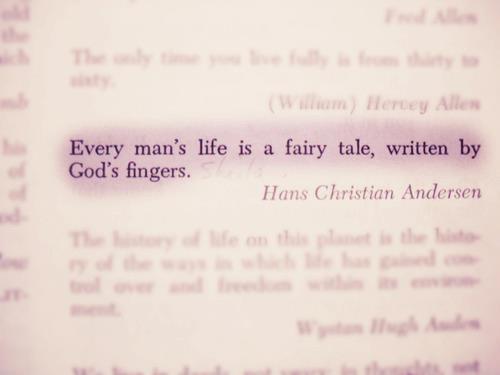
I suppose whether you agree with this or not depends on your definition of what makes a fairy tale. Is it void of any true hardship or suffering? Then that’s not a true fairy tale. Does it need fantastical creatures? That’s debatable, but I think not.

What a fairy tale needs is a happy ending. You know going in that the main character is going to live happily ever after.

If you look at life strictly from this side of heaven, then it’s not a fairy tale. There’s so much suffering and evil that goes unresolved and unpunished. There are so many wrongs that never get put right.

But if you look through the lens of the resurrection, then you see the fairy tale. In fact, you could see the whole Bible story as a sort of true fairy tale where the King comes to rescue His beloved from imminent danger.

It all depends on perspective. If you see your life through the eyes of faith, you know that the happy ending is coming, even if you might not see it this side of eternity. But it is coming.

“It is a world of magic and mystery, of deep darkness and flickering starlight. It is a world where terrible things happen and wonderful things too. It is a world where goodness is pitted against evil, love against hate, order against chaos, in a great struggle where often it is hard to be sure who belongs to which side because appearances are endlessly deceptive. Yet for all its confusion and wildness, it is a world where the battle goes ultimately to the good, who live happily ever after, and where in the long run everybody, good and evil alike, becomes known by his true name….That is the fairy tale of the Gospel with, of course, one crucial difference from all other fairy tales, which is that the claim made for it is that it is true, that it not only happened once upon a time but has kept on happening ever since and is happening still”(Frederick Buechner, Telling the Truth: The Gospel as Tragedy, Comedy, and Fairy Tale).

My Lent Readings

So I may have gone a tad overboard with my readings for Lent. I suppose technically, some of them are specifically for Lent and some are devotionals for the entire year. Here’s what I’m reading. Hopefully it will inspire you to add these books (or others like them) to your to-read list at some point:

  1. God’s Message for Each Day – Eugene Peterson. This one is a daily devotional book from the author of the Message, more of a paraphrase than a translation of the Bible but still worth using. This little devotional has short readings for each day and has been very helpful.
  2. 365 Pocket Prayers – Ronald A. Beets. I don’t know if Ronald wrote these or compiled them, but there are 365 prayers, each with a different theme. There’s also a handy index listing the prayers by category in case you want to find a prayer for guilt or shame or anxiety or such.
  3. A Barclay Prayer Book – William Barclay. This is a prayer book that follows the Christian Year and Holy Days in the Book of Common Prayer and also has prayers for all seasons. There were a couple of phrasings in there that gave me a bit of pause, but overall, I’ve liked it enough to recommend it.
  4. It Is Finished: A 40-Day Pilgrimmage Back to the Cross – Charles Martin. This one is blowing my mind with new insights about Jesus’ journey to the cross. It’s very reverent and biblical in its retelling of the scenes of Jesus’ last week before the crucifixion. Another book I highly recommend.
  5. The Book of Common Prayer (1928 edition) – This book helps get me in the proper frame of mind for both Christmas and Easter with all the Advent and Lent readings leading up to Christmas Day and Easter Sunday. Plus, there are so many beautiful collects and other readings for all the Holy Days and other important days in the Christian calendar. It makes me want to be liturgical.

All that plus reading through the Bible in a year is a lot. So proceed with caution if you dare. Or you can recommend your own Advent and/or Lent readings that have encouraged and inspired you and maybe I’ll read them next year.

The Story Behind the Song

I always love reading about classic hymns and carols and the stories of their inspiration and origins. Hymns like It Is Well with My Soul come out of tragedy and heartbreak, but the message they bring has lived on long after the writers have gone to glory.

The carol I Heard the Bells on Christmas Day has a similar story that I found recently. I’ve copied and pasted it and included the link to the original post:

“On Christmas Day in 1863, the American poet Henry Wadsworth Longfellow listened to the bells from a nearby church, overwhelmed by loss.

Two years earlier, his wife had burned to death in a fire, and he had also been badly burned trying to save her. At times, his grief was so great that he feared that he would be sent to an asylum.

His son had also been wounded in the Civil War and was temporarily paralyzed. As he listened to the church bells, Longfellow wrote a poem that reflected his grief:

‘In despair,’ he wrote, ‘I bowed my head. There is no peace on earth, I said.’

But he ended the poem, which was later put to music, on a note of triumph.

‘Then rang the bells more loud and deep
God is not dead, nor doth He sleep
The wrong shall fail, the right prevail
With peace on Earth, good will to men’

This Christmas Day will be 161 years….and the song still brings the same sense of settledness and confident hope to millions across the globe!

Do you hear the bells!! Open up your heart and hear them this Christmas!!”

The Real Country

“Peter,” said Lucy, “where is this, do you suppose?”. . . “If you ask me,” said Edmund, “it’s like somewhere in the Narnian world. Look at those mountains ahead—and the big ice-mountains beyond them. Surely they’re rather like the mountains we used to see from Narnia, the ones up Westward beyond the Waterfall?”. . .

“And yet they’re not like,” said Lucy. “They’re different. They have more colors on them and they look further away than I remembered and they’re more . . . more . . . oh, I don’t know . . .”

“More like the real thing,” said the Lord Digory softly. . . .

“But how can it be?” said Peter. “For Aslan told us older ones that we should never return to Narnia, and here we are.”

“Yes,” said Eustace. “And we saw it all destroyed and the sun put out.”

“And it’s all so different,” said Lucy.

“The Eagle is right,” said the Lord Digory. “Listen, Peter. When Aslan said you could never go back to Narnia, he meant the Narnia you were thinking of. But that was not the real Narnia. That had a beginning and an end. It was only a shadow or a copy of the real Narnia which has always been here and always will be here: just as our own world, England and all, is only a shadow or copy of something in Aslan’s real world. You need not mourn over Narnia, Lucy. All of the old Narnia that mattered, all the dear creatures, have been drawn into the real Narnia through the Door. And of course it is different; as different as a real thing is from a shadow or as waking life is from a dream.” His voice stirred everyone like a trumpet as he spoke these words: but when he added under his breath “It’s all in Plato, all in Plato: bless me, what do they teach them at these schools!” the older ones laughed. It was so exactly like the sort of thing they had heard him say long ago in that other world where his beard was grey instead of golden. He knew why they were laughing and joined in the laugh himself. But very quickly they all became grave again: for, as you know, there is a kind of happiness and wonder that makes you serious. It is too good to waste on jokes. . . .

It was the Unicorn who summed up what everyone was feeling. He stamped his right fore-hoof on the ground and neighed, and then cried:

“I have come home at last! This is my real country! I belong here. This is the land I have been looking for all my life, though I never knew it till now. The reason why we loved the old Narnia is that it sometimes looked a little like this. Bree-hee-hee! Come further up, come further in!”

From The Last Battle, C. S. Lewis

One day soon. One day soon.

God’s Will

The older I get, the more I realize that there is nothing I want outside of the will of God. As I’ve heard before, having everything without God is nothing while having God plus nothing else is everything.

I can’t imagine life without God. Instead of owning stuff, my stuff would own me. I’d be a slave to my fears and my lusts and never know true joy. I’d always be the same broken and miserable person from day to day without any hope of change.

I’m learning that the best place to be is smack dab in the middle of God’s will. I can dream of some pretty wild scenarios, but no one out-dreams God. His plans for me and for the world are so much bigger and better than anything my puny mind can conceive or comprehend.

So I wait and I trust. I keep reciting the first part of the Lord’s prayer where it says, “Your will be done on earth as it is in heaven.” I pray that even if it means that my will be undone, as Elisabeth Elliott used to pray all the time.

I’d rather have my will undone than to get my heart’s desire and be undone by it. I know how people are destroyed by fame and fortune without the grounding to handle that kind of success. I know even the severe mercies of God are better than the praises of men and the rewards of a life apart from God.

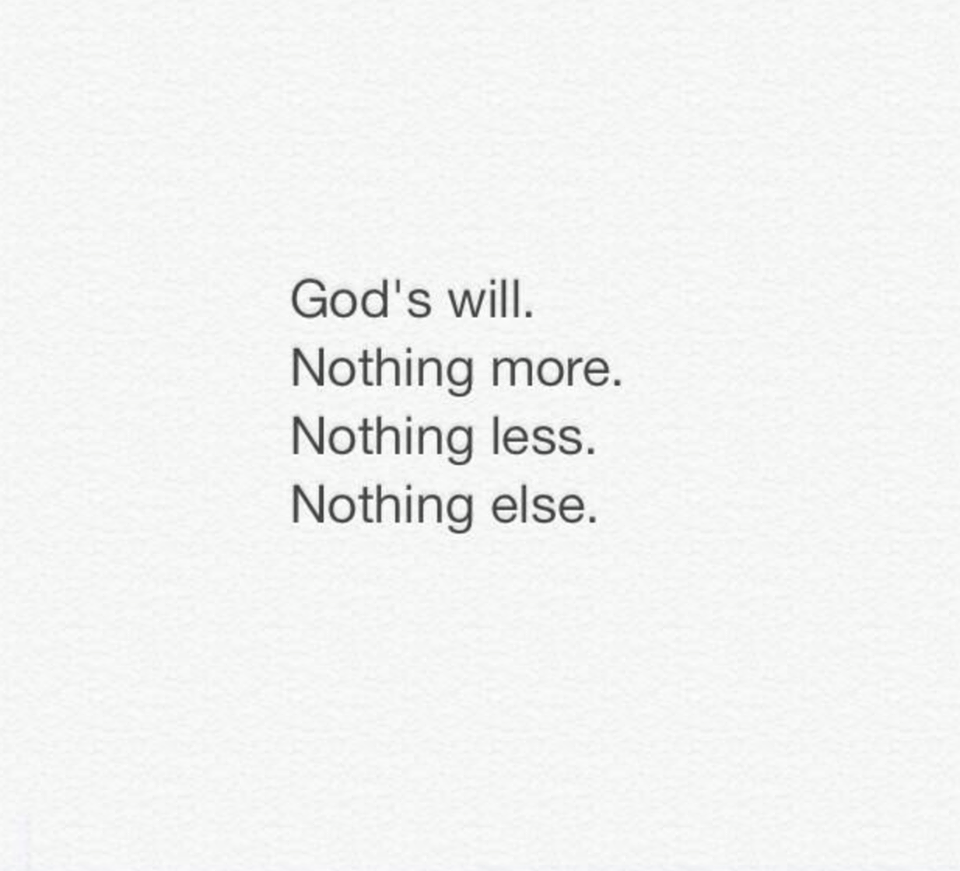
So it’s God’s will. Nothing more. Nothing less. Nothing else. Period.

Am I Unoffendable?

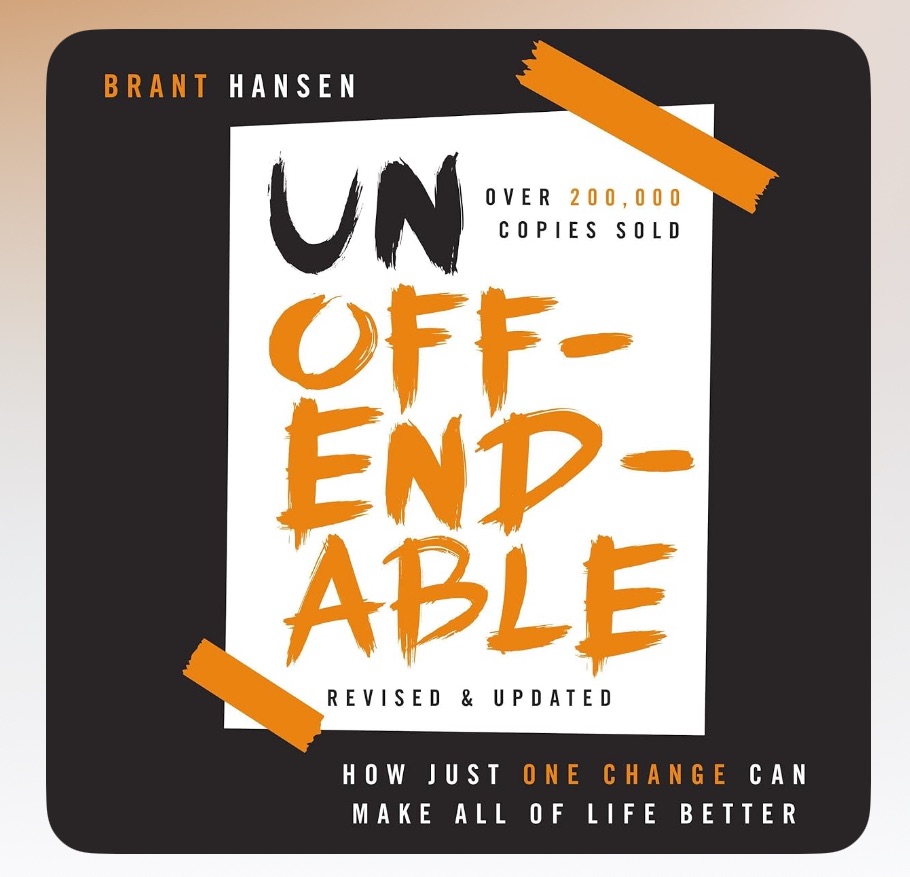
““Choosing to be unoffendable, or relinquishing my right to anger, does not mean accepting injustice. It means actively seeking justice, and loving mercy, while walking humbly with God. And that means remembering I’m not Him. What a relief” (Brant Hansen, Unoffendable).

This book is one of those that comes along and does a seismic shift on your thinking. I’ve always grown up believing that we’re supposed to be righteously angry about injustice and wrongs and sin, but this book is showing me that you can be actively against all those things without giving in to anger.

Based on what I understand, the Bible never calls for us to be angry. It does say that in your anger not to sin. It also says that anger does not produce the righteousness of God. I think when it says to be angry but don’t sin, it’s making allowances for the natural human tendency to anger. It also says not to stay there.

The only one allowed to be truly angry is God — and of course, Jesus — because God can have pure anger rooted in a holiness and righteousness that we don’t have. We can choose not to give in to anger without also giving in to all the wrongs and oppression in the world. We can fight those things out of love rather than anger.

I don’t want to give too much of the book away. It’s worth reading and says all the things I just said but way better than I just said them. Plus, if you get the audio version you get the book read by the author, which is almost always a bonus (and it is in this case).

A lot of our anger comes from the misguided view of calling out the sin in others while ignoring our own sin. We can easily become Pharisee-ical in seeing evil and wrong as being “out there” and “in them” rather than acknowledging my own sinful depravity and capacity for evil apart from the grace of God.

I’m a little over halfway there, so those are my takeaways thus far. My assignment for you is to find the actual book or the audio book and to devour it in short order. It’s an easy read (or an easy listen if you prefer). I’m even going through all the trouble of providing a link to the book on amazon.com. You’re welcome.

https://www.amazon.com/Unoffendable-Change-Better-updated-chapters/dp/1400333598/ref=sr_1_1?dib=eyJ2IjoiMSJ9.CCApAzLdwJEJ_bILerbPnP92PX4ePbEFxUdfzlwKQuQp8W7M9XUk146MAeiZVMFn_gCWS1YcpqnZy9olfkdcAfSWcn5iw6qDCNSMfQHhWM4EdxijLEVgmtywazlTVSyAjhJq8cHtUVNdhY2iyqRj5RPo8i-hjYAd2LH_aHTRyJG9DkQ7VkckmFOCsXjPi3Xs1hSaBdb8kGdBR9qVSFqkSUFMAdfYgPn_TY8uuyNJF1s.loHWjW318gTjgxlSS8Hem4fAJ5QuDVig1J42IDbTcCk&dib_tag=se&keywords=unoffendable&qid=1730083531&sr=8-1

My Favorite Bookstore

I confess that I currently listen to more books than I read. Since I spend a lot of time in my car, it makes sense to listen to books through Audible. That said, I still love an honest to goodness bookstore that only sells books.

I do love me some Barnes & Noble, but I also admit they’re like the big bad bookstore in You’ve Got Mail. They not only sell books but movies, music, and lots of other stuff. They have a very retail chain feel to them.

My favorite bookstore right now is probably Landmark Booksellers. It’s close enough so I can go there regularly. They have a unique indie vibe that I really like. They also sell new and used books, which is definitely right up my alley.

On a bit of a tangent, there’s something about holding and reading a physical book, especially if it’s older. Those old books have an aroma and a texture that makes you want to soak in every word.

Parnassus is also a legit bookstore, but it’s a bit out of my way to go there, plus the parking in Green Hills is practically nonexistent. But that’s a good one for those who live more in the Nashville area.

I hope there will always be books and people who read books and places that sell books. I can’t imagine a world with only audio books and Kindles. That would be super sad.

Today, I picked up an old used C. S. Lewis book at Landmark. It wasn’t a planned purchase, but I saw this old book with the dust jacket still intact, and it called my name. What else could I have done?

Another Good Read

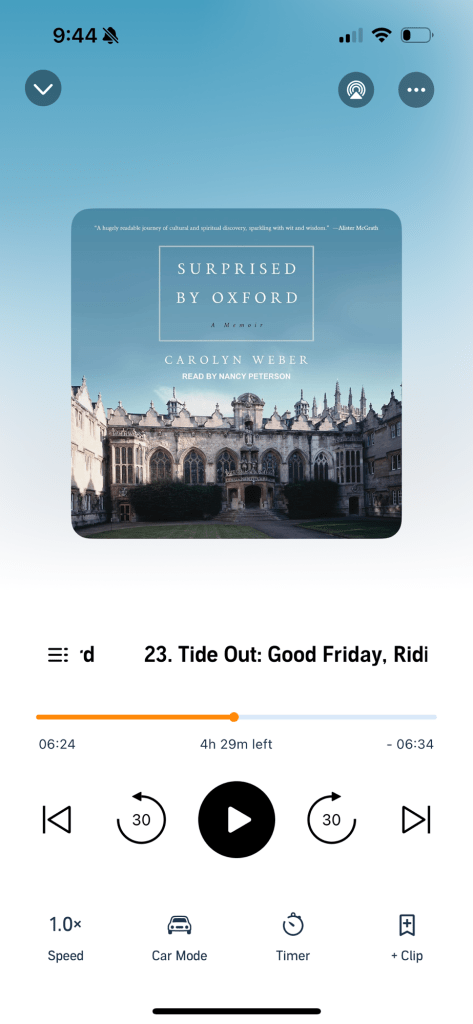
Technically, since I’m enjoying this book through Audible, it would be a good listen rather than a good read. But the narrator is really good and the story has a pace that’s just right and neither too slow or too quick.

Surprised by Oxford is right up my alley. It’s set in Oxford among the ghosts of C. S. Lewis and J. R. R. Tolkien and the like. Actually, there are no ghosts, but the fingerprints of Lewis and Tolkien are all over this story.

It’s a story about a journey to from unbelief to faith told in a riveting style that reads (or listens) like a novel rather than a memoir. I can visualize just about everything in my head despite never actually having been to Oxford.

I know there’s a movie based on the book that I want to see, but I also don’t. I know the movie will leave out significant portions of the book and condense other parts to make it fit into the 90 or so minutes that comprise the average length of a typical film. But also it will show Oxford in all its glory and make me want to go there more than I already do at the moment.

There are so many cultural and literary and musical references that are right up my alley. There are lots of mentions of U2 songs and of course lots of nods to Lewis. It’s set during the 90s when I myself would have been a college student, so I get that timeframe pretty well.

It’s definitely a book I’d recommend either listening to or actually honest to goodness reading out of an actual physical book. I know when it ends, I won’t be ready and will be a bit sad for a day or so. Then I will start my next grand audio adventure.

CAFO2024

Sometimes, you can go back. Almost.

This time, it was the Christian Alliance for Orphans (or CAFO) conference held at Brentwood Baptist Church. It was basically 13 years after the first time I volunteered for a CAFO conference.

I truly believe that if you are pro-life, you are pro-adoption and pro-fostering. The best way to show that we care for unborn babies is to keep caring for them once they’re born, especially if they’re born into unfortunate circumstances.

One of the few upsides of being unemployed is that I now have the free time to volunteer. I can be a part of something that’s bigger than me and make a difference (and possibly turn it into a career down the road). While that last part isn’t exactly super realistic, it’s not impossible.

One of my favorite parts so far is seeing the incredible diversity of the people who are attending. It’s like a small taste of heaven where there will be people from every tribe, tongue, ethnicity, race, and nation represented and bound together in worship to Jesus.

I’ve heard that one of the best ways to deal with stress/trauma/grief is to go and do for others. One of the best kinds of therapy is to serve others as a way of taking your mind off your own world for a bit. I’m not saying every single person is 100% ready nor that serving will make all your problems magically go away, but it does give a bit of perspective to step outside of yourself for a bit.

For me, the motivation is partly to recapture some of the magic from last time. I also believe in what CAFO is doing around the world. I also can’t think of a better way to spend my time.

This is not a humble brag about how great and selfless I am, but really a shameless plug for CAFO and an encouragement for you to go and find a place to serve not to get anything out of it but because of the joy of serving and most of all because God is worth it.