The Story Behind the Song

I always love reading about classic hymns and carols and the stories of their inspiration and origins. Hymns like It Is Well with My Soul come out of tragedy and heartbreak, but the message they bring has lived on long after the writers have gone to glory.

The carol I Heard the Bells on Christmas Day has a similar story that I found recently. I’ve copied and pasted it and included the link to the original post:

“On Christmas Day in 1863, the American poet Henry Wadsworth Longfellow listened to the bells from a nearby church, overwhelmed by loss.

Two years earlier, his wife had burned to death in a fire, and he had also been badly burned trying to save her. At times, his grief was so great that he feared that he would be sent to an asylum.

His son had also been wounded in the Civil War and was temporarily paralyzed. As he listened to the church bells, Longfellow wrote a poem that reflected his grief:

‘In despair,’ he wrote, ‘I bowed my head. There is no peace on earth, I said.’

But he ended the poem, which was later put to music, on a note of triumph.

‘Then rang the bells more loud and deep
God is not dead, nor doth He sleep
The wrong shall fail, the right prevail
With peace on Earth, good will to men’

This Christmas Day will be 161 years….and the song still brings the same sense of settledness and confident hope to millions across the globe!

Do you hear the bells!! Open up your heart and hear them this Christmas!!”

The Real Country

“Peter,” said Lucy, “where is this, do you suppose?”. . . “If you ask me,” said Edmund, “it’s like somewhere in the Narnian world. Look at those mountains ahead—and the big ice-mountains beyond them. Surely they’re rather like the mountains we used to see from Narnia, the ones up Westward beyond the Waterfall?”. . .

“And yet they’re not like,” said Lucy. “They’re different. They have more colors on them and they look further away than I remembered and they’re more . . . more . . . oh, I don’t know . . .”

“More like the real thing,” said the Lord Digory softly. . . .

“But how can it be?” said Peter. “For Aslan told us older ones that we should never return to Narnia, and here we are.”

“Yes,” said Eustace. “And we saw it all destroyed and the sun put out.”

“And it’s all so different,” said Lucy.

“The Eagle is right,” said the Lord Digory. “Listen, Peter. When Aslan said you could never go back to Narnia, he meant the Narnia you were thinking of. But that was not the real Narnia. That had a beginning and an end. It was only a shadow or a copy of the real Narnia which has always been here and always will be here: just as our own world, England and all, is only a shadow or copy of something in Aslan’s real world. You need not mourn over Narnia, Lucy. All of the old Narnia that mattered, all the dear creatures, have been drawn into the real Narnia through the Door. And of course it is different; as different as a real thing is from a shadow or as waking life is from a dream.” His voice stirred everyone like a trumpet as he spoke these words: but when he added under his breath “It’s all in Plato, all in Plato: bless me, what do they teach them at these schools!” the older ones laughed. It was so exactly like the sort of thing they had heard him say long ago in that other world where his beard was grey instead of golden. He knew why they were laughing and joined in the laugh himself. But very quickly they all became grave again: for, as you know, there is a kind of happiness and wonder that makes you serious. It is too good to waste on jokes. . . .

It was the Unicorn who summed up what everyone was feeling. He stamped his right fore-hoof on the ground and neighed, and then cried:

“I have come home at last! This is my real country! I belong here. This is the land I have been looking for all my life, though I never knew it till now. The reason why we loved the old Narnia is that it sometimes looked a little like this. Bree-hee-hee! Come further up, come further in!”

From The Last Battle, C. S. Lewis

One day soon. One day soon.

God’s Will

The older I get, the more I realize that there is nothing I want outside of the will of God. As I’ve heard before, having everything without God is nothing while having God plus nothing else is everything.

I can’t imagine life without God. Instead of owning stuff, my stuff would own me. I’d be a slave to my fears and my lusts and never know true joy. I’d always be the same broken and miserable person from day to day without any hope of change.

I’m learning that the best place to be is smack dab in the middle of God’s will. I can dream of some pretty wild scenarios, but no one out-dreams God. His plans for me and for the world are so much bigger and better than anything my puny mind can conceive or comprehend.

So I wait and I trust. I keep reciting the first part of the Lord’s prayer where it says, “Your will be done on earth as it is in heaven.” I pray that even if it means that my will be undone, as Elisabeth Elliott used to pray all the time.

I’d rather have my will undone than to get my heart’s desire and be undone by it. I know how people are destroyed by fame and fortune without the grounding to handle that kind of success. I know even the severe mercies of God are better than the praises of men and the rewards of a life apart from God.

So it’s God’s will. Nothing more. Nothing less. Nothing else. Period.

Am I Unoffendable?

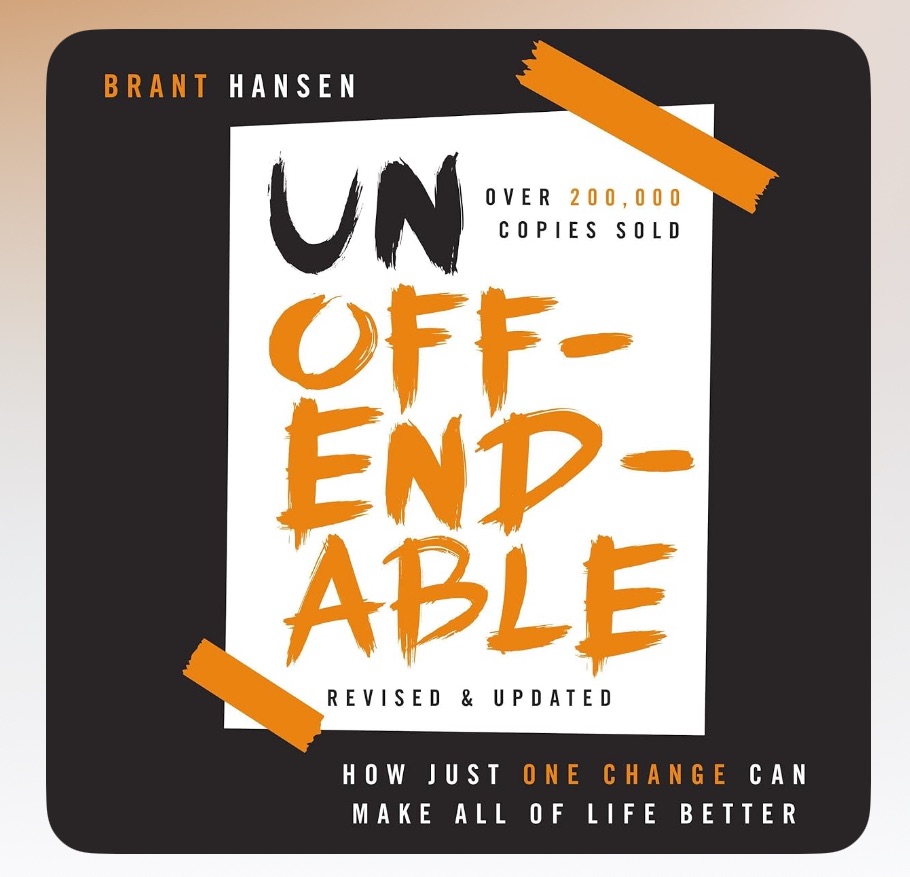
““Choosing to be unoffendable, or relinquishing my right to anger, does not mean accepting injustice. It means actively seeking justice, and loving mercy, while walking humbly with God. And that means remembering I’m not Him. What a relief” (Brant Hansen, Unoffendable).

This book is one of those that comes along and does a seismic shift on your thinking. I’ve always grown up believing that we’re supposed to be righteously angry about injustice and wrongs and sin, but this book is showing me that you can be actively against all those things without giving in to anger.

Based on what I understand, the Bible never calls for us to be angry. It does say that in your anger not to sin. It also says that anger does not produce the righteousness of God. I think when it says to be angry but don’t sin, it’s making allowances for the natural human tendency to anger. It also says not to stay there.

The only one allowed to be truly angry is God — and of course, Jesus — because God can have pure anger rooted in a holiness and righteousness that we don’t have. We can choose not to give in to anger without also giving in to all the wrongs and oppression in the world. We can fight those things out of love rather than anger.

I don’t want to give too much of the book away. It’s worth reading and says all the things I just said but way better than I just said them. Plus, if you get the audio version you get the book read by the author, which is almost always a bonus (and it is in this case).

A lot of our anger comes from the misguided view of calling out the sin in others while ignoring our own sin. We can easily become Pharisee-ical in seeing evil and wrong as being “out there” and “in them” rather than acknowledging my own sinful depravity and capacity for evil apart from the grace of God.

I’m a little over halfway there, so those are my takeaways thus far. My assignment for you is to find the actual book or the audio book and to devour it in short order. It’s an easy read (or an easy listen if you prefer). I’m even going through all the trouble of providing a link to the book on amazon.com. You’re welcome.
https://www.amazon.com/Unoffendable-Change-Better-updated-chapters/dp/1400333598/ref=sr_1_1?dib=eyJ2IjoiMSJ9.CCApAzLdwJEJ_bILerbPnP92PX4ePbEFxUdfzlwKQuQp8W7M9XUk146MAeiZVMFn_gCWS1YcpqnZy9olfkdcAfSWcn5iw6qDCNSMfQHhWM4EdxijLEVgmtywazlTVSyAjhJq8cHtUVNdhY2iyqRj5RPo8i-hjYAd2LH_aHTRyJG9DkQ7VkckmFOCsXjPi3Xs1hSaBdb8kGdBR9qVSFqkSUFMAdfYgPn_TY8uuyNJF1s.loHWjW318gTjgxlSS8Hem4fAJ5QuDVig1J42IDbTcCk&dib_tag=se&keywords=unoffendable&qid=1730083531&sr=8-1

My Favorite Bookstore

I confess that I currently listen to more books than I read. Since I spend a lot of time in my car, it makes sense to listen to books through Audible. That said, I still love an honest to goodness bookstore that only sells books.

I do love me some Barnes & Noble, but I also admit they’re like the big bad bookstore in You’ve Got Mail. They not only sell books but movies, music, and lots of other stuff. They have a very retail chain feel to them.

My favorite bookstore right now is probably Landmark Booksellers. It’s close enough so I can go there regularly. They have a unique indie vibe that I really like. They also sell new and used books, which is definitely right up my alley.

On a bit of a tangent, there’s something about holding and reading a physical book, especially if it’s older. Those old books have an aroma and a texture that makes you want to soak in every word.

Parnassus is also a legit bookstore, but it’s a bit out of my way to go there, plus the parking in Green Hills is practically nonexistent. But that’s a good one for those who live more in the Nashville area.

I hope there will always be books and people who read books and places that sell books. I can’t imagine a world with only audio books and Kindles. That would be super sad.

Today, I picked up an old used C. S. Lewis book at Landmark. It wasn’t a planned purchase, but I saw this old book with the dust jacket still intact, and it called my name. What else could I have done?

Another Good Read

Technically, since I’m enjoying this book through Audible, it would be a good listen rather than a good read. But the narrator is really good and the story has a pace that’s just right and neither too slow or too quick.

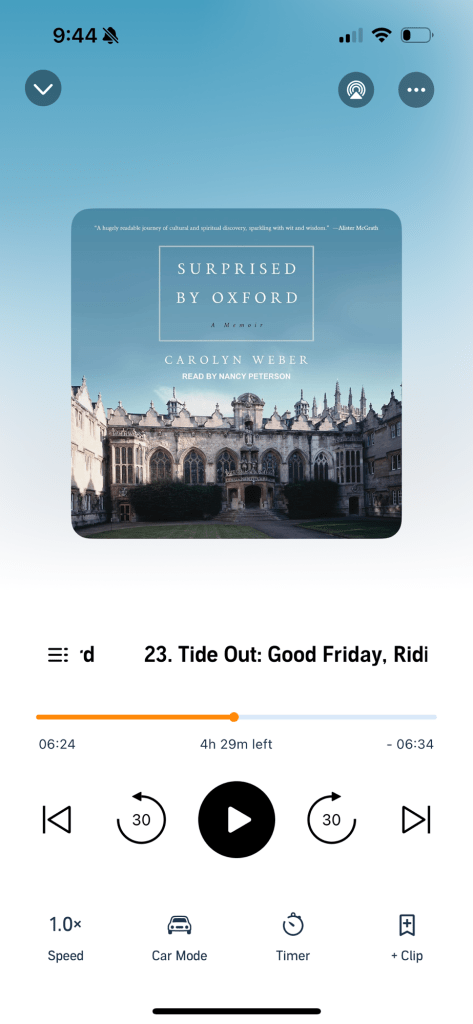
Surprised by Oxford is right up my alley. It’s set in Oxford among the ghosts of C. S. Lewis and J. R. R. Tolkien and the like. Actually, there are no ghosts, but the fingerprints of Lewis and Tolkien are all over this story.

It’s a story about a journey to from unbelief to faith told in a riveting style that reads (or listens) like a novel rather than a memoir. I can visualize just about everything in my head despite never actually having been to Oxford.

I know there’s a movie based on the book that I want to see, but I also don’t. I know the movie will leave out significant portions of the book and condense other parts to make it fit into the 90 or so minutes that comprise the average length of a typical film. But also it will show Oxford in all its glory and make me want to go there more than I already do at the moment.

There are so many cultural and literary and musical references that are right up my alley. There are lots of mentions of U2 songs and of course lots of nods to Lewis. It’s set during the 90s when I myself would have been a college student, so I get that timeframe pretty well.

It’s definitely a book I’d recommend either listening to or actually honest to goodness reading out of an actual physical book. I know when it ends, I won’t be ready and will be a bit sad for a day or so. Then I will start my next grand audio adventure.

CAFO2024

Sometimes, you can go back. Almost.

This time, it was the Christian Alliance for Orphans (or CAFO) conference held at Brentwood Baptist Church. It was basically 13 years after the first time I volunteered for a CAFO conference.

I truly believe that if you are pro-life, you are pro-adoption and pro-fostering. The best way to show that we care for unborn babies is to keep caring for them once they’re born, especially if they’re born into unfortunate circumstances.

One of the few upsides of being unemployed is that I now have the free time to volunteer. I can be a part of something that’s bigger than me and make a difference (and possibly turn it into a career down the road). While that last part isn’t exactly super realistic, it’s not impossible.

One of my favorite parts so far is seeing the incredible diversity of the people who are attending. It’s like a small taste of heaven where there will be people from every tribe, tongue, ethnicity, race, and nation represented and bound together in worship to Jesus.

I’ve heard that one of the best ways to deal with stress/trauma/grief is to go and do for others. One of the best kinds of therapy is to serve others as a way of taking your mind off your own world for a bit. I’m not saying every single person is 100% ready nor that serving will make all your problems magically go away, but it does give a bit of perspective to step outside of yourself for a bit.

For me, the motivation is partly to recapture some of the magic from last time. I also believe in what CAFO is doing around the world. I also can’t think of a better way to spend my time.

This is not a humble brag about how great and selfless I am, but really a shameless plug for CAFO and an encouragement for you to go and find a place to serve not to get anything out of it but because of the joy of serving and most of all because God is worth it.

Tiny Books

For as long as I can remember, I’ve been drawn to tiny books. The smaller, the better.

I have a tiny testament that easily fits in the palm of my hand. I also have a small Latin dictionary and an even smaller hymnal. All these tiny books are super old as well as super small.

This one is the smallest prayer book I’ve ever seen. For me, I love the idea of carrying around these precious promises of God in my pocket and having a handy prayer guide for whenever I can’t find words of my own to pray.

I’m reminded sometimes of how small I am in comparison to God. More like infinitesimal and microscopic next to the Creator whom the whole of creation can’t contain.

Yet, the verse says He is mindful of me. He knows the number of hairs on my head and when I stumble or fall. He knows every word on my tongue before I speak it.

That’s comforting when the universe seems so big and dark and void of hope. I need the nearness of an Incarnate God more than I need the majesty of an Infinite Being beyond my comprehension.

Well, I need both. I need a God close enough to know my need and a God big enough to meet it. I need a God who’s near to hear my prayer and a God mighty enough to be worthy of my prayers.

I suppose my next thing to collect will be tiny books. Now I just need a tiny shelf to put them all on. I can stare at all my small books and remember how small I am in the eyes of God, yet He still knows me by name.

Fear

“It is said that before entering the sea
a river trembles with fear.

She looks back at the path she has traveled,
from the peaks of the mountains,
the long winding road crossing forests and villages.

And in front of her,
she sees an ocean so vast,
that to enter
there seems nothing more than to disappear forever.

But there is no other way.
The river can not go back.

Nobody can go back.
To go back is impossible in existence.

The river needs to take the risk
of entering the ocean
because only then will fear disappear,
because that’s where the river will know
it’s not about disappearing into the ocean,
but of becoming the ocean” (Khalil Gibran).

I’ve learned over the years that all fear is just looking at the future and seeing the mountain but not the Mountain Mover. It’s seeing the stormy waves but not seeing the One who walks on water. It’s basically looking at life’s problems and eliminating God from the equation.

I’ve also learned that 98% of what I worry about never happens. That dreaded scenario never takes place. I find that when I get to the place where my fear is greatest . . . and take one more step, that’s when God’s strength shows up in my weakness. God’s faithfulness shows up in my obedience, regardless of whether my motives are wholly pure or not.

“Jesus Christ is like a vast ocean, He is too immense to fully explore, and too rich to fathom. You are like a bottle. The wonder of the gospel is that the bottle is in the ocean, and the ocean is in the bottle” (Jesus Manifesto, Leonard Sweet and Frank Viola).

Growing Through Obedience

“‘Aslan” said Lucy “you’re bigger’.
‘That is because you are older, little one’ answered he.
‘Not because you are?’
‘I am not. But every year you grow, you will find me bigger.’ (C.S. Lewis, Prince Caspian).”

There’s one part in Prince Caspian where Aslan calls out to Lucy to follow him, and to get the others to do the same. The catch is that Lucy is the only one who can see or hear him. The others will have to take her word for it.

That’s the moment where Lucy chooses to trust in Aslan and obey him, even though it might feel like she’s the only one. She has to go even if she goes alone.

That’s what genuine faith looks like. Faithfulness and obedience can be lonely sometimes, especially when so many others are too busy trying to blend in and not make waves to truly follow Jesus. When you are obedient, sometimes your biggest critics will come from inside the Church, not outside.

William Carey, the father of modern missions, faced opposition from other clergymen for wanting to take the gospel to India. Imagine that. Pastors and church leaders not wanting to take the gospel to unreached people. But it happened.

William Carey’s faithfulness made it possible for others to take the gospel around the world, so that heaven could be filled with voices from every tribe and tongue, every skin color and hair color, gathered around the throne as depicted in the book of Revelation.

Obedience might mean standing in the minority for what’s right versus what’s popular. William Penn once said, “Right is right, even if everyone is against it, and wrong is wrong, even if everyone is for it.”

In Prince Caspian, Lucy gets the rest to follow her. Some were more willing than others to go, but they all went. None of them could see Aslan until after they had stepped out in faith, but once they were committed to following, they could see him leading the way.

That’s the way faith is sometimes. You can’t see God until you obey what He’s told you to do. Obedience leads to faith being made sight.