Why I Love Narnia

“But between them and the foot of the sky there was something so white on the green grass that even with their eagles’ eyes they could hardly look at it. They came on and saw that it was a Lamb.

‘Come and have breakfast,’ said the Lamb in its sweet milky voice.

Then they noticed for the first time that there was a fire lit on the grass and fish roasting on it. They sat down and ate the fish, hungry now for the first time for many days. And it was the most delicious food they had ever tasted.

‘Please, Lamb,’ said Lucy, ‘is this the way to Aslan’s country?’

‘Not for you,’ said the Lamb. ‘For you the door into Aslan’s country is from your own world.’

‘What’ said Edmund. ‘Is there a way into Aslan’s country from our world too?’

“There is a way into my country from all the worlds,” said the Lamb; but as he spoke, his snowy white flushed into tawny gold and his size changed and he was Aslan himself, towering above them and scattering light from his mane.

‘Oh, Aslan,’ said Lucy. ‘Will you tell us how to get into your country from our world?’

‘I shall be telling you all the time,’ said Aslan. ‘But I will not tell you how long or short the way will be; only that it lies across a river. But do not fear that, for I am the great Bridge Builder. And now come; I will open the door in the sky and send you to your own land'” (C. S. Lewis, The Voyage of the Dawn Treader).

I know Narnia isn’t a real place. I also know Narnia represents and stands for so many things that are real. Narnia was Lewis’ way of writing a series of good children’s books, which he thought meant that any adult should be able to pick one up and enjoy it as well as any child. It just so happens that the stories ended up revolving around a Christ-like main figure named Aslan.

I think what I love about the Narnia series is that you see practical truths and lessons taught in a way where real people interact within a fantastical setting with real problems and find ways to solve them that work just as well in the real world. That’s why I also loved the Harry Potter series because it used magic as a metaphor for the challenges of growing from childhood to adulthood.

I still sometimes wish Narnia was real and there was a place where animals could talk. It would be so nice to be able to visit from time to time and come back to this reality with no time having passed. That sounds ideal to me.

But if you don’t know about Narnia, I can’t recommend those books highly enough. The best place to start is with The Magician’s Nephew, the book that starts the series with the creation of Narnia. They may have been written for kids but they’re good for kids of all ages — from 6 to 106. They’re that good.
The Books that Built Me

I had a random thought just now. Maybe I’d list some of the books I’ve read that challenged and changed me the most. It’s nowhere near a comprehensive list because I’ll think of one or two more that I should have added at 2 or 3 am.

But here is a list coming straight off the top of my head (including some series):

  1. The Valley of Vision – a collection of Puritan Prayers
  2. Hinds’ Feet on High Places – Hannah Hurnard
  3. The Normal Christian Life – Watchman Nee
  4. The Divine Conspiracy – Dallas Willard
  5. To Kill a Mockingbird – Harper Lee
  6. Les Miserables – Victor Hugo
  7. My Utmost for His Highest – Oswald Chambers
  8. 1000 Gifts – Ann Voskamp
  9. The Chronicles of Narnia – C. S. Lewis
  10. The Lord of the Rings – J. R. R. Tolkien
  11. The Space Trilogy – C. S. Lewis
  12. The Book of Common Prayer
  13. The Calvary Road – Roy Hession
  14. Any of the Mitford books by Jan Karon
  15. Foxes’ Book of Martyrs
  16. The Mark of a Man – Elisabeth Elliott
  17. Evidence not Seen – Darlene Deibler Rose
  18. Morning and Evening – Charles Spurgeon
  19. Telling the Truth – Frederick Beuchner
  20. The Princess & the Goblin/The Princess & Curdie – George MacDonald
  21. The Hiding Place – Corrie ten Boom
  22. Gold by Moonlight – Amy Carmichael
  23. Imitation of Christ – Thomas a Kempis
  24. The Return of the Prodigal – Henri Nouwen
  25. Ragamuffin Gospel – Brennan Manning
  26. Fresh Wind, Fresh Fire- Jim Cymbala

If I tried really hard (and really wanted to), I could have made this list ten times as long. I could probably name at least twice as many books that altered the course of my life and forever changed the way I think. But one that I left out on purpose but see as the ultimate #1 book is the Bible. Every other book influences me by how it restates and translates biblical themes in a new and fresh way.

Maybe one day, I’ll do another list. Or maybe I’ll list all the music and movies that influenced me. I’d love to hear some of the books that changed you for the better. I’m always looking for a new read, so maybe I’ll add your suggestions to my ever-growing list of books to read.

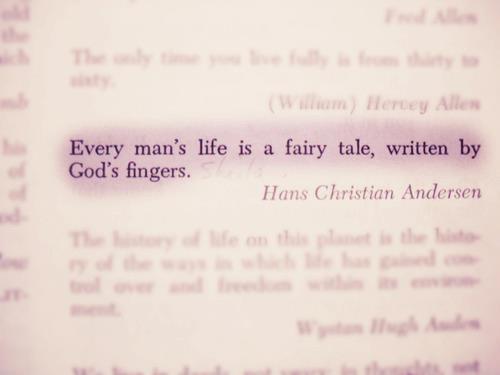
Life Is a Fairy Tale

I suppose whether you agree with this or not depends on your definition of what makes a fairy tale. Is it void of any true hardship or suffering? Then that’s not a true fairy tale. Does it need fantastical creatures? That’s debatable, but I think not.

What a fairy tale needs is a happy ending. You know going in that the main character is going to live happily ever after.

If you look at life strictly from this side of heaven, then it’s not a fairy tale. There’s so much suffering and evil that goes unresolved and unpunished. There are so many wrongs that never get put right.

But if you look through the lens of the resurrection, then you see the fairy tale. In fact, you could see the whole Bible story as a sort of true fairy tale where the King comes to rescue His beloved from imminent danger.

It all depends on perspective. If you see your life through the eyes of faith, you know that the happy ending is coming, even if you might not see it this side of eternity. But it is coming.

“It is a world of magic and mystery, of deep darkness and flickering starlight. It is a world where terrible things happen and wonderful things too. It is a world where goodness is pitted against evil, love against hate, order against chaos, in a great struggle where often it is hard to be sure who belongs to which side because appearances are endlessly deceptive. Yet for all its confusion and wildness, it is a world where the battle goes ultimately to the good, who live happily ever after, and where in the long run everybody, good and evil alike, becomes known by his true name….That is the fairy tale of the Gospel with, of course, one crucial difference from all other fairy tales, which is that the claim made for it is that it is true, that it not only happened once upon a time but has kept on happening ever since and is happening still”(Frederick Buechner, Telling the Truth: The Gospel as Tragedy, Comedy, and Fairy Tale).

Merry Christmas or Happy Holidays?

What’s really worse? Someone saying “Happy holidays” or someone who doesn’t follow Jesus saying “Merry Christmas” out of obligation and not really because they mean it or understand it? Maybe worst of all is those who claim Jesus as Lord speaking “Merry Christmas” but denying the spirit of it with lives that reflect greed, rudeness, impatience, consumerism, and anger. The best witness for Christ isn’t spoken; it’s lived out as Christ becomes incarnate in our hearts and lives.

That’s something I wrote a long time ago, but it seems to still fit. People still get bent out of shape when retail employees don’t say Merry Christmas. I think at one point I was one of those, but time has a way of softening those rough edges and growing older has given me a different perspective.

Most likely, those retail workers are exhausted. They’re usually overworked and underpaid. They’re wondering about how they’re going to pay all the bills and still provide a Christmas for their kids. The whole “Merry Christmas or Happy Holidays” debate is probably the last thing on their minds.

So what is the most Christlike thing to do? Yell at them when they don’t use the correct terminology? Or maybe be kind to them? Maybe be a little more patient with them when they’re struggling because the place they’re working is understaffed?

If Jesus offered people a light burden and an easy yoke, maybe we would do better to not lay Pharisaical burdens on people. If Jesus said come to me all who are weary, who are we to drive people off because they don’t speak the magic words of Merry Christmas?

Dwight Moody (I think) once said that Christians are the only Bible most people will ever read. If that’s so, let’s make sure the message we’re sending is the message not of God far off and unattainable but God coming near to the lowly and crushed in spirit in the form of a baby in a manger who was born for all people.

The Real Country

“Peter,” said Lucy, “where is this, do you suppose?”. . . “If you ask me,” said Edmund, “it’s like somewhere in the Narnian world. Look at those mountains ahead—and the big ice-mountains beyond them. Surely they’re rather like the mountains we used to see from Narnia, the ones up Westward beyond the Waterfall?”. . .

“And yet they’re not like,” said Lucy. “They’re different. They have more colors on them and they look further away than I remembered and they’re more . . . more . . . oh, I don’t know . . .”

“More like the real thing,” said the Lord Digory softly. . . .

“But how can it be?” said Peter. “For Aslan told us older ones that we should never return to Narnia, and here we are.”

“Yes,” said Eustace. “And we saw it all destroyed and the sun put out.”

“And it’s all so different,” said Lucy.

“The Eagle is right,” said the Lord Digory. “Listen, Peter. When Aslan said you could never go back to Narnia, he meant the Narnia you were thinking of. But that was not the real Narnia. That had a beginning and an end. It was only a shadow or a copy of the real Narnia which has always been here and always will be here: just as our own world, England and all, is only a shadow or copy of something in Aslan’s real world. You need not mourn over Narnia, Lucy. All of the old Narnia that mattered, all the dear creatures, have been drawn into the real Narnia through the Door. And of course it is different; as different as a real thing is from a shadow or as waking life is from a dream.” His voice stirred everyone like a trumpet as he spoke these words: but when he added under his breath “It’s all in Plato, all in Plato: bless me, what do they teach them at these schools!” the older ones laughed. It was so exactly like the sort of thing they had heard him say long ago in that other world where his beard was grey instead of golden. He knew why they were laughing and joined in the laugh himself. But very quickly they all became grave again: for, as you know, there is a kind of happiness and wonder that makes you serious. It is too good to waste on jokes. . . .

It was the Unicorn who summed up what everyone was feeling. He stamped his right fore-hoof on the ground and neighed, and then cried:

“I have come home at last! This is my real country! I belong here. This is the land I have been looking for all my life, though I never knew it till now. The reason why we loved the old Narnia is that it sometimes looked a little like this. Bree-hee-hee! Come further up, come further in!”

From The Last Battle, C. S. Lewis

One day soon. One day soon.

Growing Through Obedience

“‘Aslan” said Lucy “you’re bigger’.
‘That is because you are older, little one’ answered he.
‘Not because you are?’
‘I am not. But every year you grow, you will find me bigger.’ (C.S. Lewis, Prince Caspian).”

There’s one part in Prince Caspian where Aslan calls out to Lucy to follow him, and to get the others to do the same. The catch is that Lucy is the only one who can see or hear him. The others will have to take her word for it.

That’s the moment where Lucy chooses to trust in Aslan and obey him, even though it might feel like she’s the only one. She has to go even if she goes alone.

That’s what genuine faith looks like. Faithfulness and obedience can be lonely sometimes, especially when so many others are too busy trying to blend in and not make waves to truly follow Jesus. When you are obedient, sometimes your biggest critics will come from inside the Church, not outside.

William Carey, the father of modern missions, faced opposition from other clergymen for wanting to take the gospel to India. Imagine that. Pastors and church leaders not wanting to take the gospel to unreached people. But it happened.

William Carey’s faithfulness made it possible for others to take the gospel around the world, so that heaven could be filled with voices from every tribe and tongue, every skin color and hair color, gathered around the throne as depicted in the book of Revelation.

Obedience might mean standing in the minority for what’s right versus what’s popular. William Penn once said, “Right is right, even if everyone is against it, and wrong is wrong, even if everyone is for it.”

In Prince Caspian, Lucy gets the rest to follow her. Some were more willing than others to go, but they all went. None of them could see Aslan until after they had stepped out in faith, but once they were committed to following, they could see him leading the way.

That’s the way faith is sometimes. You can’t see God until you obey what He’s told you to do. Obedience leads to faith being made sight.

Victorian With a Twist

Charlotte Markham

I know. It sounds like a cocktail gone horribly wrong. It would be. But for a novel, it fits together quite well.

I’m talking about the book, Charlotte Markham and the House of Darkling by Michael Boccacino. If Emily Bronte and Tim Burton had a secret love child, it would be this book, a sort of Jane Eyre meets Beetlejuice. Needless to say, I loved it.

The atmosphere starts off gothic and gets weirder from there. I was immediately captured from the very first sentence and could hardly put the book down until I read the very last sentence. I could very easily see this book turned into a motion picture directed by the above-mentioned Tim Burton (or some other director with an eccentric and unorthodox flair).

I won’t give away any of the plot surprises other than to say that the novel starts off with a newly-hired governess to a man recently widowed and his two sons. Then there’s a horrible, unexplainable murder. And it gets better from there.

If you loved the book Johnathan Strange & Mr Norell by Susanna Clarke or any of the fantasy writings by George MacDonald or C.S. Lewis, (another amazing Victorian/fantasy blend), you’ll love this as well. If you don’t care to have your perfect Victorian world sullied by the supernatural and otherworldly, then I’d advise you to skip this one.

It took me approximately two years and two days to read it. Two years to think about buying the book and then deciding to put it on my birthday wish-list and once I had it in my hands, two days to actually read it. It would have been less if I hadn’t had to bother with trivial things like eating and sleeping.

All that to say this: check out the book. You’ll like it. I’ve saved you the trouble and put the link to the amazon page on here, so you have no more excuses. Now go and buy it.