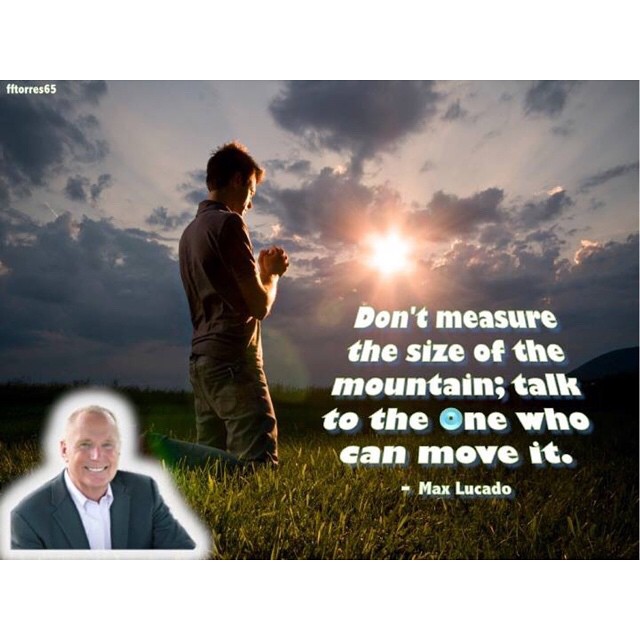
Measuring the Size of the Mountain

I like that. Some problems might seem as big and immovable as mountains, but God still moves mountains. I heard someone say once that prayer isn’t so much about reminding God how big your problems are but reminding your problems how big your God is. Ain’t that the truth?

It’s easy to get caught up in the logistics of what looks like an impossible situation. You and I can easily be like Peter and get distracted by the waves and take our eyes off of Jesus. Then we’re sunk.

But thankfully, Jesus can still save. Jesus can take us out of our problems and obstacles, but more often than not, He takes us through them rather than around or over them. Our faith grows as we see God overcome what we thought was hopeless.

Jesus said that if we had faith, we could say to the mountain to move, and it would move. He didn’t say what the size of the faith had to be. I think it’s because it’s not the amount of the faith you have that makes miracles and moves mountains but the source of your faith. God is the one doing the moving.

I still believe that’s true for followers today as it was for followers back then. We may not see the same kind of struggles and trials that those disciples did back in the first century, but we have enough of our own. And we find if we remain faithful long enough that God can still work on behalf of those whose hearts are steadfast toward Him.

This is not me telling you to squeeze your eyes and summon up more faith. Even a tiny mustard seed amount of faith will do if it’s in the right place. I still remember what a friend from college used to say: it’s not big faith in God but faith in a big God. Remember that as you can stand still and watch those mountains move.


The Door of Destitution

“We have to realize that we cannot earn or win anything from God; we must either receive it as a gift or do without it. The greatest blessing spiritually is the knowledge that we are destitute; until we get there Our Lord is powerless. He can do nothing for us if we think we are sufficient of ourselves; we have to enter into His Kingdom through the door of destitution. As long as we are rich, possessed of anything in the way of pride or independence, God cannot do anything for us. It is only when we get hungry spiritually that we receive the Holy Spirit” (Oswald Chambers, from My Utmost for His Highest).

That one hits me in my pride. I like to think that I can contribute to what God is doing. I like to thing I bring something to the table. I don’t like to think that even my very best righteousness is like filthy rags to God. I definitely don’t like to think that anything that’s good in me is God working through me.

That’s the whole point of the Beatitudes. We bring nothing but poverty of spirit, meekness, mourning, and a hungering and thirsting for righteousness, and God blesses us in spite of it all. God still works through nobodies just like He did way back when with 12 nobodies that He picked to be His disciples instead of choosing the best and wisest like every other rabbi would have.

The idea of us being children is more true than we want to admit. Children are dependent on their parents for absolutely everything, as are we to God. Our usefulness doesn’t come from any merit or talent we possess but simply us being surrendered and available to God at any and every moment. That’s when God does His best work.

But that’s also the best part. If God can use nobodies, then God can use you and me. We don’t have to have a degree from a seminary. We don’t have to have a job title like pastor or minister. We don’t even have to be able to be the best writers or speakers. We just have to show us and say, “Yes, God. Here I am. Send me.”

No Matter What

“Our prayers for guidance (or for anything else) really begin here: I trust him. This requires abandonment. We are no longer saying, ‘If I trust him, he’ll give me such and such,’ but ‘I trust him. Let him give me or withhold from me what he chooses” (Elisabeth Elliot, God’s Guidance: A Slow & Certain Light).

It’s easy to fall into the trap of trying to bargain with God. Something along the lines of “I’ll trust you if you will give me a) a job, b) a spouse, or c) lots of money.”

It feels more like a transaction than faith. If God does X, then I’ll do Y. The trouble is that I’m in no position to bargain with God. He’s the Eternal Lord and King of the Universe who has every right to destroy me because of my sin, and I’m the one who’s only alive at this moment because of His grace.

The truth is that if all God ever did was to save me from an eternity in hell and leave me alone, that would be way more than I deserve. That alone would merit my praise from now until 10,000 X 10,000 years have passed.

But that’s not all God did. He has sustained me and blessed me and been with me through every kind of joy and sorrow, triumph and trial. All He asks in return is my allegiance. My loyalty. My surrender. Me.

It’s not wrong to ask God for things, but the more I spend time with God and in His word and the more I grow in Christlikeness, the things I ask for change and my desire to have them changes.

God doesn’t owe me anything. Even the next breath is a gift. I owe God everything, more than I could possibly ever pay in a million lifetimes. Yet all God asks for is me. I think that’s a good enough reason to trust Him no matter what.

The Quiet Assurance of Joy

Every day, there’s a new batch of chaos somewhere in the world. If you’re looking to be cheered up, you probably want to skip Fox News or CNN right about now. It’s easy to get overwhelmed and live in a constant state of fear and anxiety.

But the followers of Jesus are different. Or they should be. We’ve read the last verse of the last chapter of the last book of the Bible, and we know how the story ends. We know it’s going to be alright (to reference the late Rev. Billy Graham).

The media and advertising and basically every message screaming at you from every screen is trying to keep you in a state of near panic in order to get you to buy a certain product or vote for a certain person. But Jesus promised peace to His people. He said it was a peace unlike the world gives, which is a warm and fuzzy feeling, but His is more of a calm certainty that while the middle of the story looks grim, there is a happy ending coming.

Sure, there will be wars and rumors of war. Nations will still rise up against other nations. There will be riots and violence and scandals. Many people who profess to follow Jesus will fall away. But for those who truly belong to Jesus, we are held fast by the everlasting arms that won’t let us go.

Maybe tonight turn off the television and put away the device and open up your Bible. Turn it to Revelation 22 and read the last chapter, but especially the last two verses. It’s an invitation. Yes, bad times are coming, but they won’t last. Suffering will end. Even death will pass away. But these words of God will remain, and the one who spoke them will wipe away every tear from our eyes and welcome us home into everlasting peace.

Tried and Trusted Old Words

As I get older, the more I appreciate the old hymns. I get that some may have trouble getting past some of the archaic language with all the thees and thous floating about. But there’s some sound theology in those stanzas that has brought comfort to so many down through the decades.

One that I discovered not that long ago is a hymn that I probably have never sung in any church, but the words are powerful. This speaks to all those who are in a dark night of the soul or going through a difficult season:

Whate’er my God ordains is right:
His holy will abideth;
I will be still whate’er He doth;
And follow where He guideth;
He is my God; though dark my road,
He holds me that I shall not fall:
Wherefore to Him I leave it all.

Whate’er my God ordains is right:
He never will deceive me;
He leads me by the proper path:
I know He will not leave me.
I take, content, what He hath sent;
His hand can turn my griefs away,
And patiently I wait His day.

Whate’er my God ordains is right:
His loving thought attends me;
No poison can be in the cup
That my Physician sends me.
My God is true; each morn anew
I’ll trust His grace unending,
My life to Him commending.

Whate’er my God ordains is right:
He is my Friend and Father;
He suffers naught to do me harm,
Though many storms may gather,
Now I may know both joy and woe,
Some day I shall see clearly
That He hath loved me dearly.

Whate’er my God ordains is right:
Though now this cup, in drinking,
May bitter seem to my faint heart,
I take it, all unshrinking.
My God is true; each morn anew
Sweet comfort yet shall fill my heart,
And pain and sorrow shall depart.

Whate’er my God ordains is right:
Here shall my stand be taken;
Though sorrow, need, or death be mine,
Yet I am not forsaken.
My Father’s care is round me there;
He holds me that I shall not fall:
And so to Him I leave it all” (Author: Samuel Rodigast (1675)Translator: Catherine Winkworth (1863).

The Will of God

“Outside the will of God, there’s nothing I want. Inside the will of God, there’s nothing I fear” (A. W. Tozer).

That’s where I want to be, but I’m not there yet. If I’m honest, I must confess that I probably have desires that are outside of the will of God. I also understand that anything outside of the will of God that seems good to me probably won’t be.

I love the fact that God in His plan factored in dummies like me. I don’t mean that I lack intelligence or common sense, but sometimes I can be thick-headed when it comes to the ways of God and what He wants for me. I think all of us are that way to one degree or another.

The problem is that I think too highly of what I want and not highly enough of what God wants. If I truly knew what God wants and saw what God sees, I’d want what God wants. I’d love what God loves. I’d ask for what God wills to give me.

So in one sense praying for God’s will is dangerous and in one sense it’s not. It will definitely take you out of your comfort zone and bring you to places and people that you would not have chosen for yourself. It’s also the safest place you can be outside of heaven.

“It would seem that Our Lord finds our desires not too strong, but too weak. We are half-hearted creatures, fooling about with drink and sex and ambition when infinite joy is offered us, like an ignorant child who wants to go on making mud pies in a slum because he cannot imagine what is meant by the offer of a holiday at the sea. We are far too easily pleased” (C.S. Lewis, The Weight of Glory, and Other Addresses).

Where He Leads I’ll Go

I went to a hymn sing tonight at my church. Before one of the hymns, they gave a backstory to how the hymn was penned. B. B. McKinney was talking with a missionary to Brazil who was home on furlough. The missionary, R. S. Jones, had recently been diagnosed with a health condition that would prevent him from returning to the mission field. He was devastated.

McKinney asked him what his plans were going forward. Jones replied, “I don’t know what I’ll do next, but wherever He leads, I’ll go.”

From there germinated a seed that turned into the classic hymn sung in churches through the decades up to the present that has ministered to hundreds and thousands of people.

So many right now are at a loss as to what comes next. So many are at a career crossroads or facing a difficult decision and can’t see a clear answer. The best answer anyone can give is “wherever He leads, I’ll go.”

God honors that kind of surrender and dependence. God blesses those who instead of relying on their own judgment or cleverness choose to fall on God’s mercy and cry out to Him, “Not my will but Yours, Lord. Have your own way in me.”

God is faithful. He will not lead you astray. Though the roads He leads you down may be difficult and at times overwhelming, He has promised to go with you the entire way. He will never leave you nor forsake you.

“Take up thy cross and follow me
I heard my Master say
“I gave my life to ransom thee
Surrender your all today”

Wherever He leads, I’ll go
I’ll follow my Christ who loves me so
Wherever He leads, I’ll go

He drew me closer to His side
I sought His will to know
And in that will, I now abide
Wherever He leads, I’ll go

Wherever He leads, I’ll go
I’ll follow my Christ who loves me so
Wherever He leads, I’ll go”

Unglamorous

“There is nothing thrilling about a labouring man’s work, but it is the labouring man who makes the conceptions of the genius possible; and it is the labouring saint who makes the conceptions of his Master possible. You labour at prayer and results happen all the time from God’s standpoint. What an astonishment it will be to find, when the veil is lifted, the souls that have been reaped by you, simply because you had been in the habit of taking your orders from Jesus Christ” (Oswald Chambers, My Utmost for His Highest).

That’s the part about life that no one really tells you but you learn eventually. 99% of life is unexciting and unadventurous, despite what you may have seen in just about every single movie and television show ever made.

Most of living is showing up and being faithful in your job, at your church, and in your home. Very rarely will anything you do be worthy of a news story or a newspaper headline (or a news website headline to make it 21st century). Hardly anyone outside of your immediate circle will know about most of what you do.

But that’s where God does His best work. When you are committed to be faithful in the small and menial tasks God has placed in front of you, then God can multiply those offerings like the fish and the loaves. He can open up new avenues of service that would not have been available if you weren’t already doing God’s work.

Each person who belongs to Jesus can reach those no one else can reach. Not your pastor. Not your worship leader. Not anyone but you. And your witness is showing up every day and not giving up. That will open up opportunities for you to be able to give a reason for the hope you have in Jesus and lead to gospel conversations.

I truly believe that those who have done the most for the Kingdom of God are those you and I will never know about 99% of the time. They will be the behind the scenes folks who went to work every day, came home and loved their families, and showed up every Sunday to worship and serve.

If you’re not satisfied with where you are or what you’re doing, maybe reframe it as a way of serving Jesus Himself rather than working for an employer. See what you’re doing for your family as serving Jesus. Remember that as you minister to the least of these through your church you are ministering to Jesus Himself.

God honors the longsuffering effort of patient faithfulness. If you can serve not out of your own strength but out of the overflow of the joy of the Lord that comes from time with the Lord, God sees and rewards you and those you serve. You may not get rich or famous, but you will have God’s favor which is by far the best reward of all.

What We Think About God

“What comes into our minds when we think about God is the most important thing about us. Worship is pure or base as the worshiper entertains high or low thoughts of God. For this reason the gravest question before the Church is always God Himself, and the most portentous fact about any man is not what he at a given time may say or do, but what he in his deep heart conceives God to be like” (A W Tozer).

Most people have the idea that God is like us — only bigger, stronger, faster, smarter, etc. He’s like the advanced, idealized version of us. But He’s not.

A lot of us have probably fallen into the trap of thinking that God would never do or say something because we would never do or say that. That’s a dangerous theology that puts me as the standard by which God must abide instead of the other way around.

God is not me on steroids. God is not like me. God is completely other. Apart from God’s divine initiative in revealing Himself to us, we could never ever in a million lifetimes know Him. But He revealed Himself generally through creation and specifically through Jesus. One famous author and theologian once said that Jesus was God spelling Himself out in a language humanity could understand.

All this talk about how religion is bad and we just need to follow Jesus is true to a degree. It depends on how you define the word religion. If it’s a set of rules that you need to follow to get to God, then it’s bad. But if it’s a way of understanding God, then it’s a good thing.

Believing in God is essential, but what you believe about God is vital. If you sincerely believe wrong things about God that don’t line up with the God of the Bible, then you’re sincerely wrong. You’ve chosen to follow a god of your own devising instead of the God of Abraham, Isaac and Jacob.

Who we are depends a lot on what we believe about God as much as if we believe in God. How we view God says a lot about how we view ourselves and others.

“I want neither a terrorist spirituality that keeps me in a perpetual state of fright about being in right relationship with my heavenly Father nor a sappy spirituality that portrays God as such a benign teddy bear that there is no aberrant behavior or desire of mine that he will not condone. I want a relationship with the Abba of Jesus, who is infinitely compassionate with my brokenness and at the same time an awesome, incomprehensible, and unwieldy Mystery” (Brennan Manning).

Life Is a Fairy Tale

I suppose whether you agree with this or not depends on your definition of what makes a fairy tale. Is it void of any true hardship or suffering? Then that’s not a true fairy tale. Does it need fantastical creatures? That’s debatable, but I think not.

What a fairy tale needs is a happy ending. You know going in that the main character is going to live happily ever after.

If you look at life strictly from this side of heaven, then it’s not a fairy tale. There’s so much suffering and evil that goes unresolved and unpunished. There are so many wrongs that never get put right.

But if you look through the lens of the resurrection, then you see the fairy tale. In fact, you could see the whole Bible story as a sort of true fairy tale where the King comes to rescue His beloved from imminent danger.

It all depends on perspective. If you see your life through the eyes of faith, you know that the happy ending is coming, even if you might not see it this side of eternity. But it is coming.

“It is a world of magic and mystery, of deep darkness and flickering starlight. It is a world where terrible things happen and wonderful things too. It is a world where goodness is pitted against evil, love against hate, order against chaos, in a great struggle where often it is hard to be sure who belongs to which side because appearances are endlessly deceptive. Yet for all its confusion and wildness, it is a world where the battle goes ultimately to the good, who live happily ever after, and where in the long run everybody, good and evil alike, becomes known by his true name….That is the fairy tale of the Gospel with, of course, one crucial difference from all other fairy tales, which is that the claim made for it is that it is true, that it not only happened once upon a time but has kept on happening ever since and is happening still”(Frederick Buechner, Telling the Truth: The Gospel as Tragedy, Comedy, and Fairy Tale).