My Belated Birthday Blog Post

My birthday ended 33 minutes ago. I was tossing and turning in bed, trying unsuccessfully to sleep when I remembered that I had forgotten to write my daily blog post. I suppose getting a bit forgetful comes with turning 53.

I am blessed. This season of unemployment that I’m in isn’t one that I would have chosen, but I have learned a lot. Not so much new information, though there’s been some. Mostly, it’s just being reminded of what I already knew. It’s having that information go from theoretical to experiential.

I honestly don’t know what’s next. There have been moments of near-panic and high anxiety and there have been moments of calm and serenity. I have had thoughts of “God, please help” and “I can’t wait to see what God does next.”

My main prayer remains the same. It’s the prayer that never fails — Thy will be done. Even if it’s not my will. Even if it means my will, my desires, my goals be undone. Even if it means I am undone. I want God’s will because I know it’s the best.

I don’t believe in the saying that God never gives us more than we can handle. I think God never gives us more than He can handle. It’s true that God never allows us to be tempted beyond what we can bear but gives us a way out. But God’s testing is a different matter. My dependence on God grows as I am tested beyond enduring and I lean on the Lord for strength.

“We do not want you to be uninformed, brothers and sisters, about the troubles we experienced in the province of Asia. We were under great pressure, far beyond our ability to endure, so that we despaired of life itself. Indeed, we felt we had received the sentence of death. But this happened that we might not rely on ourselves but on God, who raises the dead” (2 Corinthians 1:8-9, NIV).

There’s joy at the end of this tunnel.
He Suffered for Us

“I could never myself believe in God, if it were not for the cross. The only God I believe in is the one Nietzsche ridiculed as “God on the Cross.” In the real world of pain, how could one worship a God who was immune to it? I have entered many Buddhist temples and stood respectfully before the statue of Buddha, his legs crossed, arms folded, eyes closed, the ghost of a smile playing round his mouth, a remote look on his face, detached from the agonies of the world. But each time after a while I have had to turn away. And in imagination I have turned instead to that lonely, twisted, tortured figure on the cross, nails through hands and feet, back lacerated, limbs wrenched, brow bleeding from thorn-pricks, mouth dry and intolerably thirsty, plunged in Godforsaken darkness. That is the God for me! He laid aside his immunity to pain. He entered our world of flesh and blood, tears and death. He suffered for us” (John Stott).

Every other religion is about working our way to God and somehow managing to be good enough or obey enough rules or simply to be lucky enough to get to heaven or nirvana or whatever they believe exists after death. But Christianity is the story about how God in Jesus has come to us (and I hear Mike Glenn’s voice as I type these words). Jesus knew that man could never climb high enough to get to heaven, so He came from heaven to live among us and die for us.

It’s still a few weeks away from Lent Season and Easter, but I still think it’s good to remember that God doesn’t watch us suffering from a distance. He’s with us in our suffering. Best of all, He became one of us and suffered for us more than anyone before or since to provide redemption and salvation and freedom to all who would receive Him.

That’s a good thought for Easter, but it’s also good for any time of the year. It’s good especially for times like these when pain and suffering are the norm rather than the exception. Your King knows all about suffering and He is still here and He still reigns. One day, He will make all things right. This is our God, and Jesus is His name.

That Was God

“The great mark of a Christian is what no other characteristic can replace, namely the example of a life which can only be explained in terms of God” (Cardinal Emmanuel Suhard).

When I get to the end of my life, I don’t want people saying how great I was. I don’t want people talking about all the amazing things I said or did. I want people to look at my casket and say, “That was God. All of it.”

That was the key to the disciples in the book of Acts. People could look at them and tell they had been with Jesus. They weren’t just fans of Jesus. They weren’t followers in the social media sense of the word. They were immersed in Jesus. They ate and drank and breathed in Jesus every waking day for three years. That’s how people identified them from then on — as people who could see the marks of Jesus in them and knew that how they acted and spoke and moved was so much like Jesus that there could be no other explanation than they had been with Jesus.

If that was the goal of every believer, revival wouldn’t be a once in a lifetime thing. It would be an every single day thing. If the people who identified with Jesus actually spent enough time with Jesus so that they talked like Jesus and walked like Jesus, our churches would be full every single Sunday morning.

I don’t mean every single person would love us because of Jesus. Even Jesus Himself said that just as the world hated Him, so they would hate those who lived Him out and were His disciples. But enough people who want more than this world has to offer would be drawn to the Jesus in us to want to follow what they see in us.

May our lives be only explainable in terms of God as revealed in Jesus. May He always be on our lips and in our lifestyle.

Still Rolls the Stone

As you know, I am currently collecting old CCM vinyl. One of my favorite parts is discovering artists that I missed back in the day because they weren’t my style of music at the time. One of those is Bob Bennett, a singer-songwriter in the vein of James Taylor and Dan Fogelberg.

One of his songs that resonated deeply with me is the song Still Rolls the Stone, which speaks to Easter but also speaks to God’s ability to make any dead thing come alive and to turn those of us who were dead in our trespasses and sins into living sons and daughters of God.

Basically, the gist of the song is that because of an empty tomb on a Sunday morning, we can trust God to keep His promises and to finish what He started in each of us:

“Still rolls the stone
Still rolls the stone
Still rolls the stone from the grave

I tore off my grave clothes
And cried a pool of tears
For the voice of the Living One
Who spoke the stars and spheres
Has called me from my darkness
And led me to this place
Where the dead leap
And the blind see His face

Still rolls the stone
Still rolls the stone from the grave

Still rolls the stone
Still rolls the stone from the grave

Hearts aflame with mercy
Like the sun in midnight sky
While the doubter shrugs his shoulders
And the cynic wonders why
But as it is in Heaven
So now we proclaim
The Lord tells us here to do the same

Still rolls the stone
(Rolls the stone away)
Still rolls the stone from the grave, oh…

Still rolls the stone
(Rolls the stone away)
Still rolls the stone from the grave

In the still of a Sunday morning
A grave stands open wide
And a promise kept
While the world slept
Means that no one is inside

Still rolls the stone
Still rolls the stone from the grave, oh…

Still rolls the stone
(Rolls the stone away)
Still rolls the stone from the grave

Still rolls the stone
Still rolls the stone from the grave” (Bob Bennett)

Pure in Heart

“Who is pure in heart? Only those who have completely given their hearts to Jesus, so that he alone rules in them. Only those who do not stain their hearts with their own evil, but also not with their own good. A pure heart is the simple heart of a child, who does not know about good and evil, the heart of Adam before the fall, the heart in which the will of Jesus rules instead of one’s own conscience.… A pure heart is pure of good and evil; it belongs entirely and undivided to Christ; it looks only to him, who goes on ahead. Those alone will see God who in this life have looked only to Jesus Christ, the Son of God. Their hearts are free of defiling images; they are not pulled back and forth by the various wishes and intentions of their own. Their hearts are fully absorbed in seeing God. They will see God whose hearts mirror the image of Jesus Christ” (Dietrich Bonhoeffer).

I read one time that purity of heart is to will one thing. There is no divide between my will and God’s will or what I want versus what God wants for me. True purity of heart means living surrendered to the point where God’s will is my will and God’s desire for me is my desire.

That’s not something I think we completely achieve in this life, but as we have this Christ life continually formed inside of us, we get closer to being pure in heart. Also, maybe being pure in heart is to grow so transparent that people who look at us see less and less of us and eventually only Christ in us.

“God blesses those whose hearts are pure,
    for they will see God” (Matthew 5:8, NLT).

Prayer in the Mornin’, Prayer in the Evenin’ . . .

“This order and discipline must be sought and found in the morning prayer. It will stand the test at work. Prayer offered in early morning is decisive for the day. The wasted time we are ashamed of, the temptations we succumb to, the weakness and discouragement in our work, the disorder and lack of discipline in our thinking and in our dealings with other people․all these very frequently have their cause in our neglect of morning prayer. The ordering and scheduling of our time will become more secure when it comes from prayer” (Dietrich Bonhoeffer).

I think starting the day off with God’s Word and prayer is key. Even though I am decidedly not a morning person, I still want to begin the day the right way. It’s not a superstitious thing where my day will go off the rails if I don’t start with the Bible and prayer. I do know that there’s a subtle shift in my thinking when I miss my morning devotional time.

But I do it not because of any reward or benefit but because God deserves it. He deserves the firstfruits of my day. And I definitely understand those who save their quiet time for night or just before bed. It’s hard to read the Bible when you can’t keep your eyes open. I get it.

But the real key is to just do it. Carve out time that suits you best. Don’t let your lack of being a morning person deter you from spending time with God in His word and in prayer. So, to borrow the old Nike slogan, just do it!

The Only Path to Joy

“The greatest blessing God can give us is to put us in a position where we must trust him. This is our only path to joy. He will do whatever is necessary to disrupt our self-sufficiency and illusion of control” (Jim Dennison).

That doesn’t sound like much of a path to joy to me. I can think of a million other ways to joy other than by having my plans thwarted and my comfortable routine altered. In fact, I’d like very much to continue to live under the illusion that I’m in at least a little bit of control over my life.

But what I want isn’t necessarily what’s good for me. If I had the opportunity, I could eat my weight right now in those Reese’s Peanut Butter Pumpkin-shaped thingies. You know what I mean. They’re like the peanut butter cups, only they’re in spooky shapes.

Anyway, as long as I think I’m in control, I will never seek out God. I will continue to do my daily autopilot where I think about God on Sundays but about me for the rest of the week. I will pat myself on the back and think how good I have it made with nary a thank you to God for actually providing everything that’s good in my life.

But when the job goes away, that’s when I have to look up. When there’s a new normal, that’s when I recognize how much I’ve needed God this whole time. I remember that what I really crave beyond all the toys and comforts is what only God can give me — namely, God Himself.

So thank you, God, for all those disruptions. Thanks for shattering my delusions of independence and self-sufficiency into smithereens. Now I can see beyond my own little made-up pretend world to find You there and to find out You’ve been there all along.

Got to Have Faith, Faith, Faith

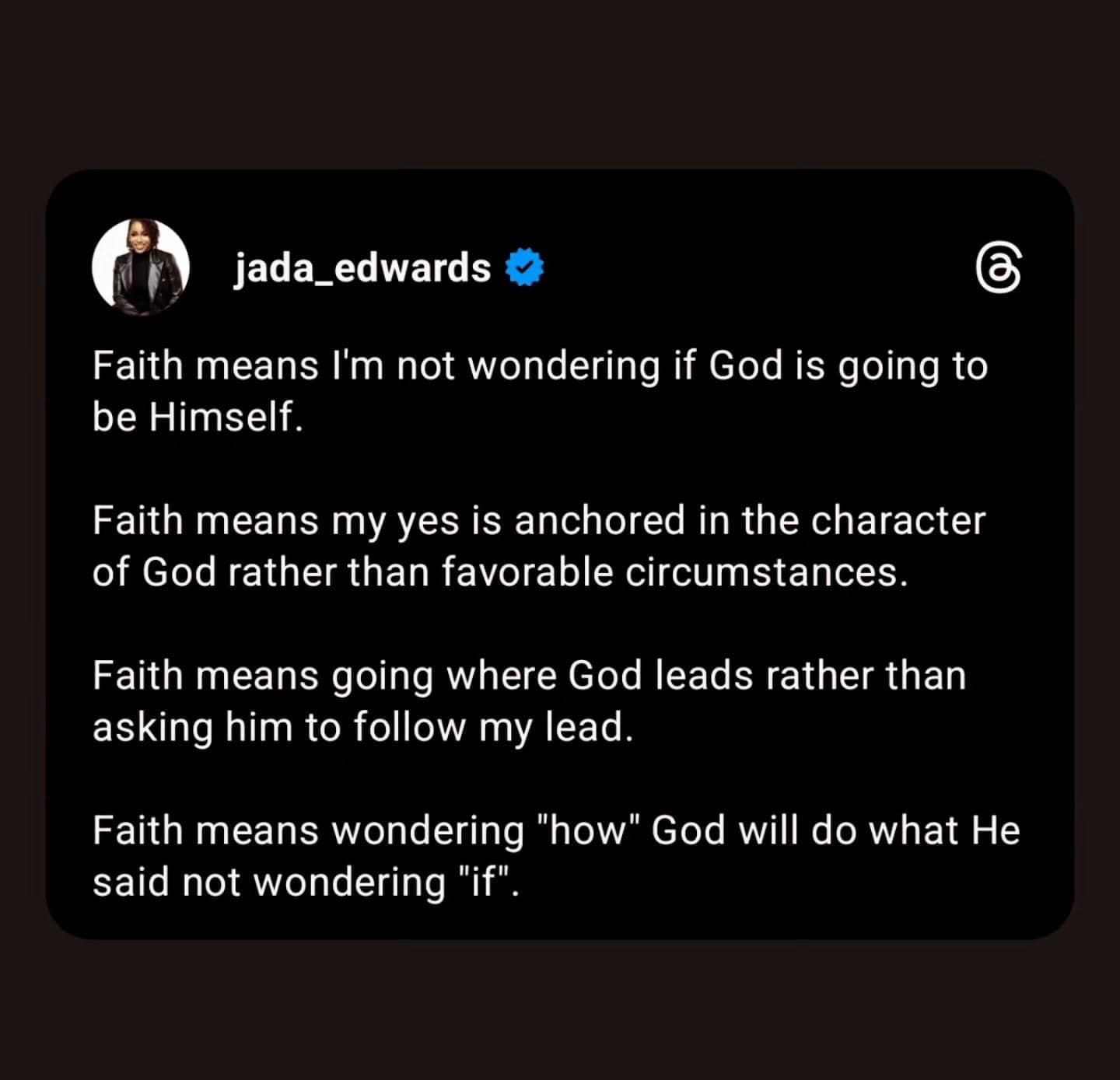
I think I read that faith means trusting an unknown future to a known God, although sometimes, God seems as unknowable as the future. I understand God as much as He has revealed Himself to me, but there’s so much more to know and even some that will never be known on this side of heaven.

I think faith means trusting what I know of me to what I know about God, giving what I know about my circumstances and my future into His Hands. I almost said understand instead of know, but faith goes beyond understanding. I trust when I do not understand because what I know of God proves His trustworthiness.

I keep thinking about that character in the Bible who said to Jesus, “I believe. Help my unbelief.”

I get that. I relate to that 1000%.

My faith doesn’t have to be complete or perfect. I don’t have to have faith the size of a mountain to move God. All I need is faith the size of a mustard seed for God to move the mountain. Again, it’s not my big faith in God but my faith in a big God who is bigger than my fears, my doubts, and my circumstances.

I confess that sometimes I wonder IF God will show up, despite having seen Him never fail to show up at the right moment. In my best moments, my faith says, “I can’t wait to see how You pull this one off, because I know You will.”

I can’t wait for the day when my faith will be made sight. Until then, I will echo the words, “I believe, help my unbelief.”

And that will always be enough.

A God We Can’t Exaggerate

“Many Spirit-filled authors have exhausted the thesaurus in order to describe God with the glory He deserves. His perfect holiness, by definition, assures us that our words can’t contain Him. Isn’t it a comfort to worship a God we cannot exaggerate?” (Francis Chan)

There’s a beautiful old book by J. B. Phillips called Your God Is Too Small. I think that’s the case for anyone who has ever lived who tried to conceive the idea of God. We always fall short. We always make God way too small.

The problem with a lot of deconstruction is that we make ourselves the standard by which God and truth are measured. We are definitely too finite and small to be any kind of measuring stick to which God must conform (thanks to Frances Chan for that one as well). It’s putting ourselves above God, essentially saying that God would never [fill in the blank] because I would never [fill in the blank].

God not only above us, He is so far beyond us that our minds could never have fathomed God at all apart from God revealing Himself to us. That blows my mind. It also humbles me whenever I get to the place where I think I have God figured out.

We can’t possibly exaggerate God. How cool is that? The biggest, grandest, wildest picture we can dream up or draw or sing about or write about falls short of who God is by far. All we can do is sit at the brink and adore the depth, to borrow from Matthew Henry.

God is never too small. Only our conception of Him is. But God made Himself incarnate and came near and became a tiny infant. That’s my favorite part.

Homesick for God?

“How many people have you made homesick for God?” (Oswald Chambers, Disciples Indeed)

That’s the key to evangelism, I think. It’s not constantly reminding people how sinful they are or ridiculing their worldview. I think in that approach we forget that we too were once sinful and had wrong beliefs about the universe.

What was it that won you over? What was it that made you want to know and love God? Was it really someone telling you what an awful person you were? Was it someone constantly berating your beliefs?

I think the key is to make people long for God to the point where they’re homesick for God. I think people seeing you loving God and living out of the overflow of God’s love for you will want to know God. People who see you loving others well the way God loved you well will crave that kind of love, even if they don’t have a name for it.

The way the early Church drew people was in how those believers loved each other. They loved lost people as well, but mainly it was in their love for each other that made people want to hear their gospel message.

If all you have is a well-defined set of doctrines and beliefs, no one cares. If all you have is a passion for making people as moral as you are, then no one wants to hear about it. But when you live transformed and let the life of Christ in you permeate everything you do, then people can’t help but see and be drawn to what they don’t have.

The key is to make people homesick for a home they’ve never known but want to go to more than anything or anywhere else. Make them homesick for God.