The Father’s Business

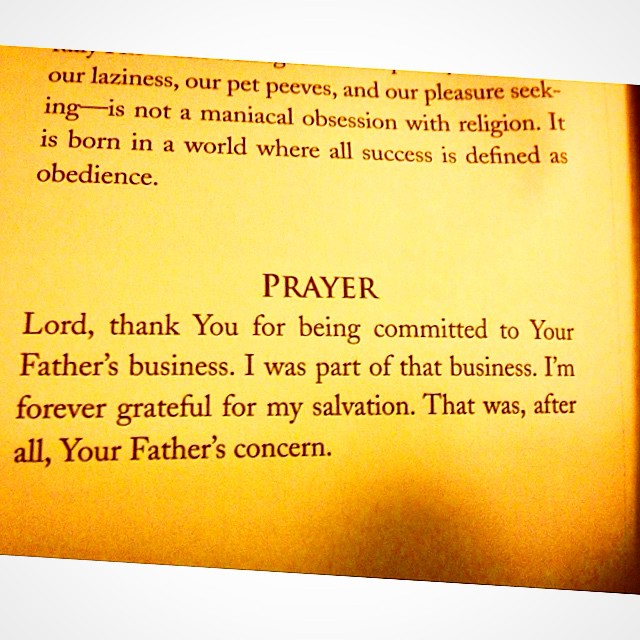
One of my favorite epiphanies about Jesus came when I heard (or read) that Jesus’ first recorded words came when His parents found Him in the temple after He went missing. He spoke of how He must be about His Father’s business. His last words before He died were, “It is finished.” Everything in between was His Father’s business — that means you and that means me and that means those for whom He came to seek and to save.

That’s our business. To seek out the lost and help them find their way to Jesus. Like Jacob Marley said to Scrooge that Christmas Eve, “Mankind was my business,” and not the obsessive hoarding of wealth and titles.

Tonight, I am thankful that I was my Father’s business. So were you. That mission that started in Bethlehem and ended in Jerusalem was to find and save us. Jesus wasn’t the one who was lost. Not really. We were.

Boxen

I started a new book recently. I’ve actually owned this book for a while, but for some reason or another have never gotten around to it. It was perpetually on my to-read-next list.

This is a collection of what C. S. Lewis, who preferred to be called Jack, wrote with his brother Warnie when they were kids growing up in Belfast in Northern Ireland. It wasn’t something they ever meant to be published but it was stories they wrote for each other to take their minds off of the outside world and losing their mother at an early age.

It feels a bit like the Beatrix Potter books (which they read as kids) where the animals wear clothes and talk and behave in human ways. If you’ve read the Narnia books, you can see where the seeds that led to those books came from.

These stories have typical childish spelling and grammar, but also they seem a bit advanced for children who were both under the age of 10. You can tell both these boys were intelligent and well-educated. I feel like these characters could have easily existed in the world that Kenneth Grahame created for The Wind in the Willows (which is a story that he also never originally meant to be published but wrote for his young son).

I’ve included a link to Amazon if you’re interested (although I think you could probably find it cheaper in a secondhand bookstore or through other book websites):

An Advent Prayer from Henri Nouwen

I realize that we are past Advent. If you follow the ancient ways, then you are aware that this is the third day of Christmas, so it still counts. Also, this time of the kingdom of God being now and not yet feels like an extended Advent season as we wait for Christ’s return:

“O Lord,

How hard it is to accept your way. You come to me as a small, powerless child born away from home. You live for me as a stranger in your own land. You die for me as a criminal outside the walls of the city, rejected by your own people, misunderstood by your friends, and feeling abandoned by your God.

As I prepare to celebrate your birth, I am trying to feel loved, accepted, and at home in this world, and I am trying to overcome the feelings of alienation and separation that continue to assail me. But I wonder now if my deep sense of homelessness does not bring me closer to you than my occasional feelings of belonging. Where do I truly celebrate your birth: in a cozy home or in an unfamiliar house, among welcoming friends or among unknown strangers, with feelings of well-being or with feelings of loneliness?

I do not have to run away from those experiences that are closest to yours. Just as you do not belong to this world, so I do not belong to this world. Every time I feel this way I have an occasion to be grateful and to embrace you better and taste more fully your joy and peace.

Come, Lord Jesus, and be with me where I feel poorest. I trust that this is the place where you will find your manger and bring your light. Come, Lord Jesus, come.

Amen” (Henri Nouwen).

On the Second Day of Christmas

I read recently where in ye olden days, the Christmas celebrations didn’t cease on December 25. They just got started.

Apparently, Christmas wasn’t just a one day shindig. It was a 12 day feast. That sounds like my kind of party.

But my second day of Christmas saw me going back to work in the cold rain. Not much joyful or triumphant about that.

At least I have my Vintage Christmas stories to entertain me on my long trek to work. They’re all short stories and poems from the likes of Louisa May Alcott, Charles Dickens, Harriet Beecher Stowe, Mark Twain, L. M. Montgomery, and others. It’s so very 19th century.

My plan is to watch my Christmas movies until at least January 6 (or whenever the Day of Epiphany is that marks the official end of Christmas). I may watch past that if the mood hits me.

It will be a bit sad to see all the festive decorations come down for another 11 months or so. There’s something about lit-up houses and yards full of seasonal characters that always lifts my spirits on a grey and cloudy day.

But I still refuse to let Christmas go just yet.

Merry Christmas 2023

“Let the just rejoice,
for their justifier is born.
Let the sick and infirm rejoice,
For their saviour is born.
Let the captives rejoice,
For their Redeemer is born.
Let slaves rejoice,
for their Master is born.
Let free men rejoice,
For their Liberator is born.
Let All Christians rejoice,
For Jesus Christ is born” (St. Augustine of Hippo, AD 354-440).

Another Christmas Day has come and gone, but this time I refuse to say that Christmas is over. It’s not like the baby in that manger that we celebrate and sing about simply ceased to exist.

No, but He grew up into the sinless Son of God who chose the way that led to Calvary so that we might choose the way that leads back to God. He chose the nails, so that we might be healed. He chose all the suffering, so that we might finally know peace.

That is something to celebrate long after December 25 is over.

Lessons Learned Slowly

“‘A thrill of hope, the weary world rejoices.’

This tiny window when the world falls asleep (or attempts to) on Christmas Eve is my favorite. Anticipation. What a gift!

Yes, we will wake up in the morning and devour our presents. We will rip our wrapping paper to shreds and down our favorite Christmas fare at the table. And then, we will feel it. The air falls flat. The glow from the lights fails to warm us fully. What’s different? Time has betrayed us. Another thing we love just cannot last.

That’s when my favorite Christmas song kicks in. “The thrill of hope” doesn’t expire tomorrow afternoon. We can access it anytime, even on a random Tuesday in March. The promise lingers. The truth remains. His birth was an entry point into time and space. His life and death? A timeless revolution. When will we ever learn that our silly calendars hold no sway.

Let us come together tomorrow with the understanding that the joy that this world affords is always tinged with sorrow, an afterburn that leaves us unsettled. Even still, let us lift our eyes to the eternal and everlasting promise. Our world IS weary, but our ‘thrill of hope’ can never, ever die!” (Jennifer Whitwell Christensen).

I used to love and dread Christmas Day.

I loved seeing all the presents as a kid and feeling all the nostalgic emotions as I got older, but I dreaded the inevitable letdown of Christmas being over for another year. I knew all those festive decorations would be going back into boxes and back into storage for another 11 months.

I dreaded coming to the end of Christmas Day and hearing the words “Christmas is over” when I was not even close to being ready for it to be over. Especially lately, when the whole season seems to fly by as quickly as one of Santa’s sleighs in the night sky.

It’s like the magical part disappears and the humdrum reappears and life goes back to grey after bursting forth in green and silver and gold and a multitude of other colors for a while. No more Christmas for 364 more days.

But the older I get, I realize that what I love most in this world are merely shadows pointing to a truer form I will know in the next. Everything that brings me joy now is a foretaste of a greater joy that no sorrow can steal nor death destroy.

When all the packages are gone and decorations put away, the hope of the season remains. I can truly be like Scrooge and honor Christmas in my heart all the days of the year because Christmas means that God has come near, and that remains true into January and beyond.

The Maker of Man Became Man

“The Word of the Father, by Whom all time was created, was made flesh and was born in time for us.

He, without whose divine permission no day completes its course, wished to have one day set aside for His human birth.

In the bosom of His Father, He existed before all the cycles of ages; born of an earthly mother, He entered upon the course of the years on this day.

The Maker of man became Man that He, Ruler of the stars, might be nourished at His mother’s breast;

that He, the Bread, might hunger;

that He, the Fountain, might thirst;

that He, the Light, might sleep;

that He, the Way, might be wearied by the journey;

that He, the Truth, might be accused by false witnesses;

that He, the Judge of the living and the dead, might be brought to trial by a mortal judge;

that He, Justice, might be condemned by the unjust;

that He, Discipline, might be scourged with whips;

that He, the Foundation, might be suspended upon a cross;

that Courage might be weakened;

that Healer might be wounded;

that Life might die.

To endure these and similar indignities for us, to free us, unworthy creatures, He who existed as the Son of God before all ages, without a beginning, deigned to become the Son of Man in these recent years.

He did this although He who submitted to such great evils for our sake had done no evil and although we, who were the recipients of so much good at His hands, had done nothing to merit these benefits.

Begotten by the Father, He was not made by the Father.

He was made Man in the mother whom He Himself had made, so that He might exist here for a while, sprung from her who could never and nowhere have existed except through His power” (Augustine of Hippo, Sermons 184-229: Sermons).
That Third Stanza

If you’re like me and grew up in Baptist churches, you probably remember those old Baptist hymnals. You might remember that we sang a select few out of those hymnals over and over. But if you’re above a certain age, you’ll certainly remember that we always sang the first, second, and fourth stanzas of any hymn. Never the third.

Today, most of us can still remember the words to any of the old standards. But if you want to stump a Baptist, request the third stanza of any hymn. Any. Hymn. It doesn’t matter. The younger ones will resort to Google while the older ones may have to dig up an old hymnal they saved when their churches went to digital and lyrics on a screen.

But every now and then, there’s a gem hiding in the third stanza. A friend posted one such from It Came Upon a Midnight Clear, a very familiar Christmas carol. But the third stanza hit me like it was brand new — probably because it WAS brand new to me:

“O ye, beneath life’s crushing load, whose forms are bending low
Who toil along the climbing way with painful steps and slow
Look now for glad and golden hours come swiftly on the wing
O rest beside the weary road and hear the angels sing.”

I love the idea of Christmas Day as a time to rest and hear the angels singing. It may not be feasible for some, but I think we should all at least try to make room to sit and ponder the mystery of Christmas — God became a baby, born to a virgin in a barn, who grew up to be the Savior of the world.

Advent, Memories, and a Christmas Story

I checked one off my list for required holiday movie viewing. I watched a Christmas Story tonight with all its round-faced kid glory. When I came to the part [spoiler alert ahead] where he finally got his long-sought Red Ryder BB gun for Christmas, I knew exactly the joy he felt.

I remember getting that present I had wanted all year. For me, it was a Commodore 64. For those who aren’t old, that’s a personal computer that had as much memory in it as a calculator. You could probably take the combined memory of every Commodore computer ever manufactured and it still wouldn’t add up to the memory in one iPhone. But it was a dream present.

I remember the joy of opening up gifts of Christmas morning to find something I had wanted and waited for the whole year. But sooner or later, the magic faded. The joy that was so strong at first waned. A lot of those presents eventually got sold at garage sales or got donated to Goodwill.

That’s the kind of joy that comes when we make Christmas a one day event where the focus is on opening presents and consuming lots of food. Soon, the giddiness is replaced by a kind of letdown and a sadness of having to wait 364 days until the next Christmas.

But when we focus on the child in the manger born on Christmas Day, the joy carries over. This child became the Savior of the world who doesn’t just live in our hearts one day of the year but all the days of the year.

This kind of joy lasts beyond December 25, even past the 12 days of Christmas. This joy is based on a hope that does not disappoint or decay or die. This hope is the now and the not yet of the kingdom of God. Now we see partly and catch glimpses of God breaking into the world, but one day we will see and know fully and see God’s kingdom on earth as it is in heaven.

We can celebrate the gifts and the food but keep our eyes fixed on the true reason for Christmas, Jesus.

Let the Stable Still Astonish

This is not the first time I’ve posted this poem here. In fact, I try to post it every year around this time because it speaks so beautifully to the true meaning of Christmas. That God should be born as a baby on a dirt floor in a stable is no less marvelous than that God should come into my heart and be born there.

God didn’t wait for me to get cleaned up or get my act together or finally figure out my life. He didn’t wait for me to come to Him. He came to me where I was in the middle of my mess and make me all those things I could never have made myself — clean, whole, pure, with a purpose.

May this poem still speak to you as it still speaks to me:

“Let the stable still astonish:
Straw-dirt floor, dull eyes,
Dusty flanks of donkeys, oxen;
Crumbling, crooked walls;
No bed to carry that pain,
And then, the child,
Rag-wrapped, laid to cry
In a trough.
Who would have chosen this?
Who would have said: ‘Yes,
Let the God of all the heavens and earth
Be born here, in this place’?

Who but the same God
Who stands in the darker, fouler rooms
of our hearts and says, ‘Yes,
let the God of Heaven and Earth
be born here–
in this place’ (Leslie Leyland Fields, Let the Stable Still Astonish).