“Humbly let go. Let go of trying to do, let go of trying to control, let go of my own way, let go of my own fears. Let God blow His wind, His trials, oxygen for joy’s fire. Leave the hand open and be. Be at peace. Bend the knee and be small and let God give what God chooses to give because He only gives love and whisper a surprised thanks. This is the fuel for joy’s flame. Fullness of joy is discovered only in the emptying of will. And I can empty. I can empty because counting His graces has awakened me to how He cherishes me, holds me, passionately values me. I can empty because I am full of His love. I can trust” (Ann Voskamp, One Thousand Gifts: A Dare to Live Fully Right Where You Are).
I’m not advocating for a kind of “let go and let God” passive approach to spirituality. I think in this case I need to let go of my way of thinking of how God should act. I should stop setting up boundaries to put God in so that He will act according to what I have set up as my standard for Him to follow.
I can trust that God’s ways are not my ways. I can trust that I would want what God wants if I knew what He knew. I would understand what He does if I could see the whole entire big picture from eternity rather than my own specific limited viewpoint. If my brain could comprehend the infinite, I could begin to think like God.
But I can’t and I’m not. “Faith is the assurance of things you have hoped for, the absolute conviction that there are realities you’ve never seen” (Hebrews 11:1, The Voice).
I trust in what I can’t see and I believe what I can’t fully understand. Otherwise, it wouldn’t be faith. It would be seeing and understanding. But even if I have the teensiest amount of faith like that of a microscopic mustard seed, that’s enough.
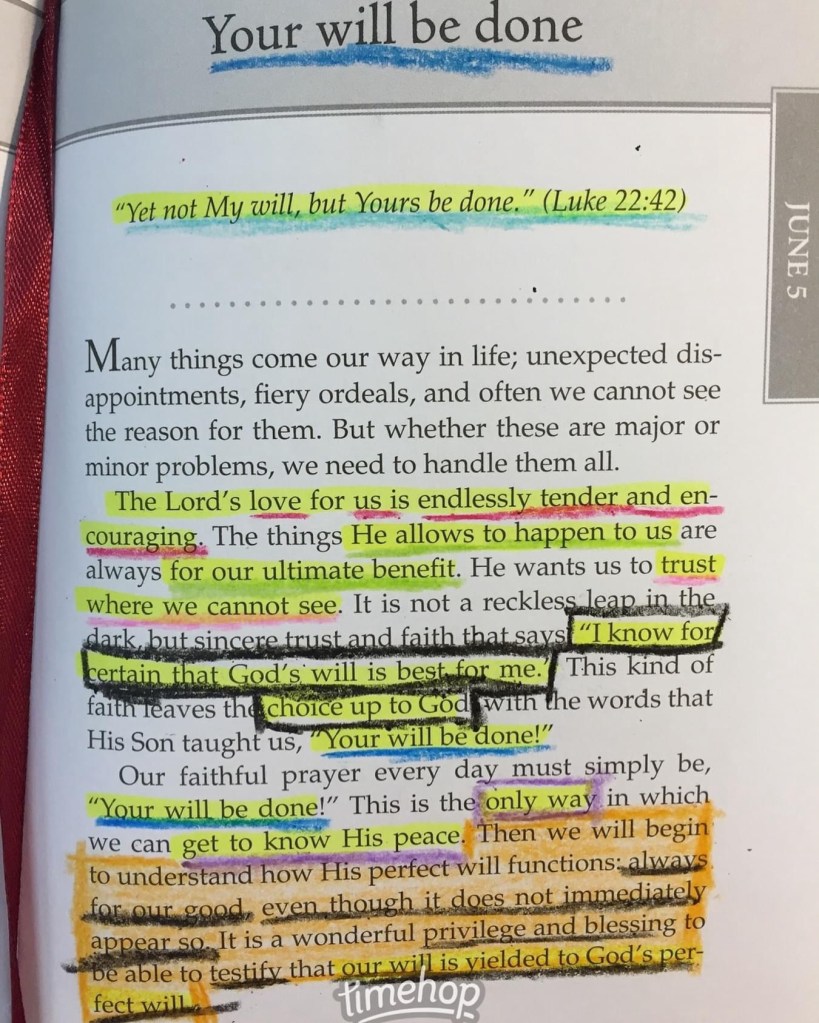
“The deepest spiritual lessons are not learned by His letting us have our way in the end, but by His making us wait, bearing with us in love and patience until we are able honestly to pray what He taught His disciples to pray: Thy will be done” (Elisabeth Elliot).
I feel likethere’s been a theme lately. I keep running across quotes from years past that are about God’s will and learning to wait for God’s timing. Could it possibly be that God is trying to get my attention?
I admit that at times I’m a slow learner. Perhaps this season is one where God can finally get my full attention without me being distracted by a million other sounds, noises, and voices. Maybe this is where I finally get to say and mean it, “Thy will be done.”
It’s one thing to say the words and still hedge your bets. I can say I want God’s will and still be working on a backup plan in case my own plan fails. But to get to the point where I pray God’s will knowing that if God doesn’t show up, I’m sunk, I’m done, is the ultimate surrender.
That’s where another prayer from the Bible comes in handy: I believe. Help my unbelief.
“Outside the will of God, there’s nothing I want. Inside the will of God, there’s nothing I fear” (A. W. Tozer).
I used to think that if God’s will for me were something I didn’t like, I’d simply go outside His will and He’d eventually forgive me. I was young and dumb. I didn’t realize that the perimeters of God’s will were more for me than Him.
I didn’t realize that it’s impossible to find happiness outside of God and God’s will because such a thing doesn’t exist. Who better than God knows my inner workings and purposes, what makes me tick, what makes me come alive? Who else could so intricately design a plan for my life that has not only God’s greatest glory but my greatest good in mind?
So my prayer these days is the same as that of Elisabeth Elliott: “Thy will be done, even if it means my will be undone.”
I never thought I’d say this, but I miss going in to work on a Monday. I almost miss getting up at 5 am to face the 27 mile trek to Donelson. I absolutely miss seeing all the people every day and drinking the coffee and telling the jokes. I even miss the parts of my job that I thought were the worst.
I know something better’s coming, but I’m not all that great at waiting. As much as I like to think I am a mostly calm individual with a low stress level most of the time, I am not. I can stress with the best sometimes.
But I keep praying “Lord, I don’t know what to do, but my eyes are on You.”
I think it’s from Josiah when he was facing a challenging situation from invading armies. The odds were not in their favor, so they cried out to the Lord. The people of God were not by and large faithful to God and probably didn’t have the right to expect God’s favor, but still they got it.
So that’s my hope. God will show up. Not when I think He should, but when He knows the time is right. Not according to my timetable, but according to His perfect plan.
I’m surprised Hollywood hasn’t already turned this into a movie. It really is the stuff of legends and dreams.
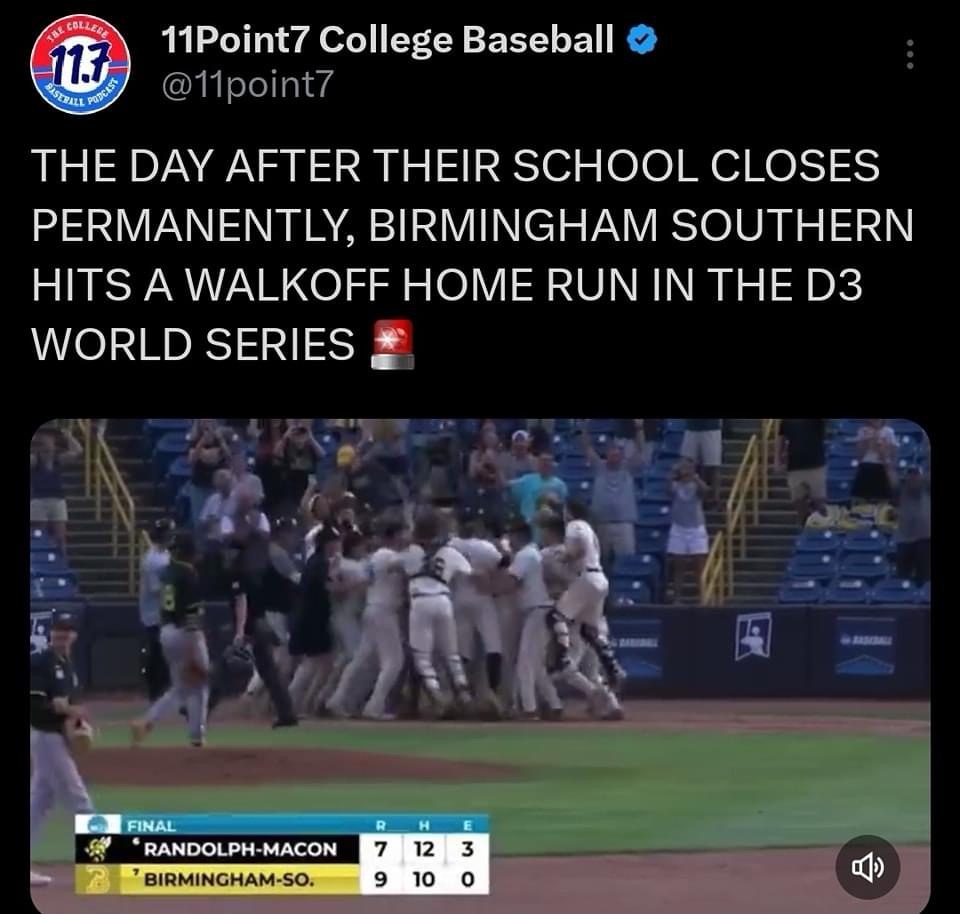
On May 31, Birmingham Southern College closed its doors for good due to financial instability. The very next day, the Birmingham Southern College Panther baseball team hits a walk-off home run to advance in the College World Series.
Basically, the players are representing something that doesn’t exist anymore. If by some miracle they win it all, there will be no place to put the trophy. No place to hang the banner. No students waiting to congratulate the champions.
It’s the very best kind of sports story, like a Hoosiers but with more heart.
I remember my high school came close to closing its doors when I was a sophomore. I don’t remember much, but I do recall not begging God to let it stay open and desperately not wanting to go anywhere else to finish out my education. Thankfully, the school stayed open.
I can’t imagine win or lose not having a school to return to in the fall. Knowing after the fact that your last day of classes for the semester were the last classes ever. I don’t know how many of these players are on sports scholarships or how many will even be able to continue their education.
I do know that there’s more baseball to play. At this point, all they can think about is winning the next game. It’s either win or go home for good.
But the best part is that now they can play without any pressure. They can play for the love of the game again like they did way back when they first picked up gloves and bats as little tykes.
I’m always one that likes to root for the underdog, especially the ones that no one gives a chance or expects to win. I’m praying for these players and coaches and their families, and I’m hoping for one last blaze of glory for Birmingham Southern College.
This was originally written by Elisabeth Elliott and is a bit longer than my usual posts. It’s worth the extra time to read it all:
The world cannot fathom strength proceeding from weakness, gain proceeding from loss, or power from meekness. Christians apprehend these truths very slowly, if at all, for we are strongly influenced by secular thinking. Let’s stop and concentrate on what Jesus meant when he said that the meek would inherit the earth. Do we understand what meekness truly is? Think first about what it isn’t.
It is not a naturally phlegmatic temperament. I knew a woman who was so phlegmatic that nothing seemed to make much difference to her at all. While drying dishes for her one day in her kitchen I asked where I should put a serving platter.
“Oh, I don’t know. Wherever you think would be a good place,” was her answer. I wondered how she managed to find things if there wasn’t a place for everything (and everything in its place). …
Meekness is most emphatically not weakness. Do you remember who was the meekest man in the Old Testament? Moses! (Num. 12:3). My mental image of him is not of a feeble man. It is shaped by Michelangelo’s sculpture and painting and by the biblical descriptions. Think of him murdering the Egyptian, smashing the tables of the commandments, grinding the golden calf to a powder, scattering it on the water and making the Israelites drink it. Nary a hint of weakness there, nor in David, who wrote, “The meek will he guide in judgment” (Psalm 25:9), nor in Isaiah, who wrote, “The meek also shall increase their joy in the Lord” (Isa. 29:19).
The Lord Jesus was the Lamb of God, and when we think of lambs we think of meekness (and perhaps weakness), but he was also the Lion of Judah, and he said, “I am meek and lowly in heart” (Matt. 11:29). He told us that we can find rest for our souls if we will come to him, take his yoke, and learn. What we must learn is meekness. It doesn’t come naturally to any of us.
Meekness is teachability. “The meek will he teach his way” (Ps. 25:9). It is the readiness to be shown, which includes the readiness to lay down my fixed notions, my objections and “what ifs” or “but what abouts,” my certainties about the right-ness of what I have always done or thought or said. It is the child’s glad “Show me! Is this the way? Please help me.” We won’t make it into the kingdom without that childlikeness, that simple willingness to be taught and corrected and helped. “Receive with meekness the engrafted word, which is able to save your souls” (James 1:21). Meekness is an explicitly spiritual quality, a fruit of the Spirit, learned, not inherited. It shows in the kind of attention we pay to one another, the tone of voice we use, the facial expression.
One weekend I spoke in Atlanta on this subject, and the following weekend I was to speak on it again in Philadelphia. As very often happens, I was sorely tested on that very point in the few days in between. That sore test was my chance to be taught and changed and helped. At the same time I was strongly tempted to indulge in the very opposite of meekness: sulking. Someone had hurt me. He or she was the one who needed to be changed! I felt I was misunderstood, unfairly treated, and unduly berated. Although I managed to keep my mouth shut, both the Lord and I knew that my thoughts did not spring from a depth of loving kindness and holy charity. I wanted to vindicate myself to the offender. That was a revelation of how little I knew of meekness.
The Spirit of God reminded me that it was he who had provided this very thing to bring that lesson of meekness which I could learn nowhere else. He was literally putting me on the spot: Would I choose, here and now, to learn of him, learn his meekness? He was despised, rejected, reviled, pierced, crushed, oppressed, afflicted, yet he did not open his mouth. What was this little incident of mine by comparison with my Lord’s suffering? He brought to mind Jesus’ willingness not only to eat with Judas, who would soon betray him, but also to kneel before him and wash his dirty feet. He showed me the look the Lord gave Peter when he had three times denied him – a look of unutterable love and forgiveness, a look of meekness which overpowered Peter’s cowardice and selfishness, and brought him to repentance. I thought of his meekness as he hung pinioned on the cross, praying even in his agony for his Father’s forgiveness for his killers. There was no venom or bitterness there, only the final proof of a sublime and invincible love.
But how shall I, not born with the smallest shred of that quality, I who love victory by argument and put-down, ever learn that holy meekness? The prophet Zephaniah tells us to seek it (Zeph. 2:3). We must walk (live) in the Spirit, not gratifying the desires of the sinful nature (for example, my desire to answer back, to offer excuses and accusations, my desire to show up the other’s fault instead of to be shown my own). We must “clothe” ourselves (Col. 3:12) with meekness – put it on, like a garment. This entails an explicit choice: I will be meek. I will not sulk, will not retaliate, will not carry a chip.
A steadfast look at Jesus instead of at the injury makes a very great difference. Seeking to see things in his light changes the aspect altogether.
In Pilgrim’s Progress, Prudence asks Christian in the House Beautiful, “Can you remember by what means you find your annoyances at times, as if they were vanquished?”
“Yes,” says Christian, “when I think what I saw at the cross, that will do it.”
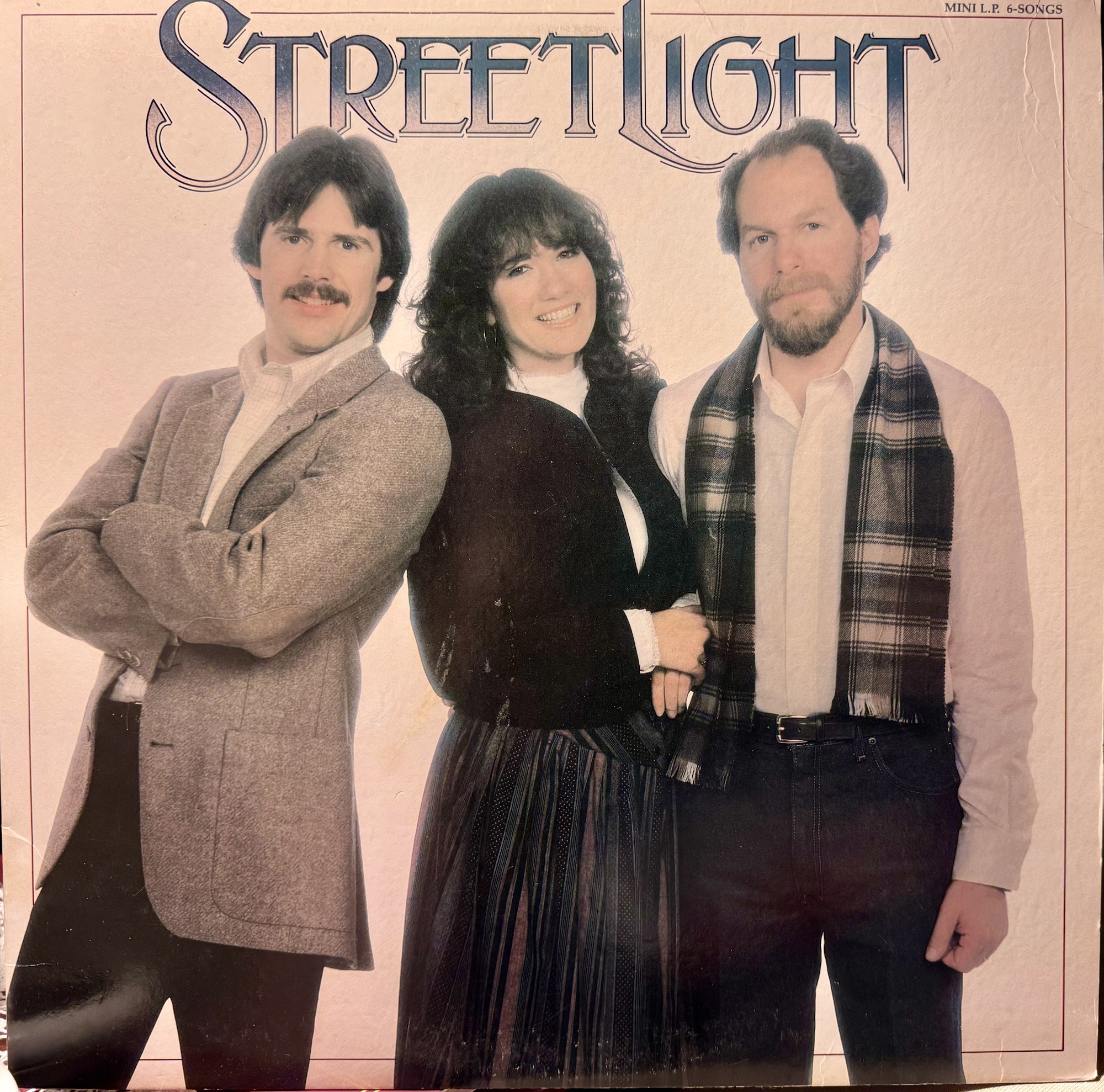
I love it when I run across something rare and precious. At least it’s precious to me. I’m aware that not many people will know about this group. So perhaps a little backstory will suffice.
Back in my Union days, I discovered a fantastic artist named Julie Miller. She put out a few CCM albums that rocked my world with her transparent and honest lyrics and folksy stylings.
Then I found out about Buddy Miller. This dude plays just about everything there is. If it’s a musical instrument, he’s likely good at it. He’s had his own career as a kind of Americana singer-songwriter.
But to find that they put out an album in the early 80s? The best part was that this find only cost me $5. Gotta love those bargain bins.
“Do not withhold good from those who deserve it when it’s in your power to help them” (Proverbs 3:27, NLT).
Last week, someone ducked me. By that I don’t mean that person avoided me like the plague, but whoever it was left a little duck on the driver side door handle of my Jeep to add to my little collection. Apparently, it’s a Jeep thing.
So this week I realized that I have basically two surfer ducks. Earlier today, I was able to re-duck the second one to another Jeep driver. It felt good to pay it forward.
I don’t mean to humble brag but to illustrate a point. We’re not all Rockefeller rich. We’re not all super movie star or rock star influential. But we each can find a way to pay forward some of the kindness done to us.
The best example of kindness I can think of begins this way: while we were yet sinners, Christ died for us.
I love that He didn’t wait for me to get my act together or start behaving before He went to the cross. I’m super thankful that Jesus didn’t do a cost effectiveness analysis on me to decide if He should die for me. I’ll never stop being grateful for the fact that I got grace instead of karma, considering what I deserve isn’t forgiveness but death and hell.
I think that alone should make me want to pass along the mercy and kindness that I’ve received. I should want to pay forward the grace I’ve been shown and do for others who can never pay me back. And there’s no better time to start than today.
“It is quite right that you should feel that ‘something terrific’ has happened to you (It has) and be ‘all glowy.’ Accept these sensations with thankfulness as birthday cards from God, but remember that they are only greetings, not the real gift. I mean, it is not the sensations that are the real thing. The real thing is the gift of the Holy Spirit which can’t usually be—perhaps not ever—experienced as a sensation or emotion. The sensations are merely the response of your nervous system. Don’t depend on them. Otherwise when they go and you are once more emotionally flat (as you certainly will be quite soon), you might think that the real thing had gone too. But it won’t. It will be there when you can’t feel it. May even be most operative when you can feel it least” (Collected Letters of C.S. Lewis Volume III, C.S. Lewis).
The problem with a faith based on feelings is that those feelings are fickle and subject to change. I mean, have you ever tried to sustain a single emotion over a 24-hour period? You can’t. You can’t make yourself feel anything indefinitely.
Also, I’ve learned that feelings can lie. What you feel at any moment can stem from something you ate yesterday that didn’t agree with you. I’ve noticed I might trend more toward negative emotions when I am tired or hungry or bored. Typically, I can’t trust what I’m feeling when I haven’t slept well the night before. I especially have learned from experience not to post any social media or respond to any social media or emails late at night. A good night’s sleep and some time have a way of miraculously changing my attitude and perspective.
But the life of faith does have an emotional component to it. You just don’t put feelings in front. That’s where faith comes in. Feelings should be the caboose of your spiritual journey, present but not leading the way.
God is real even when I don’t feel Him. God’s promises are true even when I can’t see them. Obedience is acting in loving ways even when I don’t feel loving and following God’s commands when I don’t want to.
I’ve always loved the idea that my security as a believer doesn’t depend on how tightly I hold God’s hand but how He won’t ever let go of me.


 Ragamuffingospelfan's Blog