Turning the Wine Back into Water

“Next to the Blessed Sacrament itself, your neighbor is the holiest object presented to your senses (C. S. Lewis, The Weight of Glory).

I’m guilty all the time of looking at people like they’re ordinary. I think that’s the default setting for the human race. We rarely if ever see anyone and see the image of God in him or her. We just don’t take the time to see beyond the surface labels of pretty, plain, fat, skinny, tall, short, etc.

I wonder what would happen if we could see people the way Jesus saw people. He didn’t see a stereotype or a caricature. Every time, He saw a unique individual with a story like no one else’s. He created each person with a one-of-a-kind purpose and plan that no one and nothing else can do.

He looked at you and me and thought we were worth dying for. Even at our worst moment in those times we wish we could take back or do over, Jesus still chose to go to the cross and lay down His life for us. While we were still sinners, the Bible says, Christ died for us.

I’ve been guilty of prejudging people before I’ve even had the chance to get to know them. Sometimes, I see the way they interact with others or maybe the expression on their faces. I’m sure I’m not the only one, but I’m also sure glad that Jesus didn’t judge me like that. He saw the absolute worst version of me and still loved me.

I wonder what would happen if we loved people like that. Maybe we wouldn’t have to hunt high and low for gospel conversations and opportunities to share our faith. Maybe people would seek us out and want to know more about this Jesus they see in us, even if they can’t put a name to what they see.
Abiding in Jesus

“There is no condition of life in which we cannot abide in Jesus. We have to learn to abide in Him wherever we are placed” (Oswald Chambers, in Our Brilliant Heritage).

Abide isn’t a word that we use much anymore. I can’t remember the last time I used the word abide in a sentence, unless I was reading from the Gospel of John in a more traditional translation recently.

But to abide in something isn’t pitching a tent and packing up the next day. It’s being in it for the long haul, so to speak. To abide is to remain. Specifically, to abide in Jesus is more than being around the things of Jesus but immersing in Jesus.

To abide in Jesus is to remain calm when all else is chaotic and uncertain. It’s being able to sleep on a boat in the middle of gale-force winds and crashing waves. It is to be so centered in Jesus that nothing can overthrow your peace or dampen your joy.

Jesus told us as His followers that we must abide in Him as He abides in His Father. Think about that. His abiding in the Father was a daily, hourly, even moment by moment occurrence. It was not a one hour a week or even a three times a week thing. It was every conscious moment of every single day.

I want that, but I confess I don’t really know how to do that. Lord, teach us how to abide in You. Give us the desire above all else to want to be daily aware of and immersed in You so that we can more and more reflect You to everyone we meet so that they will want to know You and abide in You, too. Amen.

Post #5,480

It is Monday, August 18, 2025. It’s hard to believe that August is already more than halfway over. Next up is September. I for one am eagerly awaiting the arrival of the ‘Ber months, even though I know the fall weather likely won’t get here until mid-October.

But there’s something psychologically satisfying about September. Generally speaking, it’s not as hot as August. There might even be another glorious fall sneak preview or two. Plus, all the coffee shops will be switching over to pumpkin spice everything, even when it’s too hot for pumpkin spice to taste good (think anything over 80 degrees).

I still say Fall is the best. No heat stroke, no bugs, no sticky sweaty humidity. And all my favorite holidays. Plus, I get to wear flannel, which is the fashion equivalent of wearing a hug. I like it that much.

But all these remaining hot days will only serve to make me appreciate fall weather all the more. By the way, the official start of fall is in 34 days. And no, I’m not counting down the days or anything. The rate this year has flown by, it will be here before I turn around twice. And then it will be over before I can blink twice.

But at least it’s coming.

In the Furnace

“One day we took the children to see a goldsmith refine gold after the ancient manner of the East. He was sitting beside his little charcoal fire. (‘He shall sit as a refiner’; the gold- or silversmith never leaves his crucible once it is on the fire.) In the red glow lay a common curved roof tile; another tile covered it like a lid. This was the crucible. In it was the medicine made of salt, tamarind fruit and burnt brick dust, and imbedded in it was the gold. The medicine does its appointed work on the gold, ‘then the fire eats it,’ and the goldsmith lifts the gold out with a pair of tongs, lets it cool, rubs it between his fingers, and if not satisfied puts it back again in fresh medicine. This time he blows the fire hotter than it was before, and each time he puts the gold into the crucible, the heat of the fire is increased; ‘it could not bear it so hot at first, but it can bear it now; what would have destroyed it then helps it now.’ ‘How do you know when the gold is purified?’ we asked him, and he answered, ‘When I can see my face in it [the liquid gold in the crucible] then it is pure’ (Amy Carmichael, Gold Cord).

Some of you are in the furnace right now. It might be the furnace of affliction, suffering, and pain. It might be the furnace of rejection and loneliness. Or it might be the furnace of unfulfilled hopes and dreams. Whatever it is, you can probably think of a million places you’d rather be than in that furnace.

But remember in the furnace is where you’re purified and sanctified. As much as I want it to be true, holiness doesn’t come from happiness. All those glorious spiritual mountaintop experiences aren’t what make you more like Jesus. It’s trudging through the valley where you learn and grow and become who God made you to be.

In one of my favorite books, Hinds’ Feet on High Places, the main character Much Afraid is sent out on a quest by the Shepherd and given two companions to help her on her way. Their names are Pain and Suffering. At first, she recoils and almost rejects them, but after some thought and reflections on the goodness of her Shepherd, she accepts their guidance. In the end, they are as much transformed as she is.

God takes what the world means to destroy us to strengthen us. He takes what was meant to set us back to move us forward. He takes what the enemy meant for evil, and He turns it for good (as the worship song goes). He’s working all things together for your and my good (even the crappy sucky stuff we’d rather move past and not have to deal with).

The end goal is for Jesus to see His likeness in us. For God to see His reflection in us and for the world to see God’s reflection in us as well. Then we know that we are truly being purified.

Always Joyful

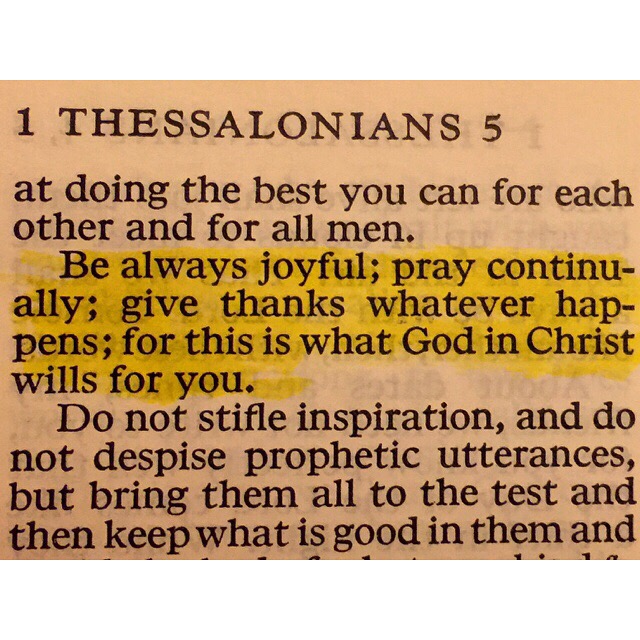
People (including me) are always seeking to know what God’s will is for their lives. It can almost become a mystical quest or a metaphorical journey. In actuality, 1 Thessalonians 5:16-18 spells it out. 1) Rejoice always, 2) pray continually, and 3) give thanks in all circumstances. That is God’s will for you.

It almost seems simplistic, but once you’ve been around a bit, you know how difficult it is to maintain a joyful spirit and not become cynical. You know how prayer can get lost amid a flurry of distractions and diversions. Giving thanks can easily be replaced by grumbling and giving complaints.

As always, God doesn’t call us to give thanks FOR everything but IN everything. I don’t rejoice for bad health or financial trouble or stressful situations, but I can be thankful in the midst of them because God is at work.

I think we tend to overcomplicate things, especially when it comes to faith. The whole KISS principle applies — Keep it Simple, Stupid. Or maybe you could find a kinder word than stupid when you’re sharing it with someone else.

Maybe Keep it Joyful. Or Keep it Prayerful. Or even Keep on Giving Thanks (though that spells out KOGT, which really isn’t a word). Or possibly forget the clever wordplay and keep your eyes on Jesus. Jesus had a joyful spirit. That doesn’t mean He was happy all the time. Scripture tells us He was a man of sorrow. But He was able to endure all the suffering because He saw joy at the end of it.

And that’s how we should be. Keep our eyes on the joy at the end of the road. Keep a prayerful spirit. Never stop telling God thank you. That is a good way to live.

Known by Name

The old saying goes something like this: Satan knows your name but calls you by your sin. God knows your sin but calls you by name.

We live in a world that preaches a watered-down god that tolerates anything and everything but has no real power to do anything about real evil. In such a culture, it’s easy to take for granted that God loves me.

But when you look at the real God from the Bible who knows every single thing about you including all those hidden sins and secret pasts, and He still loves you? And not only that, but this love isn’t a benign and vague feeling but a love demonstrated in Christ laying down His life for us.

That is an infinite love. It means He loves each and every one of us as if we were the only ones to love. He loves us with a purifying love that doesn’t merely tolerate us and cover over what’s wrong with us. His love transforms us and removes anything that is unworthy of God’s holiness or keeps us from being who God made us to be.

If we really understood and believed in that kind of love, we’d live different. We’d be different. The ones who get the love of God are the ones who love God and others well. They seek to know and do what Jesus says, not out of obligation but out of adoration. Their lives are a testimony to others and a kind of thank you back to God.

“My response is to get down on my knees before the Father, this magnificent Father who parcels out all heaven and earth. I ask him to strengthen you by his Spirit—not a brute strength but a glorious inner strength—that Christ will live in you as you open the door and invite him in. And I ask him that with both feet planted firmly on love, you’ll be able to take in with all followers of Jesus the extravagant dimensions of Christ’s love. Reach out and experience the breadth! Test its length! Plumb the depths! Rise to the heights! Live full lives, full in the fullness of God” (Ephesians 3:14-19, The Message).

Worship Music

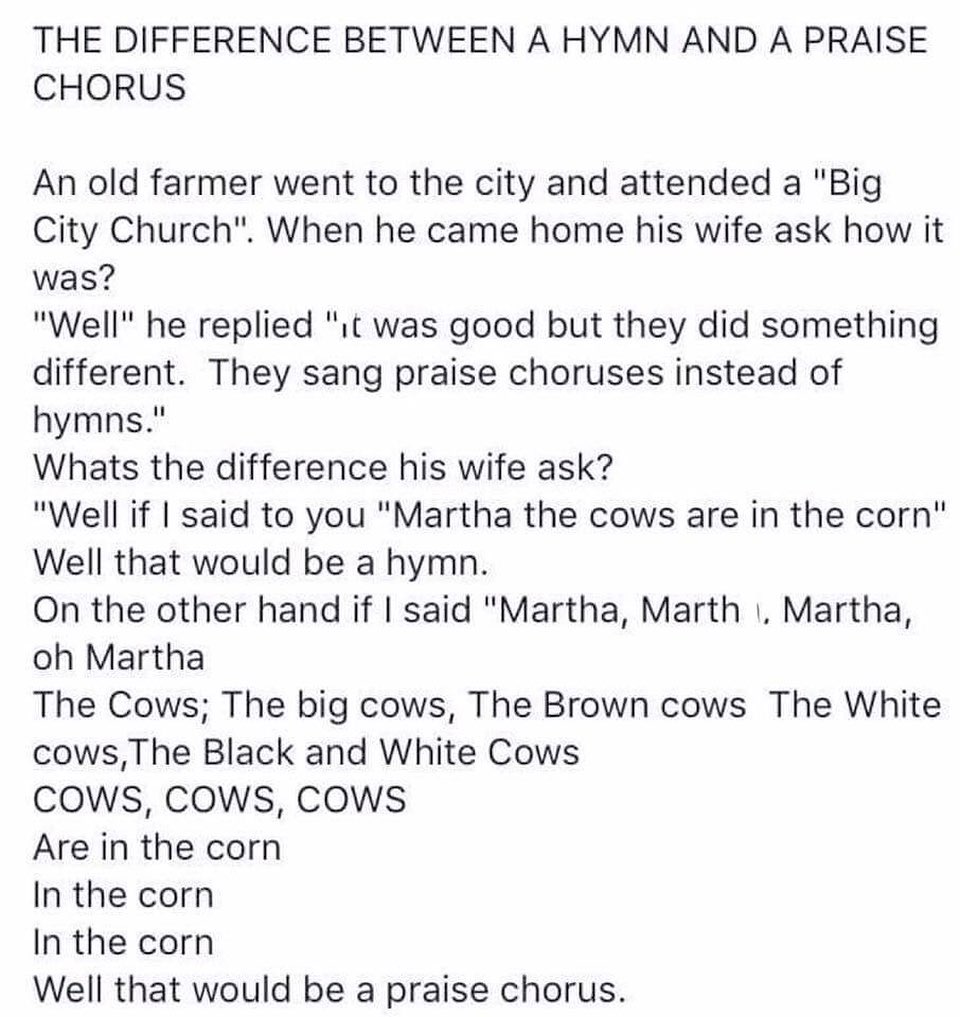
Back in the day, the debate was whether to use hymns or praise choruses in church. Lately, a lot of churches have decided that it doesn’t have to be an either/or proposition. You can do both.

As a child of the 80s and 90s, I have a nostalgic love for all the old praise choruses, but lately, I seem to be drawn back to hymns. I really love when you can take a hymn and give it a little more modern arrangement. That really makes the powerful words stand out even more.

I will say that if you pay attention to the rhyme scheme of the old hymns, they were always dead on. Every line rhymed exactly. Praise choruses? Not so much, but at least it was close most of the time. With the later modern worship music, not so much.

I really like some of the new songs, but I have to confess that some of the rhymes are really forced and don’t really rhyme at all. But that’s probably me being a little OCD. Besides, that’s not really the point of a worship song.

C. S. Lewis said that a good worship service is one where you were so focused on God that you don’t remember the sermon or the songs as much as you know that God was there. I’d add that a true worshipper knows that worship is more than just singing songs. He or she can truly sing from a heart of gratitude and praise, regardless of whether the song is an ancient hymn or a recent worship song because what matters isn’t the style or the arrangements but the God we’re singing about.

Maybe next Sunday will be another 90s throwback worship set. Maybe it will be all hymns. Or maybe it will be a blend of new and old. Regardless, I want my eyes to be on Jesus, not the setlist. That’s what truly matters, after all.

The Books that Built Me

I had a random thought just now. Maybe I’d list some of the books I’ve read that challenged and changed me the most. It’s nowhere near a comprehensive list because I’ll think of one or two more that I should have added at 2 or 3 am.

But here is a list coming straight off the top of my head (including some series):

  1. The Valley of Vision – a collection of Puritan Prayers
  2. Hinds’ Feet on High Places – Hannah Hurnard
  3. The Normal Christian Life – Watchman Nee
  4. The Divine Conspiracy – Dallas Willard
  5. To Kill a Mockingbird – Harper Lee
  6. Les Miserables – Victor Hugo
  7. My Utmost for His Highest – Oswald Chambers
  8. 1000 Gifts – Ann Voskamp
  9. The Chronicles of Narnia – C. S. Lewis
  10. The Lord of the Rings – J. R. R. Tolkien
  11. The Space Trilogy – C. S. Lewis
  12. The Book of Common Prayer
  13. The Calvary Road – Roy Hession
  14. Any of the Mitford books by Jan Karon
  15. Foxes’ Book of Martyrs
  16. The Mark of a Man – Elisabeth Elliott
  17. Evidence not Seen – Darlene Deibler Rose
  18. Morning and Evening – Charles Spurgeon
  19. Telling the Truth – Frederick Beuchner
  20. The Princess & the Goblin/The Princess & Curdie – George MacDonald
  21. The Hiding Place – Corrie ten Boom
  22. Gold by Moonlight – Amy Carmichael
  23. Imitation of Christ – Thomas a Kempis
  24. The Return of the Prodigal – Henri Nouwen
  25. Ragamuffin Gospel – Brennan Manning
  26. Fresh Wind, Fresh Fire- Jim Cymbala

If I tried really hard (and really wanted to), I could have made this list ten times as long. I could probably name at least twice as many books that altered the course of my life and forever changed the way I think. But one that I left out on purpose but see as the ultimate #1 book is the Bible. Every other book influences me by how it restates and translates biblical themes in a new and fresh way.

Maybe one day, I’ll do another list. Or maybe I’ll list all the music and movies that influenced me. I’d love to hear some of the books that changed you for the better. I’m always looking for a new read, so maybe I’ll add your suggestions to my ever-growing list of books to read.

No Deadlines

“God never hurries. There are no deadlines against which he must work. Only to know this is to quiet our spirits and relax our nerves” (A.W. Tozer).

I think the only deadlines we impose on God are the kind where our anxiety shouts at us that what we want or need must happen immediately or not at all. We view God in human terms and expect Him to act according to our timetable.

God is not on a schedule. He has no deadlines. He is never early nor is He late. His timing is always pinpoint perfect. That’s because we see in such a narrow window, while God looks through the broad scope of eternity.

When I remember that God is not obliged to meet my deadlines or my life will fall apart, then I can relax. When I recall that God is working not hurriedly but wholeheartedly, then I can rest. I can call to mind that God still has the whole world in His hands, including me and all my sometimes real, sometimes imagined worries.

When I worry, I doubt God’s goodness. When I choose the antidote to anxiety and choose to praise, then I remember.

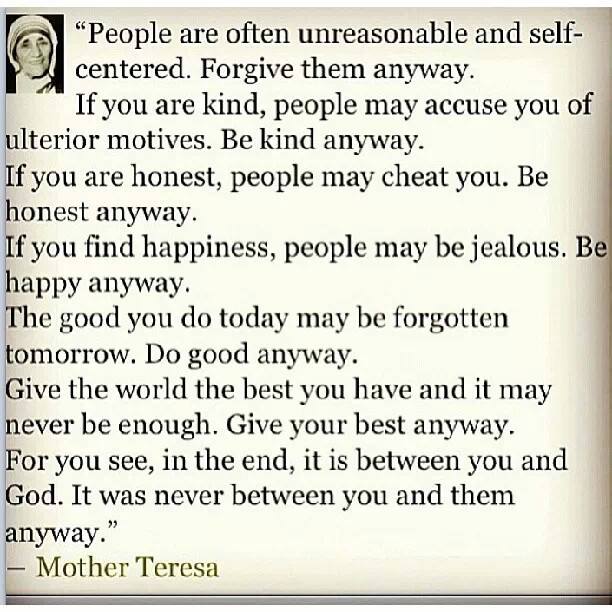
Love ‘Em Anyway

“You’re familiar with the old written law, ‘Love your friend,’ and its unwritten companion, ‘Hate your enemy.’ I’m challenging that. I’m telling you to love your enemies. Let them bring out the best in you, not the worst. When someone gives you a hard time, respond with the supple moves of prayer, for then you are working out of your true selves, your God-created selves. This is what God does. He gives his best—the sun to warm and the rain to nourish—to everyone, regardless: the good and bad, the nice and nasty. If all you do is love the lovable, do you expect a bonus? Anybody can do that. If you simply say hello to those who greet you, do you expect a medal? Any run-of-the-mill sinner does that” (Matthew 5:43-47, The Message).