He Has Overcome

I remember once I was extremely anxious about something and couldn’t sleep. I kept tossing and turning and replaying different doomsday scenarios in my head. Of course, each and every one of those scenarios involved me having to figure everything out with God not being anywhere in sight.

I remember at some point God spoke to me and basically said, “Why are you so afraid and anxious? What are you ever going to face that I haven’t already overcome by my cross?”

That’s just it. There isn’t anything. I have nothing to fear, but I still fear. Part of it is that things like fear and worry are the default settings of fallen people like you and me. Part of it is that I honestly still don’t trust God completely.

But the more I let go of fear and hold on to the promises of God, the more I find peace. The more I see God working in my circumstances, working all things together for good. The less I stress and worry about worst case scenarios.

And those scenarios that I dread? 999,999 out of 1,000,000 times, they never happen. And on that rare 1 out of 1,000,000 occurrence, God is with me in the midst of my worst case scenario and it’s not as bad as I feared because I am surrounded by loving arms that won’t let me go.

So for all of us who still need the reminder, He has overcome. Not He might or He may or He will. He has already overcome. The end.

When to Be Silent

I found some sage advice on the interwebs that I thought I’d pass along:

“1. Be silent – in the heat of anger.

2. Be silent – when you don’t have all the facts.

3. Be silent – when you haven’t verified the story.

4. Be silent – if your words will offend a weaker person.

5. Be silent – when it is time to listen.

6. Be silent – when you are tempted to make light of holy things.

7. Be silent – when you are tempted to joke about sin.

8. Be silent – if you would be ashamed of your word later.

9. Be silent – if your words would convey the wrong impression.

10. Be silent – if the issue is none of your business.

11. Be silent – when you are tempted to tell an outright lie.

12. Be silent – if your words will damage someone else’s reputation.

13. Be silent – if your words will damage a friendship.

14. Be silent – when you are feeling critical.

15. Be silent – if you can’t say it without screaming.

16. Be silent – if your words will be a poor reflection of your friends and family.

17. Be silent – if you may have to eat your words later.

18. Be silent – if you have already said it more than one time.”

I believe the book of Proverbs has plenty to say about the value of choosing to listen over speaking. There are plenty of tidbits of wisdom like being quick to speak and slow to hear. One of my favorites (which may or may not be entirely biblical) says that it’s better to keep quiet and let people think you’re a fool than to open your mouth and prove it. I love the adage that we have two ears and one mouth for a reason — take twice as long to listen as to speak.

I don’t think any of this is advocating for complete silence in situations of injustice or wrongdoing. I do think that the wisdom comes in being wise with your words and timely with your replies — not just speaking to hear your own voice, or “to hear your head rattle” as my grandmother said more than once.

The issue is not speaking up, but speaking rashly and hastily before you have all the facts and understanding or before you can see all the different viewpoints. And sometimes it’s better just to keep your mouth shut when you don’t have nothin’ nice to say.

Made New

“Jesus died for the clumsy, the broken, the ones who never say the right thing, the ones who thought they were past it (but aren’t), the anxiety-ridden, the depressed, the mentality unstable, the dads who can’t get it right and the moms who are overwhelmed; He died for those whose pasts haunt them and for those who are sucked into a cycle of self-deprecating thinking- the impure, the abused, the sexually deviant, the ones who can’t help but exaggerate their life; he died for Peter who denied him not once but three times, he died for the woman at the well who was appreciated for only her body – for the skeptic, the murderer, the thief – those who cuss and drink and smoke, and for those who don’t; he died for conservatives and the liberals and everyone in between, for senators and meth-heads, preachers and construction workers, the fundamentalist and the porn star. He died for those abused by the church and struggle to feel safe, valued, or heard. His grace is more than sufficient for an eternity of sinful lifetimes. Believe. Trust. Come, those who are WEARY and weighed down… Ask him to take it all away, ask him to forgive it all, and you will be NEW” (from an anonymous pastor).

There’s hope for all of us who can’t ever seem to get it right. The hope is that Jesus makes all things new. He didn’t come to validate your lifestyle but to save you from your sin and to give you a new life. He came not to make you good or better but to make you new. Brand new.

The good news of the gospel is that Jesus can still save anyone at anytime from any kind of past or any kind of addiction or any kind of struggle. If He can save the thief on the cross who made a last-second confession, He can certainly save you or me.

As I’ve heard before and said before, the good news of the gospel is not that you can get to God but that God has come to us in the person of Jesus. He came for me. He came for you. And He still saves.

If It Be Your Will

IIf it be your will
That I speak no more
And my voice be still
As it was before

I will speak no more
I shall abide until
I am spoken for
If it be your will

If it be your will
That a voice be true
From this broken hill
I will sing to you

From this broken hill
All your praises they shall ring
If it be your will
To let me sing

From this broken hill
All your praises they shall ring
If it be your will
To let me sing

If it be your will
If there is a choice
Let the rivers fill
Let the hills rejoice

Let your mercy spill
On all these burning hearts in hell
If it be your will
To make us well

And to draw us near
And bind us tight
All your children here
In their rags of light

In our rags of light
All dressed to kill
And end this night
If it be your will
If it be your will” (Leonard Cohen).

Lord, thy will be done.

That’s a dangerous prayer to offer up to God because He just might take you up on it. It’s not something that you pray half-heartedly unless you’re prepared for the consequences.

As the old quote says, when you pray Thy will be done, it’s saying that quite possibly your will be undone. It means that any plans or dreams or goals that you have that run contrary to the will of God must die. You must lay them at the foot of the cross and walk away from them forever.

But the good news is that God’s will is good. In fact, it’s the best. If you saw all that God saw and knew all that God knew, then you would always want what He wants and will what He wills. But from a finite and broken perspective, you see in part what God sees in whole.

So when Jesus taught His disciples to pray, He taught them to pray to the Father in heaven, “Your will be done on earth as it is in heaven.”

It’s not about getting God to endorse your will, but getting to the point where God’s will becomes your will in every aspect of your life. Even if it means laying down your life, as Jesus did in the hours before Calvary, “Not my will, but Yours.”

So, Lord, let your will be done, even if my will is undone. Amen.

Sorta Kinda

I read a quote recently that blew my mind, convicted me big time, and also comforted me — all at the same time. I could have sworn that I saved it some place, but I can’t for the life of me find it anywhere. I am so bummed. I will have to try my best to recreate it from memory.

Basically, it said that we pray for maturity and then get mad at God for the means He uses to grow us up. We ask for patience, but then get irritated at the people and circumstances that try our patience, forgetting that the very testing of our patience produces hope and growth — and sturdier patience.

We get resentful at God for the trials that bring us to our knees in dependence on God. Those trials are the means of making us look more like Jesus, but we focus on the temporary aspects of the suffering instead of the eternal weight of glory that is the end result.

In essence, I want godliness by way of ease and comfort, but that’s not how it works. I can hear that old lady from the Geico commercial now: “That’s not how this works! That’s not how any of this works!”

And she’s right. God knows that we learn best not in our victories but in our defeats. We grow not on those glorious mountaintops but in the dreaded valleys. We suffer, not because God is mean or a killjoy that doesn’t want us to be happy, but because the world is a beautiful but broken place, because we learn precious lessons in the dark that can learned nowhere else, and because we can turn around and comfort those who are walking through the same trials that we’ve been through.

Maybe I’ll find that quote somewhere. It’s was really, really good. You’ll just have to take my word for it.

Ruach

Earlier today, I was mowing the lawn in the sweltering heat. Not only was it hot, but it was kind of a very humid, almost soupy kind of hot. The kind that makes you feel like you’re swimming through the air, only without the refreshing part.

Every now and then, I felt a breeze. It was subtle, but refreshing. It kept me going. Just when I thought I was about to melt into a puddle on the front lawn, a breeze would hit me just right, and I was ready to keep going.

It’s interesting that the Hebrew word for the Holy Spirit, ruach, can also mean breath or wind. In Genesis 2:7, it says that God formed man and breathed (ruach) life into him. Interestingly, in 2 Timothy Paul talks about the Bible as being inspired — literally, “God-breathed.”

I believe the Holy Spirit is a distinct person within the Trinity, not just the breath or activity of God. He is not a force but a person with will and thoughts and emotions.

Jesus spoke of the Holy Spirit as a helper and a guide, one send to remind us of all that Jesus said and taught and to lead us into repentance and truth. This Holy Spirit is the one who convicts us of sin and leads us to confession and forgiveness.

But I like to think that the Spirit is sometimes a refreshing presence, like that summer breeze. He’s a reminder of God with us wherever we go. He’s the sustainer for when we’re at the end of ourselves and can’t go on. He’s the extra gust of wind that helps the boat reach its destination.

Sometimes, all we need is just that gentle reminder that God is here and that all will be well because He is making all things well and right and good.

A Line in the Sand

“…the only way to thwart a coming dark spiritual season is to heed Christ’s warning and apply His prescribed solutions. Here in the United States the winds are blowing with such hostility and contempt toward Christians that things are said against believers that would never be said against a Muslim, or Minority. 

Even notice the rooster on the weather vain? It is there because Pope Nicholas I decreed in the 9th century that all churches must show the symbol of a Rooster on its dome or steeple, as a symbol of Jesus’ prophecy of Peter’s betrayal (Luke 22:34). It was a reminder that the fixed laws of North, South, East and West will not change or move even when the winds of persecution can cause us to bend with the times.

When the church has no affixed, absolute, biblical truth on which it stands – when it has no ‘line in the sand’ truths, it has ceased to be the force withstanding the gates of Hell on earth. The danger is this – with this mindset the church is reduced to a good will, humanitarian organization with only a weak Christian philosophy. 

Rick Renner says: ‘It is no secret that the spiritual environment in the world is undergoing a radical change and a great gulf is beginning to divide those who are moving away from established truth and those who see what is happening and are responding by making personal re-commitments to absolute truth. The winds of change are blowing and it is producing a sifting, a dividing — a separation of wheat from chaff. The rift has become so severe that who is wheat and who is chaff may be looked upon differently depending on which group to whom you belong.’

Our job is to recognize these truths, then re-calibrate and upgrade our own lives so to honor Godly principles. A changed Church must start with us” (Lance Wallnau).

When the Church ceases to hold to biblical values and doctrines, then it ceases to be the Church. It in essence is denying its power and existing in form only. The true Church holds that Pauline theology lines up with the words of Jesus. The true Church holds up the gospel of Jesus as the the way, the truth, the life, and the only means of salvation.

Lord, may you bring true revival within Your Church.

Developing from Negatives

I like it, but I don’t like it.

I wish I could say that I learned from all the blessings God gave me, that I grew from all the euphoric mountaintop spiritual experiences I’ve ever had, that naps were God’s way of maturing me. Unfortunately, that’s not how most of us grow up in grace and faith.

Mostly, God teaches us through trials. C. S. Lewis said that pain is God’s megaphone to rouse a deaf world (and sometimes to get the attention of a hard of hearing me). As much as I dislike suffering, it seems to be the only way I learn to rely and depend on God and not myself.

The upside is that there’s not a negative experience or season that stays negative. Eventually, you start to see the lessons and benefits. You can see where God worked even those bad times for good, strengthened your faith, and gave you a ministry for those who are currently in their dark valleys.

In photography, the darker the negatives, the better the photo. If the negative is mostly grey, then there won’t be a lot of contrast. The picture will be meh. But those darker tones turn to light when you process the negative and develop the photograph. It’s such an apt descriptor of the life of faith.

The dark turns to light when God’s finished with the process of developing us.

Living Forward

It’s easy to get caught up in the what-if scenario or to play the woulda, coulda, shoulda game. If you’re like me, you could spend al day beating yourself up for dumb things you’ve said or done in the past that you wish you could go back and erase . . . or do over.

You probably could very easily spend all your time in the past where you messed up, but that wouldn’t be living. The reality is that you can’t ever go back, so dwelling on what you can’t change is futile and pointless.

But God can step into the moment you messed up and redeem it. God can go back to the place you were wounded as well as healing you from it in the present. Remember that God didn’t choose the wise and the strong and the put-together, but He chose the broken and the weak and the can’t-ever-get-it-together people to shame those who think they’re self-sufficient and have their lives totally together. He chose you and me.

The fact that God chose you means that your past now serves a purpose rather than just shame. Your mistakes and your sins are the very things God was able to work for good. Those moments and those actions that you swore you’d never tell anyone about can now be the first line of your testimony of how God took you at your worst and is transforming you into something that looks a whole lot like Jesus.

That’s the good news of the gospel. The big windshield of your future is where you’re headed for sanctification and holiness and heaven. The small rear view mirror is what shaped you into who you are and what God has delivered you from and what you can use to help others who are where you once were.

Count Your Blessings

What’s the old song? Count your blessings, name them one by one? How many of us actually do that? Count and name our blessings not generically as in “thank you, Lord, for all my blessings” but as in “thank you, Lord, for waking me up this morning, for giving me a sunny day, etc”?

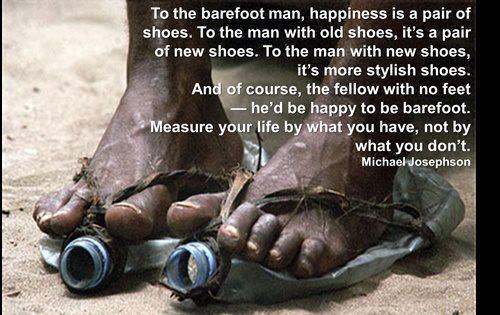
It’s a bit of a hard truth, but there are people in the world who would love to have one of your bad days. For most of us, our bad days still have us with a roof over our heads and clothes on our backs and three meals in our bellies. Most of us don’t have to worry about our kids dying from hunger or preventable diseases.

For those of us who may not always love our jobs, there’s someone who’s been out of work long enough who would do anything for any job. For those who may not always love our families, there are orphans who would love to have people to call family.

I still go back to something I heard once long ago that still resonates with me. If all God did was to die for me and save me from my sins and never did one thing more for me for the rest of my earthly life, that would be enough for an eternity’s worth of praise and thanksgiving. But the truth is that God continues to bless us daily, even if we don’t see it.

Instead of always wanting more and never having enough, the antidote to the rat race and the disease of endless consumerism is gratitude and contentment — thanking God for what you already have and being content with where you are.