I loved this the first time I saw it, and I still love it. I wish I knew who originated it. I’d love to give proper credit. But I can at least keep sharing it for those who need to hear it or read it.
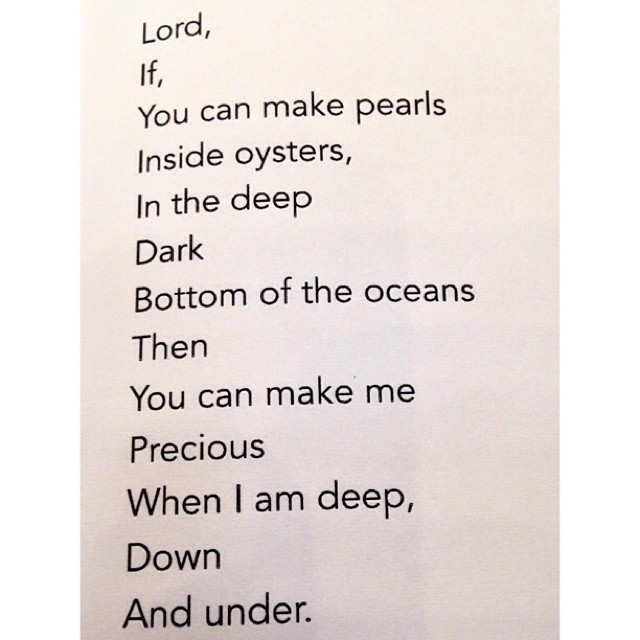
I loved this the first time I saw it, and I still love it. I wish I knew who originated it. I’d love to give proper credit. But I can at least keep sharing it for those who need to hear it or read it.
“He demands our worship, our obedience, our prostration. Do we suppose that they can do Him any good, or fear, like the chorus in Milton, that human irreverence can bring about ‘His glory’s diminution’? A man can no more diminish God’s glory by refusing to worship Him than a lunatic can put out the sun by scribbling the word ‘darkness’ on the walls of his cell. But God wills our good, and our good is to love Him (with that responsive love proper to creatures) and to love Him we must know Him: and if we know Him, we shall in fact fall on our faces. If we do not, that only shows that what we are trying to love is not yet God—though it may be the nearest approximation to God which our thought and fantasy can attain” (C. S. Lewis, The Problem of Pain).
God doesn’t need our worship and adoration. In fact, God doesn’t need us. God has no need at all because God is in Himself completely self-sufficient and whole.
It’s we who need to worship God to remind us that we in fact are not God. God is outside of us and is completely other, not just a better, faster, stronger version of us. As I read earlier, God and His ways are beyond our complete understanding or otherwise we wouldn’t need trust. We wouldn’t need faith.
We worship God because there’s no way we could have ever known God on our own. We would never have even sought God on our own if God hadn’t first sought us. We worship God because He has made Himself known to us in a way that we could understand and in a way that didn’t destroy us.
Remember that if we in our present state saw God in all His glory as He is, we would die. It would be too much for our senses and all our capacity. The finite could never hope to grasp the infinite.
But God made Himself Jesus so we could understand God.
And so we worship.
“Jesus learned obedience by the things which He suffered, not by the things which He enjoyed. In order to fit you for His purposes both here and in eternity, He has lent you this sorrow. But He bears the heavier end of the Cross laid upon you! [See Hebrews 5:8]” (Elisabeth Elliott).
I find something about older books that I don’t find in the newer ones. It seems to me that there was much more of a prophetic bold voice in the writers of faith from back in the day that’s not nearly as present in this age. Maybe it’s because talk about suffering doesn’t sell books or build brands anymore.
I personally would much rather learn obedience by doing what I enjoy. If there was a way to godliness through napping, I’d take it. But unfortunately, that’s not the way of Jesus.
Throughout the prophecies and gospels, we find a Man of Suffering acquainted with grief. We see that His whole life was leading to death on a cross at Golgotha. We learn about a ministry where people by and large rejected this Messiah because He talked about things like eating His flesh and drinking His blood and taking up your cross to be His disciple.
I don’t think Jesus would ever want us to deliberately seek out way to suffer and be unhappy. But I do think that more and more as we seek to follow Jesus, we will have trouble. We will suffer. We will be ridiculed and misunderstood and rejected and hated. Some of us will suffer physically. Some of us may well lose our lives.
But we will not undergo anything that Jesus hasn’t already endured first. We will never be asked to carry any cross that Jesus hasn’t carried first, to walk any road He hasn’t already gone before and made a way. We have the promise that He will be with us to the end of this age where everything’s upside down and people celebrate evil and condemn good.
May we endure to the end not because we are perfectly faithful to Jesus but because He is perfectly faithful to us. Amen.
“There are far, far better things ahead than any we leave behind” (C. S. Lewis).
On this date 60 years ago, we lost John F. Kennedy, C.S. Lewis, and Aldous Huxley (author of Brave New World). While most of the world only remembers the first Jack (as in Kennedy), many like me point to the second Jack (as Lewis preferred to be called) as greatly influential in their growing in both faith and imagination. Narnia lives on.
I don’t recall seeing anything about JFK on social media or the news (what little I watched of it). It’s mind-blowing to think that it’s been six decades since he was assassinated, regardless of what your thoughts are on who actually pulled the trigger. And yes, I saw the Oliver Stone movie in a theater long, long ago.
I get JFK is an icon. I get that November 22, 1963 remains a watershed moment in American history, a day of tragedy that led to better days where civil rights laws were passed.
For me, C. S. Lewis was much more influential. It started with the Narnia books and progressed from there. No one could take a complicated theological or apologetical concept and explain it in layman’s terms quite like he did. After all, intelligence isn’t spouting a lot of big words but taking something complex and making it sound simple.
His death was overshadowed by the news of the assassination of President Kennedy, as was the death of philosopher Aldous Huxley, who also died on the same day. On this day, we remember them all.

Everybody needs a cheery little animal who can fit in their hand. I can’t speak to hedgehogs as pets, but they seem cute and cheery enough if that’s your thing.
Honestly, everyone needs at least one person in their life who will always be an encourager. Everyone needs that someone who believes in them even when they don’t (or can’t).
I know in my own life the difference one small word from one person can make. Sometimes, it has the power to turn a good day into a bad one. But I can testify that one lone encouraging word has the power to transform a bad day into a good one.
I also believe that everyone needs someone who will always tell them the truth. As my old pastor used to say, the first person you lie to is yourself. If you only surround yourself with people who agree with you and tell you what you want to hear, you will go on repeating the same patterns and making the same bad choices. Like those tiny mirrors that fit on your side-view mirrors, you need someone to point out your blind spots.
Powerful people in positions of leadership are most vulnerable to temptation and failing when they don’t have accountability in the form of someone who is willing to ask the tough questions and tell them the honest truth.
Obviously, the idea is always to speak the truth in love for the betterment of the person, not as a weapon to tear that person down. The best way to speak truth is in the context of a trusting relationship where the other has invited you to speak into their life and given you permission to ask those tough questions and say the uncomfortable truths.
But I think even when speaking a word of rebuke, it’s best to sandwich it between words of encouragement and praise. Even then, we still need people who still believe in us when we veer off course.
Basically, be like that little hedgehog.
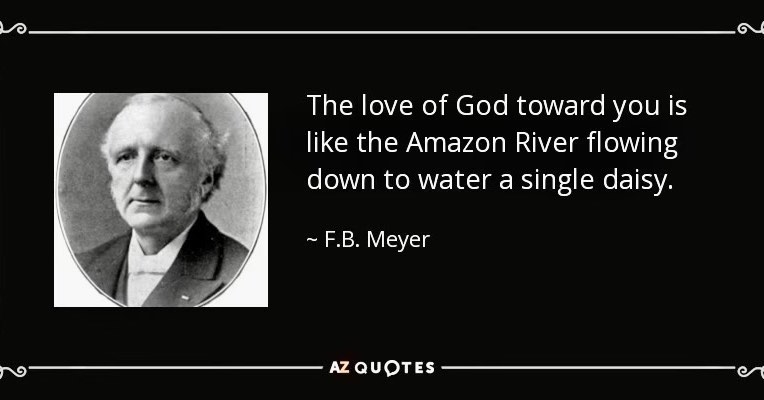
At first it seems as impossible and absurd as if a whole river served to water one single solitary flower. It seems preposterous that God should love us that much — that God should love you or me that much. But it’s true.
An infinite God’s unconditional love means that God can love each individual as if that person were the only one to receive the fullness of God’s love. It defies any kind of math logic where each person gets a fraction. God’s math means that each person receives 100% out of infinite resources.
That’s a good reason to be thankful. That’s a good reason for a Thanksgiving holiday, whether you ascribe to the original Pilgrim story or not. Actually, that should make you and I want to treat every day like a Thanksgiving — minus the part where we gorge ourselves into food comas.
The Bible commands us to live in gratitude and thanksgiving in view of what God has done for us. That’s like commanding someone who is parched with thirst to drink water or telling someone who is nearly frostbitten with cold to seek warmth. We only have to live with our eyes open to God to find a reason to be grateful and thankful.
Apart from God opening our eyes, we could never see. Apart from God seeking us first, we should never have sought God at all. That very source of thanksgiving to God comes from God and is a natural overflow of all that God lavishes on us each and every single day.
May our thanksgiving lead to thanks-living.
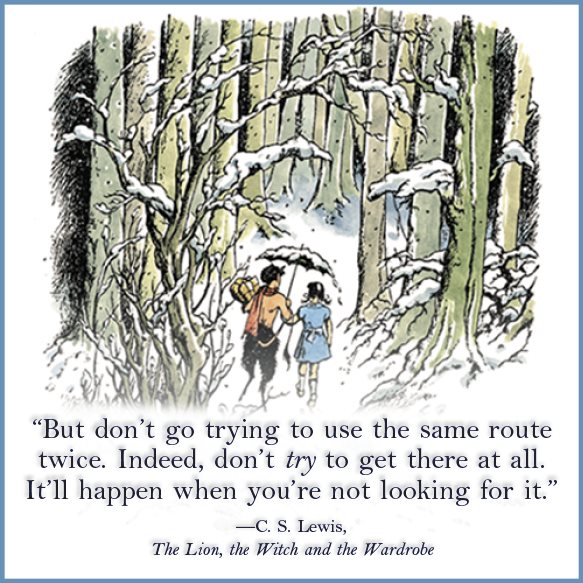
I don’t know what it is about a good fantasy book that gives me all the feels. I don’t mean a Game of Thrones-type book. I’m more into The Chronicles of Narnia and The Lord of the Rings. Currently, I’m reading The Wind and the Willows. And by reading, I mean with an actual book with actual pages that you turn with actual hands with actual fingers.
What is is about elves and hobbits and dwarves that appeals to me? Why am I drawn to talking rats and moles? Is it wrong that I want to live at Bag End with Bilbo and Frodo Baggins? I’d even put in my fair share of washing dishes and setting the table.
I think maybe these days we all need an escape from reality. We need somewhere to go where the headlines aren’t all death and doom. Whenever it’s a cold and rainy day, there’s nothing better than to read about someone traipsing through a meadow on a bright sunny afternoon. Or to imagine the possibility of stumbling on to a door that leads straight out of this world into Middle Earth or Narnia.
For me, there’s always the joy of revisiting a classic along with familiar characters and locations. It’s comforting when you remember what’s coming next and can’t wait to get to that part.
I’m always looking for recommendations, so if you can think of any send them my way by emailing them to gmendel72@icloud.com. May you always find a comfy chair and a good book to keep you company on those cold wintry nights.
Honestly, I’ve never given much thought to the question of why Jesus folded the shroud that covered His face when He rose from the grave. I was focused on other details, as I imagine the disciples were, but in the Bible even the smallest details have meaning.
This is about the best explanation that I have ever seen as to why it was folded and not simply left crumpled:
This is one I can honestly say I have never seen circulating so; if this touches you, you may want to forward it.
“Why did Jesus fold the linen burial cloth after His resurrection? I never noticed this….
The Gospel of John (20:7) tells us that the napkin, which was placed over the face of Jesus, was not just thrown aside like the grave clothes. The Bible takes an entire verse to tell us that the napkin was neatly folded, and was placed separate from the grave clothes. Early Sunday morning, while it was still dark, Mary Magdalene came to the tomb and found that the stone had been rolled away from the entrance. She ran and found Simon Peter and the other disciple, the one whom Jesus loved. She said, ‘They have taken the Lord’s body out of the tomb, and I don’t know where they have put him!’ Peter and the other disciple ran to the tomb to see.. The other disciple outran Peter and got there first. He stooped and looked in and saw the linen cloth lying there, but he didn’t go in.
Then Simon Peter arrived and went inside. He also noticed the linen wrappings lying there, while the cloth that had covered Jesus’ head was folded up and lying to the side.
Was that important? Absolutely!
Is it really significant? Yes!
In order to understand the significance of the folded napkin, you have to understand a little bit about Hebrew tradition of that day. The folded napkin had to do with the Master and Servant, and every Jewish boy knew this tradition.
When the servant set the dinner table for the master, he made sure that it was exactly the way the master wanted it…
The table was furnished perfectly, and then the servant would wait, just out of sight, until the master had finished eating, and the servant would not dare touch that table, until the master was finished. Now, if the master were done eating, he would rise from the table, wipe his fingers, his mouth, and clean his beard, and would wad up that napkin and toss it onto the table.
The servant would then know to clear the table. For in those days, the wadded napkin meant, ‘I’m done.’
But if the master got up from the table, and folded his napkin, and laid it beside his plate, the servant would not dare touch the table, because……….. The folded napkin meant, ‘I’m coming back!’
He is Coming Back!”
“If Jesus had a Facebook page… I think he probably wouldn’t weigh in much on the ‘issue of the day’. This is based on what I read in the Gospels. Just a guess.
Oh, it’s not that he didn’t care about the Big Issues. It’s that he’s the Great Physician, and injustices like the Roman occupation or even racism are just symptoms. The sickness goes deeper.
We want him to force medicine down the throats of our opponents.
He’s telling us to lie down… so he can give us a heart transplant.
But it takes humility to lie on the table. Even then, I suppose most of us would likely drift to pre-surgery sleep while yet mumbling.(‘Yeah, but it’s somebody else’s fault, you know… and what about those people… did you see… what they… did….’)
Mercifully, the Healer lovingly watches us close our eyes, and he goes to work” (Brant Hansen).
It’s interesting how God created us in His image, and ever since then we’ve been trying to return the favor. We try our best to cast Jesus in our image, whether it’s a very moralistic conservative who hates all the sins that we don’t struggle with or the laissez-faire anything goes liberal Jesus who just wants us to love everybody and who makes no demands on our lives.
But Jesus wants our hearts.
He doesn’t want to make us good. He doesn’t even want to make us better. He wants to make us brand new. It’s not that we need softer hearts — we need new hearts. We need a heart transplant.
I love the idea that yes, Jesus loved tax collectors and prostitutes and sinners. He met them where they were and loved them as they were. But He didn’t leave them that way. After they met Jesus, they weren’t tax collectors and prostitutes and sinners anymore. They were disciples who made disciples. They were followers of Jesus from then on.
The goal of the gospel isn’t to get gay people into straight marriages. It’s not to get addicts clean. It’s not to get them to vote a certain way. The goal of the gospel is to make brand new creations whose lives and conversations are a reflection of the power and grace of God to make the dead come alive. The goal of the gospel is to create a people who will stop at nothing for the rest of their lives to know Jesus and to make Him known, growing into His likeness more each day until they are just like Jesus.
“[Shasta] turned and raced for the gate in the green wall which, now for the first time, he remembered seeing. Hwin, stumbling and nearly fainting, was just entering the gate: Aravis still kept her seat but her back was covered with blood. ‘Come in, my daughter, come in,’ the robed and bearded man was saying, and then, ‘Come in, my son,’ as Shasta panted up to him. . . . They were in a wide and perfectly circular enclosure, protected by a high wall of green turf. A pool of perfectly still water, so full that the water was almost exactly level with the ground, lay before him. At one end of the pool, completely overshadowing it with its branches, there grew the hugest and most beautiful tree that Shasta had ever seen. Beyond the pool was a little low house of stone roofed with deep and ancient thatch. . . . ‘Are—are—are you,’ panted Shasta, ‘are you King Lune of Archenland?’ The old man shook his head. ‘No,’ he replied in a quiet voice, ‘I am the Hermit of the Southern March. And now, my son, waste no time on questions, but obey. This damsel is wounded. Your horses are spent. Rabadash is at this moment finding a ford over the Winding Arrow. If you run now, without a moment’s rest, you will still be in time to warn King Lune.’
Shasta’s heart fainted at these words for he felt he had no strength left. And he writhed inside at what seemed the cruelty and unfairness of the demand. He had not yet learned that if you do one good deed your reward usually is to be set to do another and harder and better one. But all he said out loud was:
‘Where is the King?'” (C. S. Lewis, The Horse and His Boy).
You might have heard that the reward for a job well done is more work. If you’re like me, you’re probably thinking something like “Well, if that’s the reward, where can I return it? I’d rather have rest for a reward.”
But when it comes to God’s service, obedience is not a have-to as much as it is a get-to. It’s not so much that I am forced to live by God’s rules and commands, but I get to find the joy that comes from living by God’s design. I get to see God working through my willingness and faithfulness.
Usually, when we’re not hearing from God, it means that there’s something God has already told us to do that we haven’t done yet. Only when we finally obey and live out what we already know will God reveal more. Only when we have stepped out in faith will God show us the next step.
I’d love to say that I always seek God’s will from a cheerful and pure heart, but I can confess that too often there is mixed in a spirit of complaining. There’s a part of me that wants to seek comfort over obedience, to let someone else to the work. But then that someone experiences the blessing of obedience and I miss out.
May we seek the joy that comes from obedience. Jesus said that the way we show love to God is to do what He says. It’s not about emotional and cathartic worship or about the amount of knowledge we possess but simply how willing are we to obey what we know God has told us.
May we always trust and obey, for there really is no other way.
 Ragamuffingospelfan's Blog