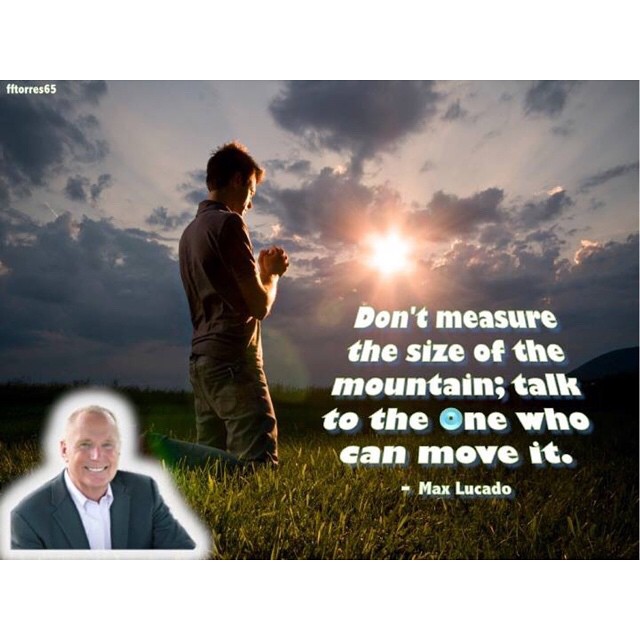
Measuring the Size of the Mountain

I like that. Some problems might seem as big and immovable as mountains, but God still moves mountains. I heard someone say once that prayer isn’t so much about reminding God how big your problems are but reminding your problems how big your God is. Ain’t that the truth?

It’s easy to get caught up in the logistics of what looks like an impossible situation. You and I can easily be like Peter and get distracted by the waves and take our eyes off of Jesus. Then we’re sunk.

But thankfully, Jesus can still save. Jesus can take us out of our problems and obstacles, but more often than not, He takes us through them rather than around or over them. Our faith grows as we see God overcome what we thought was hopeless.

Jesus said that if we had faith, we could say to the mountain to move, and it would move. He didn’t say what the size of the faith had to be. I think it’s because it’s not the amount of the faith you have that makes miracles and moves mountains but the source of your faith. God is the one doing the moving.

I still believe that’s true for followers today as it was for followers back then. We may not see the same kind of struggles and trials that those disciples did back in the first century, but we have enough of our own. And we find if we remain faithful long enough that God can still work on behalf of those whose hearts are steadfast toward Him.

This is not me telling you to squeeze your eyes and summon up more faith. Even a tiny mustard seed amount of faith will do if it’s in the right place. I still remember what a friend from college used to say: it’s not big faith in God but faith in a big God. Remember that as you can stand still and watch those mountains move.

Hallelujah!

“Hallelujah! You who serve God, praise God!
Just to speak his name is praise!
Just to remember God is a blessing—
now and tomorrow and always.
From east to west, from dawn to dusk,
keep lifting all your praises to God!
God is higher than anything and anyone,
outshining everything you can see in the skies.
Who can compare with God, our God,
so majestically enthroned,
Surveying his magnificent
heavens and earth?
He picks up the poor from out of the dirt,
rescues the wretched who’ve been thrown out with the trash,
Seats them among the honored guests,
a place of honor among the brightest and best.
He gives childless couples a family,
gives them joy as the parents of children.
Hallelujah!” (Psalm 113, The Message)

Sometimes, you need to read a familiar passage in a different translation to really get the gist of it. This one is a good example. I don’t always love The Message translation (or more accurately, paraphrase), but sometimes it really captures the nuances of the text better than a more traditional and literal translation could.

Sometimes, you just need to shout, “Hallelujah!”

The Door of Destitution

“We have to realize that we cannot earn or win anything from God; we must either receive it as a gift or do without it. The greatest blessing spiritually is the knowledge that we are destitute; until we get there Our Lord is powerless. He can do nothing for us if we think we are sufficient of ourselves; we have to enter into His Kingdom through the door of destitution. As long as we are rich, possessed of anything in the way of pride or independence, God cannot do anything for us. It is only when we get hungry spiritually that we receive the Holy Spirit” (Oswald Chambers, from My Utmost for His Highest).

That one hits me in my pride. I like to think that I can contribute to what God is doing. I like to thing I bring something to the table. I don’t like to think that even my very best righteousness is like filthy rags to God. I definitely don’t like to think that anything that’s good in me is God working through me.

That’s the whole point of the Beatitudes. We bring nothing but poverty of spirit, meekness, mourning, and a hungering and thirsting for righteousness, and God blesses us in spite of it all. God still works through nobodies just like He did way back when with 12 nobodies that He picked to be His disciples instead of choosing the best and wisest like every other rabbi would have.

The idea of us being children is more true than we want to admit. Children are dependent on their parents for absolutely everything, as are we to God. Our usefulness doesn’t come from any merit or talent we possess but simply us being surrendered and available to God at any and every moment. That’s when God does His best work.

But that’s also the best part. If God can use nobodies, then God can use you and me. We don’t have to have a degree from a seminary. We don’t have to have a job title like pastor or minister. We don’t even have to be able to be the best writers or speakers. We just have to show us and say, “Yes, God. Here I am. Send me.”

No Matter What

“Our prayers for guidance (or for anything else) really begin here: I trust him. This requires abandonment. We are no longer saying, ‘If I trust him, he’ll give me such and such,’ but ‘I trust him. Let him give me or withhold from me what he chooses” (Elisabeth Elliot, God’s Guidance: A Slow & Certain Light).

It’s easy to fall into the trap of trying to bargain with God. Something along the lines of “I’ll trust you if you will give me a) a job, b) a spouse, or c) lots of money.”

It feels more like a transaction than faith. If God does X, then I’ll do Y. The trouble is that I’m in no position to bargain with God. He’s the Eternal Lord and King of the Universe who has every right to destroy me because of my sin, and I’m the one who’s only alive at this moment because of His grace.

The truth is that if all God ever did was to save me from an eternity in hell and leave me alone, that would be way more than I deserve. That alone would merit my praise from now until 10,000 X 10,000 years have passed.

But that’s not all God did. He has sustained me and blessed me and been with me through every kind of joy and sorrow, triumph and trial. All He asks in return is my allegiance. My loyalty. My surrender. Me.

It’s not wrong to ask God for things, but the more I spend time with God and in His word and the more I grow in Christlikeness, the things I ask for change and my desire to have them changes.

God doesn’t owe me anything. Even the next breath is a gift. I owe God everything, more than I could possibly ever pay in a million lifetimes. Yet all God asks for is me. I think that’s a good enough reason to trust Him no matter what.

My Favorite Flavor Is Purple

I read somewhere recently that grape soda doesn’t taste at all like grapes, but it does taste like purple, and I can’t put into words why that is.

I immediately knew what that person was talking about. I know exactly what purple tastes like. I can’t explain it but I know. And I also know that there are probably meds for that kind of thing.

I remember as a kid I would see commercials for an orange-ish drink called Sunny D. I think that’s where you make orange juice without the oranges. At least that’s what it tasted like to me.

Anyway, the commercial was this kid looking through the fridge for something to drink. He passes up what he calls the purple stuff and goes for the Sunny D. That would not have been my choice at all. I’d have picked the purple stuff.

I suppose if I could come close to explaining it, it’s like when you taste something as a kid that blows your mind and you spend the rest of your life trying to find that same flavor again. Or maybe when you hear great music or read a great book and later on you go on a quest to find that album or that book again.

This life is a lot like that. I think we have desires that nothing in this world can completely satisfy. C. S. Lewis would say that’s because we were made for another world. Also, the deepest desires of our hearts can only be finally met in God Himself and nowhere else.

I still think that grape soda tastes like purple, and I will die on that hill.

The Quiet Assurance of Joy

Every day, there’s a new batch of chaos somewhere in the world. If you’re looking to be cheered up, you probably want to skip Fox News or CNN right about now. It’s easy to get overwhelmed and live in a constant state of fear and anxiety.

But the followers of Jesus are different. Or they should be. We’ve read the last verse of the last chapter of the last book of the Bible, and we know how the story ends. We know it’s going to be alright (to reference the late Rev. Billy Graham).

The media and advertising and basically every message screaming at you from every screen is trying to keep you in a state of near panic in order to get you to buy a certain product or vote for a certain person. But Jesus promised peace to His people. He said it was a peace unlike the world gives, which is a warm and fuzzy feeling, but His is more of a calm certainty that while the middle of the story looks grim, there is a happy ending coming.

Sure, there will be wars and rumors of war. Nations will still rise up against other nations. There will be riots and violence and scandals. Many people who profess to follow Jesus will fall away. But for those who truly belong to Jesus, we are held fast by the everlasting arms that won’t let us go.

Maybe tonight turn off the television and put away the device and open up your Bible. Turn it to Revelation 22 and read the last chapter, but especially the last two verses. It’s an invitation. Yes, bad times are coming, but they won’t last. Suffering will end. Even death will pass away. But these words of God will remain, and the one who spoke them will wipe away every tear from our eyes and welcome us home into everlasting peace.

Under Pressure

Diamonds are valuable because of what they go through to become diamonds. We have inherent value because of our Maker, and oftentimes the pressure reveals not what is in us but what is in God. That’s when we find out what we are made of, but also what God is made of.

If I had my way, I’d settle for a pressure-free existence. I’d rather not have any hardships or go through any trials. But God knows better than I what is best for me and what will make me more like Jesus. So I can trust God’s plans that I may or may not fully understand at the moment. I can trust the heart of God when I can’t see His hand at work.

Jesus said that it’s not a matter of if but when that we will have suffering and trials. But He also said that He’d be with us through the worst of it. He said that the end result will make whatever we go through to get there so much more than worth it.

“Now I’m just an old chunk of coal
But I’m gonna be a diamond some day
I’m gonna grow and glow ’til I’m so blue pure perfect
I’m gonna put a smile on everybody’s face

I’m gonna kneel and pray every day
At least I should become vain along the way
Hey, I’m just an old chunk of coal now Lord
But I’m gonna be a diamond some day” (Billy Shaver).

Silent Sufferers

This will resonate with some of you reading these words. You don’t ever want to be a burden to anyone, so you suffer silently and alone. Sometimes, you even think that telling God would make you a burden.

The lie from the pit of hell is that you are alone in your suffering. The lie is that you are a burden and no one needs or wants to know about your ailments or afflictions or griefs. The devil wants you keep you isolated and by yourself.

The truth of the matter is that in the body of Christ, no one is a burden. We are actually commanded to bear each other’s burdens, so by keeping yours to yourself, you might be depriving someone else of the joy of sharing your load.

The reality is that every one of us is flawed and broken. We all have scars. We all carry griefs and sorrows. We weren’t meant to carry those alone but in context of community.

Above all, Jesus invites us to cast our cares on Him because He cares for us. That’s where the real healing comes from. That’s where the real peace comes from. You are not a burden to Jesus. He wants you to bring anything and everything to Him.

Tried and Trusted Old Words

As I get older, the more I appreciate the old hymns. I get that some may have trouble getting past some of the archaic language with all the thees and thous floating about. But there’s some sound theology in those stanzas that has brought comfort to so many down through the decades.

One that I discovered not that long ago is a hymn that I probably have never sung in any church, but the words are powerful. This speaks to all those who are in a dark night of the soul or going through a difficult season:

Whate’er my God ordains is right:
His holy will abideth;
I will be still whate’er He doth;
And follow where He guideth;
He is my God; though dark my road,
He holds me that I shall not fall:
Wherefore to Him I leave it all.

Whate’er my God ordains is right:
He never will deceive me;
He leads me by the proper path:
I know He will not leave me.
I take, content, what He hath sent;
His hand can turn my griefs away,
And patiently I wait His day.

Whate’er my God ordains is right:
His loving thought attends me;
No poison can be in the cup
That my Physician sends me.
My God is true; each morn anew
I’ll trust His grace unending,
My life to Him commending.

Whate’er my God ordains is right:
He is my Friend and Father;
He suffers naught to do me harm,
Though many storms may gather,
Now I may know both joy and woe,
Some day I shall see clearly
That He hath loved me dearly.

Whate’er my God ordains is right:
Though now this cup, in drinking,
May bitter seem to my faint heart,
I take it, all unshrinking.
My God is true; each morn anew
Sweet comfort yet shall fill my heart,
And pain and sorrow shall depart.

Whate’er my God ordains is right:
Here shall my stand be taken;
Though sorrow, need, or death be mine,
Yet I am not forsaken.
My Father’s care is round me there;
He holds me that I shall not fall:
And so to Him I leave it all” (Author: Samuel Rodigast (1675)Translator: Catherine Winkworth (1863).

A Living Sacrifice

“Tell God you are ready to be offered, and God will prove Himself to be all you ever dreamed He would be” (Oswald Chambers).

Romans 12:1-2 talks about us offering ourselves as a living sacrifice to God as our act of worship. As the old joke goes, the only problem with living sacrifices is that they keep crawling off of the altar.

I think dying to self is a daily thing. Jesus died once and for all, but we don’t. We must put our flesh to death every single day or we will give in to it. We also must take up our cross daily and die to our own expectations of how our lives should go and how we want to live instead of how God calls us to live.

The good news is that God doesn’t see the imperfect sacrifice that just crawled off of the altar yet again. He sees the perfect sacrifice of Jesus, accomplished once for all time. He doesn’t see all the times I failed but the sinless life of His Son Jesus.

The irony of the gospel is that it’s those who seek to lose their life who get to keep it. Those who try to hold on to their life end up losing it. Those who try to become their authentic self become a shallow parody of someone else. Those who live in surrender and try to become more like Jesus really do find their truest selves in the process.

It’s about dying to live. It’s about surrendering to become truly free.