No Deadlines

“God never hurries. There are no deadlines against which he must work. Only to know this is to quiet our spirits and relax our nerves” (A.W. Tozer).

I think the only deadlines we impose on God are the kind where our anxiety shouts at us that what we want or need must happen immediately or not at all. We view God in human terms and expect Him to act according to our timetable.

God is not on a schedule. He has no deadlines. He is never early nor is He late. His timing is always pinpoint perfect. That’s because we see in such a narrow window, while God looks through the broad scope of eternity.

When I remember that God is not obliged to meet my deadlines or my life will fall apart, then I can relax. When I recall that God is working not hurriedly but wholeheartedly, then I can rest. I can call to mind that God still has the whole world in His hands, including me and all my sometimes real, sometimes imagined worries.

When I worry, I doubt God’s goodness. When I choose the antidote to anxiety and choose to praise, then I remember.
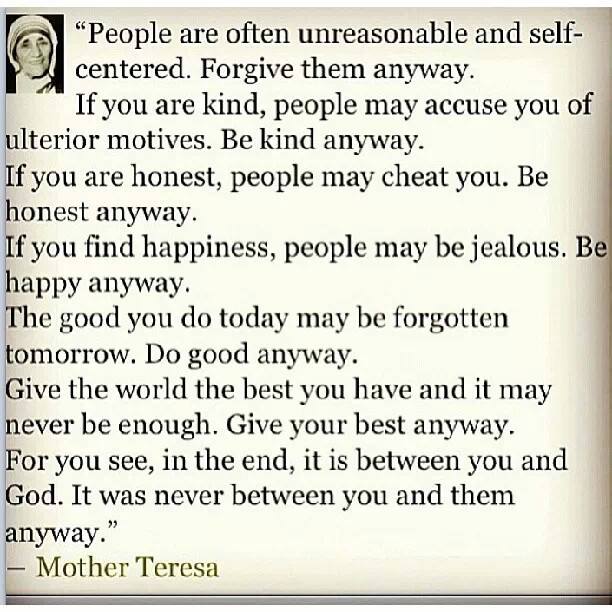
Love ‘Em Anyway

“You’re familiar with the old written law, ‘Love your friend,’ and its unwritten companion, ‘Hate your enemy.’ I’m challenging that. I’m telling you to love your enemies. Let them bring out the best in you, not the worst. When someone gives you a hard time, respond with the supple moves of prayer, for then you are working out of your true selves, your God-created selves. This is what God does. He gives his best—the sun to warm and the rain to nourish—to everyone, regardless: the good and bad, the nice and nasty. If all you do is love the lovable, do you expect a bonus? Anybody can do that. If you simply say hello to those who greet you, do you expect a medal? Any run-of-the-mill sinner does that” (Matthew 5:43-47, The Message).

Heading South

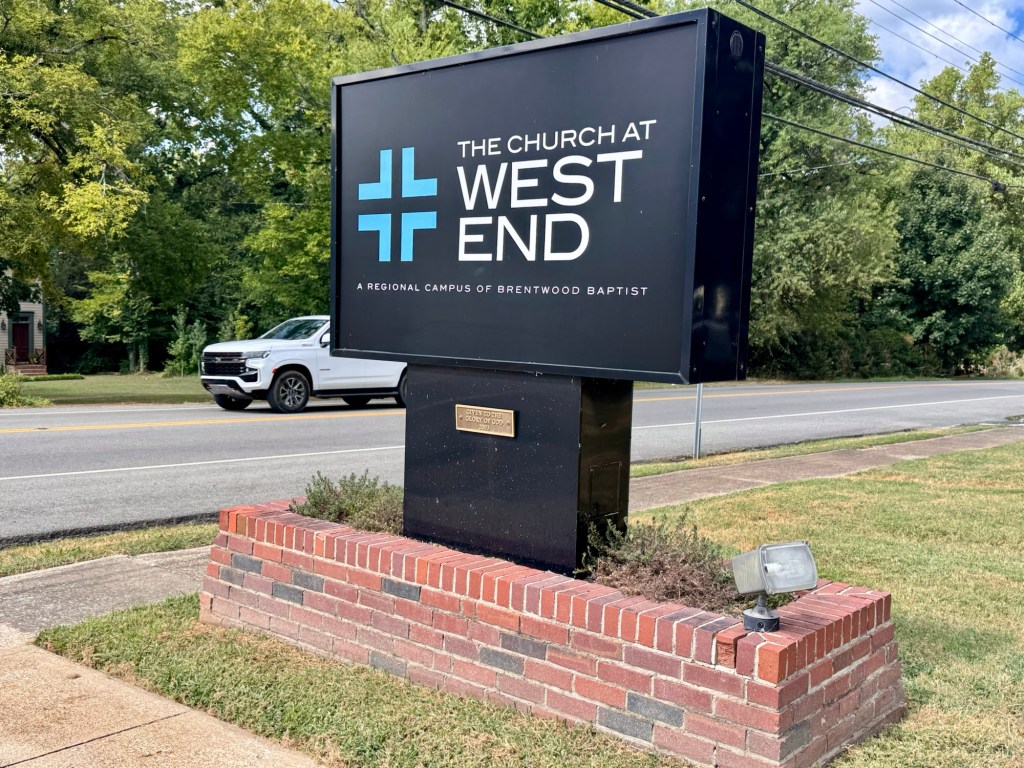
I finally got around to it. After months of thinking about it and finally deciding to make it happen, I visited the latest regional campus of Brentwood Baptist Church, The Church at West End in Columbia.

It was a bit of a drive from Brentwood to Columbia. Even on a Sunday, it took 45 minutes. But it was so worth it. I loved seeing this congregation worshipping and celebrating the Lord’s Day together.

I love how each of the campuses has a unique flavor and how each fits the community very well. Each one is a different expression of what a biblical Church should look like.

Several years ago, my goal was to visit each of the current campuses of Brentwood Baptist. At the time, there were 8, but I managed to get to each one. Now, I’m thankful that I’ve been to all 9. Maybe at some point, there will be another for me to visit.

I’m praying for the Church. It seems like more and more these days, the true Church that holds to the true faith will have to be more united than ever to survive. We will have to cross denominational lines and work together. We have to see other churches not as rivals or competition but allies and fellow saints.

God is at work. Whether it’s a massive structure that hosts thousands or a small room with a handful of people, God is present in the midst of them. People are getting saved and baptized. God is calling out faithful men and women to the ministry and the mission field.

Lord, keep us faithful to your true gospel. Bring back Your wayward churches and denominations that have strayed from Your truth. Bring back the prodigals that have wandered away and deconstructed. May we be true to all that You ask of us, and may we be one just as You, the Holy Trinity, are one.

Good Words from Dietrich Bonhoeffer

“Do not worry! Earthly goods deceive the human heart into believing that they give it security and freedom from worry. But in truth, they are what cause anxiety. The heart which clings to goods receives with them the choking burden of worry. Worry collects treasures, and treasures produce more worries. We desire to secure our lives with earthly goods; we want our worrying to make us worry-free, but the truth is the opposite. The chains which bind us to earthly goods, the clutches which hold the goods tight, are themselves worries.

Abuse of earthly goods consists of using them as a security for the next day. Worry is always directed toward tomorrow. But the goods are intended only for today in the strictest sense. It is our securing things for tomorrow which makes us so insecure today. It is enough that each day should have its own troubles. Only those who put tomorrow completely into God’s hand and receive fully today what they need for their lives are really secure. Receiving daily liberates me from tomorrow” (Dietrich Bonhoeffer).

That reminds me of something Jesus taught His disciples to pray. It was something about God giving us each day our daily bread. Something like that.

Of course, I jest a bit. We are told to ask daily for daily bread. Just like the manna in the desert for the children of God, we can’t stockpile or horde our daily bread. We only get enough for today. Tomorrow will take care of itself.

Worry doubts tomorrow’s provision. Worry doubts the heart of God. Worry forgets about all the days up to this one where God provided. But faith trusts not in the daily bread but in the Bread of Life.

Lord, give me today exactly what I need for today. Help me to trust you in the present and leave tomorrow’s troubles until tomorrow. Help me remember that you are already there and have already made provisions for me there. Amen.

An Evening Prayer

“Lord, we come to You not because you are our last hope, but because You are our first love.

We’re not waiting to come to You only when we think there’s nothing else we can do. We’re coming to You *before we do anything at all* because waiting on You is *wisest* of all. We trust You to work all this out in Your good time — because that will be the best time, and You are only good and You hold all time. *Kneeling the most lets us stand the bravest.* Tonight we kneel and lay our painful problems in Your hands and thank You for the perfect peace You put in our hearts.

In Jesus’ name, Amen. #EveningPrayer#RestinginHisWord” (Ann Voskamp).

Lord, I confess that I only come to You when I need something. Often, You are my last resort. I acknowledge that when everything is going well, I simply don’t see my need for You. It’s only when life gets difficult and stressful that I finally manage to look up to You.

Thank You for being patient with me. You have shown me more mercy than I deserve. If You treated me the way I treat You most of the time, I probably wouldn’t be here. I’d definitely be a lot worse off than I am.

But Your word says that You are faithful even when I’m faithless. You continue to work in me even when I don’t work at all. You honor Your promise to complete what You started in me even when I make promises to You that I don’t keep.

I know that I can look back and see growth. I can see change. I can see that in the past, my lackadaisical faith wouldn’t have bothered me nearly as much as it does now. I can see that I am more committed to You than I was last year or in the last decade.

Lord, make me more like You. Period.

The Whole Gospel

“There is no doctrine which I would more willingly remove from Christianity than this, if it lay in my power. But it has the full support of Scripture and, specially, of Our Lord’s own words; it has always been held by Christendom; and it has the support of reason. If a game is played, it must be possible to lose it. If the happiness of a creature lies in self-surrender, no one can make that surrender but himself (though many can help him to make it) and he may refuse. I would pay any price to be able to say truthfully “All will be saved.” But my reason retorts, ‘Without their will, or with it?’ If I say ‘Without their will’ I at once perceive a contradiction; how can the supreme voluntary act of self-surrender be involuntary? If I say ‘With their will,’ my reason replies ‘How if they will not give in?’. . .

The doors of Hell are locked on the inside. I do not mean that the ghosts may not wish to come out of Hell, in the vague fashion wherein an envious man ‘wishes’ to be happy: but they certainly do not will even the first preliminary stages of that self-abandonment through which alone the soul can reach any good. They enjoy forever the horrible freedom they have demanded, and are therefore self-enslaved: just as the blessed, forever submitting to obedience, become through all eternity more and more free” (C. S. Lewis, The Problem of Pain).

If we want to be true to the true gospel, we have to be true to the Word of God. If we are true to the Word of God, then we must believe that there is a hell as much as there is a heaven. There is no universal salvation. Some will be saved, some will not.

Jesus mentions that the road to life is narrow, and few find it. He then proceeds to say that the road to destruction is broad, and many are on it. As much as I want to believe that everyone is on their way to heaven, I can’t deny these words of Jesus.

That’s why the offer of the gospel still stands. To whomever will repent of their sins and receive Jesus as Lord and Savior, God will grant them eternal life. God will save anyone who calls on Him in faith. God is not willing that you should perish but that you should be saved.

You can pray a prayer like this: “Jesus, I know I’m a sinner. I know I’m separated from you. I deeply regret and repent of my sin. I turn to You in faith and receive you now as my Lord and Savior. I commit myself to following You for the rest of my days and to obeying whatever You ask of me from now until eternity. Thank You for saving me. Amen”

A Mic Drop Moment

“Whenever the insistence is on the point that God answers prayer, we are off the track. The meaning of prayer is that we get hold of God, not of the answer” (Oswald Chambers, My Utmost for His Highest).

I almost want to make this a mic drop moment and end this post here. There’s such a misconception about prayer being a way to inform God of what He didn’t already know or to ask Him for things He wasn’t aware that I needed.

Prayer isn’t about getting God to see things from my point of view but getting me to see things from God’s point of view. It’s not so much about answers as it is about awareness of God’s presence. When I pray, I’m acknowledging in that moment my deep need and God’s deeper provision.

What would I want from God apart from Himself anyway? As the old song says, “I’d rather have Jesus than riches untold.”

It’s like when Job asks all these questions to God. When God responds, He doesn’t answer a single one of those questions. Instead, God asks Job some of His own questions. At the end, what Job realized was that he needed not answers but God’s presence. He needed to know God hadn’t left him or forgotten about him.

My own prayers can easily become rote and full of requests. They can almost sound like the letters I used to write to Santa Claus before Christmas with my list of everything I wanted under the tree that year. They can be very me-focused when the idea of prayer is to get me very God-focused. It’s to help me see God’s purposes and plans for His entire creation and not just my own little world.

Sure, God answers prayer, but that’s not the main point of prayer. My character being transformed into the character of God and my will being transformed into His is.

The Divine Purpose

“Our lives mean much more than we can tell; they fulfill some purpose of God about which we know nothing; our part is to trust in the Lord with all our heart and not lean to our own understanding. Earthly wisdom can never come near the threshold of the Divine; if we stop short of the Divine we stop short of God’s purpose for our lives” (Oswald Chambers, Bringing Sons Unto Glory).

I’m guilty of trying to decipher God’s overall plan for me and whether or not I feel like I’m living up to it. What God calls me isn’t to figure it all out but to be faithful in the minutiae and the mundane from moment to moment. It’s to be in a constant attitude of prayerful mindfulness and paying attention to God’s voice wherever I am and whatever I’m doing.

Ultimately, it’s presenting myself as a living sacrifice with everything I do as a spiritual offering of worship to God my King. That looks a lot like doing the small stuff and the daily routine like it matters to God, because it does.

It means that the janitor is as much of a sacred office as the minister. It means that sweeping floors and scrubbing toilets can be just as much an act of worship as singing hymns. For me, it means doing my best in everything as if I were doing it directly for God.

Being faithful looks like showing up and staying prayed up and never giving up, no matter what. It means reminding yourself of God’s promises and thanking God for them in advance while you’re still waiting on their fulfillment. It means preaching the gospel to yourself every day, several times a day, until you remember that it starts and ends with God, not you.

Sometimes, being faithful isn’t about the next 24 hours. It could be the next two hours. It could be the next 15 minutes. It could be the next breath. But it’s all about remembering the God who is forever faithful.

Grieving a Furry Friend

“I will never laugh at anyone for grieving over a loved beast. I think God wants us to love Him more, not to love creatures (even animals) less. We love everything in one way too much (i.e., at the expense of our love for Him), but in another way we love everything too little.

No person, animal, flower, or even pebble has ever been loved too much—i.e., more than every one of God’s works deserves” (C. S. Lewis, The Collected Letters of C.S. Lewis, Volume III).

Over the years, we’ve lost a number of pets. It never gets easy. Even when they get to be old and full of years, you think that final goodbye will be easier, but it never is. It’s like they take a piece of us with them when they go.

I remember when Lucy passed, I grieved more over her than over some people I had lost. I don’t think it was because I loved her more than I loved them but because she was always nearby, an immediate presence. I would never make fun of anyone who grieves over losing a dog or a cat (or any other kind of beloved critter).

There are many different ways to cope with the loss. One that I’ve found is to go to a shelter and find an animal who needs to be loved. I’ve heard grief expressed as love with nowhere to go. If you rescue an animal, you have an outlet for that love. It’s not that you love your previous pet any less, but you can continue that love with a new pet.

I like to think our pets will be in heaven. The Bible says that all of creation longs for the day when it will be restored. Maybe that includes all those critters we’ve loved and lost. I like to think so. I like to think that Murphy, Reggie, Gracie, Sammie, Paddy, Oliver, Dixie, Lucy, Linus, and Molly will all be there when I finally get there (plus a few more that I’ve forgotten).

All animals are God’s creations, and to love them well is to honor God well. I only wished that they could live a little longer, but I am grateful for each and every one of them.

My Favorite Non-Bible Quote

“I have cast my anchor in the port of peace, knowing that present and future are in nail-pierced hands” (from The Valley of Vision).

I think outside the Bible, The Valley of Vision is my favorite book. It’s a collection of Puritan prayers (and man, did those Puritans know how to pray!) I think there are a lot of misconceptions when it comes to who the Puritans were and how they lived — like the word puritannical. But that’s a topic for another day.

I love that my present and future are in nail-pierced hands. Jesus took the nails so I wouldn’t have to. He endured the cross in my place. Is there anything I need that He wouldn’t give me? Will there ever be a moment where I truly lack that He won’t provide?

I love that the glorified Jesus still bears the scars from those nails. Those scars are proof that He endured and overcame. He met death, the grave, and hell on their own terms and defeated them all forever. He showed that our own scars are not ugly mementoes but also the proof that we have overcome and lived to tell the tale.

Those nail-scarred hands are the hands that shaped the world and formed me in my mother’s womb. Those are the hands that healed the blind man and touched the leper. Those are the hands that welcomed the little children to come to Him. Those are the hands that stretched wide on an old rugged cross for you and me to take our sin and give us life.

Truly, my present and my future, my hopes and dreams, all of me is held by nail-scarred hands.